

Vietnam continues to affirm its position as a strategic investment destination for foreign investors seeking opportunities to expand their business operations in Southeast Asia. According to figures published by the General Statistics Office (early October 2026), in the first 9 months of 2026, total registered FDI capital reached approximately USD 50.36 billion and disbursed capital reached approximately USD 21.07 billion. However, for a market-entry plan to achieve the highest practical effectiveness, investors need to prepare a comprehensive roadmap that goes beyond the basic administrative procedures for establishing a company.
This article summarizes 5 strategic factors that investors need to proactively build scenarios for from the very beginning, covering the entire project life cycle from the start of market entry (entry) to capital withdrawal (exit). For an overview of the market and the investment roadmap, you may also refer to the articles Invest in Vietnam 2026-2030 and Entering Vietnam Market Guide.
1. Foreign Direct Investment in Vietnam: Plan Your Entry and Exit
Proactively establishing a strategy for both the entry direction and the exit scenario from the very beginning helps investors choose the right legal ownership structure while also preparing a well-organized document-retention system. This helps optimize the initial operating schedule and eliminates the legal risks that arise when capital withdrawal or project dissolution is needed in the future.
1.1. Registration Documents for Foreign Direct Investment Vietnam
To establish an FDI company, investors need to prepare a standardized set of legal documents for the two core licensing steps:
- Application for the Investment Registration Certificate (IRC): Includes the Investment project proposal; a notarized copy of the passport (for individual investors); legal-entity documents consularized at the Vietnamese Embassy/Consulate in the home country (for corporate investors); a bank account balance confirmation to prove financial capacity; and a lawful office/premises lease contract (foreign direct investment vietnam)
- Application for the Enterprise Registration Certificate (ERC): Includes the company Charter, the list and information of the legal representative, and the information of the Chief Accountant or the Person in charge of accounting.
Important note: Consular legalization of foreign documents usually takes 14–30 days, so it should be carried out within 30 days before the filing date. Reference processing times: the IRC takes approximately 5–6 weeks, and the ERC approximately 1–2 weeks after the IRC is issued (not including the time for inter-agency consultation and explanation for conditional business lines). After receiving the ERC, the investor must complete the full contribution of charter capital within 90 days through the Direct Investment Capital Account (DICA) and keep complete money-transfer documents.
1.2. Exit Planning for Foreign Direct Investment Vietnam
Under Articles 207–208 of the 2020 Law on Enterprises, the prerequisite for a company to dissolve is that it must settle all debts and other financial obligations. The dissolution and capital withdrawal process includes the main legal steps:
- Pass the Resolution on company dissolution (foreign direct investment vietnam)
- Finalize taxes and complete the procedure to terminate the validity of the tax code with the tax authority.
- Carry out the procedure to terminate the investment project with the investment registration authority (under the 2025 Law on Investment, effective from 01/03/2026).
- Liquidate the company’s assets.
- Remit all remaining capital and lawful profits abroad through the DICA account, then close the account.
In practice, the dissolution procedure usually takes several months, of which the tax inspection and finalization stage is the most time-consuming. Maintaining standardized accounting books, financial statements audited by an independent auditor, and complete capital-contribution documents over the years is the key factor that significantly shortens the time for tax inspection and capital withdrawal.
2. Profit Remittance from Foreign Direct Investment Vietnam
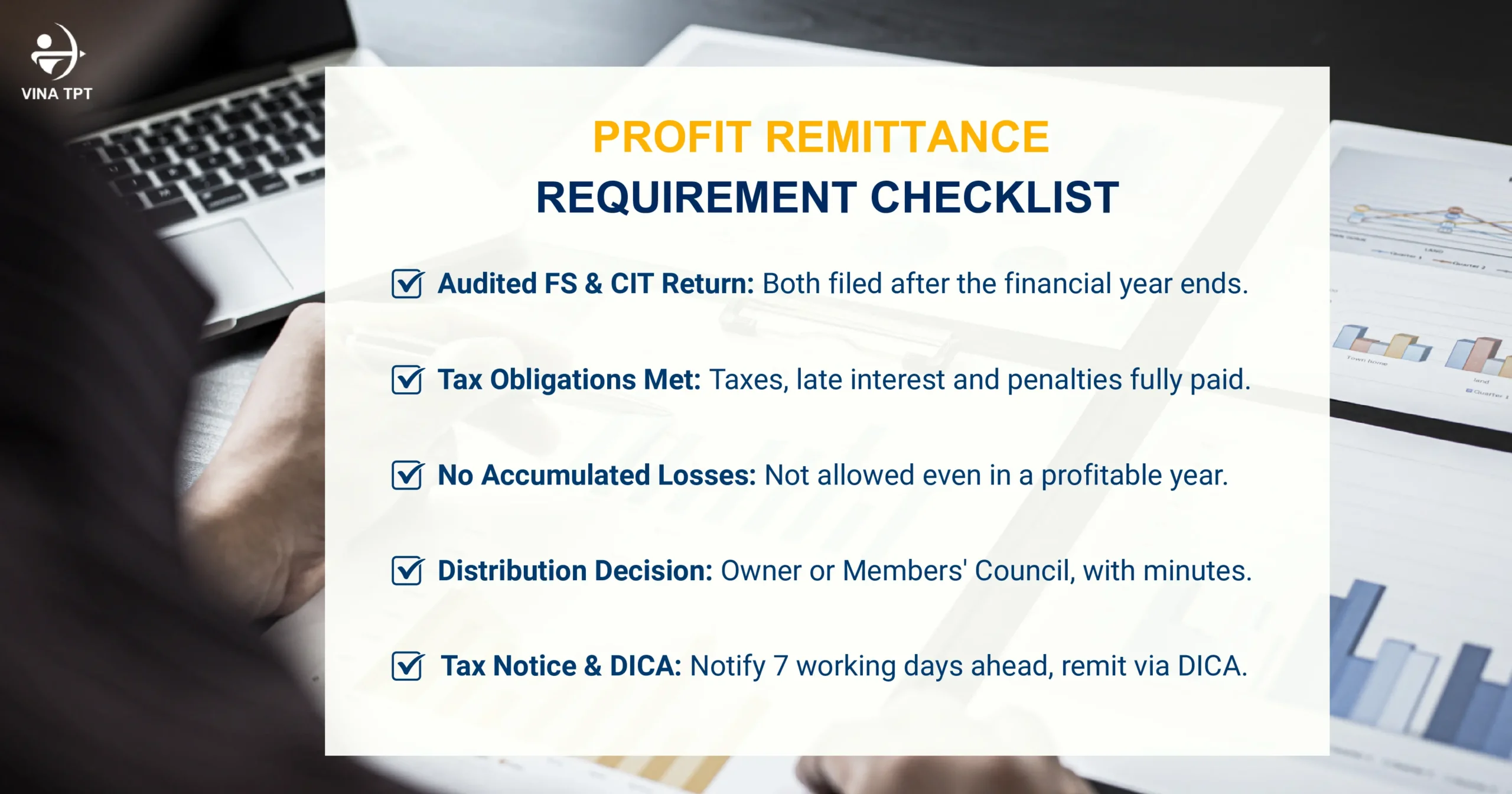
An FDI company is entitled to lawfully remit profits abroad periodically each year after the end of the financial year, provided that it has submitted the audited Financial Statements and the CIT finalization return and has fulfilled all tax obligations to the Vietnamese State (including taxes, late-payment interest or penalties, if any). A company is strictly not permitted to remit profits if its Financial Statements still show accumulated losses, even if the current year generates a profit (under Circular 186/2010/TT-BTC) (foreign direct investment vietnam)
In terms of documents and procedures, the company needs to prepare the Decision on profit distribution of the Owner / Members’ Council together with the corresponding Meeting Minutes. In addition, the company must send a written notice to the managing tax authority at least 07 working days before making the transfer (using the form under Circular 186/2010/TT-BTC).
The transfer must be made through a DICA account opened at a licensed commercial bank (under Circular 06/2019/TT-NHNN). The bank will review a file that includes: the audited Financial Statements, the CIT finalization return, tax payment documents, and the Resolution on dividend distribution (foreign direct investment vietnam)
On tax policy: Profits distributed to a parent company that is a foreign organization are currently not subject to withholding tax at source; where the investor is a foreign individual, Personal Income Tax (PIT) applies at a rate of 5% on the profit received.
Explore Vina TPT’s Accounting Services
3. Tax Framework for Foreign Direct Investment Vietnam
FDI companies in Vietnam need to grasp the following main types of taxes:
Value Added Tax (VAT)
The standard VAT rate is 10%, with a reduced 8% rate available for eligible goods and services until 31 December 2026. Certain sectors are excluded. Businesses should verify applicable rates and meet input VAT deduction requirements.
Corporate Income Tax (CIT)
The standard CIT rate is 20%. Eligible businesses may qualify for 15% or 17% rates based on revenue and applicable conditions. Qualifying investment projects in incentivized sectors or locations may receive preferential rates of 10% or 17%, alongside tax exemptions or reductions.
Personal Income Tax (PIT)
Vietnamese tax residents are subject to progressive PIT rates of 5%–35% on employment income, while non-residents generally pay 20% on employment income sourced in Vietnam. Tax obligations depend on residency status, taxable income, deductions, and applicable tax treaties.
Foreign Contractor Tax (FCT)
FCT generally applies to payments made to foreign contractors for services, royalties, interest, and other Vietnam-sourced income, subject to applicable exemptions. Under the direct method, VAT rates generally range from 2%–5% and CIT rates from 0.1%–10%, depending on the transaction.
a. Related-Party Rules in Foreign Direct Investment Vietnam
Transactions arising between an FDI company and its Parent Company or related parties within the group (such as management fees, brand royalty fees, loan agreements, or purchases and sales of goods/services) must comply with the market-price principle (Arm’s Length Principle).
The company is obliged to fully declare the Appendices on related-party transaction information attached to the CIT finalization return, and to prepare and retain the Transfer Pricing Documentation in accordance with Decree 132/2020/ND-CP.
(Details of the filing schedule and tax compliance are presented in the articles Vietnam tax compliance FDI and Tax services in Vietnam.)
4. Immigration and Residency for Foreign Direct Investment Vietnam
For foreign direct investment in Vietnam, immigration and residency planning should be coordinated with company establishment, particularly when foreign investors or managers intend to work and reside in the country long term.
- Visas & Temporary Residence Cards (TRC): A business visa (DN) or E-visa is suitable only for market survey and short-term work purposes and is not a substitute for a long-term residence permit. Investor visas are classified by the value of capital contribution (Law 47/2014/QH13, amended by Law 51/2019/QH14 and Law 23/2023/QH15):
- Category ĐT1 (Capital contribution of VND 100 billion or more): Eligible for a Temporary Residence Card (TRC) with a maximum term of 10 years.
- Category ĐT2 (Capital contribution from VND 50 billion to under VND 100 billion): Granted a TRC with a maximum term of 5 years.
- Category ĐT3 (Capital contribution from VND 3 billion to under VND 50 billion): Granted a TRC with a maximum term of 3 years.
- Category ĐT4 (Capital contribution under VND 3 billion): Granted only an investor visa with a maximum term of 12 months, and not eligible for a TRC.
>>> Read more details in the article: Vietnam Visa, Work Permit and TRC: A Guide for Foreign Investors.
- Work Permit (WP): Owners and capital-contributing members of a Limited Liability Company, or the Chairperson/Members of the Board of Directors of a Joint Stock Company with a capital contribution value of VND 3 billion or more, are exempt from the Work Permit. Where the capital contribution is under VND 3 billion, the procedure for issuing a WP is still mandatory (under Decree 219/2025/ND-CP, effective from 07/08/2025). Other foreign experts and managers must all have a WP before officially starting work.
- Legal representative: The company must ensure that it always has at least 01 Legal Representative residing in Vietnam (Article 12 of the 2020 Law on Enterprises). In addition, foreign personnel need to register for Electronic Identification (VNeID) Level 2 (which usually requires holding a TRC) to carry out online transactions and administrative procedures. Investors should clearly plan their actual time of presence in Vietnam before deciding to appoint personnel to this position.
>>> See also the article: Legal representative for FDI company
5. Workplace Culture and Foreign Direct Investment Vietnam
Beyond legal and financial planning, successful foreign direct investment in Vietnam also depends on understanding local workplace culture, communication practices and employee expectations.
- Respect for hierarchy & communication etiquette: The working culture in Vietnam values titles, positions and length of service. Politeness in communication, greetings and work emails with superiors is the foundation for building trust quickly.
- Team spirit & preserving harmony: Important decisions are usually made after consulting the team in order to reach a common consensus. Subordinate staff tend to be reluctant to directly challenge the opinions of managers in group meetings. The answer “Yes” sometimes means “information received” rather than fully meaning agreement; managers should proactively confirm the details in writing or ask open-ended questions.
- Standardizing operating procedures: Vietnamese personnel have a fast and flexible ability to adapt. However, to ensure consistent work quality, companies should set up a system of Standard Operating Procedures (SOP), transparent KPIs and clear approval authority levels from the very beginning (foreign direct investment vietnam)
- Staff development & work-life balance: The young workforce is very eager to learn; building a clear training and promotion path is an effective way to retain talent. In addition, companies generally value the balance between work and life (work-life balance), limit communication outside working hours and maintain the culture of a lunch break at the office.
Operational implementation note: Important agreements are usually most effective when discussed directly or through fast communication channels (phone, Zalo). Work progress tends to slow down during the Lunar New Year (Tet) holiday, so investors need to proactively factor this into the schedule. In addition, terms on Gross/Net salary, mandatory Social Insurance and the 13th-month bonus (a market practice, not required by law) need to be recorded transparently in the Offer Letter and the Labor Contract.
6. How Vina TPT Supports Foreign Direct Investment Vietnam
Vina TPT supports foreign direct investment in Vietnam throughout the entire investment lifecycle, from legal structuring and company establishment to ongoing compliance, profit remittance and eventual exit.
- Entry stage: Advice on optimizing the legal ownership structure; drafting and filing the IRC application (5–6 weeks) and the ERC application (1–2 weeks); providing the Vina TPT Shared Office solution as a lawful business registration address for clients using the company establishment service.
- Operating stage: Providing a full package of VAS Accounting, Tax, Payroll management & Social Insurance, Transfer Pricing Documentation advisory, Visa / WP / TRC procedures, and preparation of the lawful profit-remittance file to the Parent Company.
- Exit stage: Carrying out the full company dissolution procedure – tax finalization, closing the tax code, terminating the investment project, remitting the remaining capital abroad; advising on M&A transactions and transfers of capital contribution.
Built on more than 20 years of experience accompanying more than 500 corporate clients, Vina TPT’s team of experts holding CPA and ACCA certificates and Lawyer qualifications communicates fluently in English, Japanese, and is ready to support investors in managing risks in every respect.
EXPLORE OUR FULL COMPANY ESTABLISHMENT SERVICES