Having business partners transfer funds on your behalf to pay for goods, or having employees pay in advance for the company, are situations that frequently arise in enterprises. However, without meticulous recordkeeping, this convenience turns into a risk, leaving accountants vulnerable to the rejection of deductible business expenses, the loss of input VAT deductibility, or severe administrative tax penalties during audit settlements.
In practice, tax authorities fully accept third-party payment transactions, provided you thoroughly understand the regulations and prepare carefully.
How can you legalize these cash flows with absolute safety? In this article, Vina TPT will resolve all doubts with detailed instructions on the conditions for recording authorized payment expenses, along with a checklist of required documents compiled from the latest tax official letters.
Overview of Payment Authorization (Paying on Behalf Of) in Enterprises
During business operations, cash flow does not always travel directly from the buyer’s account to the seller’s account. In many cases, due to operational requirements, enterprises must utilize a third party to handle payments to vendors.
What is Payment Authorization?
Payment authorization (paying on behalf of another party) is an arrangement in which an enterprise (Party A – Buyer/Authorizing Party) enters into a written agreement to designate a third party (Party B – Authorized Party) to make payments on its behalf to a supplier (Party C) for goods or services purchased.
The essence of this transaction is a cash flow movement through an intermediary. Although Party B’s bank account directly disburses funds to Party C, the underlying business expense and ownership rights of the goods or services belong entirely to Party A.
Common Scenarios Requiring Payment Authorization
In practice, accounting departments frequently encounter payment authorization under the following forms:
- Parent company paying on behalf of a subsidiary: Frequently occurs when a newly incorporated subsidiary has not yet opened a bank account or is facing temporary liquidity issues.
- Business partner (customer) settling bills on your behalf: Customer X owes money to your company. At the same time, your company owes supplier Y. You execute payment authorization procedures for Customer X to transfer funds directly to settle the debt owed to supplier Y.
- Individual paying on behalf of the company: Directors, department heads, or employees use personal bank cards or cash to pay in advance for procurement or business travel expenses, after which the company carries out reimbursement procedures.
2. Conditions for accounting authorized expenditures as deductible expenses
To ensure a payment made through a third party is accepted by tax authorities as a deductible expense when calculating Corporate Income Tax (CIT), an enterprise must prove the legitimacy of the transaction through core requirements.
General Principles for Deductible Expenses when Calculating CIT
Pursuant to Point c2, Paragraph 1, Article 9 of Decree No. 320/2025/ND-CP:
“c2) In cases where an enterprise incurs expenses resulting from authorizing or assigning employees to directly purchase goods or services to serve the enterprise’s production and business operations valued at 5 million VND or more, and such expenses are paid by the employee using non-cash payment services, these expenses shall be included in deductible expenses if all of the following conditions are met: Legitimate invoices and supporting documents as prescribed by laws on accounting, invoices, and documents are present; financial regulations, internal rules, or decisions of the enterprise specifying the authorization or permission for employees to pay for goods and services serving business operations are in place; and such expenses are subsequently reimbursed by the enterprise to the employee;”
This rule is reaffirmed in Official Letter No. 619/VLO-QLDN3 dated March 6, 2026, issued by the Tax Department of Vinh Long Province regarding deductible expenses for CIT calculation purposes.
A business expense qualifies as deductible when it satisfies 3 fundamental conditions:
- The expense actually arises in connection with the enterprise’s production and business activities.
- The expense is supported by adequate legal invoices and documentation as required by law.
- For single-transaction invoices for goods and services valued at 5 million VND or more (inclusive of VAT), non-cash payment vouchers are MANDATORY.
Specific Conditions for Authorized Payment Expenses
Common Risk: Accountants often mistakenly assume that a Bank Debit Advice (issued to the party paying on behalf) is sufficient. However, without proper legal agreements, tax authorities reserve the right to disallow the entire expense.
To account for authorized payments safely, enterprises must ensure:
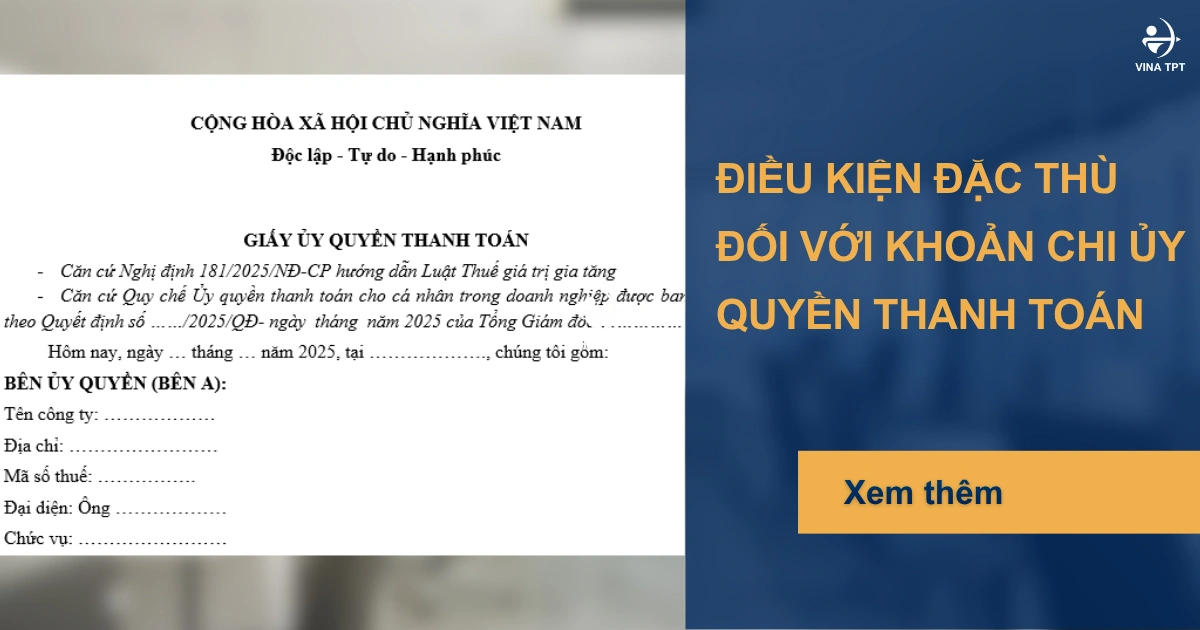
- Written Agreements: Payment authorization must be clearly defined within the initial commercial contract, an attached contract addendum, or a standalone Power of Attorney / Authorization Contract signed and stamped by participating parties.
- Accurately Named Invoices: VAT invoices or sales invoices issued by the supplier (Party C) MUST state the name, address, and tax code of the Authorizing Party (Party A – the actual buyer), and must never be issued in the name of the party paying on behalf (Party B).
- Transparent Cash Flow: When reimbursing the party paying on behalf, the enterprise must also use non-cash payment methods.
Detailed Accounting Guidelines for Payment Authorization (With Examples)
From an accounting standpoint, journal entries must reflect the true nature of liabilities. Payments made on behalf of another entity are not recorded as revenue or expenses for the party making the payment. We use other receivables/payables accounts (Account 1388, Account 3388) as intermediary accounts.
Accounting Entries for the Authorizing Party (The Party Requesting Payment on Its Behalf)
When buying goods or services and relying on a third party for settlement, the accountant records the asset/expense and recognizes a liability to the paying party:
Step 1: Record expenses, inventory/assets, and liabilities for payments made on behalf
- Debit Account 152, 153, 156, 211, 641, 642… (Value of goods/services excluding VAT)
- Debit Account 1331 (Deductible input VAT – if applicable)
- Credit Account 3388 – Other payables (Detailed sub-account for the company paying on behalf).
Step 2: When reimbursing funds to the party that paid on your behalf
- Debit Account 3388 (Detailed sub-account for the company paying on behalf)
- Credit Account 112 (Bank deposits).
Accounting Entries for the Authorized Party (The Party Paying on Behalf)
The paying party functions solely as a payment intermediary; therefore, it only records journal entries related to cash flow and receivables, and must never record entries to Account 511 or Accounts 632/642.
Step 1: When disbursing funds from the bank to pay on behalf
- Debit Account 1388 – Other receivables (Detailed sub-account for the requesting company)
- Credit Account 112 (Bank deposits).
Step 2: When receiving reimbursement from the requesting company
- Debit Account 112 (Bank deposits)
- Credit Account 1388 (Detailed sub-account for the requesting company).
Practical Case Example
Manufacturing Company A purchases raw materials from Company C for a total payment value of 50,000,000 VND (inclusive of 10% VAT). The invoice issued by Company C is made under Company A’s name.
Due to temporary cash flow constraints, Company A executes an Authorization Contract requesting Company B (a business partner) to transfer 50,000,000 VND from Company B’s bank account to Company C’s bank account. One week later, Company A transfers 50,000,000 VND back to reimburse Company B.
Specific Journal Entries:
At Company A (Buyer – Requesting payment on its behalf):
Based on Company C’s invoice and the Authorization Contract, record inventory intake:
- Debit Account 152: 45,454,545 VND
- Debit Account 1331: 4,545,455 VND
- Credit Account 3388 (Details for Company B): 50,000,000 VND
When transferring funds to reimburse Company B:
- Debit Account 3388 (Details for Company B): 50,000,000 VND
- Credit Account 112: 50,000,000 VND
At Company B (Party paying on behalf):
When transferring 50 million VND to Company C:
- Debit Account 1388 (Details for Company A): 50,000,000 VND
- Có TK 112: 50.000.000 VNĐ
When receiving the 50 million VND reimbursement from Company A:
- Debit Account 112: 50,000,000 VND
- Credit Account 1388 (Details for Company A): 50,000,000 VND
Important Notes on Input VAT and Foreign Contractor Tax (FCT) in Payment Authorization
Third-party transactions are key focal points during tax audits. To ensure compliance, keep these tax aspects in mind.
Conditions for Input VAT Deduction
Pursuant to Official Letter No. 1619/CT-CS, to qualify for input VAT deduction on purchased goods and services valued at 5 million VND or more, debt offset settlements or payments via third parties are deemed valid non-cash payments if:
- Payment via third parties / payment authorization is explicitly stipulated in a written agreement.
- The third party is a legally operating entity or individual.
- When reimbursing the paying party, the beneficiary enterprise must still use bank transfers if the total transaction value reaches the mandatory non-cash payment threshold.

Payment Authorization Involving Foreign Partners
When a Vietnamese enterprise enters into an import contract for services, copyrights, or goods bundled with services from a foreign supplier (without a commercial presence in Vietnam) and authorizes another party to pay, the obligation to declare and pay Foreign Contractor Tax (FCT) remains with the Vietnamese enterprise (the Authorizing Party).
The paying party merely acts as a remittance agent and is not responsible for FCT declaration unless there is a specific agreement authorizing them to declare and pay taxes on behalf of the principal.
Frequently Asked Questions on Payment Authorization
Can an individual be authorized to make payments on behalf of a Company?
Yes, it is permitted. According to guidance official letters, Directors or staff members may use personal bank accounts or credit cards to settle payments for company goods and services. However, the company MUST maintain Financial Management Regulations or Internal Expenditure Rules detailing this process, accompanied by a Payment/Reimbursement Request and personal bank statements showing funds transferred to the vendor (if required).
How should input invoices with the wrong recipient name be handled?
- If the vendor mistakenly issues the invoice stating the “Paying Party’s Name/Tax ID” instead of the “Actual Buyer (Authorizing Party)”, the invoice is invalid. Resolution steps:
- Both parties draft an Invoice Adjustment Minutes clearly stating the reason for the error (misstatement of the paying party’s details).
- The vendor issues an Adjusted Invoice or Replacement Invoice sent to the actual buyer with correct details, serving as the basis for accounting and tax declarations.
Are corporate purchases of agricultural products from non-business individuals via payment authorization considered valid expenses?
In this case, expenses are non-deductible due to the lack of valid invoices and supporting documentation prescribed under accounting and tax invoice regulations.
Summary
Accounting for payment authorization is straightforward regarding double-entry bookkeeping, but presents tax compliance risks if supporting documentation is neglected. To protect corporate expenses, keep these 3 core rules in mind:
(1) Always maintain clear written authorization agreements.
(2) Ensure VAT invoices are issued under the actual buyer’s name.
(3) Execute non-cash payments for transaction values of 5 million VND or higher.
We hope this guide facilitates your payment authorization procedures. If your enterprise requires specialized partnership in bookkeeping and tax compliance, contact Vina TPT for expert accounting consultation!
Contact us for a consultation today.