Mastering Internal Accounting Skills for FDI Companies in Vietnam

accounting skills

accounting skills

1. Why FDI Companies Struggle with Internal Accounting in Vietnam

Foreign Direct Investment (FDI) companies bring international expertise, modern technologies, and capital into Vietnam. However, when it comes to internal accounting and the accounting skills required to meet both local and international standards, many enterprises find themselves navigating an unfamiliar landscape. The root causes of these struggles can be categorized into three main areas.

1.1 Differences in Accounting Standards

One of the biggest challenges is the gap between Vietnamese Accounting Standards (VAS) and International Financial Reporting Standards (IFRS). While IFRS emphasizes transparency and fair value measurement, VAS is more rules-based and focuses on historical cost. This difference often creates confusion for multinational finance teams that are accustomed to global practices. Companies operating across multiple jurisdictions often need dual reporting systems, which increases complexity and cost.

1.2 Regulatory Complexity and Compliance Burden

Vietnamese tax regulations are subject to frequent updates. Circulars and decrees from the Ministry of Finance may significantly alter reporting requirements. For Foreign-invested enterprises, keeping up with these changes while ensuring compliance is resource-intensive. This is particularly critical since any misstep in compliance can lead to financial penalties and reputational risks.

1.3 Talent Gaps in Internal Accounting Teams

Despite Vietnam’s growing talent pool, there remains a shortage of accountants who are equally proficient in both local standards and international practices. Many internal teams lack the experience to handle cross-border transactions, intercompany reconciliations, and transfer pricing documentation. This talent gap makes it difficult for Foreign-invested enterprises firms to establish strong internal accounting functions.

Optimize Your Accounting Today

2. Building a Solid Foundation of Local Accounting Knowledge

For FDI businesses, success begins with a deep understanding of local accounting practices. Internal teams must not only learn the technical aspects of VAS but also grasp the cultural and operational nuances of doing business in Vietnam.

2.1 Mastering Vietnamese Accounting Standards

FDI companies should prioritize training sessions for their accounting staff to build expertise in VAS. This includes familiarity with chart of accounts, revenue recognition methods, and local expense allocation rules. By mastering VAS, internal teams can reduce reporting errors and create a solid bridge to IFRS-based reporting.

2.2 Understanding Local Taxation Principles

Knowledge of Vietnam’s tax system is equally essential. From corporate income tax (CIT) and value-added tax (VAT) to personal income tax (PIT), each element requires careful management. Internal accountants who are well-versed in these principles can optimize tax planning strategies while ensuring compliance with regulations published by the General Department of Taxation.

3. Essential Skills to Manage Complex FDI Transactions

The complexity of Foreign Direct Investment operations demands specialized skills in managing cross-border and multi-currency transactions. Internal accounting teams must go beyond bookkeeping and become strategic partners in financial management.

3.1 Transfer Pricing Management

Transfer pricing is one of the most sensitive areas in Foreign Direct Investment accounting. Internal teams must be capable of preparing proper transfer pricing documentation and benchmarking studies, ensuring compliance with Decree 132/2020/ND-CP. Failure to meet requirements could result in significant fines or tax adjustments.

3.2 Multi-Currency and Intercompany Transactions

Enterprises often deal with transactions in multiple currencies, requiring skills in foreign exchange management and consolidation. Internal accountants need to understand how currency fluctuations impact both profit margins and tax liabilities. Case studies from companies like Intel Vietnam highlight how effective foreign currency management safeguards profits in volatile markets.

3.3 Advanced Financial Reporting

Internal accounting teams should also be trained to prepare consolidated financial statements that align both with VAS and IFRS. This skill enables management to make informed decisions while also meeting reporting obligations in home countries.
accounting skills

4. Strengthening Internal Controls While Ensuring Compliance

Strong internal controls are the backbone of reliable financial management. For Foreign Direct Investment companies, this means establishing processes that prevent fraud, reduce errors, and guarantee compliance.

4.1 Risk-Based Internal Audits

An effective internal audit function ensures that accounting records are accurate and compliant. Internal teams must develop auditing skills that go beyond formality, focusing on risk-based audits that highlight vulnerabilities in financial processes.

4.2 Compliance with Local and International Regulations

Internal accountants must be trained to monitor compliance with both Vietnamese laws and international frameworks such as the OECD transfer pricing guidelines. According to the OECD, aligning local practices with global standards helps multinational corporations mitigate risks and maintain investor confidence.

4.3 Technology-Enabled Controls

Implementing enterprise resource planning (ERP) systems strengthens internal controls by automating reconciliations and approvals. Companies like Samsung Vietnam have successfully deployed SAP ERP to streamline compliance reporting and reduce manual errors.

Book Expert Guidance

5. Preparing Accounting Teams for Future Growth

As Vietnam continues to attract large-scale FDI projects, internal accounting skills must evolve to meet future demands.

5.1 Continuous Professional Development

Foreign-invested enterprises should encourage their internal accounting staff to pursue certifications such as CPA Vietnam, ACCA, or CMA. These qualifications equip accountants with the knowledge to manage increasingly complex operations.

5.2 Building Multidisciplinary Teams

The future of FDI accounting will require collaboration between finance, legal, and operational experts. Internal accountants must be capable of working cross-functionally, ensuring financial decisions align with overall business strategies.

5.3 Anticipating Regulatory Shifts

Vietnam is preparing for gradual convergence with IFRS, expected to become mandatory in coming years. Internal teams that prepare early for this transition will ensure smoother adaptation and minimize disruption.

6. Turning Internal Accounting Skills into Value with Vina TPT

While building internal accounting skills is essential, many companies still need external guidance to accelerate the process. This is where Vina TPT’s internal accounting services provide a competitive advantage.

With decades of experience serving Foreign Direct Investment enterprises, Vina TPT offers:

  • Training programs that strengthen internal accounting capabilities.
  • Advisory on VAS-IFRS convergence and compliance.
  • Tailored solutions for transfer pricing, internal audits, and financial reporting.

By partnering with Vina TPT, Foreign Direct Investment companies transform internal accounting from a compliance burden into a strategic driver of growth. This partnership ensures that internal teams are not only capable of managing current challenges but are also prepared for the evolving financial landscape in Vietnam.


accounting skills


Driving Growth Through Effective Financial Management for FDI Businesses

international accounting standards

international accounting standards

1. Setting the Foundation: Understanding FDI Financial Structures

Establishing strong financial management practices is the cornerstone of success for foreign direct investment (FDI) companies in Vietnam. Every investment requires a clear financial structure that aligns with both the investor’s home country standards and the host country’s regulatory framework.

Foreign-capital businesses must carefully decide how to allocate capital, manage equity contributions, and set up local subsidiaries or joint ventures. For example, a manufacturing firm entering Vietnam may need to balance its initial equity with local bank loans to secure working capital. Without a strong foundation, misaligned structures can lead to tax inefficiencies and compliance risks.

The World Bank notes that transparent and well-structured financial systems directly impact the long-term stability of Foreign Direct Investment inflows in emerging markets like Vietnam.

Set Up Financial Structure

2. Building Strong Cash Flow Management for Long-Term Stability

One of the biggest challenges for Foreign Direct Investment enterprises is maintaining consistent cash flow management. In Vietnam, companies often face delays in payments due to differences in local business culture and long supply chain cycles.

By implementing robust forecasting tools, Foreign-capital businesses can predict cash inflows and outflows more accurately. For example, using rolling cash flow forecasts helps companies adjust their strategies for seasonal demand or currency fluctuations. Ensuring liquidity not only prevents short-term financial distress but also builds investor confidence for expansion.

On the Vina TPT homepage, businesses can explore consulting services designed to strengthen financial structures and ensure stability through effective cash flow solutions.

3. Profit Optimization Techniques Tailored for FDI Enterprises

For these enterprises, profit optimization is not just about increasing revenue – it is about aligning financial strategies with Vietnam’s unique market conditions. Adjusting pricing strategies for local demand, streamlining supply chain costs, and leveraging tax incentives can significantly boost margins.

Additionally, transfer pricing strategies must comply with Vietnamese regulations while ensuring profits are not eroded by double taxation. Many investors also overlook the benefits of reinvesting profits in Vietnam to take advantage of available financial support programs.

According to PwC Vietnam, businesses that regularly review their cost structures and adjust to local market dynamics outperform those that apply “one-size-fits-all” strategies.

4. Integrating Financial Management with Local Compliance in Vietnam

An essential element of managing FDI operations is aligning financial management with Vietnam’s compliance requirements. Unlike international standards such as IFRS, Vietnamese Accounting Standards (VAS) have specific rules that businesses must follow.

Areas like tax reporting, value-added tax (VAT), and labor-related expenses can create complications if not handled correctly. Non-compliance not only leads to financial penalties but also threatens business continuity.

Internal policies must ensure that accounting procedures, audit processes, and statutory filings are regularly updated to reflect local requirements. To see related strategies, check our article on Accounting Procedures for FDI Operations in Vietnam.

Ensure VAS Compliance

5. Leveraging Technology for Smarter Financial Management

Technology is reshaping how Foreign Direct Investment companies approach management in finance. Automated accounting software, cloud-based ERP systems, and AI-driven analytics help businesses optimize cash flow, track performance in real time, and improve accuracy in reporting.

In Vietnam, digital transformation is also supported by government initiatives that encourage businesses to adopt e-invoicing and digital tax reporting. These tools reduce administrative burdens and improve compliance, giving companies more time to focus on growth.

By investing in modern financial technology, Foreign Direct Investment enterprises can strengthen decision-making and stay competitive in a fast-evolving business landscape.

6. Partnering with Vina TPT for Sustainable Growth

Even with strong internal systems, navigating Vietnam’s financial landscape requires expert guidance. Vina TPT Financial Management provides tailored solutions that help Foreign-invested companies align financial structures, optimize cash flow, and ensure compliance with local laws.

From preparing accurate financial reports to advising on profit optimization and leveraging technology for smarter management, we acts as a long-term partner for sustainable growth.

With our deep expertise in both Vietnamese regulations and global standards, we empower businesses to not only survive but thrive in the competitive Vietnamese market.

Learn more about our Financial Management Services and discover how Vina TPT can help you maximize your investment potential in Vietnam.

Vina TPT Financial Management

Accounting Services in Vietnam for FDI Compliance. 

What service do FDI company need to stay compliant in vietnam

Accounting services in Vietnam

As Vietnam’s economy thrives with a surge in foreign direct investment (FDI), the demand for accounting services in Vietnam has become critical for businesses to comply with local regulations and optimize operations. This comprehensive guide explores accounting solutions, from compliance to outsourcing, empowering you to make informed decisions. Discover how VINA TPT Company Limited, a leading provider, can support your business needs. 

What Are Accounting Services in Vietnam? 

Accounting services in Vietnam encompass professional solutions that help businesses manage finances, adhere to legal requirements, and produce accurate reports. Distinguished by local standards like Vietnamese Accounting Standards (VAS) and the transition to International Financial Reporting Standards (IFRS), these services are vital in an open economic landscape. 

  • Daily bookkeeping, including bank transactions and asset management. 
  • Preparation of financial statements compliant with VAS/IFRS, tailored for FDI companies. 
  • Tax advisory and lawful cost optimization. 
  • Audit support and financial due diligence. 

The growth of the accounting sector in Vietnam is closely tied to the rise of foreign enterprises, necessitating specialized solutions. For instance, a Japanese company in Ho Chi Minh City might require bilingual accounting services to meet internal and legal demands. 

Benefits of Outsourcing Accounting Services in Vietnam 

Outsourcing accounting services in Vietnam offers tangible benefits, especially for small and medium enterprises (SMEs) and FDI companies. Compared to in-house management, this approach saves costs, time, and reduces legal risks. 

  • Cost savings: Avoid investing in expensive staff and software, paying only for service packages as needed. 
  • Access to local expertise: Teams with deep knowledge of Vietnamese tax laws minimize penalty risks. 
  • Focus on core business: Free up resources to focus on strategic growth rather than bookkeeping. 
  • Rapid regulatory updates: Providers like VINA TPT stay updated with the latest regulations. 

For example, a U.S. company in Da Nang cut administrative costs by 30% by outsourcing to VINA TPT while ensuring timely VAT compliance. This highlights the practical value of outsourcing amid Vietnam’s growing international investment climate. 

Key Types of Accounting Services Available in Vietnam

1/ Bookkeeping and Financial Reporting 

Bookkeeping and financial reporting form the backbone of accounting services in Vietnam, ensuring transparent business operations. 

  • Record daily transactions, reconcile bank accounts, and manage assets. 
  • Prepare financial statements per VAS, with IFRS conversion support when required. 
  • Utilize accounting software like MISA or Fast for enhanced efficiency. 

A small business in Ho Chi Minh City improved report accuracy to 95% by adopting this process with expert assistance. 

2/ Tax Compliance and Advisory 

Tax compliance is mandatory, and accounting services in Vietnam help businesses optimize financial obligations. 

Tax Type  Rate (%)  Filing Period 
VAT  0, 5, 8, 10  Monthly/Quarterly 
CIT  15-17-20  Annually 
PIT  5-35  Quarterly 
  • File and submit VAT, CIT, and PIT taxes on time. 
  • Offer tax optimization, VAT refund assistance, and dispute resolution. 
  • Provide expertise in transfer pricing and Global Minimum Tax (Pillar Two). 

Download Vietnam Tax Handbook For Investor

3/ Payroll and HR Services 

Payroll and human resource management are crucial, particularly for foreign workers in Vietnam. 

  • Calculate salaries, contribute to social and health insurance. 
  • Assist with work permits and visas for foreign employees. 
  • Draft labor contracts and manage personnel records. 

Outsourcing saves 20% of administrative time compared to in-house management, especially in Ho Chi Minh City and Da Nang. 

4/ Chief Accountant Appointment 

Under Vietnamese law, companies must appoint a chief accountant, a need this service addresses. 

  • Register a chief accountant with tax authorities. 
  • Ensure compliance with related legal requirements. 
  • Reduce internal management burdens for small businesses. 

Outsourcing this role with VINA TPT helps new companies avoid violations. 

5/ Audit Assistance and Due Diligence 

Audit support and financial due diligence are essential for large enterprises. 

  • Prepare documents for annual audits. 
  • Conduct financial due diligence for M&A, adhering to Vietnamese standards. 
  • Assist in explanations to regulatory bodies. 

How to Choose the Right Accounting Service Provider in Vietnam 

How do you select the ideal accounting services in Vietnam provider? Consider these key factors. 

  • Experience: Teams with over 10 years in the field. 
  • Certifications: Chief accountant and tax advisory credentials from the Ministry of Finance. 
  • Bilingual support: Essential for FDI companies. 
Factor  In-house  Outsourced 
Cost  High (salaries, software)  Low (package-based) 
Expertise  Limited  High (specialists) 

VINA TPT offers bilingual (Vietnamese/English/Japanese) services and international certifications, surpassing many competitors. 

Top Accounting Firms and Providers in Vietnam 

Leading accounting services in Vietnam providers include: 

Company  Strength  Contact 
Acclime  Comprehensive FDI support  www.acclime.com 
TMF Group  Global services  www.tmf-group.com 
VINA TPT  Holistic solutions, expert team  www.vinatpt.com 

VINA TPT stands out with over 20 years of experience, offices in Ho Chi Minh City and Da Nang, and a team led by Mr. Lê Quốc Duy—a renowned consultant for Japanese and international firms, contributing to Mizuho Asia Report and Japanese journals.

Top accounting services in vietnam

Frequently Asked Questions (FAQs) 

  • What are the main taxes for foreign companies in Vietnam? VAT, CIT, and PIT with specific rates per regulation. 
  • How much do accounting services cost in Vietnam? Ranges from $85-800/month depending on the package; contact VINA TPT for a quote. 
  • Is outsourcing compliant with Vietnamese law? Yes, when using reputable providers like VINA TPT. 
  • What documents are needed for tax filings? Invoices, financial statements, and labor contracts. 
  • How to process a VAT refund? Reach out to VINA TPT for step-by-step assistance. 


EXPLORE OUR ACCOUNTING SERVICE

LATEST SOCIAL INSURANCE POLICY 2025 – 5 CHANGES TO NOTE

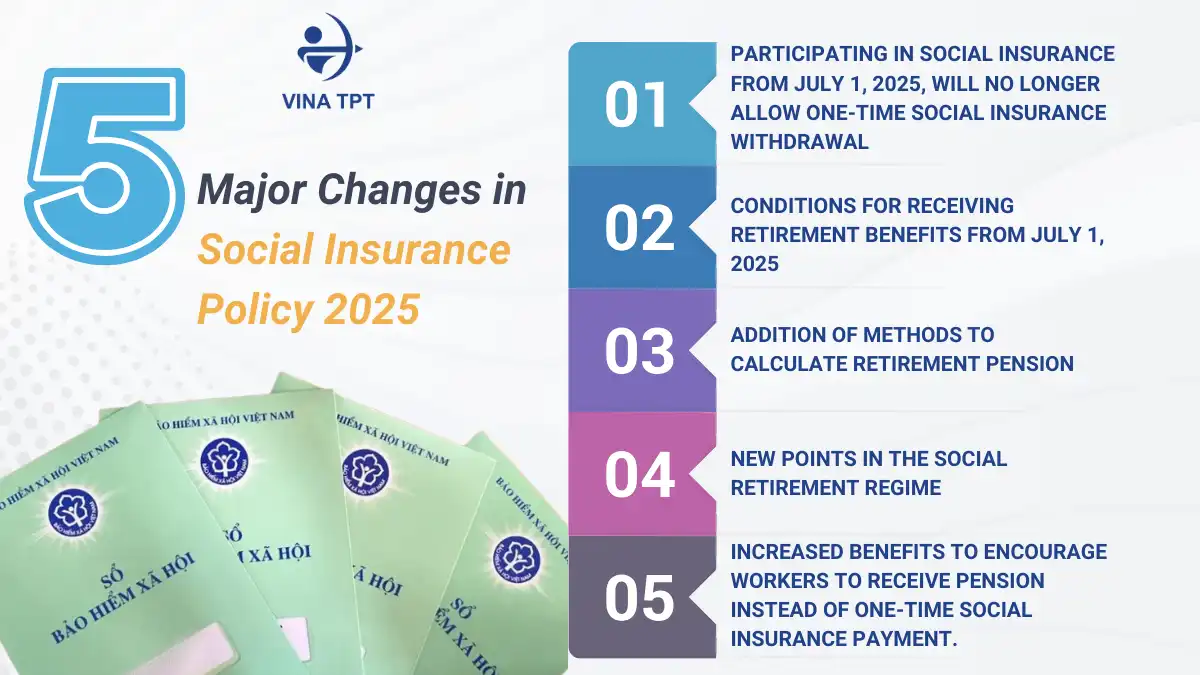
Infographic showing key changes in social insurance policy 2025 and compliance tips for employers

Infographic showing key changes in social insurance policy 2025 and compliance tips for employers

Participation in Social Insurance from July 1, 2025, Will Not Allow One-Time Withdrawal under the social insurance policy 2025. 

According to the 2025 social insurance policy, employees starting to participate in social insurance from July 1, 2025, will not be allowed to withdraw social insurance in one lump sum. except in the following cases:  

  • Reaching retirement age but having less than 15 years of social insurance contributions.  
  • Emigrating abroad for permanent residence.  
  • Suffering from life-threatening diseases such as cancer, paralysis, decompensated cirrhosis, severe tuberculosis, or AIDS.  
  • Employees who contributed to social insurance before July 1, 2025, and after 12 months are no longer subject to mandatory social insurance or voluntary social insurance, with less than 20 years of contributions.  

This aims to limit one-time social insurance withdrawals, encouraging employees to maintain participation for long-term pension benefits.  

Conditions for Receiving a Pension from July 1, 2025 as regulated by the social insurance policy 2025. 

According to the latest social insurance policy, effective from July 1, 2025, the conditions for employees to receive a monthly pension have been adjusted as follows:  

  • Minimum social insurance contribution period: Reduced from 20 years to 15 years. 
  • Retirement age: Employees must reach the retirement age as stipulated in Clause 2, Article 169 of the Labor Code, specifically as follows: From 2025, under normal working conditions, the retirement age is 61 years and 3 months for male employees and 56 years and 8 months for female employees; thereafter, it increases by 3 months for males and 4 months for females each year. 

This provision aims to enable those who join social insurance late or irregularly to accumulate at least 15 years of contributions to receive a monthly pension, instead of a one-time withdrawal. 

Additionally, employees who reach retirement age and have contributed to social insurance for 15 years or more will receive a free health insurance card for healthcare throughout their pension period. 

2025 Social Insurance Policy Supplements Pension Benefit Calculation Method in the latest social insurance policy 2025. 

Based on Clause b, Paragraph 1, Article 66 of the 2024 Social Insurance Law (effective from July 1, 2025), a new method for calculating pension benefits has been added for male employees with a social insurance contribution period of 15 to under 20 years. 

Infographic showing key changes in social insurance policy 2025 and compliance tips for employers

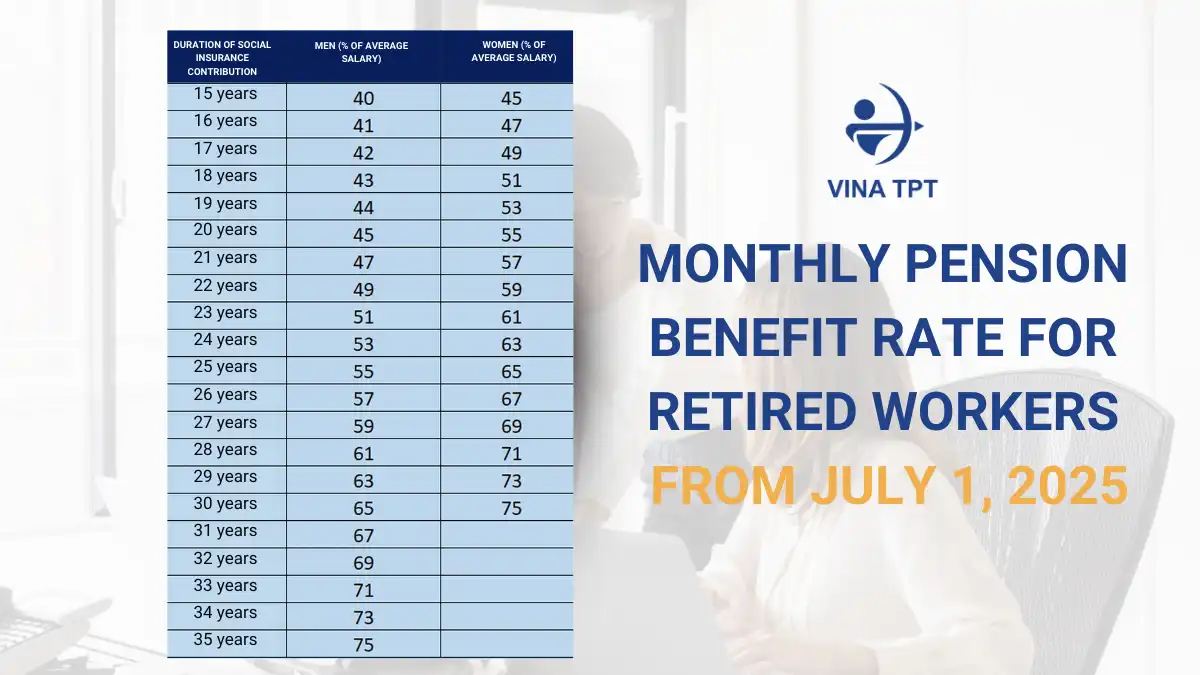
Accordingly, the monthly pension benefit from July 1, 2025, is stipulated as follows:  

Male employees:   

Contributing 20 years of social insurance entitles them to 45%.  

– Thereafter, an additional 2% is added for each additional year.  

– The maximum benefit rate is 75%.  

– For male employees with a contribution period of 15 to under 20 years, they receive 40%, with an additional 1% for each additional year.  

Female employees:  

– Contributing 15 years of social insurance entitles them to 45%.  

– Thereafter, an additional 2% is added for each additional year.  

– The maximum benefit rate is 75%.  

Case of early retirement due to reduced working capacity:   

– A 2% reduction for each year of early retirement before the stipulated age.  

– If the early retirement period is less than 6 months, there is no reduction in the pension benefit percentage; if it is from 6 months to under 12 months, a 1% reduction applies.  

New Aspects in the Social Pension Scheme introduced by the social insurance policy 2025. 

Infographic showing key changes in social insurance policy 2025 and compliance tips for employers

Addition of Social Pension Benefits for Those Without Pensions  

Under the 2025 social insurance policy, the state will provide a monthly social pension to elderly individuals without a pension or those ineligible for social insurance benefits, provided they meet the following conditions:  

(i) Aged 75 or older. 

(ii) Not receiving a pension or monthly social insurance benefits, except as otherwise stipulated by the government. 

(iii) Submitting a written request for social pension benefits. 

Note: Vietnamese citizens aged 70 to under 75 from poor or near-poor households, meeting the conditions in clauses (ii) and (iii) above, are eligible for social pension benefits. 

Reduction in the Age for Receiving Social Pension Benefits  

The 2025 social insurance policy (2024 Social Insurance Law) stipulates a reduction in the age for receiving social pension benefits from 80 to 75 years for elderly individuals without pensions. Additionally, those aged 70 or older from poor or near-poor households will also be considered for this benefit.  

2025 Social Insurance Policy Increases Benefits to Encourage Employees to Receive Pensions Instead of One-Time Withdrawals 

To encourage employees to maintain participation in social insurance for pension benefits, the 2025 social insurance policy introduces additional benefits. 

In cases where employees have ceased participating in social insurance, do not opt for a one-time withdrawal, and preserve their contribution period to continue participation, they have the opportunity to enjoy higher benefits such as: 

  • Receiving higher benefits for various schemes calculated based on contribution time (sickness, work accidents, occupational diseases, etc.) upon continued participation; 
  • Eligible for a pension under more favorable conditions; 
  • During the pension period, the social insurance fund covers health insurance; 
  • Eligible for a monthly allowance if not meeting pension conditions and not yet at the age for social pension benefits; 
  • During the monthly allowance period, the state budget covers health insurance. 

CONCLUSION  

The changes in the 2025 social insurance policy have a significant impact on the rights of employees and businesses. Timely awareness and understanding of the new regulations will help you and your business proactively plan finances and ensure social security benefits. 

If you need further information or support regarding social insurance issues, please CONTACT us for timely and accurate advice.  

Contact VINA TPT for Support

📞 (+84) 984 980 069
📧infor@vinatpt.com
🌐 https://vinatpt.com
🏢 5th Floor, More Building, 83B Hoang Sa, Da Kao Ward, District 1, HCMC 

Vina TPT Tax Consultant Vietnam

What is a Value Added Tax (VAT) Invoice?

what is a value added tax

What is Value Added Tax (VAT) Invoice? Do You Understand It Correctly?

An invoice is used to record transactions of goods and services, showing the tax amount the seller must pay and the buyer can deduct.

This article will help you understand what this invoice is, its purposes, and important notes for issuance.

 Value Added Tax

What is a Value Added Tax (VAT) Invoice?

Based on Clause 1, Article 8 of Decree 123/2020/NĐ-CP, it can be understood that:

The red invoice (commonly referred to as a VAT invoice) is a document issued by the seller to the buyer to record the transaction value for tax declaration and payment purposes.

These invoices are used by organizations applying the deduction method for tax reporting, and are applicable to activities such as:

  • Sale of goods and provision of services domestically;
  • International transportation activities;
  • Export to non-tariff zones and cases considered as exports;
  • Export of goods and services abroad.

What is a VAT Invoice Used For?

So, what is a VAT invoice used for, and what role does it play for businesses?

A VAT invoice serves as a basis for calculating and declaring taxes for businesses.

This ensures transparency, supports legal compliance, and provides critical data for effective tax management.

  • Tax declaration and deduction:Businesses use VAT invoices to declare input and output taxes, reducing the tax burden.
  • Transaction proof:: Invoices are valid evidence during tax audits or inspections.
  • Financial management: Assists businesses in tracking revenue, costs, and tax obligations transparently.

According to Circular 78/2014/TT-BTC, a VAT invoice is the basis for tax authorities to verify transaction transparency.

Notes When Issuing VAT Invoices

Issuing VAT invoices requires strict compliance with regulations to avoid legal risks.

The following are important notes:

  • Ensure accurate information: Names, tax codes, and addresses of buyers and sellers must be correct.
  • Issuance timing: Must be issued immediately upon delivery of goods or service provision.
  • Use valid software: For e-invoices, use software approved by tax authorities.
  • Storage: Retain invoices for at least 10 years for inspection purposes.

Errors in VAT invoices may result in administrative fines or rejection of tax deductions.

Content of a VAT Invoice

Below are the essential components of a VAT invoice:

  • Information of the seller and the buyer: Seller and buyer information: Includes the seller’s name, address, tax code; buyer’s name, address, tax code (if applicable).
  • List of goods and services: Specifies the name, unit, quantity, unit price, and total amount of goods or services.
  • Invoice issuance date: The date of transaction recording and invoice issuance, typically when goods/services are delivered.

  • Total pre-tax value: The total amount excluding VAT.
  • Taxable value: The basis for calculating VAT to be paid or deducted.
  • Applied VAT rate: Can be 0%, 5%, or 10% depending on the type of goods/services.
  • VAT amount: Calculated based on the taxable value and applied rate.
  • Total payment: The total amount the buyer must pay, including goods/services value and VAT.
  • Signature: Legal representative or authorized person’s signature (if applicable); for e-invoices, a digital signature may substitute.

Proper and accurate invoice preparation prevents tax errors, protects legal rights, and demonstrates professionalism in business operations.

VAT Invoice Template

The VAT invoice template for individuals and organizations is stipulated in Appendix III of Decree 123/2020/NĐ-CP, including: Nghị định 123/2020/NĐ-CP, bao gồm:

(i) • (i) Download Template 01/GTGT:For organizations and individuals using the deduction method for VAT.

(ii) • (ii) Download Template 01/GTGT-ĐT: For specific organizations and enterprises.

(iii) • (iii) Download Template 01/GTGT-NT:: For specific organizations and enterprises receiving payment in foreign currency.**

Latest Regulations on VAT Invoices

• 7 notes on e-invoices under Decree 70 & Circular 32: See details.

• Tax news update – May 2025: See details.

• Invoices under 20 million VND via bank transfer from 1/7/2 See details.

Contact VINA TPT for Support

📞 (+84) 984 980 069
📧 vtpt-infor@classlib.net
🌐 https://vietnamtax.net.vn/
🏢 5th Floor, More Building, 83B Hoang Sa, Tan Dinh Ward, HCMC