Starting an Import Export Company in Vietnam: A Guide to Licenses & Procedures

starting a import export company in vietnam

Import export company in Vietnam – is 100% foreign ownership allowed in this sector?

Vietnam has emerged as one of Southeast Asia’s most dynamic trading hubs, supported by a strong network of Free Trade Agreements (FTAs) including CPTPP, EVFTA, UKVFTA, and RCEP. These agreements provide preferential tariff rates, streamlined market access, and enhanced supply chain efficiency for both import and export activities. Combined with modern logistics infrastructure such as the deep-water ports at Cai Mep-Thi Vai and Cat Lai, along with expanding international airports, Vietnam offers foreign investors an ideal gateway to establish an import export company in Vietnam. 

In 2026, the Law on Investment 2025 (effective from March 1, 2026, with conditional business lines from July 1, 2026) introduces significant improvements, including an optional ERC-first pathway and a substantial reduction in conditional sectors. This guide provides a clear, up-to-date roadmap for setting up a 100% foreign-owned (FDI) import-export company in Vietnam, covering the legal framework, licensing steps, post-incorporation compliance, tax obligations, and practical FAQs. 

1/ Legal Framework for Import Export Company in Vietnam

Vietnam’s investment regime for foreign direct investment (FDI) in trading activities is based on the Law on Investment 2025, the Law on Enterprises 2020 (as amended), and the Law on Foreign Trade Management 2017. Since its WTO accession in 2007, Vietnam has progressively liberalized trading rights and grants national treatment to properly registered foreign-invested enterprises (FIEs). 

Key features under the 2025 Law include: 

  • 100% foreign ownership permitted for most general trading, import, and export activities. 
  • Trading rights automatically granted through registered business lines (VSIC codes) in the IRC and ERC, allowing import and export of non-prohibited goods. 
  • Reduction of approximately 38 conditional business lines and revision of another 20 sectors (effective July 2026), making the setup process more investor-friendly. 
  • Optional ERC-first approach: Eligible investors can incorporate the company before obtaining the Investment Registration Certificate (IRC), with the IRC to be secured within 12 months. 

Understanding Trading Rights: Import, Export, and Distribution 

Import export company in Vietnam – clear differentiation helps prevent common compliance issues:

  • Export rights: Allow purchasing goods domestically and exporting them. FDI companies generally enjoy this without additional licensing for non-restricted items. 
  • Import rights: Permit bringing goods into Vietnam for resale, processing, or internal use, in line with the registered business scope. 
  • Distribution rights (wholesale/retail): More strictly regulated and may require additional approval from the Department of Industry and Trade (DoIT), especially for certain consumer goods. Pure import-export operations typically do not need full distribution rights. 

Accurate registration of VSIC codes and project objectives is essential to avoid customs delays or operational restrictions. 

2/ Step-by-Step Licensing Process for FDI Import Export Company in Vietnam

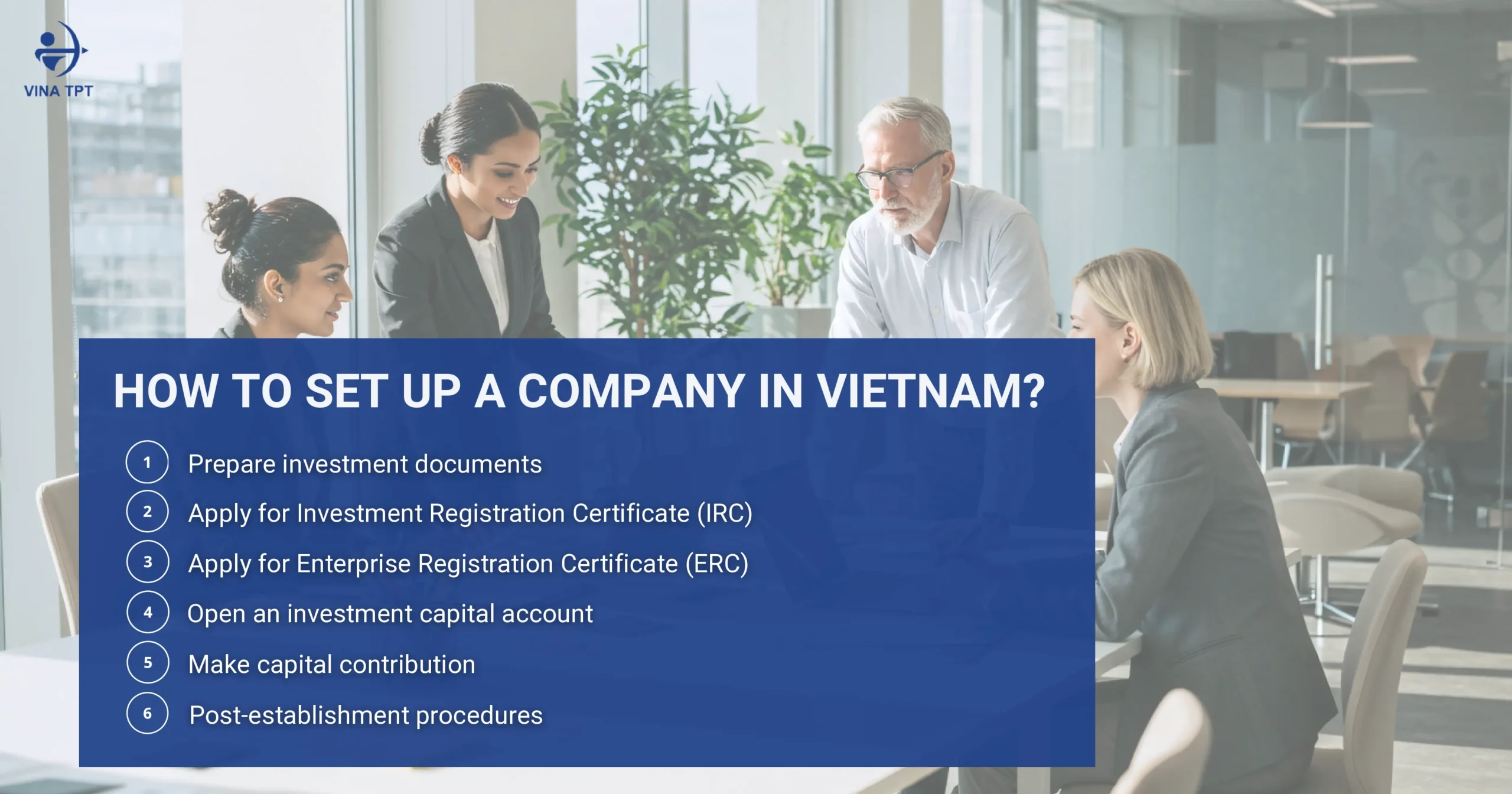
The licensing process has become more flexible in 2026. The traditional route is IRC → ERC, but the new optional ERC-first path accelerates initial incorporation for qualifying projects. The overall timeline is typically 4–8 weeks, handled mainly by the provincial Ministry of Finance.

Foreign investors are required to obtain two key certificates before operating a business, including an import export company in Vietnam.

Step 1: Securing the Investment Registration Certificate (IRC) 

The IRC approves the investment project, including capital, location, objectives, and business lines. 

Required documents include:

  • Application form for investment registration. 
  • Detailed investment project proposal (business activities, capital sources, and timeline). 
  • Proof of the investor’s financial and legal capacity (bank statements, audited accounts, or commitments; passports and business documents must be consular legalized and translated into Vietnamese). 
  • Proof of business address (lease agreement or ownership documents). 

Processing time: Approximately 5-7 weeks for standard projects (longer for conditional cases). 

The IRC serves as the legal foundation for company formation and trading rights. 

EXPLORE SET UP COMPANY SERVICES

Step 2: Obtaining the Enterprise Registration Certificate (ERC) 

Apply for the ERC via the National Business Registration Portal to establish the legal entity and obtain a tax code. 

Key documents: import export company in Vietnam

  • Copy of IRC (if applicable). 
  • Company charter. 
  • List of members/shareholders and legal representative details. 
  • Power of attorney (if needed). 

Processing time: 7 – 10 working days.

The ERC enables opening a Direct Investment Capital Account (DICA), signing contracts, and starting preparatory operations. 

>>> Reference: Essential Step For Setting Up a Company in Vietnam| Trading Businesses

Step 3: The Mandatory “Business License” for Trading Activities 

For pure import export company in Vietnam, no separate general trading license is required beyond properly registered business lines in the IRC/ERC, thanks to Vietnam’s WTO commitments. Trading rights are embedded in these certificates. 

However, attention is needed in the following cases: 

  • Distribution/wholesale activities: May require a specific Business License for goods trading and related activities from the Department of Industry and Trade (DoIT). 
  • Restricted or conditional goods (e.g., rice, sugar, petroleum, tobacco, certain chemicals): Additional permits or quotas from relevant ministries are mandatory. 
  • Post-setup: Register for a customs code if engaging in frequent import/export operations. 

Always cross-check HS codes against the latest prohibited and restricted lists (updates to Decree 69/2018/ND-CP and its successors). Many investors overlook the DoIT sub-license when distribution elements are involved, leading to compliance gaps. 

import export company in vietnam

3/ Essential Post-Incorporation Compliance & Tax Planning 

After obtaining the licenses, the focus shifts to operational readiness and risk mitigation. 

Capital Contribution Rules (The 90-Day Deadline) 

Investors must fully contribute the registered charter capital within 90 days from the date of ERC issuance (excluding time for asset transportation, import, and ownership transfer). Failure to meet this deadline may result in administrative fines, blocked bank transactions, or requirements to adjust the charter capital. Choose a realistic capital level that matches your anticipated trade volume. All capital contributions must be made through the dedicated DICA. 

Overview of Tax Planning  

  • Corporate Income Tax (CIT): Standard rate of 20%. Preferential rates (10% for 15 years or 17% for 10 years) and exemptions are available for encouraged sectors, locations, or export-oriented projects. 
  • Value-Added Tax (VAT): 0% on exports (with possible refund of input VAT); standard 10% or reduced rates on imports and domestic sales. 
  • Import/Export Duties: Preferential or zero rates under FTAs, with exemptions on machinery and equipment for qualifying projects. 

Early tax planning helps optimize cash flow, especially for export-focused businesses. 

4/ Key Taxes FDI Trading Companies in Vietnam Must Comply With 

FDI trading companies must comply with the following key taxes: 

  • VAT: Charged on imports (creditable or refundable for exporters); 0% rate on qualified exports. 
  • CIT: 20% on taxable profits, with available incentives and 5-year loss carry-forward. 
  • Personal Income Tax (PIT): Progressive rates from 5% to 35% on employee salaries, plus withholding on certain foreign payments. 
  • Import/Export Duties: Calculated based on HS codes and applicable FTAs — critical for profit margin planning. Restricted goods may be subject to quotas or special taxes. 
  • Foreign Contractor Withholding Tax: Applies to payments for overseas services (combined CIT + VAT). 

Maintaining accurate accounting records is essential for claiming VAT refunds and duty exemptions. Audits and customs inspections are common, so robust bookkeeping is highly recommended. For specific goods such as petroleum or rice, additional excise or consumption taxes may apply. 

>>> Download Vietnam Tax Handbook For Investor

5/ FAQ: Frequently Asked Questions about Setting Up an Import Export Company in Vietnam 

> What is the minimum capital requirement? 

There is no statutory minimum capital for general trading companies. However, the charter capital should be realistic and sufficient for the intended business scale. Typical starting amounts range from USD 20,000 to USD 100,000 or more, depending on operations. 

> How long does the entire licensing process take? 

Usually 6–8 weeks for obtaining the business license for import–export activities. Additional time is required for restricted goods or distribution rights. 

> Which items are restricted or prohibited? 

Prohibited items include weapons, explosives, and certain used consumer goods. Restricted items (requiring special licenses or quotas) include rice, petroleum products, tobacco, sugar, certain chemicals, and cultural products. FDI companies often face limitations when exporting rice or trading petroleum. 

> Do I need a physical office or warehouse? 

A registered business address is mandatory. Virtual offices have certain limitations; however, at the initial stage, you may use a virtual office to complete the company registration before securing a suitable physical location. 

Warehousing requirements will depend on your specific business model. 

> Can business lines be amended later? 

Yes, you can amend or add business lines later. This process requires approval from the licensing authority. 

6/ Conclusion & Strategic Consultation Offer for Import Export Company in Vietnam

In 2026, establishing an import export company in Vietnam has never been more accessible, thanks to the streamlined Law on Investment 2025, strong FTA benefits, and excellent logistics infrastructure. By properly following the IRC and ERC process, registering accurate trading rights, meeting the 90-day capital contribution deadline, and maintaining tax compliance, foreign investors can successfully enter one of Asia’s most promising trade markets. 

However, nuances related to conditional goods, distribution rights, and post-setup obligations still require careful attention to avoid unnecessary delays or penalties. 

Our specialized Vina TPT legal team provides comprehensive support for FDI company formation, licensing, tax optimization, and ongoing compliance tailored specifically for import export businesses in Vietnam.  

Contact Vina TPT today for a personalized consultation and turn your import-export ambitions into a compliant and profitable operation in Vietnam. 

BOOK A FREE CONSULTATION

(This guide is based on regulations as of April 2026. Laws and implementing decrees may be updated — please consult official authorities or qualified legal and tax advisors for your specific situation.) 
establish import export company in vietnam with vina tpt

Starting a business in Vietnam: 12 frequently asked questions by foreign investors

starting-a-business-in-vietnam-12-frequently-asked-questions-by-foreign-investors

Vietnam continues to be an attractive destination for FDI capital thanks to its strategic location, competitive costs, and continuously improving business environment. With the Law on Investment 2025 taking effect from March 1, 2026, the company incorporation process has become more flexible. In many cases, investors can now obtain the Enterprise Registration Certificate (ERC) before the Investment Registration Certificate (IRC).

However, understanding the legal procedures, required documents, timelines, and ongoing compliance obligations remains a challenge for many new foreign investors.

This article compiles the 12 most frequently asked questions by foreign investors when starting a business in Vietnam. The content is organized by stage to give you a clear overview of the entire process – from preparation to operation.

12 most frequently asked questions about starting a business in Vietnam 2026

starting-a-business-in-vietnam-12-frequently-asked-questions-by-foreign-investors

1. Can foreigners own 100% of a company in Vietnam in 2026?

Most business sectors in Vietnam allow 100% foreign ownership. According to Vietnam’s WTO commitments and the Law on Investment 2025, only a few sectors, such as advertising, logistics, tourism, and education, may have ownership restrictions or require joint ventures with Vietnamese partners.

Tip: Check the business line code and market access conditions carefully before planning to avoid having to amend your application during the appraisal process.

2. What is the minimum charter capital required for a foreign-owned company?

Vietnamese law does not set a universal minimum charter capital for all sectors. However, the registered capital must be appropriate to the project scale and will be reviewed by the licensing authority.

In practice, common reference levels include:

  • Trading and distribution: USD 10,000 – 50,000 (USD 10,000 is often considered the practical minimum)
  • Fintech: around USD 2 million, depending on the business model and licensing requirements
  • Commercial banks: approximately USD 120 million (under specialized regulations)
  • Real estate: No fixed minimum, but a minimum equity ratio of 20% (for projects under 20 hectares) or 15% (for projects of 20 hectares and above) is required.

Important note: Charter capital must be fully contributed within 90 days from the date the Enterprise Registration Certificate (ERC) is issued. Failure to do so may result in administrative penalties and affect the company’s credibility with authorities and partners.

3. What documents must foreign investors prepare and do they require consular legalization?

Document preparation is a critical step when starting a business in Vietnam. The main required documents include:

  1. Application for investment project implementation
  2. Proof of the investor’s legal status (passport for individuals; Certificate of Incorporation for organizations)
  3. Investment project proposal (including objectives, scale, total investment capital, funding plan, location, timeline, and socio-economic impact assessment)
  4. Proof of financial capacity (bank statements or parent company support letter)
  5. Documents proving the project location (office lease agreement or proof of legal right to use the premises)
  6. Technology explanation (if the project requires technology appraisal)
  7. Business Cooperation Contract (BCC)

Important: All foreign documents must be consular legalized, notarized, and officially translated into Vietnamese. This is a mandatory requirement for the application to be accepted.

4. Which business lines are still conditional or restricted for foreign investors?

Approximately 80% of business lines in Vietnam have no conditions, allowing relatively straightforward operations after company registration.

However, investors should pay attention to:

  • Conditional business lines: Education, healthcare, logistics, tourism, advertising, real estate, etc. (require sub-licenses, facilities, or professional capacity)
  • Restricted market access sectors: May limit foreign ownership percentage or require joint ventures with Vietnamese partners
  • Prohibited sectors: As stipulated by Vietnamese law

From July 1, 2026, the updated list of conditional business lines under the Law on Investment 2025 will be fully applied. Always verify your business line code and specific conditions before registration.

5. Should I choose a Limited Liability Company (LLC) or Joint Stock Company (JSC)?

The choice depends on your investment objectives, project scale, and future development plans.

  • Limited Liability Company (LLC): Most popular among foreign investors due to its simple structure, high flexibility, and suitability for startups or medium-sized businesses.
  • Joint Stock Company (JSC): Better suited for companies planning to raise capital from multiple investors or prepare for future listing.

For the initial stage of starting a business in Vietnam, an LLC is usually recommended. You can later convert to a JSC when scaling or seeking larger investments.

starting-a-business-in-vietnam-12-frequently-asked-questions-by-foreign-investors

6. What is the difference between IRC and ERC under the new Investment Law 2026?

  • IRC (Investment Registration Certificate): Approves the investment project, including capital, business lines, location, and incentives (if any).
  • ERC (Enterprise Registration Certificate): Establishes the company’s legal entity status, including the tax code and business registration details.

Under the Law on Investment 2025, in non-restricted sectors, investors can apply for the ERC before the IRC. This allows the company to obtain legal status earlier for opening bank accounts, leasing offices, or applying for visas.

7. How long does it actually take to register a company in Vietnam in 2026?

The timeline depends on the project type and document quality. The process typically includes:

  • Investment Registration Certificate (IRC): 30 – 45 working days
  • Enterprise Registration Certificate (ERC): 7 – 10 working days after IRC approval

With complete and valid documents, the total process usually takes 6 to 8 weeks. Proper preparation and working with an experienced consultant can significantly reduce delays.

EXPLORE OUR SERVICES

8. Do I need a Vietnamese legal representative or director?

Every company in Vietnam must have at least one legal representative residing in Vietnam. This person can be a Vietnamese citizen or a foreigner holding a valid Temporary Residence Card (TRC).

Foreign investors can serve as the legal representative themselves if they meet the residency requirements.

>>> You may also be interested in: Nominee Director in Vietnam: Legal Risks, Requirements, and Safer Alternatives for Foreign Investors (2026 Guide)

9. Can I apply for a Temporary Residence Card (TRC) during or right after registration?

Yes. Investors can apply for a TRC after the company receives its ERC and holds an appropriate DT visa (DT1-DT3 depending on capital contribution).

Processing time is typically 5-15 working days. Many investors apply for the TRC immediately after company registration to secure long-term residency.

>>> You may also be interested in: Guide to Securing a TRC Vietnam for Foreign Investors in 2026

starting-a-business-in-vietnam-12-frequently-asked-questions-by-foreign-investors

10. What must I do immediately after receiving the Enterprise Registration Certificate (ERC)?

After receiving the ERC, you should promptly complete the following:

  • Open an investment capital account (DICA) and fully contribute charter capital within 90 days
  • Register for tax, obtain a digital signature, and issue electronic invoices
  • Register and announce the company seal (if required)
  • Register employees and social insurance (if hiring staff)

11. What are the key ongoing compliance obligations (tax, reporting, IAR…)?

Once operational, companies in Vietnam must fulfill regular compliance obligations, including:

  • Declaration and payment of VAT, Corporate Income Tax (CIT), and Personal Income Tax (PIT)
  • Submission of Investment Activity Reports (IAR) – quarterly and annually for FDI companies
  • Preparation of annual financial statements (some companies require statutory audit)
  • Updating any changes in company registration (capital, business lines, legal representative, etc.)
12. When and why should I consider outsourced financial accounting services?

It is highly recommended to engage outsourced accounting services from the early stage if you do not yet have an internal team familiar with VAS and Vietnamese tax regulations.

Outsourcing helps control costs, minimize compliance risks, and ensures timely, accurate financial reports for both management and investors.

Looking for a reliable accounting partner? Explore Vina TPT’s outsourced accounting services to find the right solution for your business.

Explore Accounting Service

Why choose Vina TPT for starting and operating your business in Vietnam

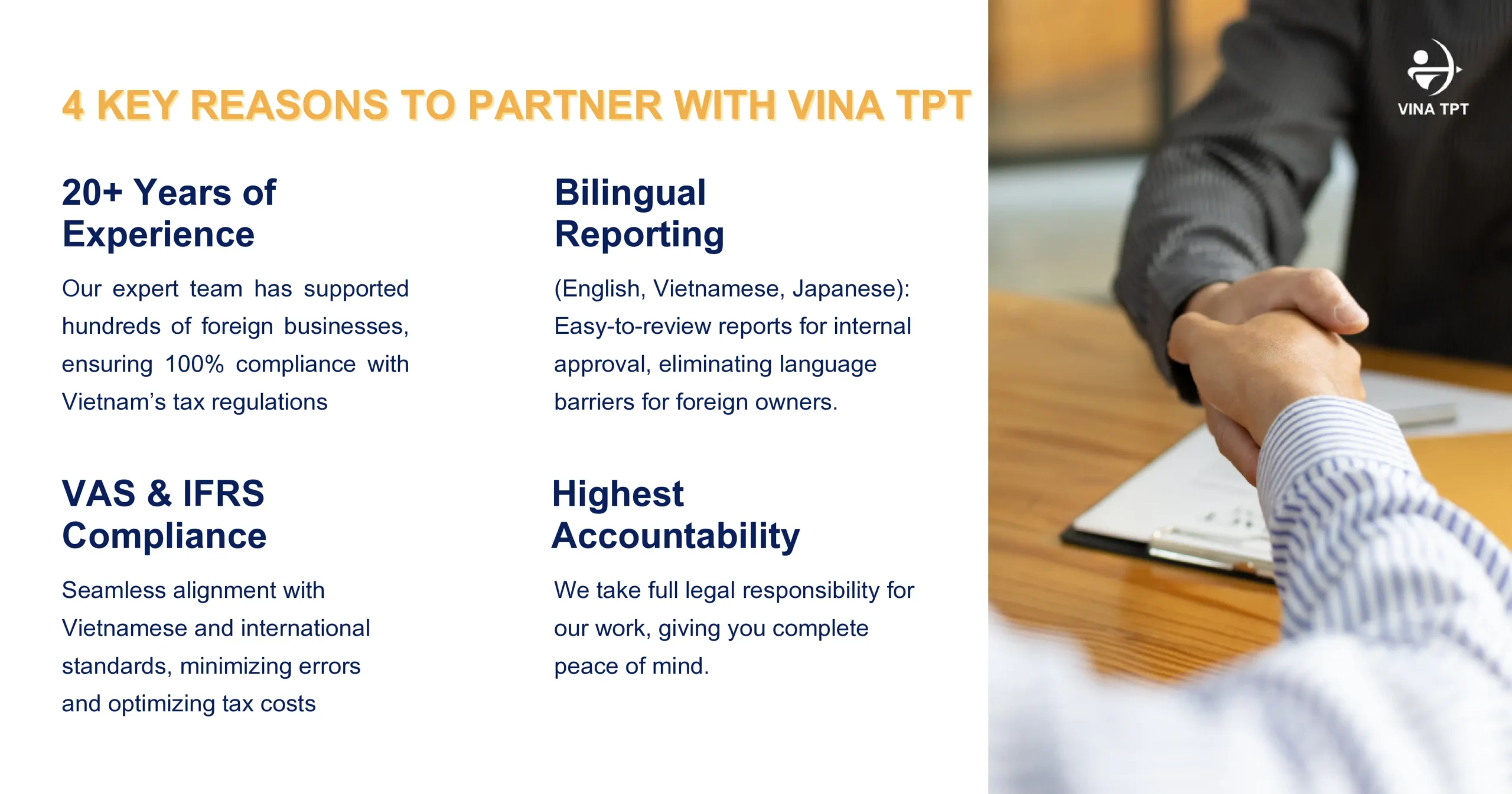
With over 20 years of experience supporting FDI enterprises, Vina TPT provides comprehensive solutions for foreign investors when starting a business in Vietnam:

  • Full support for IRC, ERC, TRC, and work permit procedures
  • Qualified Chief Accountant and outsourced finance & accounting services (bookkeeping, tax, payroll)
  • Bilingual and multilingual reporting (Vietnamese – English – Japanese)
  • End-to-end support from company formation through operations and expansion

Each client is supported by a multi-level expert team (Assistant – Senior – Manager), ensuring accuracy and timeliness.

starting-a-business-in-vietnam-12-frequently-asked-questions-by-foreign-investors

Conclusion

With the Law on Investment 2025, starting a business in Vietnam has become more transparent and flexible. However, thorough preparation regarding documents, capital, and compliance obligations remains essential for success.

Partnering with a professional consulting firm will help you save time, reduce risks, and focus on your core business activities.

Contact Vina TPT today for personalized consultation and a tailored solution for your investment plan in Vietnam.

BOOK A FREE CONSULTATION

Nominee Director Vietnam: Legal risks, requirements, and safer alternatives for foreign investors (2026 Guide)

nominee-director-in-vietnam

Foreign investors often face challenges when establishing a company in Vietnam, particularly in appointing a legal representative. Vietnamese law requires at least one individual who resides in Vietnam to serve in this role. As a result, many investors consider using a Nominee Director Vietnam – a person who appears on official documents but does not actively participate in day-to-day management.

However, significant changes took effect in 2025-2026. The amended Law on Enterprises 2025 and Decree 168/2025 introduced strict requirements for disclosing Ultimate Beneficial Owners (UBO). A Nominee Director is no longer a simple way to maintain anonymity. Attempting to conceal the true owner can lead to heavy administrative fines, legal disputes, and even loss of control over the company.

This article explains the concept, reasons for use, legal requirements, and major risks of using a Nominee Director in Vietnam. It also presents safer, more transparent alternatives for FDI enterprises.

1. What is a Nominee Director Vietnam?

A Nominee Director in Vietnam is an individual appointed as the legal representative on official company registration documents, mainly to satisfy the legal requirement that at least one legal representative must reside in Vietnam. In most cases, this person does not participate in the company’s actual management.

To understand clearly, it is important to distinguish three key concepts:

  • Legal Representative: Under the Law on Enterprises 2025, every company in Vietnam must have at least one legal representative who resides in Vietnam. This person bears full legal responsibility for signing contracts, representing the company before state authorities, banks, and partners, and ensuring compliance with tax and labor obligations.
  • Nominee Director: This is a method of appointing a legal representative where the individual is named on paper to satisfy legal requirements but does not participate in actual management. Real control remains with the foreign investor through internal agreements.
  • Nominee Shareholder: This relates to ownership of shares or capital contributions. The nominee holds the shares on paper but is not necessarily the legal representative. These are two entirely different roles.

Even with internal agreements, Vietnamese law still holds the appointed legal representative fully accountable. Therefore, a Nominee Director Vietnam is only a temporary solution and carries significant risks – especially after mandatory transparent UBO disclosure began in 2025.

2. Why do foreign investors consider using a Nominee Director Vietnam?

Although the risks are increasing, many foreign investors still consider using a Nominee Director in Vietnam during the early stages of starting a business in Vietnam. Here are the most common reasons:

  • They do not yet reside permanently in Vietnam or lack a TRC and work permit: Most foreign investors are not ready or able to relocate to Vietnam immediately. Obtaining a Temporary Residence Card (TRC) and work permit requires time and separate procedures. While waiting, they need a legally residing representative to allow the company to operate. A Nominee Director serves as a temporary solution to meet the legal requirement of having a representative who resides in Vietnam.
  • They want to speed up the company incorporation process: The IRC/ERC registration process can sometimes be delayed due to project approval or document preparation. Appointing a Nominee Director allows the company to complete registration faster, open bank accounts, and begin certain operations without waiting for the main investor to be physically present in Vietnam.
  • Certain business sectors require clear “local presence”: Even though the Law on Investment 2025 has opened the market further, some conditional or restricted sectors – such as logistics, education, advertising, and tourism – still exist. In these cases, having a Vietnamese-named legal representative on paper can make the application smoother and create a stronger impression of “local presence” when dealing with partners and government authorities.
  • To reduce the initial administrative and management burden on the parent company: When establishing a subsidiary or branch in Vietnam, headquarters often prefer to focus on high-level strategy rather than daily administrative tasks. Using a Nominee Director helps reduce the workload related to legal procedures, signing minor contracts, and dealing with state agencies in the early phase – saving time and internal resources for the parent company.

Important Note: While these reasons may seem practical in the initial stage, using a Nominee Director should only be a temporary solution. With the mandatory Ultimate Beneficial Owner (UBO) disclosure requirements effective from 2025, long-term use of a Nominee Director has become increasingly risky and is no longer aligned with Vietnam’s push toward greater transparency in the investment environment.

3. Legal requirements for Directors and Legal Representatives in Vietnam

According to the Law on Enterprises and related regulations, a legal representative must meet these conditions:

  • Be an individual (Vietnamese or foreign) residing in Vietnam.
  • Be at least 18 years old and have full legal capacity.
  • Be responsible for signing contracts, representing the company before authorities, and ensuring overall compliance.
  • Have no prohibitions on establishing or managing enterprises in Vietnam (including no bankruptcy declarations).

Companies must always maintain at least one legal representative residing in Vietnam. If this person leaves the country, they must provide a written power of attorney to another resident. They remain fully responsible for the actions of the authorized person.

DISCOVER HOW WE SUPPORT YOUR BUSINESS GROWTH

4. Major legal risks of using a Nominee Director Vietnam

This is the highest-risk area for foreign investors, especially after the UBO regulations took effect:

  • Loss of company control: The Nominee Director has actual legal authority to sign contracts, borrow money, transfer assets, or even dissolve the company. In disputes, courts typically recognize the nominee as the legitimate representative.
  • UBO disclosure risks: Hiding or misdeclaring the ultimate beneficial owner violates Decree 168/2025. This can result in heavy administrative fines or even revocation of the investment project if considered a “sham transaction.”
  • Civil and criminal liability: Both the nominee and the real beneficial owner may be jointly liable for tax debts, labor violations, or economic crimes. Cases where the nominee “disappears” or demands extra benefits often lead to prolonged litigation.
  • Internal agreements are often unenforceable: Powers of attorney or indemnity agreements can be declared invalid by courts if they are seen as attempts to conceal the true purpose.
  • Risks to FDI projects: Authorities may revoke the Investment Registration Certificate (IRC) or Enterprise Registration Certificate (ERC) if a nominee structure is found to circumvent foreign ownership restrictions.

In practice, many disputes have resulted in asset loss, operational disruption, and significant financial damage for foreign investors.

nominee-director-in-vietnam

5. Are there safer alternatives to a Nominee Director Vietnam?

Yes. Foreign investors can choose more transparent and secure options that still meet the legal representative requirement while maintaining control and complying with UBO disclosure rules.

Recommended alternatives include:

  • Appointing the foreign investor directly as director combined with obtaining a TRC Vietnam
  • Using a Qualified Chief Accountant service (a licensed professional who can serve as legal representative)
  • Implementing a dual legal representative mechanism (one local and one foreign)
  • Engaging a professional legal representative service

These solutions prioritize transparency, reduce risks, and support long-term sustainable operations. However, in certain transitional situations, such as when the investor is still abroad or has not yet completed legal requirements, a Nominee Director may still be used temporarily with strong safeguards.

nominee-director-in-vietnam

6. How to choose a reliable Nominee Director Vietnam service (If Needed)

If you still need a nominee director during the transition period, pay close attention to these factors to minimize risks:

  • Clear and robust contracts: The agreement must clearly define responsibilities, indemnity clauses, scope of power of attorney, and control mechanisms to ensure real control remains with the investor.
  • Reputable service provider: Choose a provider with a clear legal entity, proven experience, and the ability to support UBO compliance under Decree 168/2025.
  • Independent legal review: Have an independent legal advisor review all contracts to avoid gaps and ensure balanced rights between parties.
  • Avoid choosing based solely on price: Low-cost services that lack transparency or proper control processes often carry hidden long-term risks.

A Nominee Director should only be used when truly necessary and for a short period. Combine it with strong internal controls to limit future disputes or legal liability.

How Vina TPT supports foreign investors with company setup & compliance

With more than 20 years of experience assisting FDI enterprises, Vina TPT understands the challenges foreign investors face during company incorporation — especially when considering a Nominee Director to meet legal requirements.

Instead of relying on high-risk solutions, Vina TPT offers comprehensive and transparent alternatives, including:

  • Advice on capital structuring and FDI company establishment (IRC/ERC)
  • Support for appointing a suitable legal representative, including Qualified Chief Accountant services
  • Outsourced finance and accounting, tax compliance, and payroll services
  • Assistance with TRC Vietnam applications and work permit exemptions for investors
  • Guidance on UBO disclosure and compliance under Decree 168/2025

In an environment where UBO regulations are increasingly strict, using a Nominee Director is no longer a safe long-term option. Non-transparent structures can lead to legal, financial, and operational risks.

Choosing a transparent structure, working with professional services, and ensuring full legal compliance not only minimizes risks but also enhances credibility and supports sustainable growth for your FDI business in Vietnam.

Contact Vina TPT today for expert advice on company establishment, capital structuring, legal representative appointment, and tailored finance & accounting solutions for your investment model.

BOOK A FREE CONSULTATION


How Do I Start a Business in Vietnam? Guide for Foreign Investors

how-do-i-start-a-business-in-vietnam-from-idea-to-legal-setup-with-local-experts

When asking the question “How do I start a business?”, foreign investors are entering the stage of clarifying their business ideas and moving toward building a legally compliant and operational business model in Vietnam.

Based on over 20 years of experience in business consulting and supporting the establishment and operation of hundreds of FDI enterprises in Vietnam, this article will guide investors through each step, from preparation to registration and operation, while highlighting key considerations to ensure efficiency and minimize risks.

1. How can foreign investors start a business in Vietnam?

how-do-i-start-a-business-in-vietnam-from-idea-to-legal-setup-with-local-experts

1.1. Requirements for foreign investors to establish a company in Vietnam

Before answering the question “How do I start a business?”, foreign investors need to determine whether their intended business line is eligible for investment. Under the Investment Law, business sectors in Vietnam are classified based on market access levels and regulatory conditions.

In practice, business sectors can be grouped into five main categories:

  • Unconditional business sectors (accounting for approximately 80%): These are sectors that are not subject to specific investment conditions or foreign ownership restrictions. Investors can proceed with standard business registration and comply with general regulations (tax, accounting, labor, etc.).
    Examples: manufacturing, wholesale trading, software development, consulting services, F&B.
  • Investment incentive sectors: These sectors are encouraged by the government and may benefit from incentives such as Corporate Income Tax (CIT) reductions, land rental incentives, or other support policies depending on the project.
    Examples: high technology, R&D, renewable energy, high-tech agriculture, digital transformation.
  • Conditional business sectors: These sectors are allowed to operate but require additional conditions such as sub-licenses, legal capital, technical standards, or professional certifications.
    Examples: education, healthcare, real estate, logistics, food services.
  • Market access restricted sectors for foreign investors: Foreign investors may face limitations on ownership ratio, investment structure, or scope of operations in these sectors.
    Examples: retail distribution, telecommunications, aviation, advertising, financial services.
  • Prohibited business sectors: These activities are strictly prohibited under Vietnamese law due to national security, social ethics, or public health concerns.
    Examples: drug trafficking, human trafficking, prostitution, explosives.

Note:

In practice, the majority of business sectors in Vietnam fall under unconditional categories (around 80%), meaning investors can enter the market relatively easily. However, some industries may overlap across categories (for example, renewable energy can be both incentivized and conditional).

To avoid confusion and streamline the licensing process, investors are advised to check the relevant business codes and applicable conditions on the Business Line Code Lookup page before submitting their applications.

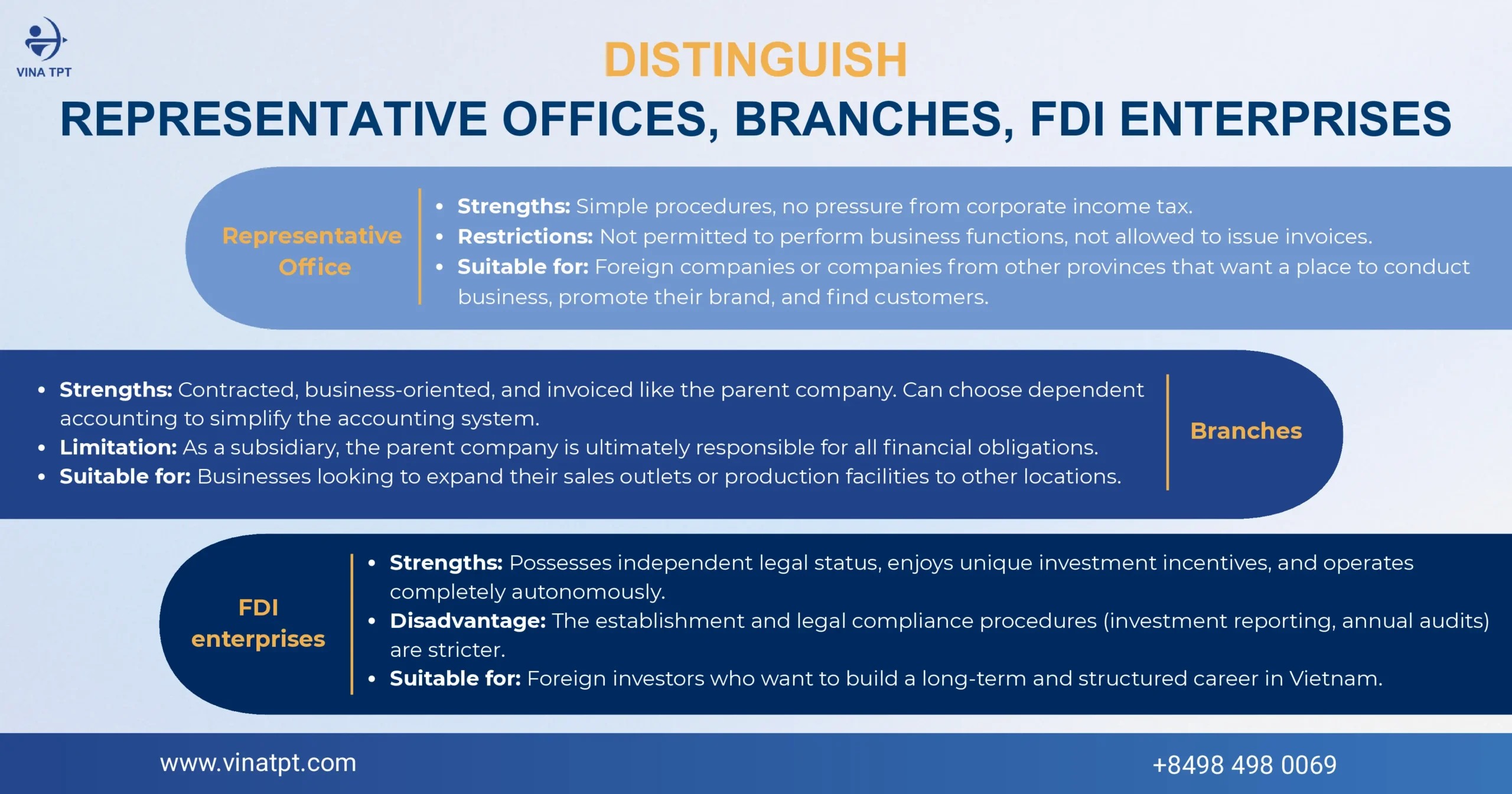
1.2. What company types are suitable?

According to the Investment Law 2020, when exploring how to start a business in Vietnam, foreign investors can choose from several common business structures:

  • Limited Liability Company (LLC): This includes single-member LLCs or multi-member LLCs (with up to 50 capital contributors). This is the most commonly chosen structure by foreign investors due to its simple governance, strong control over operations, and flexibility in either 100% foreign ownership or joint ventures with local partners.
  • Joint Stock Company (JSC): Requires at least three shareholders with no maximum limit. This structure is suitable for businesses planning to raise capital, expand operations, or pursue long-term growth strategies.
  • Representative Office: This entity does not have a commercial function and is primarily used for market research, trade promotion, and liaison activities with partners in Vietnam.

In practice, most foreign investors prefer an LLC when they want full ownership and simplified management, while a JSC is generally more suitable for projects with long-term expansion and capital mobilization plans.

how-do-i-start-a-business-in-vietnam-from-idea-to-legal-setup-with-local-experts

1.3. How much investment capital is required?

One of the key questions when exploring how do I start a business is the required capital. Vietnamese law does not impose a universal minimum charter capital across all sectors. However, in practice, capital must align with project scale, industry, and financial capacity.

Reference capital levels by industry:

  • Trading & distribution: Typically USD 10,000 – 50,000 (USD 10,000 is often considered a minimum reference level).
  • Fintech: Some models may require around USD 2 million depending on licensing conditions.
  • Commercial banking: Minimum capital requirement of approximately USD 120 million.
  • Real estate: No fixed capital requirement, but requires minimum equity of 20% (projects under 20 ha) or 15% (projects over 20 ha).

The above capital levels are for reference only and may vary depending on the investor’s specific business plan and the requirements of the licensing authority.

In practice, charter capital is not merely a formal requirement but directly impacts the application review process and the feasibility of project implementation. If the registered capital does not align with the scale of operations, the business may be required to provide explanations or make adjustments during the licensing process.

1.4. Business registration process in Vietnam

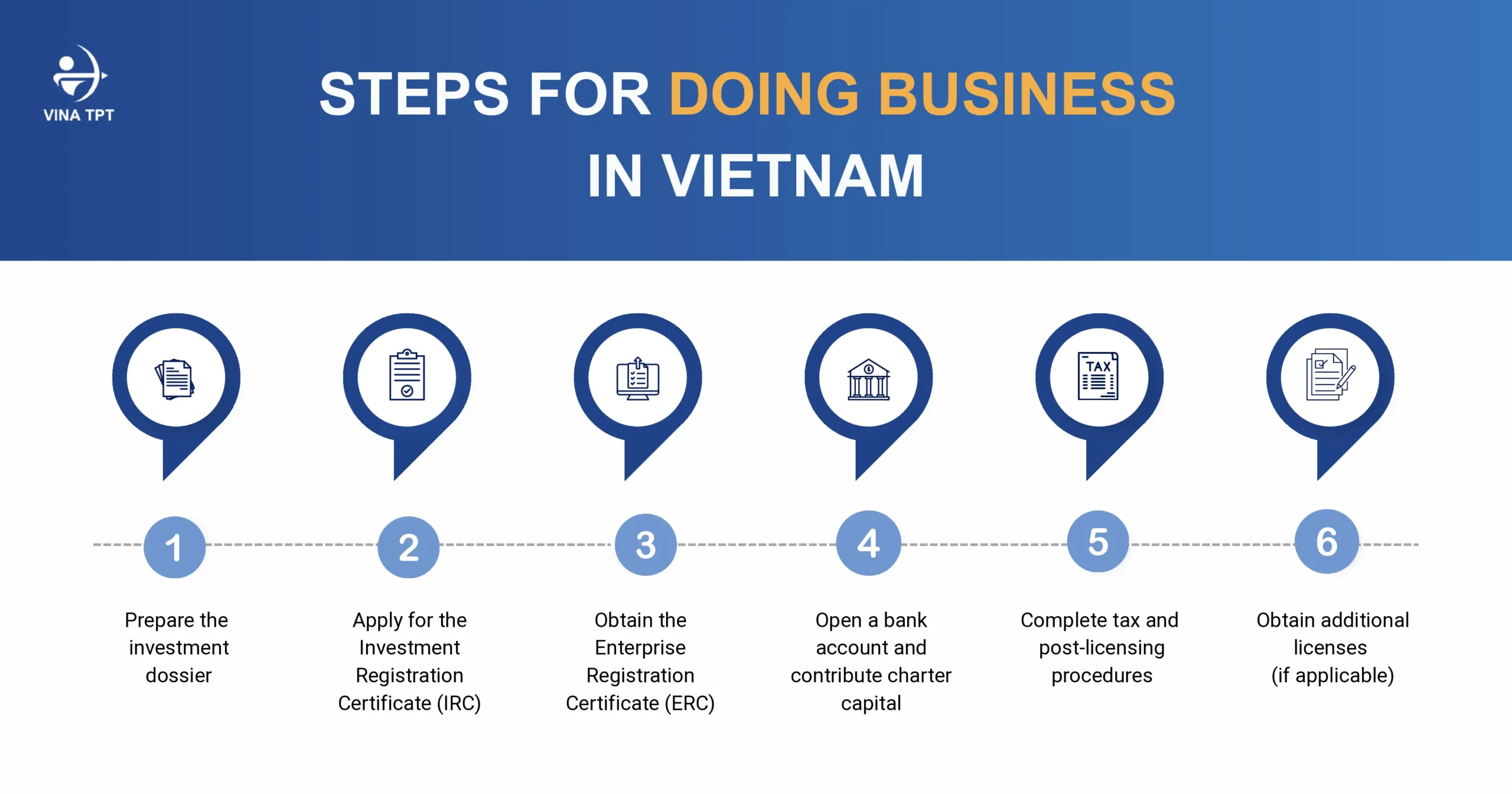
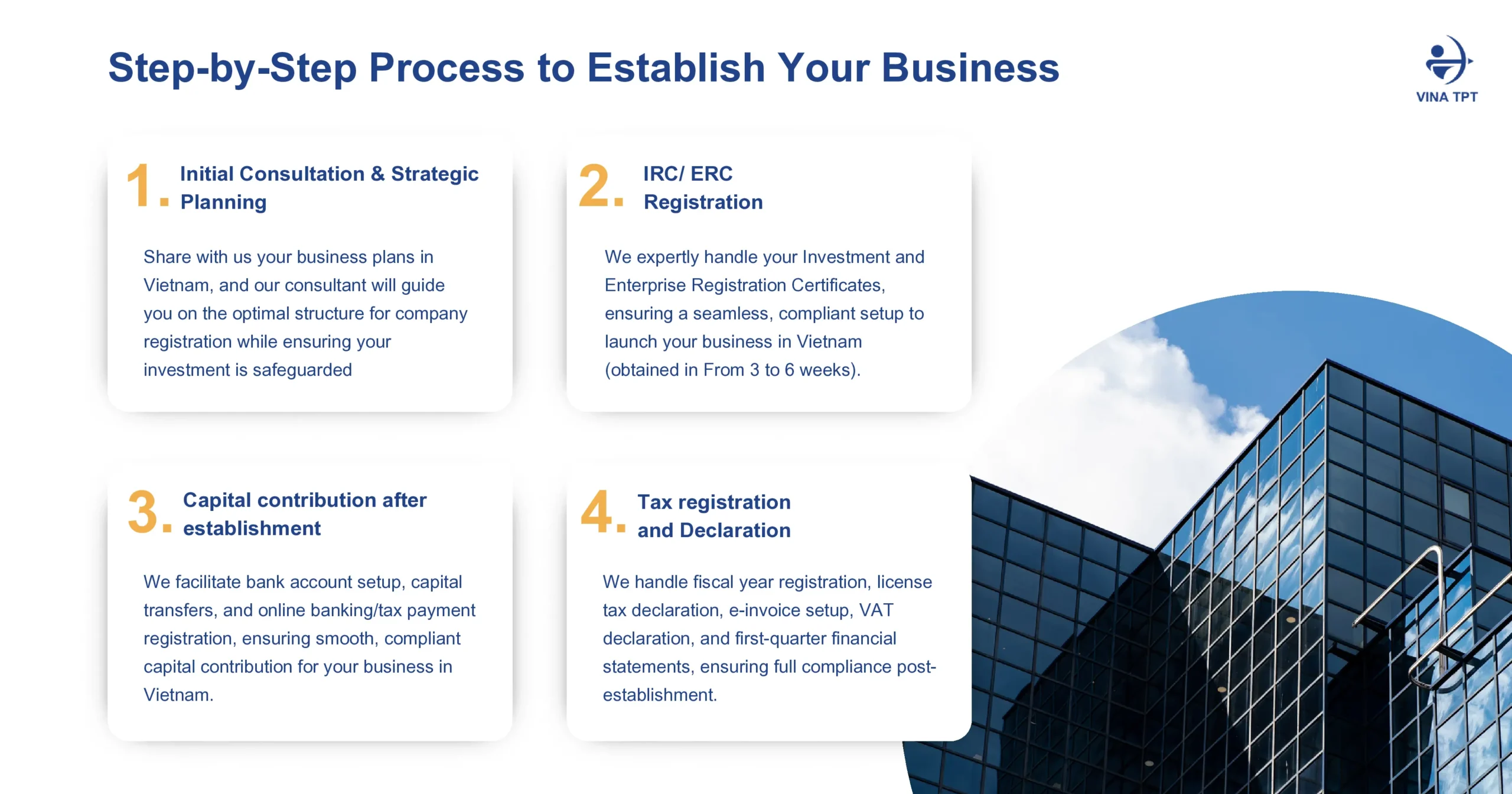
The process of setting up a business in Vietnam typically includes 6 steps, taking around 8-10 weeks depending on the industry:

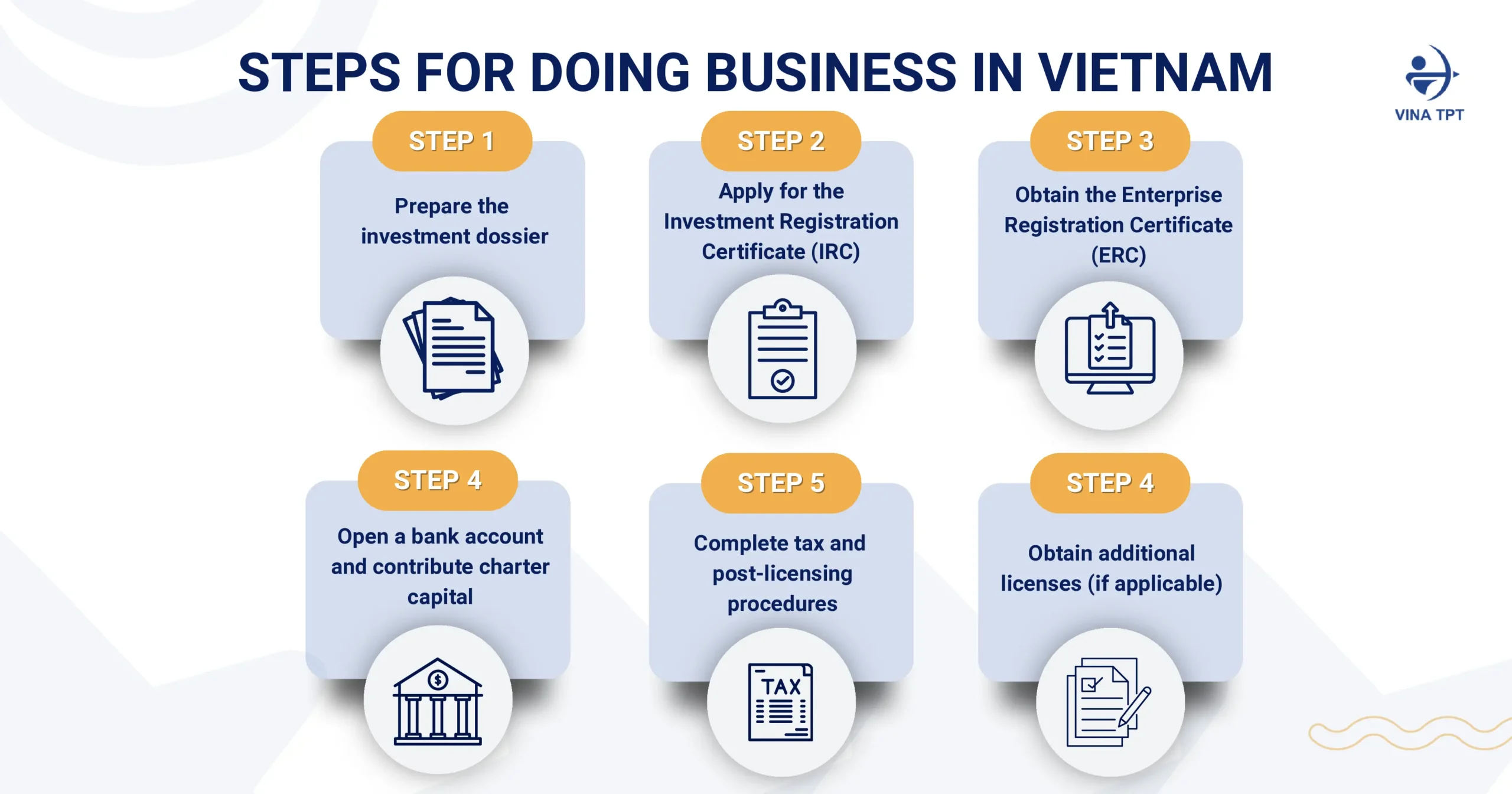
  • Step 1: Prepare and submit the IRC application
  • Step 2: Obtain the Investment Registration Certificate (IRC)
  • Step 3: Obtain the Enterprise Registration Certificate (ERC)
  • Step 4: Open a capital account and contribute capital (within 90 days)
  • Step 5: Complete post-licensing procedures (tax, e-invoices, labor registration)
  • Step 6: Apply for sub-licenses (if applicable)

In practice, many companies underestimate post-licensing procedures and capital contribution obligations, leading to delays or compliance issues. Proper preparation from the beginning helps shorten timelines and avoid revisions.

After answering “How do I start a business?”, companies move into the operational stage, focusing on financial reporting, tax compliance, hiring, and payroll management.

EXPLORE OUR SERVICES

2. Legal and tax considerations investors should note from the beginning

2.1. What taxes must businesses declare?

After establishment, companies in Vietnam must comply with several taxes, including:

Value-Added Tax (VAT): VAT is one of the most frequently arising taxes during business operations, especially for companies engaged in trading goods, services, or import-export activities. 

Corporate Income Tax (Corporate Income Tax – CIT): CIT is calculated based on the company’s profits. This obligation not only includes annual finalization but also requires quarterly provisional payments and ongoing monitoring of business performance to ensure compliance with regulations.

Personal Income Tax (Personal Income Tax – PIT): Businesses are responsible for withholding, declaring, and paying PIT on behalf of employees for salaries, wages, and other taxable income. Proper compliance is essential to avoid risks such as tax reassessment and administrative penalties.

In practice, many businesses encounter issues from the early stages due to a lack of understanding of filing cycles, tax-specific obligations, or inconsistencies between reports. Having a clear understanding of each tax type helps companies establish an effective accounting and tax system from the beginning.

>>> For more details, refer to: Tax Tips for Small Business in Vietnam: Avoid Common Compliance Mistakes

2.2. Key considerations for hiring and payroll management

Managing payroll in Vietnam can be challenging for FDI companies, especially in the early stages:

  • Labor and insurance regulations (social, health, unemployment insurance) frequently change
  • Salary structures and PIT calculations are complex
  • Language barriers and legal differences create additional challenges

In reality, knowing how do I start a business is not enough without understanding local practices, many FDI companies choose payroll outsourcing services to ensure compliance and reduce internal workload.

>>> See more: Payroll Outsourcing Services in Vietnam: Benefits and Choosing the Right Provider

3. Important considerations when starting a business in Vietnam

Even after understanding how do I start a business, many investors still face challenges due to frequently changing regulations and local administrative practices.

For example, similar applications may require different procedures depending on the authority or location. Tax and labor policies are also regularly updated.

Without proper knowledge, businesses may face repeated revisions, delays, and unnecessary costs.

Therefore, many FDI companies choose to work with consulting firms for partial or full-service support to ensure compliance and efficiency.

4. When should investors work with a consulting firm?

Outsourcing business setup services is especially recommended when:

  • Entering Vietnam for the first time
  • Operating in conditional business sectors
  • Needing fast project implementation
  • Wanting to optimize tax, accounting, and HR from the beginning

For many investors, outsourcing support is the most effective way to answer how do I start a business in Vietnam. Professional consulting firms act as long-term partners, helping businesses minimize risks and operate effectively in Vietnam.

how-do-i-start-a-business-in-vietnam-from-idea-to-legal-setup-with-local-experts

If you are planning how do I start a business in Vietnam, working with an experienced consulting firm is highly recommended. Learn more about Vina TPT’s services to receive tailored consultation for your investment plan.

BOOK A FREE CONSULTATION

A Complete Guide for Japanese Investors Setting Up a Business in Vietnam

According to the Ministry of Finance, in the first eight months of 2025, newly registered FDI capital from Japan to Vietnam reached USD 877.9 million, accounting for about 8% of total registered investment capital. In addition, a survey by the Japan Bank for International Cooperation (JBIC) ranks Vietnam second among the most attractive overseas investment destinations for Japanese enterprises.

So when considering setting up a business in Vietnam, what types of enterprises can Japanese investors choose? What is the company establishment process, and what legal issues should investors pay attention to? This article outlines common company structures, the company establishment process, and key considerations for Japanese investors investing in Vietnam.

a-complete-guide-for-japanese-investors-setting-up-a-business-in-vietnam

1. Why Vietnam is an attractive destination for Japanese investors

Vietnam is becoming an increasingly attractive investment destination for many Japanese companies due to several advantages:

  • Stable Vietnam – Japan relations: The two countries maintain a Comprehensive Strategic Partnership, creating a stable foundation for long-term cooperation and a reliable investment environment for Japanese enterprises considering setting up a business in Vietnam.
  • Competitive production costs and investment incentives: Vietnam has a young workforce, competitive production costs, and various tax incentive policies designed to attract foreign investment.
  • Strategic location in the regional supply chain: Located in the center of Southeast Asia and participating in major free trade agreements such as the Comprehensive and Progressive Agreement for Trans-Pacific Partnership (CPTPP) and the Regional Comprehensive Economic Partnership (RCEP), Vietnam provides favorable conditions for Japanese companies to expand manufacturing and export activities to many markets in the region.
  • A rapidly growing domestic market: With a population of over 100 million people and a growing middle class, Vietnam represents a promising consumer market for many Japanese companies considering setting up a business in Vietnam.

So what company types for foreign investors in Vietnam are available for Japanese investors?

2. Các loại hình thành lập doanh nghiệp phổ biến tại Việt Nam cho nhà đầu tư Nhật

According to Article 21 of the Investment Law 2020, Japanese investors may establish four main types of business entities when setting up a business in Vietnam, including:

  • Single-member limited liability company (100% foreign-owned): This is a company owned by a single individual or organization. In foreign investment cases, the owner is typically a foreign investor or a foreign company.
  • Multi-member limited liability company: This is one of the most common company types for foreign investors in Vietnam, allowing 2 to 50 capital contributors. Foreign investors may participate with ownership ratios permitted under the relevant business sector regulations.
  • Joint-stock company: This type of enterprise has at least three shareholders and is allowed to issue shares to raise capital from investors.
  • Representative office: A representative office does not conduct business activities like a company. It mainly performs functions such as market research, trade promotion, and liaison support with local partners.

Below is a comparison of the key characteristics, advantages, and disadvantages of each structure available when setting up a business in Vietnam.

Criteria

Single-member LLC Multi-member LLC Joint-stock company

Representative office

Suitable for Investors wanting 100% ownership and full control Joint ventures or cooperative projects Large companies requiring capital mobilization Foreign companies exploring the market
Members/shareholders 1 individual or organization 2–50 members Minimum 3 shareholders, unlimited maximum Not applicable
Legal entity status Yes Yes Yes Not an independent legal entity
Organizational structure Members’ Council, Director/General Director Members’ Council, Chairman, Director/General Director, Supervisory Board (if required) General Meeting of Shareholders, Board of Directors, Director/General Director, Supervisory Board or Internal Audit Chief Representative
Capital mobilization Limited, mainly from owner Capital contribution from members High, can issue shares No capital mobilization function
Share issuance rights No No Yes No
Advantages Simple structure, full decision-making authority Risk and capital shared among members High fundraising ability, possibility of stock exchange listing Simple establishment procedure, suitable for market research
Disadvantages Difficult to raise external capital Member limit (max 50) More complex governance structure Not allowed to conduct business activities

In general, choosing the right company types for foreign investors in Vietnam directly affects the company’s operational strategy and governance structure after setting up a business in Vietnam. The choice will largely depend on the investor’s objectives and business strategy.

EXPLORE OUR SERVICES

3. Step-by-step process for setting up a business in Vietnam

Step 1: Prepare the investment dossier

This is the critical first step in the process of setting up business in Vietnam. The dossier must be prepared in accordance with the Investment Law 2025.

  • Written request for implementation of the investment project
  • Documents proving the investor’s legal status:
    • For individuals: Citizen ID/Passport (copy)
    • For organizations: Certificate of incorporation or equivalent legal document (copy)
  • Investment project proposal (including investor information, objectives, investment capital, scale, capital mobilization plan, location, schedule, and socio-economic efficiency assessment)
  • Documents proving financial capacity:
    • Individuals: savings book, bank balance confirmation
    • Organizations: financial statements for the last two years, financial commitment from the parent company or a financial institution
  • Head office lease agreement or documents proving the right to use the project location
  • Technology explanation (for projects subject to technology appraisal)
  • BCC business cooperation contract (if investing under this form)

The dossier is submitted to the Department of Finance in the province/city where the project’s head office is located.

Step 2: Submit the application for the Investment Registration Certificate (IRC)

Obtaining the Investment Registration Certificate is also a key step in business registration in Vietnam for Japanese investors, as this certificate officially approves and confirms the company’s investment project.

Required documents include:

  • Application form and a detailed project proposal (objectives, scale, investment capital, location, and timeline)
  • Proof of financial capability (bank statements, audited financial reports, or credit agreements)
  • Legal documents: notarized passport (individual) or business registration certificate (organization), both legalized
  • Proof of location (lease agreement or land use rights)
  • Power of attorney (if using a third-party service)

Foreign documents must be consular legalized and officially translated into Vietnamese. The processing time for an IRC application is typically 5-6 weeks , depending on the nature of the project and the review requirements of the investment registration authority. It is recommended to work with a professional service provider such as Vina TPT to avoid delays.

Step 3: Obtain the Enterprise Registration Certificate (ERC)

After the IRC is issued, the next step in setting up business in Vietnam is obtaining the ERC to establish the company’s legal entity status. Typically, the ERC is issued within 7-14 days from the submission date.

Step 4: Open a corporate bank account and inject charter capital

Foreign investors who open new company in Vietnam are required to:

  • Open a dedicated investment capital account at a licensed bank in Vietnam
  • Contribute the full charter capital within 90 days from the ERC issuance date to avoid penalties and maintain credibility for future licenses

Step 5: Complete tax registration and post-licensing procedures

Before officially commencing operations, the enterprise must:

  • Register for a tax code and purchase a digital signature
  • Apply for e-invoice issuance/registration
  • Register labor and enroll employees in social insurance

Tax and labor obligations are the final steps in doing business in Vietnam before official operations begin.

Step 6: Apply for sector-specific licenses (if applicable)

Conditional business sectors may require additional sub-licenses such as business licenses, import-export licenses, or environmental permits.

By following these steps and staying updated on regulations, foreign investors can successfully establish operations in Vietnam.

4. Common challenges for Japanese investors when setting up a business in Vietnam

Although Vietnam is an attractive investment destination, the process of setting up a business in Vietnam may present several challenges for foreign investors, especially those entering the market for the first time.

  • Differences in legal systems: Vietnam’s legal system and licensing procedures differ significantly from Japan’s. For example, companies must obtain an Investment Registration Certificate (IRC) before applying for an Enterprise Registration Certificate (ERC). Some sectors also require additional sub-licenses, which can make the licensing process more complex.
  • Language and business culture barriers: Most legal documents and administrative procedures related to setting up a business in Vietnam are conducted in Vietnamese, including contracts, registration documents, and tax filings. Even with interpreters, reviewing legal documents in detail can still be challenging.
  • Administrative procedures involving multiple authorities: Administrative procedures in Vietnam often involve several regulatory bodies. For example: Representative offices must register with the Department of Industry and Trade and Branches of foreign traders may need to register with the Ministry of Industry and Trade. Incorrectly identifying the competent authority may delay the licensing process.
  • Tax and accounting compliance: After setting up a business in Vietnam, investors must comply with various tax obligations such as: Value Added Tax (VAT), Corporate Income Tax (CIT), Personal Income Tax (PIT)…These regulations are regularly updated. For instance, the personal income tax policy was updated at the end of 2025 and is expected to take effect from July 1, 2026. Without proper expertise, businesses may face compliance risks and unnecessary financial costs.

For this reason, many foreign investors choose to work with professional consulting firms to support the entire process from company establishment to legal compliance and operational management.

5. Support solutions for Japanese investors setting up a business in Vietnam

With over 20 years of experience in consulting and setting up a business in Vietnam, Vina TPT has supported numerous foreign investors in establishing and operating their businesses in Vietnam.

Notably, more than 80% of Vina TPT’s clients are Japanese companies, giving our team extensive practical experience in setting up a business in Vietnam and handling business registration in Vietnam for Japanese investors.

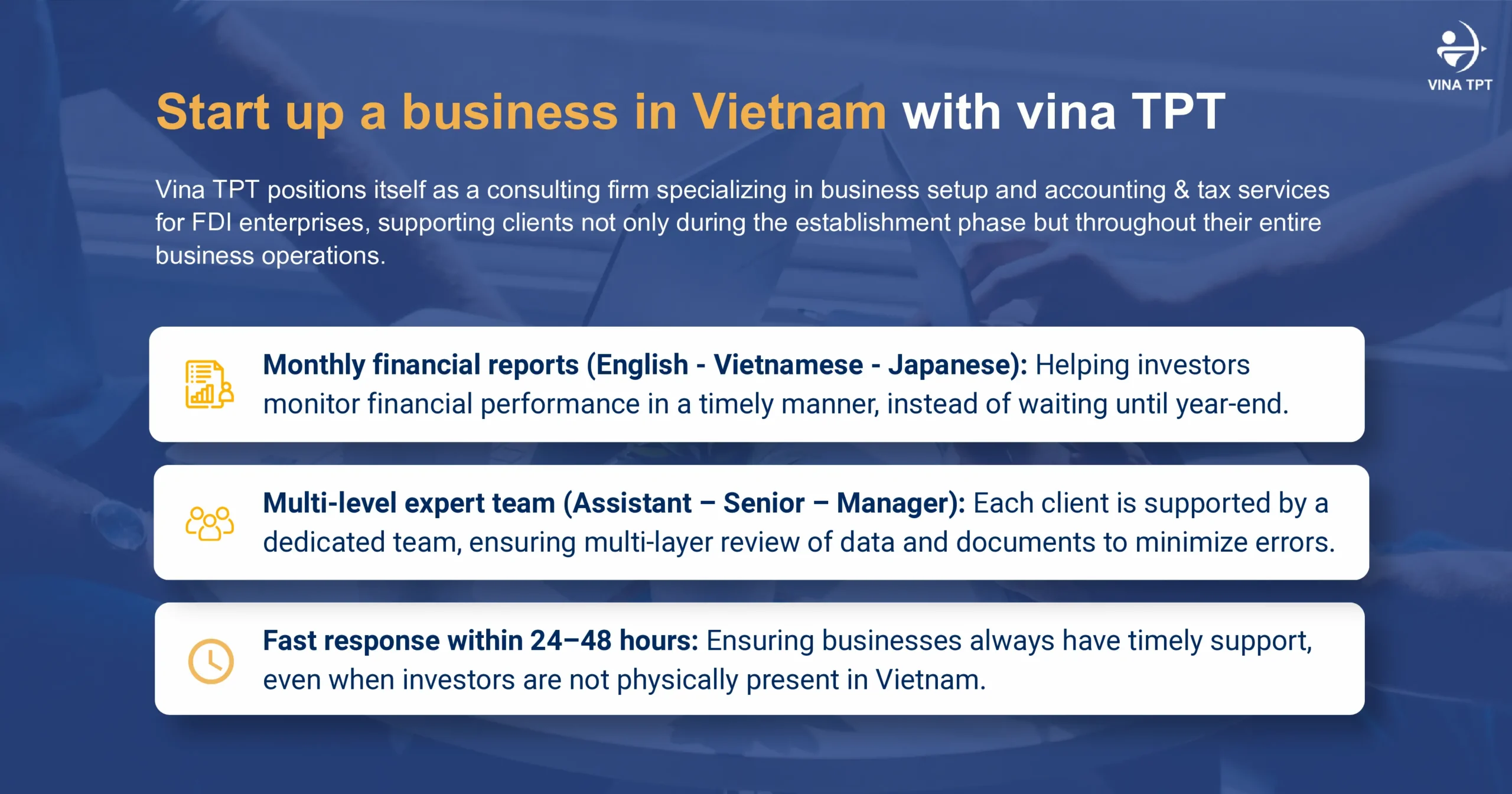
Our specialists can communicate and work directly in Japanese, helping ensure that communication and document processing are carried out quickly and accurately. In addition to company establishment services, Vina TPT also provides accounting and tax consulting services after incorporation, helping businesses maintain full compliance with Vietnamese regulations. In particular, monthly financial reports are provided in three languages (Japanese, English, and Vietnamese) allowing investors to easily monitor business performance.

Furthermore, Vina TPT also supports all related procedures for foreign investors and experts, including visa, work permits, and Temporary Residence Cards (TRC). As a result, investors do not need to work with multiple service providers while still being able to operate their business in Vietnam smoothly and efficiently.

If you are planning setting up a business in Vietnam, contact Vina TPT today for professional consultation and step-by-step support, from investment licensing to post-establishment compliance.

BOOK A FREE CONSULTATION

Vietnam LLC Registration Requirements: A Complete Guide for Investor

Vietnam LLC Registration Requirements: A Complete Guide for Investor

A limited liability company (LLC) is one of the most common business structures chosen by foreign investors when investing in Vietnam. This type of company allows the owner to be liable only within the scope of the contributed capital, has a relatively simple governance structure, and offers flexibility in choosing either 100% foreign ownership or cooperation with other partners.

So, how is the process of establishing an LLC in Vietnam carried out, and what should investors pay attention to during the company registration process? The article below provides detailed guidance on Vietnam LLC registration requirements as well as the necessary procedures.

Vietnam LLC Registration Requirements: A Complete Guide for Investor

1. Classification of LLCs: Which type is suitable for your business?

Before reviewing the Vietnam LLC registration requirements, investors need to determine which business structure best fits their business plan. In Vietnam, a limited liability company has two main forms: a single-member LLC and a multi-member LLC.

The table below compares the key features of these two LLC types, helping investors choose the model that best suits their business plan and satisfies the Vietnam LLC registration requirements.

Criteria Single-member LLC Multi-member LLC
Number of members 1 individual or organization From 2 to 50 members
Organizational structure Relatively simple, including: Owner, Company President, and Director/General Director More complex, including: Members’ Council, Chairman of the Members’ Council, and Director. If the company has more than 11 members, a Supervisory Board is mandatory to ensure transparency
Capital mobilization Limited, 100% from the owner More flexible, from multiple members in the Members’ Council
Suitable for Investors who want to own 100% of the capital Joint ventures or multiple investors

If an investor wants full ownership and direct control over decision-making, a single-member LLC is often the more suitable choice.

Single-member LLC offers flexibility and full control, making it suitable for individuals who want to independently manage their business.

Meanwhile, a multi-member LLC is an ideal option for partnerships, allowing investors to mobilize capital and share risks, thereby creating a stronger foundation for larger-scale growth.

2. Vietnam LLC registration requirements

To establish an LLC in Vietnam, you need to clearly understand the Vietnam LLC registration requirements and the relevant legal regulations.

2.1. Company name

Company name is one of the important requirements when registering a business in Vietnam. According to the Law on Enterprises, the name of a limited liability company must include two components:

  • Business type: “Limited Liability Company” or “LLC” (for a single-member company, it may be written as “Single-member Limited Liability Company”).
  • Company’s proper name: Written using letters in the Vietnamese alphabet, and it may include the letters F, J, Z, W, numbers, and symbols.

For example: Harvion LLC.

When naming a company, investors should note the following regulations:

  • The company name must not be identical or confusingly similar to an existing registered business name nationwide.
  • Names of state agencies, political organizations, or armed forces units cannot be used unless permitted.
  • Words or symbols that violate historical traditions, culture, ethics, or social norms are not allowed.
  • A foreign-language name or abbreviated name must be translated from the Vietnamese name and must not duplicate another company’s name.
  • Registered trademarks or protected trade names cannot be used as part of the company name without the owner’s consent.

In addition, before submitting a business registration application, investors should check the company name in advance on the National Business Registration Database to ensure that the proposed name is not duplicated or confusingly similar.

>>> Reference: How to check company name availability in Vietnam before registration

2.2. Head office address

One of the Vietnam LLC registration requirements is that the company must have a clear and lawful head office address, for example: 325 Hung Vuong, Dong Ha Ward, Quang Tri Province.

Under the Housing Law 2023, enterprises are not allowed to register their head office in apartment buildings used for residential purposes or collective housing.

The head office is where the company places its office, displays its signboard, and conducts business transactions.

If the company has not yet found a suitable location, using a virtual office provided by Vina TPT is also a common solution at the initial stage, as long as the address meets the legal conditions for enterprise registration:

  • The virtual office address must not be located in a residential apartment or an area prohibited for business registration
  • It must be capable of receiving mail and official correspondence from state authorities
  • The lessor must have sufficient documents proving the lawful right to lease the premises

2.3. Charter capital

Charter capital is the amount of capital that you commit to contribute for operating the company. For FDI enterprises, although the law does not impose a general minimum charter capital, in practice the charter capital should be appropriate to the project scale and the investor’s financial capacity in order to satisfy the Vietnam LLC requirements.

Although there is no general minimum charter capital requirement, in practice the expected capital level often varies by industry. Typical reference ranges include:

  • Trading and distribution sector: Charter capital is often around USD 10,000 – USD 50,000, with USD 10,000 commonly considered the minimum reference level.
  • Fintech sector: Certain financial technology models may require charter capital of approximately USD 2 million, depending on the specific service model and licensing requirements.
  • Commercial banking: The minimum charter capital is typically around USD 120 million.
  • Real estate sector: Vietnamese law does not set a fixed charter capital requirement; however, it requires a minimum equity ratio of 20% for projects under 20 hectares and 15% for projects of 20 hectares or more, ensuring that investors have sufficient financial capacity to implement the project.

Therefore, when determining charter capital, investors should choose an amount that aligns with the business scale, investment plan, and financial capacity, while also ensuring compliance with the legal requirements of the intended business sector.

2.4. Business lines

Selecting the appropriate business lines is also part of the Vietnam LLC registration requirements. Enterprises may register business lines that are not included in the list of prohibited sectors under Vietnamese law.

However, certain conditional sectors such as education, healthcare, and real estate may require statutory capital, sector-specific licenses, or practicing certificates.

When establishing a company in Vietnam, investors can proactively look up business line codes and the corresponding scope of activities on the Business Line Code Lookup portal to minimize the risk of adjustments or additions during the appraisal process.

For FDI enterprises, some sectors require a specific foreign ownership ratio or other special conditions under the Investment Law. Please contact Vina TPT for detailed advice on the most suitable business lines.

EXPLORE OUR SERVICES

2.5. Legal representative

The legal representative must satisfy the Vietnam LLC registration requirements, specifically:

  • Be at least 18 years old
  • Have full legal capacity
  • Not necessarily be a capital-contributing member

The legal representative may be either Vietnamese or foreign, so FDI enterprises can be assured on this point.

In addition, under the Enterprise Law 2025, it is necessary to review the legal status of both the legal representative and the capital-contributing investors. Certain individuals, such as civil servants and public employees, may be restricted from or prohibited from establishing, contributing capital to, or managing an enterprise under current regulations.

3. Steps to register LLC in Vietnam for foreign investors

Step 1: Prepare the investment dossier

This is an important first stage in the steps to register LLC in Vietnam. The dossier must satisfy the Vietnam LLC registration requirements under the Investment Law 2025.

The dossier includes:

  • A written request for implementation of the investment project
  • Documents proving the investor’s legal status:
    • For individuals: ID card/Passport (copy)
    • For organizations: Certificate of Incorporation or equivalent legal document (copy)
  • Investment project proposal (including investor information, project objectives, investment capital, scale, capital mobilization plan, location, timeline, and socio-economic efficiency assessment)
  • Documents proving financial capacity:
    • For individuals: savings book, bank balance confirmation
    • For organizations: financial statements for the most recent 2 years, financial commitment from the parent company or a financial institution
  • Head office lease agreement or documents proving the right to use the project location
  • Technology explanation (for projects subject to technology appraisal)
  • BCC contract, if the investment is made in the form of a business cooperation contract

The dossier is submitted to the Department of Finance in the province or city where the project’s head office is located.

Step 2: Apply for the Investment Registration Certificate (IRC)

This is an important step in the Steps to register LLC in Vietnam for foreign investors. The IRC approves the investor’s project and specifies the charter capital, scale, location, and business scope. Without the IRC, the investor cannot proceed with company registration.

Required documents include:

  • Application form and detailed project proposal (objectives, scale, investment capital, location, and timeline)
  • Proof of financial capacity (bank statements, audited financial statements, or credit agreements)
  • Legal documents: notarized passport (for individuals) or business registration certificate (for organizations), both duly legalized
  • Proof of project location (lease agreement or land use rights)
  • Power of attorney (if using third-party services)

All foreign-issued documents must be consular legalized and officially translated into Vietnamese.

Normally, from submission to issuance, the IRC process takes around 5-6 weeks. To avoid delays and optimize processing time, investors should cooperate with a professional company formation service provider such as Vina TPT, where experienced specialists can provide support throughout the process.

EXPLORE OUR SERVICES

Step 3: Obtain the Enterprise Registration Certificate (ERC)

After obtaining the IRC, the company continues with the Steps to register LLC in Vietnam by applying for the ERC in order to complete the Vietnam LLC registration requirements.

Normally, the ERC is issued within 7-14 days from the date of submission.

Step 4: Open a corporate bank account and contribute charter capital

Foreign investors who open a new company in Vietnam are required to:

  • Open a dedicated investment capital account at a licensed bank operating in Vietnam
  • Contribute the full charter capital within 90 days from the date of ERC issuance.

Note: This is an important legal requirement; however, in practice many investors overlook or delay fulfilling the capital contribution obligation after completing the company establishment procedures. Failure to contribute the full charter capital within the required timeframe may result in administrative penalties, mandatory adjustments to the charter capital, and may also affect the company’s credibility and ability to obtain other licenses or complete legal procedures in the future.

Therefore, enterprises should plan the capital transfer in advance and complete the capital contribution procedures within the statutory deadline.

Step 5: Apply for sector-specific licenses (if any)

Some conditional sectors require additional licenses such as a business license, import-export license, or environmental permit in order to fully satisfy the Vietnam LLC registration requirements.

By following these steps and keeping up to date with legal changes, foreign investors can successfully establish a company in Vietnam.

4. Estimated timeline and costs

The time required to complete all Vietnam LLC registration requirements is usually around 2-3 months, depending on the business line and the scale of investment.

5. Important legal notes for FDI enterprises to satisfy Vietnam LLC registration requirements

When establishing an FDI limited liability company in Vietnam, investors should pay attention to several important legal issues related to ownership ratios, capital contribution, and investment reporting obligations.

Foreign ownership ratio by sector

One of the most common questions foreign investors ask when considering setting up a business in Vietnam is: “Do foreign investors need to have a Vietnamese partner (local partner) in order to establish a company?”

Under the Investment Law 2025 and Decree 31/2021/ND-CP, foreign investors are allowed to own capital in Vietnamese enterprises. However, some sectors may be subject to market access restrictions or foreign ownership limits.

These restrictions are set out in the List of Sectors with Market Access Restrictions for Foreign Investors.

Where an enterprise operates in multiple sectors, the foreign ownership ratio must comply with the lowest limitation applicable among those sectors.

Regulations on capital contribution in foreign currency

Under the Foreign Exchange Ordinance and Circular 06/2019/TT-NHNN of the State Bank of Vietnam, foreign investors must make capital contributions through a Direct Investment Capital Account (DICA) opened at a licensed bank in Vietnam. All transactions related to capital contribution, repatriation of profits abroad, or transfer of capital must be conducted through this account to ensure compliance with foreign exchange control regulations.

As mentioned in the section on charter capital, investors must contribute the full charter capital within 90 days from the date the Enterprise Registration Certificate (ERC) is issued to avoid administrative penalties and potential legal complications in the future.

Investment Activity Reporting obligations

After an FDI enterprise is established and begins operations, it must submit periodic Investment Activity Reports in accordance with the Investment Law 2020, Decree 31/2021/ND-CP, and Circular 03/2021/TT-BKHDT. This obligation applies specifically to foreign-invested enterprises and must be submitted quarterly and annually through the National Investment Information System. The report typically includes information on investment capital implementation, revenue, labor, tax obligations, and the progress of project implementation.

Complying with these regulations helps ensure transparent investment activities and reduces legal risks during operation in Vietnam.

Overall, the process of establishing an LLC in Vietnam is not simple, especially for foreign investors who are unfamiliar with local laws and often face language and cultural barriers. Therefore, working with a professional consulting firm can make the company registration process faster and more efficient.

If an investor plans to establish a limited liability company (LLC) in Vietnam, Vina TPT can support the entire process, from obtaining the Investment Registration Certificate (IRC) and Enterprise Registration Certificate (ERC) to handling post-establishment procedures. Our English-speaking consultants will assist with preparing documentation and working with the relevant authorities. Contact Vina TPT for detailed consultation.

BOOK A FREE CONSULTATION

How to Start a Business in Vietnam: Consulting Sector Guide

how-to-start-a-business-in-vietnam-consulting-sector-guide

Vietnam’s business landscape has been expanding rapidly as the government places increasing emphasis on developing the private sector. Today, private enterprises account for around 50% of the country’s GDP and employ more than 80% of the national workforce, with over 940,000 registered businesses currently operating nationwide. 

As this entrepreneurial ecosystem continues to grow, many companies face challenges in areas such as management, marketing strategy, business development, and digital transformation. As a result, professional consulting services are becoming increasingly important for businesses seeking to improve competitiveness and navigate Vietnam’s evolving market environment.

If you are considering establishing a consulting company in Vietnam, understanding the legal framework and business registration process is an essential first step

how-to-start-a-business-in-vietnam-consulting-sector-guide 

1. Is consulting a conditional business line?

Under the Investment Law 2025 (effective from January 3, 2026), most common consulting services, such as management consulting, business consulting, marketing consulting, human resources consulting, and strategy consulting are not classified as conditional business lines.

This allows foreign investors to establish a 100% foreign-owned enterprise without requiring a Vietnamese partner and without applying for additional sub-licenses after obtaining the IRC and ERC. This is a significant advantage compared to sectors included in the restricted market access list.

However, for certain specialized consulting sectors, how to start a business will be more complex because additional industry-specific conditions must be satisfied. In such cases, the enterprise must comply with requirements relating to professional practicing certificates, capacity conditions, or separate licenses in accordance with regulations of the relevant ministries.

Therefore, before initiating procedures, investors should review Decree 31/2021/ND-CP and Decree 239/2025/ND-CP to determine whether the intended business line falls under the conditional category, thereby ensuring that they start a consulting business in Vietnam in the right direction and minimize the risk of dossier amendments.

2. Key consulting services currently in demand in Vietnam

In Vietnam, several consulting sectors are attracting the attention of foreign investors who are determining how to start a business at an early stage, including:

  • Management consulting: Including strategic planning, corporate restructuring, operational optimization, and performance management.
  • Technology and software consulting: Associated with digital transformation, IT system advisory, software solutions, automation, and data management.
  • Marketing consulting: Including brand building, market research, communications, and digital advertising. This group of business support services has been committed to market opening by Vietnam under WTO agreements and does not require a separate sub-license.
  • Tourism and service development consulting: Consulting on product development strategies, destination management, and tourism service operations. For each service group, how to start a business may differ in terms of operational scope and personnel requirements.
  • Healthcare management consulting: Primarily focusing on hospital management, service development strategies, and optimization of healthcare systems. If the enterprise provides medical examination and treatment services or specialized medical practice, it will be subject to conditions under the Law on Medical Examination and Treatment.

In general, strategic and business-support consulting services enjoy a high level of openness to foreign investors, while services directly related to technical expertise or specialized professional practice are subject to stricter conditions.

Explore Our Services

3. Conditions for establishing a consulting company in Vietnam for foreign investors

When establishing a foreign-invested consulting company in Vietnam, investors must meet several basic conditions relating to capital, office location, and management structure. 

3.1 Capital and financial capacity requirements

Although the Enterprise Law 2025 does not set a minimum charter capital for consulting companies, the Department of Finance will review the registered capital to ensure it is appropriate for the company’s operational scale, business plan, and proposed services.

In practice:

  • Charter capital of approximately USD 20,000-50,000 is generally considered appropriate for a professional consulting model with stable personnel and office operations.
  • For smaller-scale models with a limited service scope, charter capital in the range of USD 10,000 may still be accepted if the business plan clearly demonstrates reasonable and low initial investment costs.

Determining an appropriate capital level not only serves dossier appraisal requirements but also creates a financial foundation for operations in the early stage, especially when the enterprise is exploring how to start a business and has not yet generated stable revenue.

3.2 Office location requirements

When a foreign enterprise determines how to start a business in Vietnam, the head office location is a mandatory and important requirement. The location must:

  • Be permitted for use as an office or commercial premises;
  • Not be a residential apartment used solely for housing or a property without business function;
  • Have legal documentation proving the lawful right of use by the lessor.

Choosing an appropriate office location directly affects the validity of the dossier in the process of how to start a business.

If the enterprise has not yet secured a suitable location, Vina TPT provides consultation on virtual office solutions that satisfy enterprise registration conditions in accordance with legal regulations.

The use of a virtual office is a flexible solution in the early stage of how to start a business and is fully acceptable provided that:

  • The address is not located in a residential apartment building or a prohibited business registration area;
  • It is capable of receiving correspondence and official documents from state authorities;
  • The lessor has sufficient documentation proving lawful leasing rights;
  • The building is designated for “office” or “commercial – service” functions.

This solution helps enterprises optimize initial costs while still ensuring legal conditions for obtaining the Investment Registration Certificate (IRC) and the Enterprise Registration Certificate (ERC).

3.3 Legal representative requirements

Another important aspect in how to start a business is the appointment of a legal representative.

A foreign-invested consulting company must have at least one legal representative residing in Vietnam. The legal representative may be a foreign investor lawfully residing in Vietnam, or another individual (a Vietnamese citizen or a foreigner with valid residence documents) appointed by the enterprise.

This person is responsible for:

  • Organizing and managing company operations;
  • Fulfilling tax and financial reporting obligations;
  • Registering labor and social insurance;
  • Working with state authorities in administrative procedures.

Appointing a legal representative residing in Vietnam is a mandatory requirement and plays an important role in ensuring continuity in corporate governance and legal compliance. Lack of appropriate personnel preparation may cause difficulties in how to start a business, particularly when planning to start a consulting business in Vietnam with a foreign management team.

how-to-start-a-business-in-vietnam-consulting-sector-guide

4. How to start a business in Vietnam for a consulting company – detailed step-by-step procedures

For the consulting sector, how to start a business generally includes the following steps:

Step 1: Prepare the application dossier for the Investment Registration Certificate (IRC)

Under the Investment Law 2025, investors are required to prepare:

  • A written request for implementation of the investment project;
  • Legal documents of the investor (passport for individuals; business registration certificate for organizations);
  • Investment project proposal (objectives of providing consulting services, scale, capital, location, duration of operation);
  • Documents proving financial capacity;
  • Office lease agreement or documents proving the lawful right to use the project location;
  • Technology explanation (if the project involves technology subject to appraisal).

The dossier is submitted to the competent investment registration authority in the province/city where the head office is located.

Note: Foreign documents must undergo consular legalization and be translated into Vietnamese.

Step 2: Obtain the Investment Registration Certificate (IRC)

The IRC records basic information of the consulting project, including:

  • The investor;
  • The registered consulting service business lines;
  • Investment capital and charter capital;
  • Location and duration of operation.

For standard consulting services (not classified as conditional business lines), this procedure mainly focuses on the validity of the dossier and financial capacity.

Step 3: Register the enterprise and obtain the Enterprise Registration Certificate (ERC)

After obtaining the IRC, the enterprise proceeds with company registration under the Enterprise Law 2025 to receive the Enterprise Registration Certificate (ERC).

The ERC establishes the company’s legal entity status and records:

  • The name of the consulting company;
  • Head office address;
  • Legal representative;
  • Charter capital;
  • Business lines (corresponding consulting service codes).

Step 4: Open an investment capital account and contribute capital

Immediately after obtaining the ERC, the enterprise must open a dedicated investment capital account at a bank licensed to operate in Vietnam.

The full charter capital must be contributed within 90 days from the ERC issuance date to avoid administrative penalties and ensure compliance of the enterprise.

Step 5: Complete post-establishment procedures

Before commencing operations, the consulting company must:

  • Complete initial tax registration and register for electronic invoices;
  • Purchase a digital signature;
  • Register labor and social insurance (if employees are hired).

After licensing, tax procedures and capital contribution complete the overall picture of how to start a business in Vietnam; from a practical perspective, this is the “final sprint” of the business registration process in Vietnam that many enterprises tend to underestimate.

Step 6: Obtain sector-specific licenses (if operating in conditional consulting sectors)

If the company provides consulting services in specialized sectors such as construction consulting, legal consulting, securities investment consulting, etc., the enterprise must satisfy additional requirements relating to practicing certificates or professional licenses under the corresponding specialized laws.

Complying with the correct sequence helps ensure that how to start a business proceeds smoothly and minimizes dossier amendments, especially when planning to start a consulting business in Vietnam in sectors requiring specialized expertise.

how-to-start-a-business-in-vietnam-consulting-sector-guide

5. Common mistakes when opening a consulting company in Vietnam

Many investors fail not because the market is difficult, but because they do not properly understand how to start a business. Below are common mistakes foreign investors often make when establishing a consulting company in Vietnam:

Mistake 1: Choosing an inappropriate enterprise structure

Many investors choose an enterprise structure based on habits in their home country without evaluating governance needs and capital mobilization capacity in Vietnam. An unsuitable choice (single-member LLC, multi-member LLC, joint stock company) may misalign with how to start a business, creating limitations in ownership structure, capital transfer, or future fundraising, and may even require conversion procedures later.

To avoid costly adjustments, investors should clearly determine growth objectives, number of shareholders/members, and fundraising plans before submitting the dossier.

Mistake 2: Failing to carefully review business line conditions

Registering business lines that fall under restricted market access or conditional sectors without reviewing relevant regulations often results in IRC dossiers being requested for clarification, amendment, or extended processing time.

Failure to thoroughly review business lines poses legal risks in how to start a business with foreign investment.

Investors should review the list of restricted market access sectors, specialized licensing conditions, and operational scope before finalizing project objectives.

Mistake 3: Selecting the wrong CPC code when registering business lines

For foreign-invested enterprises determining how to start a business correctly, in addition to registering Vietnam Standard Industrial Classification (VSIC) codes, investors must also refer to Vietnam’s WTO service commitments schedule, where services are classified under CPC (Central Product Classification) codes.

Common CPC codes in consulting and business services include:

  • Management consulting services – CPC 865
  • Marketing consulting services (marketing management) – CPC 86503
  • HR consulting services – CPC 86504 (management consulting); labor supply services – CPC 872
  • Software consulting services – CPC 842

Incorrect identification of CPC codes may result in:

  • Misapplication of market access conditions;
  • Misunderstanding of foreign ownership limits;
  • Unnecessary requirements for specialized licenses;
  • IRC dossier amendments.

Therefore, properly reviewing CPC codes before submitting the investment dossier is crucial to ensure accurate appraisal and minimize future amendment risks.

Mistake 4: Confusing the IRC and ERC procedures

Foreign-invested enterprises must generally follow the sequence: obtain the IRC (project approval) first, then register the ERC (legal entity establishment).

Confusing these procedures or preparing dossiers in the wrong order may delay implementation plans and lead to amendments.

Investors should build a legal roadmap in stages and prepare documentation corresponding to each certificate type.

Mistake 5: Lack of post-establishment financial and tax planning

Many enterprises focus on licensing but fail to anticipate tax obligations, operating costs, and periodic filing schedules, leading to penalties and operational disruption.

Immediately after establishment, enterprises should set up an accounting system, register e-invoices and digital signatures, and establish monthly/quarterly compliance plans to ensure stable operations.

Mistake 6: Failure to prepare labor and work permit plans

For foreign managers or experts, work permits and lawful residence status are required for long-term employment in Vietnam.

Without prior planning, enterprises may face management time limitations or urgent administrative procedures affecting operations.

Labor planning, work permits, and temporary residence cards should be integrated immediately after completing establishment procedures.

Mistake 7: Lack of understanding of the local business environment and culture

Differences in working styles, administrative procedures, and communication standards may affect negotiations, HR management, and coordination with partners or authorities.

Understanding the local context and establishing appropriate internal processes helps reduce operational friction and improve implementation efficiency from the early stage.

In cases where investors wish to optimize how to start a business and minimize potential risks, engaging professional consulting services can help standardize the entire process.

With over 20 years of experience supporting FDI enterprises in company formation, tax – accounting, and HR services in Vietnam, Vina TPT provides comprehensive consulting and implementation solutions, ensuring compliance with regulations and alignment with long-term investment objectives.

Contact Vina TPT for detailed consultation on how to start a business in line with your business model and investment goals.

how-to-start-a-business-in-vietnam-consulting-sector-guide

BOOK A FREE CONSULTATION

Americans Doing Business in Vietnam (2026): Legal Guidance & Detailed Procedures

americans-doing-business-in-vietnam-2026-legal-guidance-detailed-procedures

In recent years, Vietnam has continued to strengthen its position as a strategic destination for U.S. investors thanks to a stable economic environment, competitive costs, and an extensive network of free trade agreements. However, doing business in Vietnam requires foreign investors to comply with strict legal regulations and tax obligations.

The article below provides detailed guidance on key conditions, procedures, and important legal matters when doing business in Vietnam.

americans-doing-business-in-vietnam-2026-legal-guidance-detailed-procedures

1. What are the conditions for Americans doing business in Vietnam?

Legal eligibility of investment business lines

Before doing a business in Vietnam, investors need to determine whether their intended business activities are permitted for investment. Under the Investment Law 2020, business sectors are classified into several main categories with different levels of accessibility and regulatory conditions.

Typically, investment sectors can be classified into four main groups:

No.

Category Definition

Typical Examples

1 Unconditional business sectors (80% of all sectors) Sectors that are not included in the list of conditional or market-restricted business lines. Businesses only need to complete business registration and comply with general legal regulations (tax, environment, safety, etc.). General manufacturing, wholesale trading, management consulting, IT (software), F&B, certain domestic logistics services…
2 Investment incentive sectors Sectors encouraged by the government. Incentives (such as Corporate Income Tax (CIT) benefits, land rental incentives, etc.) depend on the industry, location, and project scale. High technology, R&D, renewable energy, high-tech agriculture, supporting industries, digital transformation, semiconductors…
3 Conditional business sectors Sectors that are permitted to operate but must meet specific conditions (such as sub-licenses, legal capital, technical standards, or professional certificates). These are regulated under Appendix IV of the Investment Law and its amendments. Education, healthcare, real estate, logistics, food services, transportation, cosmetics manufacturing…
4 Market access restricted sectors for foreign investors Sectors where foreign investors are subject to restrictions on ownership ratio, investment form, or scope of operations. The list is issued by the Government (currently under Decree 31/2021/ND-CP and its amendments). Retail distribution, telecommunications, aviation, advertising, financial services, media…
5 Prohibited business sectors Activities that are strictly prohibited for reasons of national security, social ethics, or public health under Article 6 of the Investment Law. Applicable to both domestic and foreign investors. Drug trafficking, human/organ trafficking, prostitution, explosives, human cloning, trading endangered wildlife…

Note:
The majority of business sectors in Vietnam fall under unconditional sectors (accounting for approximately 80%). However, some industries may simultaneously belong to multiple categories (for example, renewable energy can be both an incentivized sector and a conditional business sector).

To avoid confusion and streamline the licensing process, investors are advised to check the relevant business codes and applicable conditions on the Business Line Code Lookup page before submitting their applications.

Meeting investment capital and financial capacity requirements

Vietnam’s enterprise law does not set a general minimum charter capital when foreign investors do business in Vietnam; however, certain conditional business lines require statutory capital under specialized regulations.

Therefore, the investment registration authority requires investors to demonstrate sufficient financial capacity to implement the project. This is commonly evidenced by:

  • Bank statements of the parent company/investing entity
  • Audited financial statements for the most recent year
  • A financial guarantee letter from a bank

Having a lawful company head office in Vietnam

The company must have a clear and lawful head office address within Vietnam. When doing business in Vietnam, investors need to prove this address with documents such as:

  • A lease agreement for office premises with a valid lease term
  • Documents proving the lessor’s land use/ownership rights, such as a Land Use Right Certificate

The enterprise must record this address on the Enterprise Registration Certificate, as government authorities will send notices and may conduct inspections at this address.

However, if the enterprise has not yet found a suitable office location, using a Virtual Office is also a common solution when doing business in Vietnam, provided that: the virtual office address is not located in a residential apartment building or a prohibited area for business registration; it is able to receive mail and official correspondence from authorities; and the lessor has sufficient documents proving a lawful right to lease.

Within Vina TPT’s Company Setup Services in Vietnam, we provide reputable virtual office solutions suitable for each operating model – helping ensure the dossier is complete from the start and minimizing later amendments.

International legalization of the investor’s legal documents

To do business in Vietnam, investors are required to prepare several legal documents issued in their home country. Common documents include:

  • Passport of the individual investor
  • Business Registration Certificate or Certificate of Incorporation (for corporate investors)
  • Financial documents proving the investor’s financial capacity, if requested by the competent authority
  • Other supporting documents related to the investment project (depending on the specific case)

For these documents to be recognized by the competent authorities in Vietnam, they must undergo a consular legalization process. This process typically includes the following steps:

  • Notarization in the issuing country
  • Consular legalization at the Vietnamese Embassy/Consulate in that country
  • Certified translation into Vietnamese after legalization

Only after completing all of these procedures can the documents be used as part of the investment registration dossier submitted to the competent authorities in Vietnam.

Explore Our Services

Other specific requirements

Depending on the sector, a project for doing business in Vietnam may need to satisfy additional requirements such as:

  • Environmental impact assessment (for projects with potential environmental impacts)
  • Technology solutions and qualified personnel plans
  • Land use plan (if the project requires land allocation/lease from the State)

americans-doing-business-in-vietnam-2026-legal-guidance-detailed-procedures-2

2. Step-by-step procedure for doing business in Vietnam

Doing business in Vietnam with foreign investment requires a clear, structured process to ensure full legal compliance and smooth operations. This step-by-step guide is designed specifically for foreign-invested trading or commercial businesses.

Step 1: Prepare the investment dossier

This is the critical first step in the process of doing business in Vietnam. The dossier must be prepared in accordance with the Investment Law 2025.

  • Written request for implementation of the investment project
  • Documents proving the investor’s legal status:
    • For individuals: Citizen ID/Passport (copy)
    • For organizations: Certificate of incorporation or equivalent legal document (copy)
  • Investment project proposal (including investor information, objectives, investment capital, scale, capital mobilization plan, location, schedule, and socio-economic efficiency assessment)
  • Documents proving financial capacity:
    • Individuals: savings book, bank balance confirmation
    • Organizations: financial statements for the last two years, financial commitment from the parent company or a financial institution
  • Head office lease agreement or documents proving the right to use the project location
  • Technology explanation (for projects subject to technology appraisal)
  • BCC business cooperation contract (if investing under this form)

The dossier is submitted to the Department of Finance in the province/city where the project’s head office is located.

Step 2: Submit the application for the Investment Registration Certificate (IRC)

The IRC is a prerequisite for open new company in Vietnam for foreign investors. The IRC approves the investor’s project and specifies charter capital, scale, location, and business scope. Without an IRC, investors cannot proceed with company registration.

Required documents include:

  • Application form and a detailed project proposal (objectives, scale, investment capital, location, and timeline)
  • Proof of financial capability (bank statements, audited financial reports, or credit agreements)
  • Legal documents: notarized passport (individual) or business registration certificate (organization), both legalized
  • Proof of location (lease agreement or land use rights)
  • Power of attorney (if using a third-party service)

Foreign documents must be consular legalized and officially translated into Vietnamese. The processing time for an IRC application is typically 5-6 weeks , depending on the nature of the project and the review requirements of the investment registration authority. It is recommended to work with a professional service provider such as Vina TPT to avoid delays.

Step 3: Obtain the Enterprise Registration Certificate (ERC)

After the IRC is issued, the next step in doing business in Vietnam is obtaining the ERC to establish the company’s legal entity status. Typically, the ERC is issued within 7-14 days from the submission date.

Step 4: Open a corporate bank account and inject charter capital

Foreign investors who open new company in Vietnam are required to:

  • Open a dedicated investment capital account at a licensed bank in Vietnam
  • Contribute the full charter capital within 90 days from the ERC issuance date to avoid penalties and maintain credibility for future licenses

Step 5: Complete tax registration and post-licensing procedures

Before officially commencing operations, the enterprise must:

  • Register for a tax code and purchase a digital signature
  • Apply for e-invoice issuance/registration
  • Register labor and enroll employees in social insurance

Tax and labor obligations are the final steps in doing business in Vietnam before official operations begin.

Step 6: Apply for sector-specific licenses (if applicable)

Conditional business sectors may require additional sub-licenses such as business licenses, import-export licenses, or environmental permits.

By following these steps and staying updated on regulations, foreign investors can successfully establish operations in Vietnam.

americans-doing-business-in-vietnam-2026-legal-guidance-detailed-procedures

3. Frequently Asked Questions when doing business in Vietnam

Can Americans own 100% of a company in Vietnam?

U.S. investors can fully own up to 100% equity when doing business in Vietnam, except in restricted business lines. Certain conditional sectors such as pharmaceuticals, oil and gas, or printing may impose ownership caps or require a local partner.

How long does the process take?

Doing business in Vietnam for foreign investors typically takes 6-8 weeks (about 1-2 months), depending on the business line, complexity, and the province/city of registration. In particular:

  • The IRC usually takes 30 – 45 working days
  • The ERC takes 7-14 days

What is the minimum capital required to do business in Vietnam?

Under the Enterprise Law 2025, Vietnam does not impose a general minimum capital requirement for enterprises.

However, conditional business lines may require statutory capital (e.g., real estate, banking, insurance, security services). Authorities commonly recommend at least USD 10,000 to demonstrate financial capacity and avoid delays. The exact amount depends on the business plan and scale.

How can a foreigner start doing business in Vietnam?

To officially operate in Vietnam, foreign investors should follow a clear legal roadmap rather than simply registering a company.

In general, the process includes:

  • Obtaining the Investment Registration Certificate (IRC) – recording and approving the investment project
  • Obtaining the Enterprise Registration Certificate (ERC) – establishing the company’s legal entity in Vietnam
  • Completing post-licensing procedures such as opening a corporate bank account and contributing charter capital according to the registered schedule
  • Completing initial tax registration and, if required, applying for a business license or sector-specific licenses before officially operating

In practice, each step has distinct dossier and legal requirements, especially for conditional business lines or special projects. Therefore, preparing correctly from the beginning helps shorten processing time and minimize requests for supplementation.

With extensive experience supporting FDI enterprises throughout establishment and operations, Vina TPT provides end-to-end advisory and implementation services to ensure the process is accurate, transparent, and compliant with current regulations.

4. Vina TPT solutions for doing business in Vietnam

Vina TPT’s Company Setup Services in Vietnam for foreign investors include:

  • Orientation consulting & planning: Simply share your business plan in Vietnam, and our specialists will advise the most suitable company registration option – while prioritizing investment safety.
  • Business licensing (IRC/ERC): We support the full preparation and submission of IRC and ERC dossiers, ensuring a smooth and compliant establishment process. Estimated timeline: 3-6 weeks.
  • Post-establishment capital contribution: We assist with bank account opening, capital transfer, and online banking/tax payment registration to ensure charter capital contribution is smooth and compliant for your enterprise in Vietnam.
  • Tax registration and filings: Vina TPT continues to support post-establishment procedures such as fiscal year registration, business license tax declaration, e-invoice setup, VAT filings, and preparation of the first quarter financial report – helping the business operate properly from day one.

americans-doing-business-in-vietnam-2026-legal-guidance-detailed-procedures 

Doing business in Vietnam can be complex and requires careful preparation. If investors lack experience and want to focus more on business operations, you should consider professional advisory services such as Vina TPT. We not only understand the law and possess strong expertise, but also have hands-on experience and deep understanding of corporate culture. Contact Vina TPT today for free consultation.

BOOK A FREE CONSULTATION

Set Up Company Service in Vietnam for Foreigners – Expert Setup & Free Consultation 2026

set-up-company-in-vietnam-for-foreigners-Vina-tPT

Vietnam remains a top FDI destination in 2026, with strong economic growth, favorable FTAs, and attractive incentives in high-tech, manufacturing, and renewable energy sectors. For foreign investors, accessing this market through company formation offers huge potential, but the process involves complex regulations, IRC/ERC registration, document legalization, and compliance hurdles that can be time-consuming and risky without proper support.

In this article, we provide a clear, step-by-step guide on how to use our set up company service in Vietnam for foreigners. We cover detailed timelines, required documents, costs, and key steps, while highlighting how Vina TPT’s professional service makes the entire process fast, compliant, and hassle-free Law on Investment 2020 (Luật đầu tư 2020)

1. Why Choose Vietnam for Company Setup in 2026

Vietnam continues to be a premier investment hub, allowing 100% foreign ownership in most industries and offering no minimum capital requirements for many sectors. Investors can also benefit from generous tax incentives, including CIT reductions and exemptions for priority projects. In 2026, the landscape is even more efficient; with e-ID integration and streamlined online submissions via the National Business Registration Portal, utilizing a professional set up company service ensures a faster, more transparent, and fully compliant entry into this booming market.

Types of Business Entities for Foreigners

Entity Type Foreign Ownership Minimum Capital Main Activities Allowed Best For
100% Foreign-Owned LLC 100% No (most sectors) Full trading, manufacturing, services Most foreign investors
Joint Venture Partial Varies Shared ownership with local partner Restricted sectors
Branch Office 100% No Same as parent company (limited scope) Expanding existing business
Representative Office 100% No Market research, liaison only Testing market before full setup

The 100% Foreign-Owned LLC is the most popular and flexible option for foreigners seeking full control.

set-up-company-in-vietnam-for-foreigners-Vina-tPT-2

2. Step-by-Step Set Up Company Process

The entire process typically takes 2 – 4 months in 2026, depending on sector, document readiness, and province.

  1. Step 1: Obtain IRC (30 – 45 Working Days) Submit your investment dossier – including the business plan, legalized parent company certificates, and office lease – to the DPI. This certificate approves your project’s scale and legitimacy. Non-conditional sectors often see faster approval through 2026’s expedited digital tracks.
  2. Step 2: Get ERC (7 -10  Working Days) Once the IRC is approved, file for your Enterprise Registration Certificate via the National Portal. This step officially establishes your legal entity and tax ID. The process is now fully streamlined online, ensuring a rapid turnaround for foreign investors.
  3. Step 3: Post-Setup Tasks (1 – 3 Weeks) Finalize operations by engraving the company seal, opening corporate bank accounts, and registering for e-invoices. Be mindful that delays often stem from document legalization or specific sub-license requirements. Our set up company service at Vina TPT proactively manages these hurdles to keep your launch on track.

Explore the Service

3. Common Challenges and How Vina TPT’s Set Up Company Service Helps You Succeed

Foreign investors often encounter delays from incorrect document legalization, misunderstanding conditional sectors, or missing the 90-day capital contribution deadline after ERC issuance. Choosing the wrong entity or location can also lead to higher costs and ongoing compliance issues.

Vina TPT’s set up company service gives you a clear edge:

  • End-to-end support: We manage everything—from free company name check, document preparation & legalization, IRC/ERC submission, to bank account opening, tax registration, and full post-setup compliance.
  • Faster timeline: With over 20 years of experience and strong relationships with DPI offices nationwide, we complete most setups in 2–3 months (often faster than average).
  • Risk-free & fully compliant: 100% data protection, transparent fixed pricing (no hidden fees), and zero-penalty guarantee through expert legal review.
  • Exclusive advantages: Free initial consultation, name availability check, and feasibility assessment before you commit—saving you time and avoiding costly mistakes.

Hundreds of clients from the US, EU, Japan, Singapore, and Korea have successfully launched their businesses in Vietnam through Vina TPT—focusing on growth instead of paperwork.

set-up-company-in-vietnam-for-foreigners-Vina-tPT-3

4. Start Your Business Journey in Vietnam with Vina TPT

Setting up a company in Vietnam in 2026 is more accessible than ever, thanks to streamlined regulations and strong FDI support. With the right partner, you can go from idea to operational business quickly, compliantly, and cost-effectively.

Ready to get started? Contact Vina TPT today for your free consultation, company name check, and personalized set up company service plan. Let our experts handle the details so you can focus on building your success in Vietnam.

BOOK A FREE CONSULTATION

Vietnam Representative Office Compliance Obligations Guide

Vietnam-Representative-Office-Compliance-Obligations-Guide-vina-tpt-2

Vietnam-Representative-Office-Compliance-Obligations-Guide-Vina-tpt

Are you a foreign investor eyeing Vietnam’s dynamic market but wary of full-scale commitments? Establishing a Representative Office (RO) offers a low-risk entry point for market research, networking, and promotion without generating revenue. However, navigating compliance is crucial to avoid fines, license revocation, or unintended tax liabilities like Permanent Establishment (PE) risks. This comprehensive guide, updated for 2026 regulations, draws from key laws such as the Commercial Law 2005, Enterprise Law 2020, and Decree 07/2016/ND-CP (with procedural tweaks noted in recent updates).  

Key benefits of staying compliant include: 

  • Protecting your parent company’s reputation and avoiding penalties  
  • Leveraging Vietnam’s FDI incentives while minimizing bureaucratic hurdles. 
  • Ensuring seamless extensions or closures without disruptions. 

By the end, you’ll have actionable insights, checklists, and expert tips to thrive. Let’s dive in, starting with the basics. 

1. What is a Representative Office in Vietnam? 

A Representative Office (RO) in Vietnam serves as a non-commercial extension of a foreign company, ideal for exploring opportunities without direct business activities. Governed by evolving regulations, it’s a popular choice for FDI firms in 2026, with over 2,000 active ROs contributing to Vietnam’s economic growth. This section builds a foundational understanding, comparing it to other structures for informed decisions. 

Permitted and Prohibited Activities 

ROs are strictly limited to non-revenue-generating roles to prevent PE triggers. Permitted activities include: 

  • Market surveys and research. 
  • Promoting parent company products/services. 
  • Liaison with local partners. 
  • Attending trade fairs and seminars. 

Prohibited activities encompass: 

  • Direct sales or contract signing. 
  • Revenue generation or invoicing. 
  • Manufacturing or service provision for profit. 
  • Sub-leasing office space. 

For example, an RO can host promotional events but cannot close deals—violations could lead to audits or shutdowns. 

Comparison with Branches and Subsidiaries 

Structure  Legal Status  Activities  Taxation  Liability 
Representative Office  Dependent unit, no legal personality  Non-commercial (research, promotion)  No CIT/VAT; PIT on staff  Limited to parent company 
Branch  Dependent, but operational  Commercial trading possible  CIT (20%), VAT applicable  Parent liable 
Subsidiary (LLC/JSC)  Independent entity  Full business operations  CIT (20%), VAT, audits  Limited to invested capital 

ROs offer simpler compliance for initial market entry, unlike branches which require more reporting or subsidiaries needing capital injection (minimum varies by sector). Choose RO if your goal is testing waters without financial exposure. 

2. Key Conditions for Establishing a Representative Office 

Setting up an RO in Vietnam is straightforward but requires meeting eligibility thresholds to ensure alignment with national interests. This process, handled by the Department of Industry and Trade (DOIT), emphasizes transparency and typically completes in 4-6 weeks. Here’s a logical breakdown from requirements to execution. 

Eligibility Requirements for Foreign Companies 

Foreign entities must fulfill these criteria: 

  • Parent company operational for at least 1 year in home country. 
  • Activities compliant with Vietnam’s WTO and international treaties (e.g., no restricted sectors without ministerial approval). 
  • Proof of good standing and financial stability via audited statements. 
  • No prior violations in Vietnam. 

These ensure only reputable firms enter, reducing risks for local markets. 

Required Documents and Application Process 

Follow these numbered steps: 

  1. Prepare legalized documents: Certificate of incorporation, audited financials (last year), and parent company charter. 
  2. Draft application form (Form I-1 from Decree 07/2016/ND-CP). 
  3. Secure office lease agreement in Vietnam. 
  4. Notarize and translate all docs into Vietnamese. 
  5. Submit to provincial DOIT or relevant ministry. 

Include a letter of appointment for the Chief Representative. Digital submissions are encouraged in 2026 for faster processing. 

3. Post-Registration Compliance Procedures 

Once licensed, immediate actions are vital to operationalize your RO legally. This phase focuses on administrative setups within 30-45 days, preventing delays in hiring or banking. Overlooking these can trigger inspections—follow this timeline-driven guide. 

Initial Setup Steps (Stamp, Tax Code, Bank Account) 

  1. Register official seal (stamp) with Public Security within 15 days. 
  2. Obtain tax identification number (TIN) from local tax authority. 
  3. Open a foreign currency bank account for operational expenses (e.g., salaries, rent). 
  4. Register with social insurance if hiring staff. 

These steps enable daily functions; use banks like HSBC for RO-specific accounts. 

Notifying Authorities and Publishing Announcements 

  • Notify DOIT of operations start within 7 days. 
  • Publish establishment announcement in three consecutive newspaper issues (print or online). 
  • Inform tax and labor departments of Chief Representative details. 

This publicizes your presence, ensuring transparency per Decree 07. 

Common Pitfalls to Avoid 

  • Delaying seal registration: Leads to invalid contracts. 
  • Ignoring TIN: Blocks payroll processing. 
  • Incomplete publications: Fines up to 10 million VND. 
  • Tip: Engage local consultants for seamless compliance.

Establishment Representative Office with Vina TPT

Establishment Representative Office with Vina TPT

4. Tax Compliance Obligations for Representative Offices

ROs enjoy tax exemptions but must handle employee-related duties diligently. No CIT or VAT applies since no revenue is generated, but PIT withholding is mandatory. This section outlines exemptions and filings with practical examples. 

Personal Income Tax (PIT) Withholding and Reporting 

  • Withhold PIT on salaries (progressive rates: 5-35%). 
  • File monthly/quarterly declarations; annual finalization by March 31. 
  • Example: For a 20 million VND salary, withhold ~10% PIT plus insurances. 

Report via e-tax portal for efficiency. 

Other Taxes and Filings 

  • Business license tax: Pay if operations exceed thresholds. 
  • Monthly filings: PIT and insurances. 
  • Deadlines: Quarterly by end of month following quarter. 

Vietnam-Representative-Office-Compliance-Obligations-Guide-vina-tpt-3

5. Labor and Payroll Compliance Requirements 

Hiring staff for your Representative Office (RO) in Vietnam must align with the Labor Code 2019 (amended) and Social Insurance Law 2024 to ensure fair treatment and avoid penalties. This includes drafting compliant contracts, managing payroll deductions, and handling insurances. With employer contributions totaling approximately 21.5% of the salary base (as per 2026 rates), budgeting is essential. Below, we clarify employee contributions to social insurance (SHUI) and expand on requirements for foreign workers, including the Temporary Residence Card (TRC). 

Hiring Employees and Labor Contracts 

  • Draft bilingual (English-Vietnamese) contracts detailing job terms, salary, benefits, working hours (up to 48 hours/week), and probation periods (up to 60 days for skilled roles). 
  • Register contracts with the local Department of Labor, Invalids, and Social Affairs (DOLISA) within 30 days of signing. 
  • Limit staffing to roles essential for RO functions like market research or liaison; there’s no strict cap, but justify headcount in annual reports to authorities. 

Consider including non-compete clauses for sensitive positions, but ensure they comply with Vietnamese law limits (e.g., no more than 1 year post-employment). For all employees, emphasize transparency to build trust and reduce disputes. 

Social, Health, and Unemployment Insurance Contributions 

All employees, including locals and foreigners (with some exemptions), must participate in mandatory insurances under the Social Insurance Law 2024. Contributions are calculated on the salary base (minimum regional wage or actual salary, capped at 20 times the base salary—approximately 36 million VND/month in 2026 for most cases). Here’s the breakdown for 2026 rates, clarifying both employer and employee shares: 

Insurance Type  Employer Share (%)  Employee Share (%)  Base  Notes 
Social Insurance (BHXH) – Pension and Death  14  8  Salary  Covers retirement and survivor benefits. 
Social Insurance (BHXH) – Sickness and Maternity  3  0  Salary  Employer-funded for sick leave and maternity (up to 6 months paid). 
Social Insurance (BHXH) – Occupational Accident and Disease  0.5  0  Salary  Covers work-related injuries; optional for low-risk ROs but mandatory in practice. 
Health Insurance (BHYT)  3  1.5  Salary  Provides medical coverage; integrated with national health system. 
Unemployment Insurance (BHTN)  1  1  Salary  Supports job loss benefits (up to 60% salary for 3-12 months). 
Total  21.5  10.5  Salary  Overall cap: 32% combined. 

Explore Payroll & Insurance Services

Work Permits and Visas for Foreign Staff 

Foreign staff (expats) add expertise but require extra steps for legal work and residency. Process these early to avoid operational delays. 

  1. Apply for a work permit via DOLISA (exemptions available for intra-company transfers, managers, or short-term experts under 30 days). 
  2. Secure a visa (e.g., LĐ1/LĐ2 for labor) upon entry or conversion. 
  3. Requirements: Health certificate (issued in Vietnam or legalized abroad), clean criminal record (from home country), and professional qualifications (e.g., degree + 3 years experience for skilled roles). 

The process typically takes 15-30 days; renew permits annually (up to 2 years max). For long-term stays, obtain a Temporary Residence Card (TRC) to replace frequent visa runs—it’s mandatory for expats residing over 1 year and simplifies travel in/out of Vietnam. 

6. Annual Reporting and Record-Keeping Duties 

Sustained compliance hinges on timely reports and audits. ROs must document activities for potential inspections every 3-5 years. Use templates for efficiency. 

Representative office annual performance report 

  • Submit to DOIT by January 30: Detail operations, staff, expenses. 
  • Include financial summaries (no audits required). 
  • Template: Cover achievements, challenges, future plans. 

Statistical and Labor Reports 

Report Type  Frequency  Deadline 
Annual performance report  Annual  Jan 30 
Labor Changes  Monthly  End of month 
Statistical  Semi-annual  Jul/Jan 

7. Ready to Ensure Full Compliance for Your Representative Office in Vietnam? 

Navigating the compliance landscape for a Representative Office (RO) in Vietnam can be complex, with evolving regulations, strict deadlines, and potential risks like fines, license revocation, or Permanent Establishment (PE) issues. By following the detailed guidance in this article you can operate confidently and focus on market growth. 

At Vina TPT, we specialize in supporting foreign investors and FDI enterprises with comprehensive, reliable solutions tailored to Vietnam’s business environment. With over 20 years of experience and a team of certified experts in Vietnamese Accounting Standards (VAS), IFRS, international tax law, and FDI regulations, we have successfully assisted more than 200 international clients in establishing and maintaining compliant operations. 

Our Key Services for Representative Offices and FDI Businesses 

  • Tax advisory and compliance — including PIT withholding/finalization, business license tax handling, and PE risk assessments. 
  • Labor and HR support — contract drafting, social/health/unemployment insurance registration (BHXH/BHYT/BHTN), work permit/TRC applications for foreign staff, and monthly labor reports. 
  • RO setup, extension, and closure consulting — handling all paperwork, DOIT submissions, seal/tax code/bank account setups, and termination clearances. 
  • Annual reporting and audit preparation — ensuring timely activity/statistical reports and readiness for government inspections. 

We prioritize 100% data protection, transparent pricing, and personalized service to help your RO thrive without unnecessary stress. Whether you’re just starting market research or managing an established office in Ho Chi Minh City or beyond, our one-stop approach saves time and minimizes risks. 

Let Vina TPT be your trusted partner in Vietnam – ensuring seamless compliance so you can focus on business growth in one of Asia’s most promising markets. Reach out now, we’re here to help! 

BOOK A FREE CONSULTATION