Understanding Vietnam’s licensing requirements for premium F&B concepts from America

Understanding Vietnam’s licensing requirements for premium F&B concepts from America

Company-formation

1. Finding Your Market Fit Before Registering a Company in Vietnam

Vietnam is becoming an attractive destination for international F&B brands, especially high-end models from the US. However, before starting the company formation process, investors need to clearly understand local consumer behavior and culinary trends in major cities such as Ho Chi Minh City, Hanoi, and Da Nang. 

Unlike the US market, Vietnamese customers have a strong differentiation between high-end and mass consumer groups. Therefore, determining brand positioning such as casual dining, premium restaurant, or street concept, plays a decisive role in choosing an investment model. Careful research helps businesses avoid opening in the wrong segment, reducing financial risks when operating the first store.

2. Choosing the Right Business Model for Your F&B Chain

Not all models are suitable for Vietnamese regulations. American brands can choose three main directions:

  • 100% foreign-owned companies: proactively manage the brand, ensure consistent quality, but the legal process is more complicated.
  • Cooperating with local partners: helps shorten the time to penetrate the market, but requires a clear brand and financial control mechanism.
  • Franchising: suitable for brands with a reputation, but requires the franchise contract to be legally registered with the Ministry of Industry and Trade.
  • Mergers & Acquisitions (M&A): For investors seeking a faster route, acquiring an existing Vietnamese F&B company can be highly effective. However, this approach demands thorough due diligence, including legal, financial, and operational assessments to ensure compliance and minimize hidden risks.

The choice of model directly affects the type of legal entity when performing company registration services as well as the tax structure, licenses and initial investment costs.

SELECT THE BEST BUSINESS STRUCTURE IN VIETNAM

3. Company Registration Services That Simplify Expansion

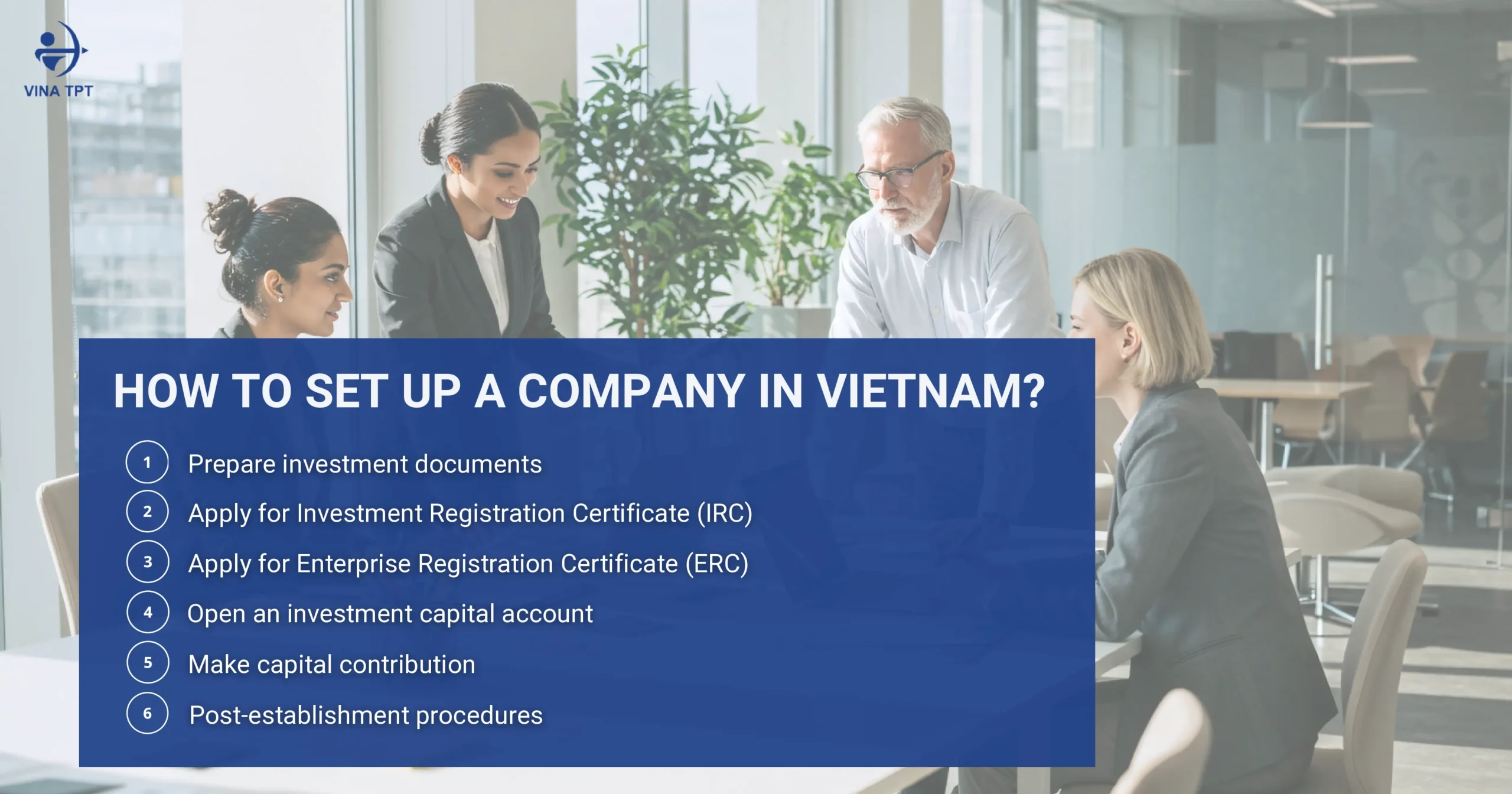
Registering an F&B company in Vietnam requires careful legal preparation. Investors need to complete the investment certificate (IRC) – if there is foreign capital, and enterprise registration certificate (ERC).

The F&B sector in Vietnam belongs to the group of “conditional” industries, which means that after being granted an ERC, businesses cannot operate immediately but need to register additional related industry codes:

  • Code 5610: Restaurant and catering services.
  • Code 5629: Other food and beverage services.
  • Code 4632: Wholesale of food and beverages.
  • Code 4722: Retail sale of food in specialized stores.

Registering the correct industry code helps businesses to conveniently apply for sub-licenses such as Food Safety Certificate, Fire Prevention and Fighting License, Alcohol and Beer Sales License, etc.

To ensure the business establishment process is quick and in compliance with regulations, international F&B brands should cooperate with a professional company registration service provider. This solution helps shorten the multi-step legal process, ensures accurate records and completes procedures on time. 

Vina TPT company registration service helps businesses shorten the time, prepare documents according to FDI standards, and ensure compliance with all licensing regulations in Vietnam.

Company-formation

4. Licensing and Compliance: What F&B Investors Often Miss

Many international F&B brands fail in Vietnam not because of poor products, but because they do not understand the Vietnam F&B market licensing requirements. To operate legally, businesses need:

  • Food Safety License for processing or serving locations.
  • Fire prevention and fighting license for each facility, issued after completing technical acceptance.
  • License to sell wine, beer or alcoholic beverages if they are on the list of conditional businesses.
  • Environmental and labor hygiene license, especially for large-scale processing facilities.

Missing one of these licenses can result in a business being suspended or being fined. Preparing all documents and complying from the beginning helps the inspection, acceptance and licensing process go smoothly, while also building a professional brand image in the eyes of Vietnamese management agencies.

5. Building a Scalable System: HR, Tax & Operations

As the F&B chain expands, the management problem becomes more complicated. Investors need to have a tightly operating human resource (HR), tax and accounting management system. Vietnam requires businesses to declare taxes monthly, finalize taxes annually and comply with regulations on accounting for FDI enterprises.

Setting up an internal ERP system and cooperating with a local consulting unit helps businesses minimize fixed costs, while controlling financial activities, profits, and tax obligations. In addition, good compliance with business license tax and regulations on electronic invoices helps businesses avoid the risk of being subject to surprise inspections.

6. Partnering with Experts Like Vina TPT to Go Further

Instead of handling dozens of administrative procedures and legal regulations themselves, many international F&B brands choose Vina TPT company registration service as their strategic partner in Vietnam.

With a team of experts with numerous experience in the field of business registration, investment consulting and F&B licensing, Vina TPT provides full support from company formation, FDI dossier preparation, operating license to accounting and tax after establishment.

Vina TPT experts not only understand Vietnamese regulations, but also have experience supporting many American and Japanese brands to successfully deploy premium dining models. This helps investors focus on the core, customer experience and brand development, instead of wasting time on administrative procedures.

Start successfully in the Vietnamese market today by contacting Vina TPT now!

BOOK A FREE CONSULTATION

Company-formation

Company registration service for Japanese mechanical manufacturing

Company-registration-service-for-Japanese-mechanical-manufacturing

register-a-company-service-for-japanese

1. Vietnam – A Strategic Base for Japanese Mechanical Manufacturers

Register a company in Vietnam has become increasingly appealing, as the country has emerged over the past decade as a new manufacturing hub in Asia, particularly attractive to Japanese mechanical engineering companies. The reasons come from reasonable operating costs, highly skilled technical human resources and a favorable geographical location for connecting the regional supply chain. In addition, the Vietnamese government has also implemented many tax incentives and infrastructure support policies to attract FDI, especially in the field of mechanical engineering and supporting industries.

For Japanese enterprises, setting up a business in Vietnam not only helps reduce costs but also expands access to the ASEAN market, while maintaining production quality according to Japanese standards. This is the reason why more and more mechanical corporations choose Vietnam as a strategic production base in Southeast Asia.

2. Legal Requirements to Register a Mechanical Manufacturing Company

To register a mechanical manufacturing company in Vietnam, businesses need to carry out some important legal procedures:

2.1 Investment Registration Certificate (IRC) if there is foreign capital.

IRC is the first license allowing the investor to implement the project in Vietnam.

The required documents usually include:

  • Application for investment project implementation and Project proposal: stating the objectives, scale, location, investment capital, progress.
  • Proof of the investor’s financial capacity: bank statement, credit contract or collateral.
  • Legal documents of the investor:
    • Individual: Notarized passport, consular legalization.
    • Organization: Business registration certificate or equivalent document, consular legalization.
  • Project location: lease contract or land/office use rights certificate.

After the IRC is granted (or for 100% domestic-owned enterprises), the investor applies for an ERC – an official license for the enterprise to operate, and also the tax code of the company.

2.2 Enterprise Registration Certificate (ERC) at the Department of Finance.

The ERC dossier usually includes:

  • Application for enterprise registration.
  • Company Charter: stipulates the organizational structure, powers of members/shareholders, capital ratio and management method.
  • List of members/shareholders and legal representatives: clearly state information, ownership ratio, voting rights.
  • Appointment decision and authorization letter (if any).
  • Capital contribution plan & financial evidence: bank statement or credit contract (especially important for large capital projects).

For the mechanical industry, some activities such as heavy metal processing, precision mechanical equipment manufacturing or industrial machinery assembly may require additional specialized licenses or technical safety certificates.

Using a professional service to register a company helps investors avoid legal errors and ensures that documents are processed in accordance with the regulations of Vietnamese authorities.

REGISTER YOUR COMPANY IN VIETNAM NOW

3. Site Selection and Industrial Licensing for Manufacturing Facilities

Choosing a factory location is one of the most important strategic decisions when Japanese mechanical enterprises register a company in Vietnam. A suitable location not only affects the initial investment cost but also determines production efficiency and future expansion.

In terms of location, northern regions such as Bac Ninh, Hai Phong, Hung Yen have the advantage of being close to seaports, convenient for exporting to Japan and ASEAN. Meanwhile, southern regions such as Binh Duong, Dong Nai, Long An have good industrial infrastructure and support services, suitable for domestic supply chains. In addition to land rental costs, businesses also need to consider the ability to recruit technical workers – industrial parks near training centers in Hanoi or Ho Chi Minh City help reduce personnel costs.

register-a-company-service-for-japanese

Investment incentives are also a factor worth considering: corporate income tax exemption for the first 2-4 years, 50% reduction in the following years, support for infrastructure costs or land rental. Many localities also have their own promotion programs for Japanese investors.

After selecting a location, businesses must complete the factory operation licenses, including:

  • Construction license according to the approved industrial park planning.
  • Environmental impact assessment (EIA) report according to regulations of the Ministry of Natural Resources and Environment.
  • Certificate of safety of machinery and equipment, especially for imported mechanical lines.
  • Fire safety certification, ensuring safety systems and labor standards.

Completing all these procedures helps businesses operate legally, avoid interruptions in the production process and facilitate future expansion or investment incentives.

4. Understanding Vietnam’s Regulatory Standards for Mechanical Production to Register a Company 

For Japanese mechanical enterprises, establishing a factory in Vietnam involves not only investment and location but also compliance with local technical, safety, and quality standards, a key factor to maintain reputation and meet global requirements.

4.1. Technical Standards System

Vietnam applies two main groups of standards:

  • TCVN (Vietnam National Standards): Recommended standards based on ISO and JIS, used to control quality and production processes.
  • QCVN (Technical Regulations): Mandatory standards on safety, emissions, and energy use. Non-compliance can lead to fines or suspension.

For export-oriented firms, applying ISO 9001, ISO 14001, ISO 45001, and JIS standards ensures product quality equivalent to factories in Japan.

4.2. Equipment Inspection and Product Certification

All imported machinery are CNCs, lathes, welding, or lifting equipment, and must pass technical safety inspections before operation. Products supplied to FDI projects or exports require CR/CQ certificates, and some industries also need IATF 16949 certification.

Proactive inspection and certification reduce technical risks and enhance global competitiveness.

4.3. Environmental and Workplace Safety

Mechanical factories must install air, wastewater, and waste treatment systems meeting national standards. Enterprises also need regular safety training, inspection of lifting equipment and electrical systems, and proper protective gear.

Strict compliance not only fulfills legal requirements but reflects the Japanese values of safety, discipline, and quality.

4.4. Advantages of Japanese Enterprises

By maintaining JIS or Kaizen-5S management models, Japanese enterprises can:

  • Transfer technology easily
  • Build trust with authorities and partners
  • Access programs from JETRO, JBIC, and Vietnam-Japan cooperation projects

This foundation supports stable, long-term investment with optimized costs and minimal legal risk.

5. How Vina TPT Company Registration Service Simplifies the Setup Process

In the context of the increasingly complex Vietnamese legal system, register a company for foreign enterprises, especially in the mechanical field, requires in-depth knowledge of investment, accounting, tax and technical standards. Vina TPT company registration service was established with the mission of supporting foreign investors, especially Japanese enterprises, to set up business operations in Vietnam quickly, legally and effectively.

Vina TPT provides comprehensive solutions for the process of setting up a business in Vietnam, including:

  • Consulting on investment strategies and choosing a business model suitable for the scale of mechanical production.
  • Preparing documents and applying for an Investment Registration Certificate (IRC) and Enterprise Registration Certificate (ERC) according to the provisions of the Investment Law and the Enterprise Law.
  • Consulting on construction permits, environmental permits, equipment safety certificates and mechanical factory operation procedures.

register-a-company-service-for-japanese

Thanks to a closed service system, Vina TPT helps Japanese enterprises save maximum time, reduce legal risks and ensure the factory launch progress on schedule.

The biggest difference of Vina TPT company registration lies in the team of experts with over 20 years of practical experience in the field of corporate law, accounting, tax in Vietnam.

How Vina TPT Supports Japanese Manufacturing Enterprises: 

  • .Proven FDI Experience: Advised many Japanese projects in mechanics, electronics, and supporting industries, fully understanding local licensing and compliance.
  • Cultural Alignment: Operates with Japanese-style precision, transparency, and discipline in all documentation and processes.
  • End-to-End Support: A strategic partner from setup to operation and expansion.
  • Bilingual Team: Fluent Japanese communication ensures smooth coordination and minimized barriers.
  • Focused on Results: Ensures legal compliance, cost efficiency, and sustainable growth for every project.

Contact Vina TPT today for free consultation on the process register a company and setting up a mechanical factory in Vietnam.

CONTACT US NOW

register-a-company-service-for-japanese

Starting a Korean BBQ or Café in Vietnam? Here’s a 4-Step Registration Guide

 business-license-in-vietnam

1. Why Korean F&B Brands Are Thriving in Vietnam

Business license in Vietnam is a crucial step for any foreign F&B brand looking to enter the market. In recent years, Vietnam has become one of the fastest growing F&B markets in Southeast Asia, with spending on food and entertainment accounting for more than 35% of young consumers’ total disposable income. The booming middle class, the growing popularity of “eating out”, and the strong influence of Hallyu (Korean Wave) culture have created ideal conditions for Korean food brands to expand their business.

From Korean BBQ chains, Seoul-style cafes, to dessert shops, Vietnamese consumers especially Gen Z and Millennials see enjoying Korean food as a cultural experience rather than just eating. This explains why many Korean brands, from traditional restaurants to franchised coffee chains, are choosing Vietnam as their second strategic move after Korea.

However, behind that attractive potential are a series of legal challenges that foreign investors need to understand. Many Korean brands encounter difficulties when setting up a business in Vietnam (enterprise registration), applying for an F&B business license, or completing food safety and hygiene certifications. Therefore, understanding the correct legal establishment process is the first factor that determines success when establishing a business in Vietnam.

Before going into the licensing process, you can consider a few concepts that are very popular in Vietnam: Korean tabletop BBQ, K-café & dessert, fast-casual K-food (fried chicken, mixed rice), and fusion/comfort food concepts. Each concept will affect the scale, location, and type of license required, so you should determine the concept before starting

 business-license-in-vietnam


2. Step 1 – Understanding Vietnam’s F&B Business License Requirements

To open a restaurant or cafe in Vietnam, Korean investors need the following types of business licenses in Vietnam:

  • Investment Registration Certificate (IRC): certifying that the company legally authorizes an investment project and records its key details
  • Enterprise Registration Certificate (ERC): certifying that the company is legal and allowed to operate in Vietnam.
  • Food Safety and Hygiene Certificate: required for food processing or serving establishments.
  • Fire Safety Certificate: ensures that the location meets fire prevention and fighting standards.
  • Other local permits: such as sign registration, environmental license (if there is a food production scale).

Full preparation of these business license in Vietnam helps companies operate legally, avoiding the risk of being fined or having their business suspended. 

3. Step 2 – Choosing the Right Legal Structure for Korean Investors

When setting up a business in Vietnam, Korean investors can choose one of three popular legal forms:

  • 100% foreign-owned company: Full management, suitable for brands with experience and large capital.
  • Joint Venture: Cooperate with Vietnamese partners, helping to understand the market and process licenses faster.
  • Franchise model: Flexible solution for BBQ or cafe chains that want to expand their brand without directly managing operations.

Each model has its own advantages and disadvantages, depending on the scale, capital, and long-term development strategy of the Korean brand in Vietnam. In addition, at this stage, the most important thing is to determine whether to apply for an Investment Registration Certificate (IRC) or not, as this procedure will affect the entire time and plan of operation later.

According to the Vietnam Investment Law, an IRC is a mandatory license if Korean investors want to:

  • Establish a 100% Korean-owned company in Vietnam (e.g., a company managing a BBQ chain, cafe, bakery, etc.);
  • Contribute more than 51% of capital to a Vietnamese company operating in the F&B sector;
  • Open a branch or restaurant under a Korean parent company.

In this case, the process will include two stages:

  • Apply for IRC: Investment Registration Certificate, issued by the Department of Planning and Investment (DPI).
  • Apply for ERC: Enterprise Registration Certificate (similar to a company establishment license).

The estimated time for completion is:

Document preparation: 1-2 weeks, depending on the volume of documents and the level of complexity.

  • IRC appraisal: 20-45 working days.
  • ERC issuance: 10-20 working days after IRC (or similar if the enterprise is a domestic enterprise).

4. Step 3 – The Registration & Licensing Process Explained

 business-license-in-vietnam

The process of setting up a business license in Vietnam includes the following basic steps:

  1. Preparing legal documents (investor passport, company charter, legal head office address).
  2. Complete the application and apply for IRC, ERC.

If the project has FDI capital, IRC is the first license allowing the investor to implement the project in Vietnam.

The required documents usually include:

  • Application for investment project implementation and Project proposal: stating the objectives, scale, location, investment capital, progress.
  • Proof of the investor’s financial capacity: bank statement, credit contract or collateral.
  • Legal documents of the investor:
    • Individual: Notarized passport, consular legalization.
    • Organization: Business registration certificate or equivalent document, consular legalization.
  • Project location: lease contract or land/office use rights certificate.

After the IRC is granted (or for 100% domestic-owned enterprises), the investor applies for an ERC – an official license for the enterprise to operate, and also the tax code of the company.

The ERC dossier usually includes:

  • Application for enterprise registration.
  • Company Charter: stipulates the organizational structure, powers of members/shareholders, capital ratio and management method.
  • List of members/shareholders and legal representatives: clearly state information, ownership ratio, voting rights.
  • Appointment decision and authorization letter (if any).
  • Capital contribution plan & financial evidence: bank statement or credit contract (especially important for large capital projects).

      3.Register for tax code and electronic invoice.

      4.Open a company bank account and pay charter capital.

      5.Carve the company seal and register the sample seal with the authorities. 

GET EXPERT BUSINESS REGISTRATION SUPPORT

5. Step 4 – Post-License Requirements for F&B Businesses

After obtaining the operating license, the enterprise needs to complete the following post-registration procedures:

  • Renting a business premises in accordance with local planning
  • Signing a labor contract and registering personnel with the labor management agency
  • Registering taxes and social insurance for employees
  • Signing contracts with suppliers of raw materials and operating services
  • Checking and certifying food safety before opening
  • Registering for trademark protection to protect intellectual property rights in Vietnam

These steps help enterprises ensure comprehensive compliance and be ready to operate stably.

6. Simplify Your Market Entry with Vina TPT Company Registration Service

With many years of experience supporting Korean F&B brands in Vietnam, Vina TPT Company Registration Service provides a complete solution including:

  • Consulting on choosing the right type of business
  • Drafting and submitting registration documents to the Department of Planning and Investment
  • Applying for hygiene, fire prevention and trademark licenses
  • Setting up accounting, tax and labor systems according to Vietnamese regulations

Vina TPT acts as a “one-stop service” to help Korean investors shorten time, reduce legal risks and focus on brand development.

7. From Startup to Success: Launching Your Korean BBQ or Café Smoothly

Opening a Korean restaurant or cafe in Vietnam is not only an attractive business opportunity, but also a journey to bring Korean culinary culture closer to Vietnamese customers. With clear instructions and a reliable legal partner like Vina TPT, the business registration process will become simpler, more legal and sustainable than ever.

Contact Vina TPT today for detailed advice on the F&B business license in Vietnam – fast, transparent and legal.

BOOK A FREE CONSULTATION

Entering Vietnam’s Clothing Market: A Practical Guide for Chinese Manufacturers

Vina TPT company registration service supporting Chinese clothing investors in Vietnam

business-license-in-vietnam-for-chinese-manufacturer

1. Why Vietnam Is the Next Stop for China’s Clothing Giants

Vietnam is emerging as one of the most dynamic consumer markets in Southeast Asia, especially in the fashion and retail sectors. The middle class is growing rapidly, average incomes are rising, and young people’s shopping trends are gradually shifting towards brands with unique styles and reasonable prices.

For foreign investors and Chinese fashion brands, obtaining a business license in Vietnam is the first important step to legally enter this fast-growing market. With proper licensing and strategic market entry, businesses can take full advantage of Vietnam’s expanding retail opportunities and rising consumer demand.

Vietnamese consumers, especially Gen Z and Millennials, prefer modern fashion that quickly updates global trends while maintaining high practicality. This creates a great advantage for Chinese businesses, which have the ability to produce quickly, flexibly, and at competitive costs.

Not only does Vietnam have great purchasing power, it is also a politically stable market, transparent in investment, and benefits from many free trade agreements (CPTPP, RCEP, EVFTA). In addition, obtaining a business license in Vietnam for fashion or retail activities has become increasingly streamlined, making importing, distributing, or opening Chinese fashion brands in Vietnam easier and more compliant than ever. business license in vietnam

2. Choosing the Right Market Entry Strategy

Chinese businesses can choose one of three popular models when expanding into the Vietnamese market:

  • Establishing a 100% foreign-owned company (WFOE): Suitable for brands that want to control the entire import-distribution-retail process. This model allows for opening physical stores or doing business online after obtaining the required business license in Vietnam.
  • Cooperating with local distributors: helps save costs, quickly access the market, and take advantage of the existing retail network.
  • Joint Venture: Cooperating with Vietnamese businesses to combine local knowledge with goods sources and management capacity from China.

Each form has its own advantages in terms of control level, cost and risk, so it is necessary to consult carefully before choosing.

3. Beyond Paperwork: Setting the Foundation for Operations

To open a business in Vietnam, businesses need to carry out some important legal procedures to have business license in Vietnam:

Investment Registration Certificate (IRC) if there is foreign capital. IRC is the first license allowing the investor to implement the project in Vietnam.

The required documents usually include:

  • Application for investment project implementation and Project proposal: stating the objectives, scale, location, investment capital, progress.
  • Proof of the investor’s financial capacity: bank statement, credit contract or collateral.
  • Legal documents of the investor:
    • Individual: Notarized passport, consular legalization.
    • Organization: Business registration certificate or equivalent document, consular legalization.
  • Project location: lease contract or land/office use rights certificate.

After the IRC is granted (or for 100% domestic-owned enterprises), the investor applies for an ERC – an official license for the enterprise to operate, and also the tax code of the company.

Enterprise Registration Certificate (ERC) at the Department of Planning & Investment. The ERC dossier usually includes:

  • Application for enterprise registration.
  • Company Charter: stipulates the organizational structure, powers of members/shareholders, capital ratio and management method.
  • List of members/shareholders and legal representatives: clearly state information, ownership ratio, voting rights.
  • Appointment decision and authorization letter (if any).
  • Capital contribution plan & financial evidence: bank statement or credit contract (especially important for large capital projects).

Register appropriate business lines, for example:

  • Wholesale and retail of garments and fashion accessories.
  • Import and export of fashion goods.
  • E-commerce business (if selling online).

The good news is that the fashion trade and distribution industry does not require any special sub-licenses, so the establishment procedure is quite simple and the processing time is fast.

After obtaining the business license in Vietnam, the business needs to register a tax code, open a bank account, issue electronic invoices and declare taxes periodically to operate legally.

CONSULT ON BUSINESS LICENSE IN VIETNAM

4. Workforce and Culture Integration

The Vietnamese market is diverse and can be divided into 3 key areas:

  • Ho Chi Minh City: a vibrant commercial center, suitable for young, dynamic fashion.
  • Hanoi: a traditional market, favoring brands with reliability and elegant designs.
  • Da Nang, Can Tho: emerging markets, low cost, easy to test retail models.

In addition to choosing a strategic business location, businesses need to:

  • Cooperate with logistics units to optimize shipping costs from China to Vietnam.
  • Build a localized marketing strategy, combining platforms such as TikTok, Shopee, Lazada and Facebook, which currently account for the majority of online fashion sales channels in Vietnam.
  • Understand Vietnamese fashion tastes: prioritize light, airy, easy-to-match and highly applicable products.

5. Local Compliance and Ethical Manufacturing

When operating in Vietnam, recruiting and managing local human resources is an important factor.

Chinese enterprises need to clearly understand the regulations on labor contracts, social insurance, and personal income tax (PIT) to avoid violations.

In addition, cultural differences should also be noted:

  • Vietnamese people value respect, gentleness, and collaboration in the working environment.
  • A team of dedicated employees, paid on time and transparently will help operations run smoothly, especially in the retail and customer care sectors.

Many foreign enterprises choose to outsource payroll and HR services to ensure compliance, optimize costs, and reduce administrative risks. In addition, working with a professional consulting partner also helps businesses handle legal procedures such as applying for a business license in Vietnam, registering employees, and setting up a compliant payroll system, ensuring smooth and lawful operations from the start.

6. How Vina TPT Helps You Scale Smoothly

Vina TPT Company Registration is a consulting and implementation unit for comprehensive services for foreign investors in Vietnam, especially Chinese enterprises in the fields of fashion, trade and light manufacturing.

We provide:

  • Investment consulting & legal structure according to the desired business model.
  • Business registration services (ERC, IRC), opening bank accounts, tax codes and electronic invoices.
  • Accounting, tax, payroll, periodic compliance management, ensuring transparent and legal operations.
  • Bilingual support in English – Vietnamese, helping businesses easily exchange and process documents.

With a team of experts with more than 2015 years of experience in the fields of foreign investment, finance and law, Vina TPT has accompanied hundreds of Chinese FDI companies to successfully expand in Vietnam – from establishment to stable operation.

7. From Setup to Growth: Building a Sustainable Clothing Brand in Vietnam

Vietnam is not only a “production hub” but also a booming consumer market with long-term potential.

Chinese businesses can take advantage of this market to build their brands, develop distribution channels, and expand into Southeast Asia.

With a deep understanding of Vietnam’s legal framework, tax regulations, and consumer market, Vina TPT helps you take every step with confidence – from setting up a legal entity and applying for business licenses in Vietnam, to managing finances and ensuring smooth operations.

Want to bring a Chinese fashion brand to Vietnam quickly and legally? 

Let Vina TPT accompany you through the entire process of company registration, compliance and tax accounting, helping you focus on developing your brand.

BOOK A FREE CONSULTATION

business-license-in-vietnam-for-chinese-manufacturer

Bridging VAS and J-GAAP: Accounting Outsourcing Solutions for Japanese Companies in Vietnam

Accounting and financial reporting for Japanese companies in Vietnam under VAS and J-GAAP standards

accounting-outsourcing-services-for-japanese

1. Japanese Firms Face Complex Financial Localization in Vietnam

Japanese corporations are known for their strict financial and accounting processes and high standards of transparency. However, when expanding operations to Vietnam, they face significant differences between Vietnamese accounting standards (VAS) and Japanese accounting standards (J-GAAP). This difference lies not only in the way revenue and expenses are recorded, but also affects the way financial statements are presented and reconciled between the parent company in Japan and its branch in Vietnam.

Many Japanese enterprises share that ensuring compliance with VAS as required by Vietnamese tax authorities while maintaining the internal reporting format according to J-GAAP is a complex problem. To handle these challenges efficiently, many turn to accounting outsourcing services provided by a professional accounting services company in Vietnam. These services not only ensure accurate reconciliation between the two systems but also support the preparation of bilingual reports and bank statements in Japanese, helping Japanese corporations maintain compliance, transparency, and efficiency across borders.

2. Challenges in Reconciling VAS and Japanese GAAP

What makes Japanese companies difficult is not only the difference in accounting regulations, but also in the actual operation process. The way revenue is recognized between the two systems can be different: VAS is based on the time of completion of the delivery obligation, while J-GAAP can record according to the contract conditions.

Another problem is the difference in exchange rates: VAS uses actual or average exchange rates, while J-GAAP may require re-recording at the end-of-period exchange rate, leading to discrepancies in consolidated reports. In addition, preparing bank statements in Japanese or bilingual financial statements to send to the parent company is also a significant challenge, requiring accounting personnel who are both knowledgeable in the field and fluent in the language.

In many cases, Japanese companies have to maintain two separate sets of accounting systems or spend a lot of time adjusting data. This not only increases operating costs but also prolongs the auditing process, reducing the effectiveness of internal financial management.

GET JAPAN-VIETNAM ACCOUNTING SUPPORT

3. Why Accounting Outsourcing Services Is the Optimal Solution

Accounting outsourcing services is becoming an inevitable trend in the Japanese business community in Vietnam. Instead of building a large internal team, businesses can cooperate with a professional unit – both understanding Vietnamese tax regulations and the J-GAAP system.

This solution helps businesses significantly save on personnel costs, minimize the risk of errors in declarations, and maintain standard bilingual financial reports (English – Japanese – Vietnamese), meeting the requirements of both tax authorities and parent companies. In particular, professional accounting service companies can build a data standardization process, ensuring that reports can be directly integrated into the group’s management system in Japan.

Accounting outsourcing services also helps businesses be more flexible – easily expanding or reducing the scale of accounting when there are changes in the project, without affecting the continuity of financial operations.

4. How Vina TPT Simplifies Accounting for Japanese Companies

Vina TPT Accounting Service is the leading accounting services company providing accounting and financial solutions for Japanese enterprises in Vietnam. We deeply understand the differences between VAS and J-GAAP and have built a specialized process to help Japanese clients localize their financial systems while maintaining the transparency standards of the parent corporation.

Vina TPT’s team of experts includes Japanese – English bilingual accountants and tax consultants, who are intensively trained in Japanese accounting standards, Vietnamese taxes, and specialized communication skills in Japanese. 

In particular, Mr. Le Quoc Duy, the chief expert in charge of Japanese customers, has more than 2015 years of experience working with large corporations in the fields of manufacturing, finance, and logistics of Japan in Vietnam.

accounting-outsourcing-services-for-japanese

We support businesses in the entire process:

  • Standardizing data and preparing bank statements in Japanese
  • Reconciling and converting reports from VAS to J-GAAP
  • Review documents before sending to HQ
  • And provide regular advice to ensure accuracy and compliance in the long term.

5. Build Transparent, Compliant and Cross-Cultural Financial Systems

With specialized accounting outsourcing services, Japanese enterprises in Vietnam not only solve compliance issues, but also create a transparent, reliable and cross-culturally compatible financial system. Standardized and bilingual financial data helps strengthen trust between the Vietnamese branch and the Japanese parent company, and facilitates smoother group audits.

In the long term, maintaining a transparent accounting and financial system not only helps companies control costs and optimize profits, but also demonstrates a standard operating philosophy that is consistent with Japanese business culture: accuracy – discipline – reliability.

Contact Vina TPT Accounting Service today for advice on outsourcing accounting solutions and bilingual financial reporting in accordance with J-GAAP standards. We help Japanese businesses in Vietnam operate more easily – accurately, compliantly and sustainably.

BOOK A FREE CONSULTATION

Accounting-and-financial-reporting-for-Japanese-companies-in-Vietnam

Payroll & workforce management for Chinese electronics companies

Vina TPT Payroll Service consulting outsource payroll for Chinese companies

payroll-workforce-management-for-chinese-electronics-companies

1. Growing Presence of Chinese Electronics Companies in Vietnam

As global supply chains restructure, Vietnam has become a top destination for Chinese electronics manufacturers – offering both large-scale manufacturing capacity and tax advantages and a young workforce. As manufacturing costs in China continue to rise, many Chinese electronics corporations and businesses have chosen Vietnam as their next destination to expand their factories and optimize their supply chains. Vietnam not only has a strategic geographical location, close to China, but also possesses a young workforce, competitive labor costs and many attractive free trade agreements (FTAs). 

However, this rapid expansion also brings with it many challenges in human resource management and payroll processing. Electronic businesses need professional payroll services and workforce management systems to ensure legal compliance, maintain productivity and manage costs effectively. This is what makes the demand for payroll partners in Vietnam increasingly strong in the Chinese business community.

2. Payroll Challenges for Foreign Manufacturing Businesses in Vietnam

Vietnam has a complex legal and labor tax system, especially for foreign enterprises. Requirements for personal income tax (PIT), social insurance (SI), health insurance (HI) declarations and periodic labor reports make payroll management a multi-layered process. Even small errors in tax declarations or insurance payments can lead to administrative violations and audit risks.

In addition to legal factors, the operation of a non-synchronous payroll system between departments or factories makes it difficult for many enterprises to ensure accuracy, transparency and data security. In this context, professional payroll processing services become an inevitable choice that help Chinese enterprises minimize errors, save resources and focus on production goals.

TALK TO A PAYROLL EXPERT IN VIETNAM

3. Why Outsourced Payroll Services is the Smart Move for Chinese Manufacturers

Outsourcing payroll brings clear benefits to Chinese electronics manufacturers in Vietnam. Instead of setting up a complex human resource accounting department, businesses can entrust the entire process of calculating salaries, deducting taxes, and preparing reports to a specialized unit. This not only helps save fixed costs but also eliminates the risk of legal violations when Vietnam’s regulations change frequently.

Moreover, outsourcing payroll services helps businesses be more flexible when expanding production. As the number of employees increases rapidly in each stage, the service provider can adjust the management process accordingly, ensuring accuracy and timeliness. As a result, businesses do not need to invest in additional software infrastructure or internal personnel, while still maintaining consistency in salary and benefits management.

payroll-services-for-Chinese-companies

4. Key Features of Professional Payroll Processing Services in Vietnam

An effective payroll services needs to ensure that the entire process chain is operated accurately and transparently:

  • Collect and process timekeeping data from different departments and shifts.
  • Calculate salaries, allowances and bonuses according to each level, position and performance.
  • Deduct and declare personal income tax (PIT), along with social insurance (SI) according to regulations.
  • Issue payroll and transfer automatically on time, ensuring confidentiality.
  • Prepare periodic human resource and financial reports, serving internal auditing and management.

All these steps are performed on a secure, automated software platform and have the ability to flexibly integrate with the enterprise’s existing human resource management system.

In addition, professional service providers also:

  • Support timely tax declaration and payment, timely update of new regulations from tax authorities.
  • Labor policy and benefits consulting for Vietnamese employees and foreign workers.
  • Help Chinese electronics enterprises reduce administrative burden, while ensuring all human resources activities run smoothly and legally.

Once the payroll process is automated and transparent, the next step is to optimize the entire HR management system to operate more efficiently.

5. Integrating Workforce Management with Payroll Services for Smooth Operations

When a business implements workforce management integrated with payroll services, the entire internal operating system is connected into a seamless chain:  from timekeeping, shift assignment, performance tracking to payroll and HR reporting. Synchronizing data between departments not only helps managers accurately track productivity, turnover rates or HR costs, but also supports the leadership team in making strategic decisions quickly and based on real data.

In addition, an integrated HR management system also contributes to improving the employee experience. When factors such as salary, bonus, allowances, benefits or insurance are processed transparently, accurately and on time, employees will feel secure, thereby increasing engagement and reducing turnover.

Especially for large-scale Chinese electronics factories with many rotating shifts, applying payroll solutions combined with modern human resource management technology helps standardize operating processes, limit manual errors and ensure strict compliance with labor regulations in Vietnam. This is the foundation for businesses to operate stably, optimize costs and build a sustainable workforce in the long term.

6. Partnering with Vina TPT Payroll Service for Chinese Companies in Vietnam

Vina TPT Payroll Service is a leading partner in the field of payroll services and workforce management for foreign enterprises in Vietnam, especially Chinese electronics companies. With more than 15 years of experience working with large-scale manufacturing corporations, Vina TPT has built a team of experts including human resources specialists, tax accountants and corporate lawyers with in-depth expertise and understanding of the Vietnamese legal system.

Vina TPT experts not only support salary calculation, tax and insurance declaration but also advise on human resource management strategies, build a system of salary and welfare policies suitable for Chinese corporate culture. Thanks to the combination of consulting capacity and modern management technology, Vina TPT helps businesses operate effectively, minimize costs and ensure compliance with Vietnamese laws throughout the operation process.

Contact Vina TPT Payroll Service now to get advice on payroll outsourcing solutions in Vietnam that are suitable for your electronics factory model!

BOOK A FREE CONSULTATION

payroll-services-for-Chinese-companies

Business Established in Vietnam for Korean Electronics Manufacturers

Korean investor receiving business license in Vietnam

setting-up-electronics-business-in-Vietnam

1. Vietnam – The Next Hub for Korean Electronics Manufacturers

As Korean companies continue to look for new growth opportunities across Asia, Vietnam has become one of the most attractive destinations for manufacturing expansion. With a favorable investment climate and a streamlined business license in Vietnam process for foreign enterprises, Vietnam offers Korean electronics manufacturers an ideal entry point to establish long-term operations. Supported by government incentives and a robust supply chain ecosystem, the country is quickly evolving into a major production hub in the region.

Major corporations such as Samsung, LG, and Hanwha have established large-scale production complexes in Bac Ninh, Thai Nguyen, and Hai Phong, regions that are rapidly becoming Vietnam’s key electronics hubs, supported by modern logistics networks, seaports, and government investment incentives.

Moreover, Vietnam’s active participation in free trade agreements such as CPTPP and EVFTA has unlocked significant tariff advantages, enhancing its competitiveness in the global supply chain. A young, skilled workforce combined with the nation’s push for digital transformation positions Vietnam as the “new manufacturing base” for the global electronics industry, much like South Korea’s industrial rise in the 1990s.

For Korean investors, establishing a business in Vietnam not only optimizes production costs but also opens access to ASEAN, China, and India markets. By obtaining the appropriate business license in Vietnam and leveraging professional strategic consulting, Korean electronics enterprises can streamline the enterprise registration process and transform Vietnam into a sustainable hub for manufacturing and innovation in the region.

2. Strategic Considerations Before Enterprise Registration in Vietnam

Before starting the registration process, investors need to carefully consider strategic factors.

Location is key: Northern regions such as Bac Ninh, Hai Phong, Thai Nguyen currently have many Korean electronics factories, convenient for connecting and sharing the supply chain.

Legal form also directly affects the right to operate and tax obligations. Enterprises can choose to establish a 100% foreign-owned company, joint venture with a Vietnamese partner or open a representative office.

In addition, the domestic supply chain in Vietnam is expanding rapidly, providing components and logistics services suitable for electronics production. Understanding these factors helps Korean enterprises optimize costs and limit risks when entering new markets.

Book a Free Consultation on Your Business License

3. Understanding Business License in Vietnam and Compliance for Electronics Companies

After being granted the Investment Registration Certificate (IRC) and Enterprise Registration Certificate (ERC), the electronics enterprise needs to apply for a business license appropriate to the field of operation.

The electronics manufacturing industry has its own requirements on environmental safety, technology standards and fire prevention.

The estimated time for completion is:

Document preparation: 1-2 weeks, depending on the volume of documents and the level of complexity.

  • IRC appraisal: 20-45 working days.
  • ERC issuance: 10-20 working days after IRC (or similar if the enterprise is a domestic enterprise).

In fact, if the enterprise cooperates with a reputable company registration service, it will help the enterprise quickly handle the consular legalization, translation and submission of documents, shortening the time and increasing the possibility of being licensed the first time.

setting-up-electronics-business-in-Vietnam

4. How to Establish Business in Vietnam and Maintain Legal Compliance

To successfully establish a business in Vietnam, investors need to take the following important steps:

Step 1: Complete the application and apply for Business License in Vietnam IRC, ERC.

If the project has FDI capital, IRC is the first license allowing the investor to implement the project in Vietnam.

The required documents usually include:

  • Application for investment project implementation and Project proposal: stating the objectives, scale, location, investment capital, progress.
  • Proof of the investor’s financial capacity: bank statement, credit contract or collateral.
  • Legal documents of the investor:
    • Individual: Notarized passport, consular legalization.
    • Organization: Business registration certificate or equivalent document, consular legalization.
  • Project location: lease contract or land/office use rights certificate.

After the IRC is granted (or for 100% domestic-owned enterprises), the investor applies for an ERC – an official license for the enterprise to operate, and also the tax code of the company.

The ERC dossier usually includes:

  • Application for enterprise registration.
  • Company Charter: stipulates the organizational structure, powers of members/shareholders, capital ratio and management method.
  • List of members/shareholders and legal representatives: clearly state information, ownership ratio, voting rights.
  • Appointment decision and authorization letter (if any).
  • Capital contribution plan & financial evidence: bank statement or credit contract (especially important for large capital projects).

Step 2: Open a bank account and contribute charter capital within 90 days from the date of issuance of ERC.

Step 3: Register a tax code and set up an accounting system according to Vietnamese standards.

Step 4: Sign a labor contract, pay social insurance and manage payroll according to regulations.

5. Vina TPT Company Registration – Partnering with Korean Electronics Manufacturers for a Sustainable Setup

With more than a decade of experience in investment consulting and business registration services, Vina TPT has successfully assisted hundreds of FDI enterprises, including a large number of Korean electronics manufacturers in establishing and expanding their operations in Vietnam.

Our comprehensive service scope covers every stage of the process — from investment model consulting and legal documentation, to business license application in Vietnam, business license renewal, and regulatory compliance. This integrated approach ensures a smooth and compliant market entry for Korean investors.

Backed by a team of seasoned professionals with in-depth knowledge of Vietnam’s business, tax, and labor laws, Vina TPT provides end-to-end business license advisory and compliance support, helping investors confidently execute their projects while focusing on production growth and long-term success.

Partnering with Vina TPT Business Advisory and Company Registration means more than saving time and costs. It’s about having a trusted local partner who truly understands how to help Korean investors establish, operate, and sustain successful ventures in Vietnam.

Contact Vina TPT for consultation and support on business registration in Vietnam quickly, legally and at optimal cost.

BOOK A FREE CONSULTATION

setting-up-electronics-business-in-Vietnam

Business advisory for Singaporean investors establishing real estate businesses in Vietnam

alt="Business advisory services for Singaporean investors entering Vietnam’s real estate market"

business-advisory-services

1. Vietnam Real Estate: The Next Strategic Move for Singapore Investors

Over the past decade, Vietnam has become one of the most dynamic real estate markets in Asia, with rapid urbanization, high housing demand and a boom in industrial zones. In particular, Singapore is a leading financial, investment and business advisory center in the region, is considering Vietnam as a new “profit drop point” in its strategy to expand in Southeast Asia.

Singaporean investors see in Vietnam not only high profit potential, but also an opportunity to participate in a market that is changing strongly in terms of infrastructure, urban planning and Foreign Direct Investment attraction policies. Vietnam, with its affordable land prices, youthful workforce, and fast-growing transport infrastructure including airports, seaports, and metro lines, is emerging as a promising mirror of Singapore in its early development phase.

However, to realize the opportunity, investors need to clearly understand Vietnam’s legal framework, licensing process and tax mechanism – factors that can directly impact the profitability and safety of the project.

2. Before you invest: Understanding Vietnam’s Real Estate Landscape

Real estate in Vietnam is divided into many different types, including: industrial park development, housing projects, offices, resorts, trade – services and logistics. However, not all segments are open to foreign investors.

According to current regulations, investors can:

  • Contribute capital or buy shares in Vietnamese enterprises with existing real estate projects.
  • Establish a 100% foreign-owned company to develop projects if granted appropriate investment licenses.
  • Lease or sublease land in industrial parks, export processing zones, high-tech zones.

However, direct ownership of land in Vietnam is not allowed, because land is owned by the entire people and managed by the State. Investors can only use land through leasing or joint ventures with domestic partners.

In addition, the tax and regulatory systems related to real estate (VAT, CIT, transfer tax, land fees) also have significant differences compared to Singapore. Lack of understanding or misapplication of investment structures can lead to legal risks or reduced profit efficiency.

At this stage, partnering with a professional business advisory firm becomes essential. A qualified advisory team can help Singaporean investors navigate Vietnam’s complex real estate regulations, review investment structures, and ensure full compliance with local laws. With expert guidance on legal, financial, and tax aspects, investors can make informed decisions and minimize potential risks from the very beginning. Business Advisory

Business advisory for Singaporean investors establishing real estate businesses in Vietnam

3. From Licensing to Launch: Key Steps in Establishing a Real Estate Business

The process of setting up a real estate business in Vietnam usually includes four main stages, requiring close coordination between investors, lawyers and management agencies:

Stage 1: Investment strategy consulting: Business Advisory

Investors need to clearly define their goals (developing new projects, acquiring, cooperating or operating), assess the legal feasibility of the model and choose a locality with appropriate policies.

Stage 2: Applying for an Investment Registration Certificate (IRC):

This is the first license that allows foreign-invested enterprises to carry out projects in Vietnam.

Documents typically required for IRC application include:

  • Application for investment project implementation & Project proposal: Stating objectives, scope, scale, investment capital, location, and implementation schedule.
  • Proof of investor’s financial capacity: Bank statements, audited financial reports, credit contracts, or collateral documents.
  • Legal documents of the investor:
  • For individuals: Notarized passport, consular legalization.
  • For organizations: Business Registration Certificate or equivalent, consular legalization.
  • Evidence of project location: Office/land lease agreement or land use rights certificate.
  • Power of attorney/authorization letter (if the investor appoints a third party to handle procedures).

Stage 3: Enterprise Establishment (ERC):

After having IRC, investors register to establish an enterprise, determine the type of company (LLC, joint stock or joint venture). Choosing the right model will greatly affect the capital mechanism, voting rights and profit distribution.

Stage 4: Compliance and project implementation:

Enterprises must complete tax, insurance, financial and environmental procedures before officially starting operations. This is also the stage where business advisory services become especially important to ensure that all activities are legal and effective.

All foreign documents must be consular legalized and officially translated into Vietnamese before submission. This step often prolongs the preparation process, so it is recommended that investors cooperate with a reliable company registration service to ensure accuracy and save time.

4. Tax Business Advisory: Maximizing Profitability through Smart Structuring

In real estate investment, tax optimization and smart business structure are decisive factors for net profit. Vietnam applies corporate income tax (CIT) at 20%, but there are tax incentives for investment projects in industrial parks, economic zones or investment-encouraged sectors (logistics, infrastructure, social housing, etc.).

In addition, if investors know how to structure capital flows and divide profits reasonably, they can avoid double taxation between Vietnam and Singapore thanks to the Double Taxation Avoidance Agreement (DTA) signed by the two countries. This is a great advantage, but it can only be maximized when there is a business tax advisory team that understands both tax systems.

Vina TPT experts often advise Singaporean investors about business advisory on multi-level legal entity structure strategies, cash flow allocation and legal profit transfer, to ensure optimal profits while still strictly complying with regulations in Vietnam.

OPTIMIZE YOUR TAX STRUCTURE NOW

5. Common Mistakes Foreign Real Estate Investors Should Avoid

Despite the wide-open opportunities, many foreign investors including large corporations, have encountered trouble when investing in Vietnamese real estate due to common mistakes. Some typical mistakes include:

  • Choosing the wrong investment model (for example, registering a trading company instead of a project development company, leading to restrictions on land use).
  • Not updating legal changes related to land, environment and construction.
  • Delaying in contributing capital as committed, violating the terms of the investment license.
  • Choosing a local partner who lacks capacity or is not transparent, leading to disputes.

An excellent business advisory service will help investors avoid these mistakes right from the start, thanks to legal review, partner assessment and risk control throughout the investment process. 

Business advisory for Singaporean investors establishing real estate businesses in Vietnam

6. Why Partnering with Vina TPT Business Advisory Makes a Difference 

With over 15 years of experience in advising companies, Vina TPT Business Advisory Service’s team of legal, accounting and tax experts has worked with hundreds of international enterprises in the real estate, infrastructure and manufacturing sectors.

We provide end-to-end solutions, from developing investment strategies, applying for IRC/ERC licenses, advising on tax structures, to compliance management and post-investment operational accounting. Vina TPT’s strength lies in combining a deep understanding of Vietnamese law with international operational standards, helping Singaporean investors ensure compliance while optimizing profits.

If you are looking for a business consulting partner with market knowledge and the ability to handle everything from legal to tax, Vina TPT Business Advisory is the reliable bridge between Singapore and Vietnam.

BOOK A FREE CONSULTATION

business-advisory-services

Business Setup Consultant Vietnam: Start Your Small Foreign Business Smoothly

alt="Foreign investors establish business in Vietnam with professional setup consultant support"

alt="Foreign investors establish business in Vietnam with professional setup consultant support"

1. Why Small Foreign Investors Choose to Establish Business in Vietnam

Vietnam is becoming an ideal destination for small investors thanks to its low operating costs, young workforce and large consumer market. Compared to many other countries in the region, establishing a business in Vietnam brings clear advantages in terms of rental costs, labor and customer access. In addition, the Vietnamese Government is increasingly issuing many preferential policies to attract FDI capital, especially in the fields of technology, education, trade services and clean agriculture.

Some small business sectors that are attracting the attention of foreign investors include:

  • International style restaurants and cafes
  • Foreign language and skills training centers
  • Small-scale e-commerce startups
  • Consulting and creative design services
  • Beauty & wellness services
  • Fashion and lifestyle boutiques
  • Cosmetics and personal care retail. These sectors are particularly attractive to investors from Japan, South Korea, the United States, and China, where consumer demand and business expansion opportunities in Vietnam are seen as highly promising.

With strong growth potential, opening a small-scale company is not only suitable for market exploration but also a foundation for future business expansion.

DISCOVER HOW BUSINESS SETUP CONSULTANT VIETNAM CAN HELP YOU 

2. Legal Basics for Small-Scale Foreign Businesses

To establish a business in Vietnam, small investors need to understand the basic legal regulations. The good news is that small-scale projects often require low investment capital and simpler procedures than large enterprises.

Some important legal factors include:

  • Minimum investment capital: depending on the field, many industries do not require high statutory capital, making it easy for investors to start.
  • Registered industries: need to choose industries that are allowed according to Vietnamese law and the WTO.
  • Business license: for conditional fields such as education, logistics services, or restaurants – cafes, businesses need to apply for additional specialized licenses.
  • Business type: the most popular for small investors is a Limited Liability Company (LLC) or Representative Office.

Understanding these conditions will help the business registration process go smoothly and legally from the beginning.

3. Step-by-Step Guide to Setting Up a Small Business

When small foreign investors plan to establish business in Vietnam, understanding the step-by-step process is essential to avoid unnecessary delays and legal risks. Setting up a business may sound complex, but with the right guidance, it can be smooth and straightforward.

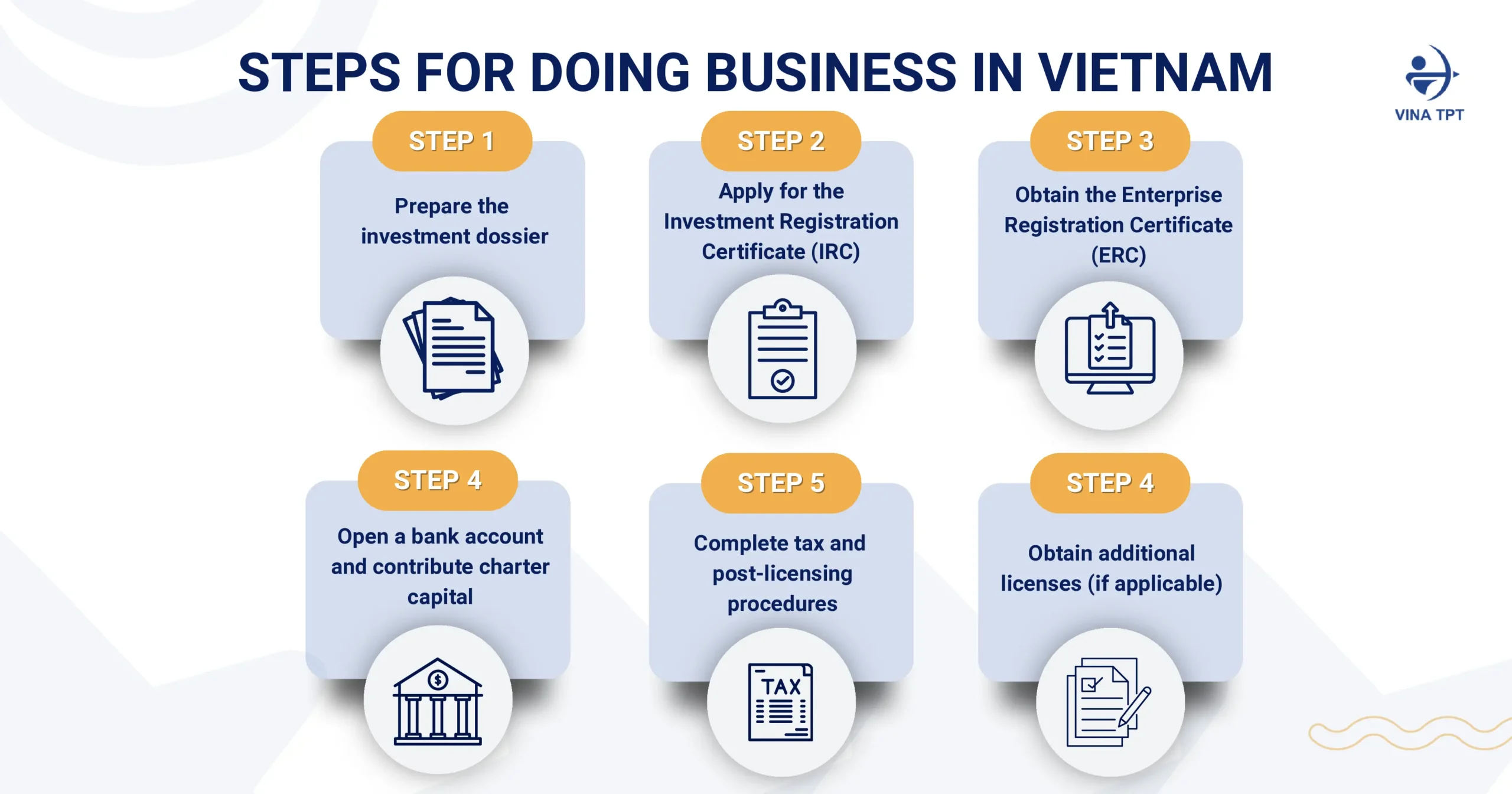
Step 1: Prepare the investment documents – This includes drafting the investment proposal, choosing the right business structure (LLC, joint venture, or representative office), and identifying the scope of activities. Investors need to ensure that their chosen industry is open for foreign participation under Vietnamese law.

Step 2: Apply for the Investment Registration Certificate (IRC) – For most foreign-owned companies, this is the first legal approval. It confirms the investor’s right to operate in Vietnam and outlines essential project details such as charter capital, investment scale, location, and business scope. Without the IRC, foreign investors cannot proceed to the next step of enterprise registration.

Documents typically required for IRC application include:

  • Application for investment project implementation & Project proposal: Stating objectives, scope, scale, investment capital, location, and implementation schedule.
  • Proof of investor’s financial capacity: Bank statements, audited financial reports, credit contracts, or collateral documents.
  • Legal documents of the investor:
  • For individuals: Notarized passport, consular legalization.
  • For organizations: Business Registration Certificate or equivalent, consular legalization.
  • Evidence of project location: Office/land lease agreement or land use rights certificate.
  • Power of attorney/authorization letter (if the investor appoints a third party to handle procedures).

All foreign documents must be consular legalized and officially translated into Vietnamese before submission. This step often prolongs the preparation process, so it is recommended that investors cooperate with a reliable company registration service to ensure accuracy and save time.

Step 3: Obtain the Enterprise Registration Certificate (ERC) – Once the IRC is granted, the next step is to register the business entity officially. This is comparable to a company registration service and provides the legal identity of the enterprise.

Step 4: Open a bank account and contribute charter capital. After receiving the Enterprise Registration Certificate (ERC), investors are required to open a capital account at a licensed commercial bank in Vietnam. This account will be used exclusively for injecting charter capital and handling transactions related to foreign investment.

Capital contribution timeline: The owner/members/shareholders must fully contribute the registered charter capital within 90 days from the issuance date of the ERC. Failure to meet this deadline may result in administrative penalties or forced adjustment of charter capital in the company’s registration.

Contributing capital on time is not only a compliance requirement but also strengthens the company’s credibility when applying for future business licenses, work permits, or expanding operations in Vietnam.

Step 5: Register for tax and post-licensing procedures – This includes obtaining tax codes, registering for VAT, and fulfilling labor and insurance obligations if hiring employees.

Step 6: Apply for additional sector-specific licenses (if required) – For industries such as F&B, education, or e-commerce, further permits may be necessary.

By working with a trusted business setup consultant Vietnam, small investors can streamline the above steps, reduce administrative burdens, and ensure full compliance with local regulations. Firms like Vina TPT company registration provide end-to-end assistance, helping investors save time and resources while minimizing costly mistakes.

I If you want to establish business in Vietnam without unnecessary delays, consider working with a reliable company registration service like Vina TPT. Our business setup consultant Vietnam team is ready to guide you through every step smoothly. With a team of seasoned lawyers and tax experts possessing 10–20 years of experience and having worked with more than 200 FDI enterprises, we are well-equipped to anticipate regulatory hurdles, streamline documentation, and ensure full compliance with local laws.

alt="Foreign investors establish business in Vietnam with professional setup consultant support"

4. Cost-Saving Tips for Small Investors

For small investors establishing a business in Vietnam, saving costs is an important factor in maintaining capital flow for business operations. One of the most effective ways is to choose a business type that is suitable for the scale and development goals, such as a limited liability company instead of a joint stock company. In addition, optimizing charter capital also helps reduce initial financial pressure while still ensuring compliance with legal requirements. Instead of handling all the complicated procedures themselves, investors should use a professional company registration service. This not only helps minimize the risk of errors, but also saves time and costs arising from delayed procedures or having to supplement them many times.

5. Working with a Business Setup Consultant

Working with a business setup consultant Vietnam brings great advantages to foreign investors, especially small businesses that are new to the market. With a deep understanding of the legal system, licensing conditions and administrative procedures, consultants will help the entire procedure take place quickly and legally. Moreover, they also play the role of strategic advisors, providing cost-optimized solutions, choosing feasible business lines and supporting the handling of problems arising during the business operation process. This helps investors not only shorten the time to set up a business but also focus on core business activities from the very first days.

To turn investment plans into reality quickly and economically, many small investors have chosen to accompany Vina TPT with a complete company registration service, ensuring legal and transparent procedures right from the first step.

6. Vina TPT Company Registration Service for Small Investors

With experience supporting hundreds of foreign investors, Vina TPT company registration service offers a complete solution specifically for small businesses.

Vina TPT’s strengths:

  • Advising on costs and reasonable capital structures for small startups.
  • Preparing complete and correct business registration documents.
  • Representing and monitoring the progress with state agencies.
  • Supporting post-registration procedures: seal engraving, account opening, tax declaration.

alt="Foreign investors establish business in Vietnam with professional setup consultant support"

Thanks to professional services and a team of legal experts, Vina TPT helps small investors establish businesses in Vietnam easily, quickly and legally.

Contact Vina TPT now to use the Business setup consultant Vietnam service to start your business journey in Vietnam with optimal costs and transparent procedures.

BOOK A FREE CONSULTATION

Laywer-Establish-business-Vietnam-VinaTPT


Cost Comparison: In-House HR vs Outsourced Payroll for FDI in Vietnam

Vina TPT HR outsourcing Vietnam solution for foreign businesses

hr-outsourcing-vietnam-consultant-service

1. HR Management Challenges for FDI Companies in Vietnam

As FDI companies expand their operations and investments in Vietnam, HR Outsourcing Vietnam becomes an increasingly relevant solution as one of the biggest challenges is hiring employees and building an internal HR department. The labor system in Vietnam has many specific regulations such as social insurance, health insurance, personal income tax law and regulations on labor contracts. For newly established businesses in Vietnam, understanding this entire legal framework often takes a lot of time, resources and is prone to errors. 

In addition, cultural differences and language barriers also create additional pressure when businesses want to recruit the right people, manage benefits and set up Human Resources Management Challenges for FDI Companies in Vietnam

As FDI companies expand their operations and investments in Vietnam, HR Outsourcing Vietnam becomes an increasingly relevant solution as one of the biggest challenges is hiring employees and building an internal Human Resources department. The labor system in Vietnam has many specific regulations such as social insurance, health insurance, personal income tax law and regulations on labor contracts. For newly established businesses in Vietnam, understanding this entire legal framework often takes a lot of time, resources and is prone to errors. 


In addition, cultural differences and language barriers also create additional pressure when businesses want to recruit the right people, manage benefits and set up Hiring Relation systems. This is the reason why more and more FDI companies choose HR & payroll service as a safer, more economical and effective solution than building an in-house HR team from the beginning.

2. Understanding In-House HR Costs

When maintaining an in-house HR department, FDI enterprises must consider many hidden and fixed costs. First is the recruitment cost, including advertising, headhunter fees, interviews, and training. Next is the salary and benefits for the Human Resources team, which are often higher due to the demand for personnel with legal knowledge and bilingual skills. Moreover, for every in-house employee, enterprises must also pay compulsory social insurance, health insurance, and unemployment insurance, which together amount to approximately 20.5% of the employee’s monthly salary.

In addition, enterprises need to invest in HR & payroll software systems, employee records management, timekeeping, and payroll calculation. Operating costs such as office space, equipment, and the management time required from the board of directors also cannot be overlooked. Particularly for businesses in Vietnam during the early stages, this total cost structure can easily exceed the planned budget, creating financial pressure and reducing operational flexibility. 

Therefore, outsourcing or applying HR & payroll service is becoming a more effective alternative, helping FDI enterprises balance finances and focus on business development.

DISCOVER HR OUTSOURCING VIETNAM BENEFITS

3. Breakdown of Outsourced HR & Payroll Service Expenses

When choosing HR & payroll service, businesses only need to pay service fee based on the number of employees, instead of bearing the entire fixed cost of in-house HR. HR outsourcing service usually includes many items: drafting labor contracts, registering for social insurance, managing employee records, processing monthly payroll, declaring and paying personal income tax. Some advanced packages also support legal advice, updating changes in labor laws, and providing periodic human resources reports. Compared to maintaining an entire HR department, outsourcing allows businesses to predict and control costs more clearly. Especially for companies that have just opened a business in Vietnam, Vina TPT Hiring Employees Service brings advantages thanks to its flexible model, all-inclusive services, and transparent costs, ensuring that businesses only pay for what is necessary without incurring unexpected fees.

4. Key Factors Beyond Cost

Although cost is an important factor, when comparing in-house HR and outsourced service, FDI enterprises need to consider more long-term values. One of them is compliance with Vietnamese labor laws, a factor that helps avoid legal risks and protect brand reputation. Next is flexibility, allowing enterprises to easily expand or reduce the size of their staff without having to recruit or fire them complicatedly. In addition, outsourcing also brings operational efficiency, helping the management focus resources on business development strategies in Vietnam instead of handling administrative procedures. 
With HR & payroll service, enterprises have access to experts who understand the market, laws and local HR processes. This is a factor that Vina TPT Hiring Employees Service is providing outstandingly, bringing peace of mind to FDI when managing human resources in Vietnam.

5. Cost-Benefit Analysis: In-House vs Outsourcing

If analyzed as a whole, we can see a clear difference between maintaining an in-house HR department and using HR outsourcing combined with HR & payroll service:

HR in-house:

  • Enterprises have the ability to directly control their human resources and internal processes.
  • However, the costs of recruitment, training, salaries, benefits and maintaining the management system are very high.
  • The risk of errors in compliance with labor laws and tax regulations often occurs, especially for FDI enterprises that have just started doing business in Vietnam.

Outsourced HR & payroll service:

  • Provides a cost-saving solution, easily scalable according to the size of the workforce.
  • Reduces costs by 30–50% compared to maintaining in-house HR while still ensuring transparency and effective management.
  • Minimizes legal and administrative risks, while ensuring compliance with labor and tax regulations in Vietnam.
  • Creating transparent human resource data, supporting businesses in long-term development planning.

Looking at both costs and benefits, outsourcing HR is not only a short-term option but also an optimal strategy for FDI companies that want to develop sustainably in Vietnam.

6. Vina TPT Hiring Employees Service Advantage

Vina TPT Hiring Employees Service is specially designed for FDI enterprises that want to build and operate their business in Vietnam effectively. With a team of experts knowledgeable in labor, insurance and tax laws, Vina TPT provides a complete HR & payroll service solution including: recruitment, contract drafting, salary and bonus management, social insurance, and personal income tax declaration. The big difference of Vina TPT is the ability to advise on human resource strategies in parallel with legal compliance, ensuring that businesses both save costs and operate transparently. Instead of spending months building in-house HR, businesses can quickly deploy an optimal HR system in just a few days. This is the advantage that helps FDI companies confidently expand their scale, flexibly manage human resources and develop sustainably in the Vietnamese market.
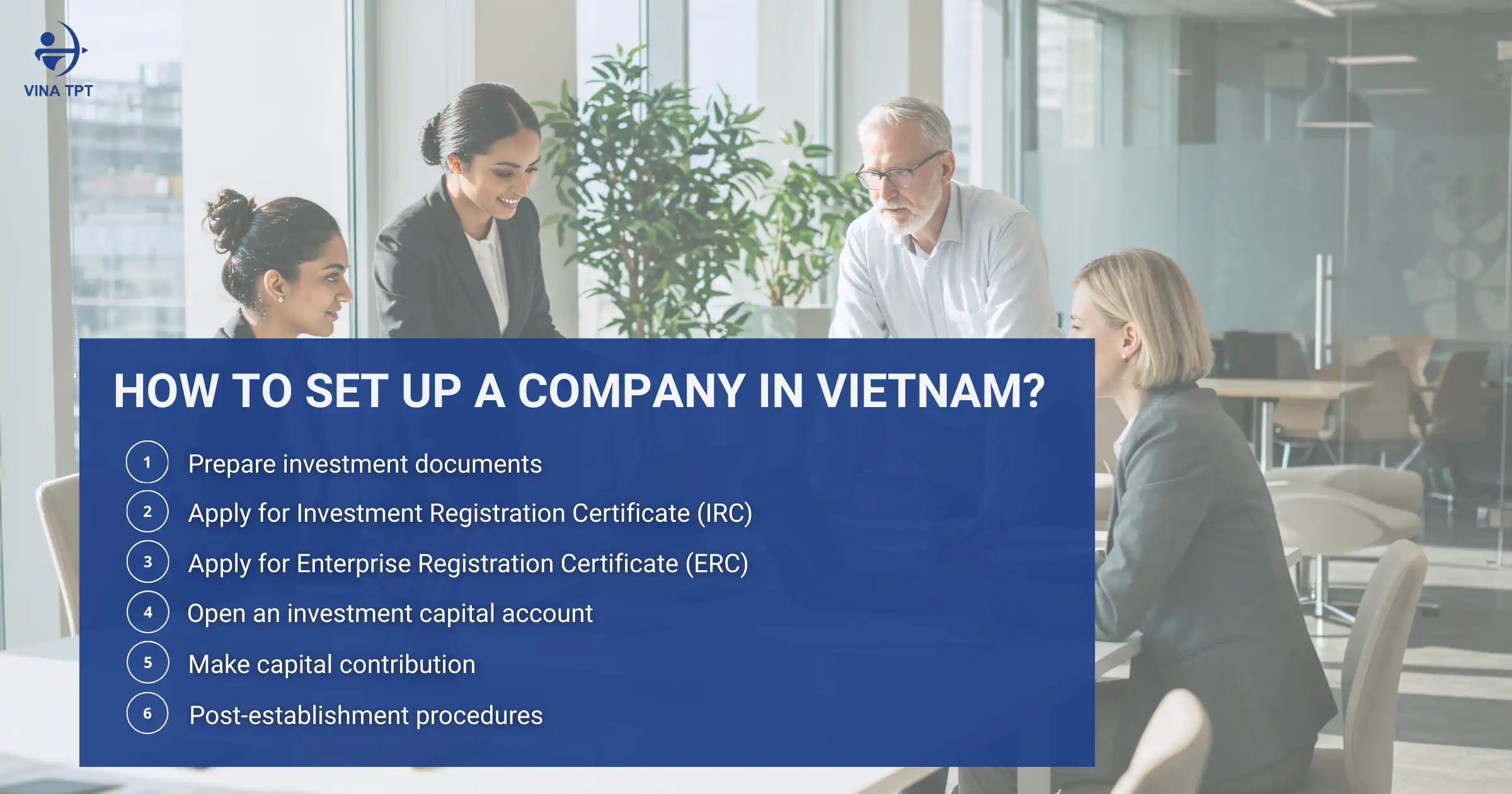
Vina TPT’s HR & payroll service helps businesses save costs, reduce risks and focus on business development in Vietnam. Contact now!

BOOK A FREE CONSULTATION

Payroll-HR-Manager-Vietnam-VinaTPT