Setting Up a Representative Office in Vietnam: Step-by-Step Guide for Foreigners 2026

As Vietnam continues to attract foreign direct investment (FDI) with robust economic growth in 2025-2026, many international businesses choose to establish a Representative Office (RO) as their initial market entry strategy. An RO allows foreign companies to build a legal presence, conduct market research, and liaise with local partners without engaging in direct profit-generating activities.

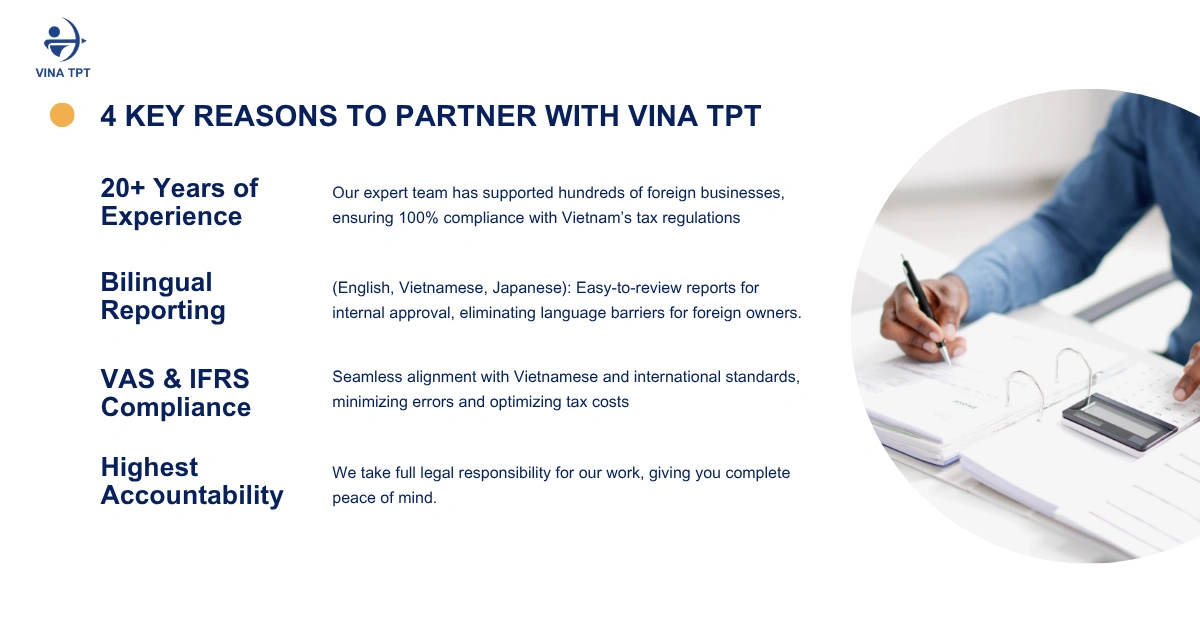
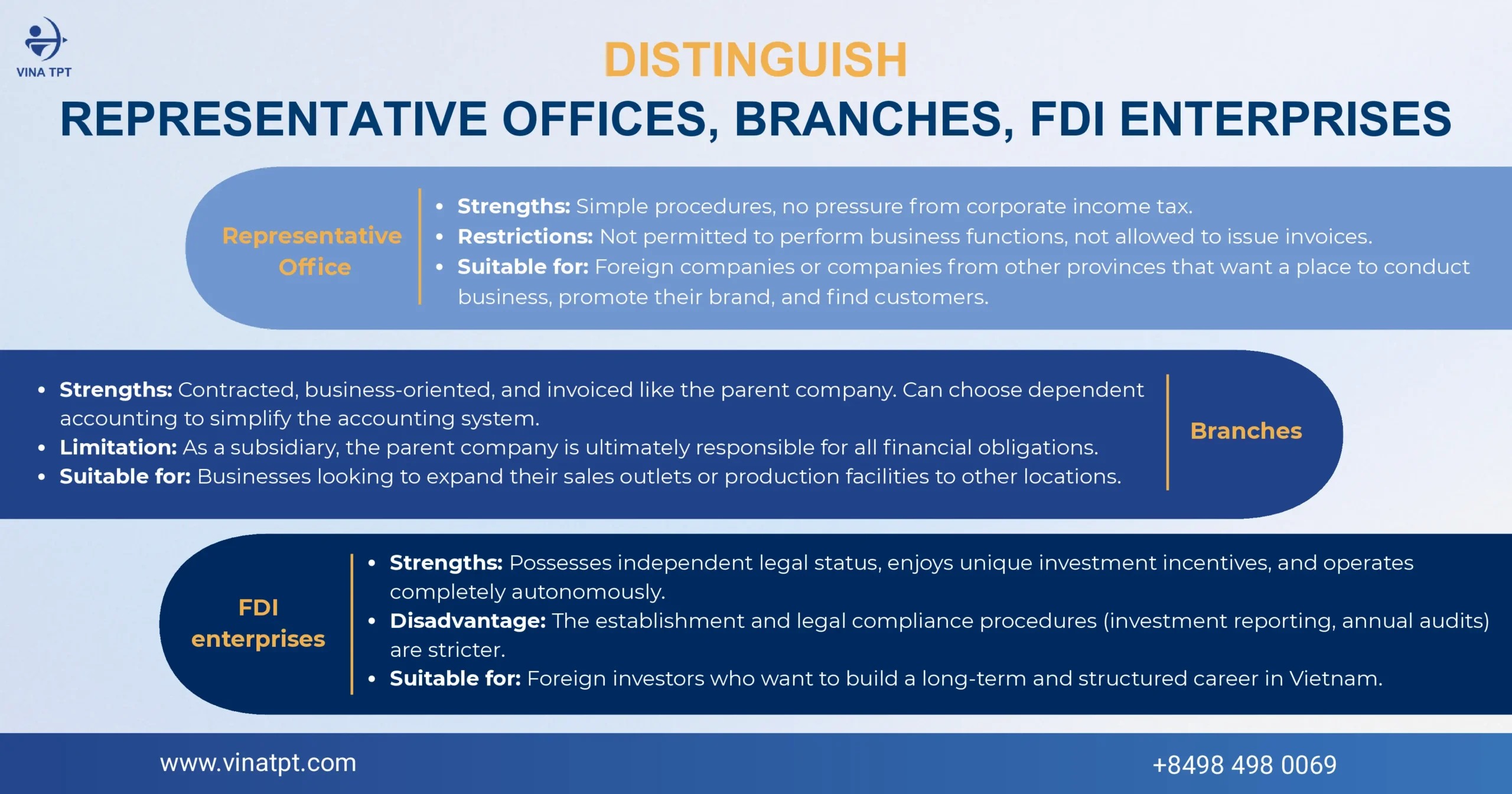
With over 20 years of experience supporting more than 200 foreign clients, Vina TPT specializes in guiding investors through this process efficiently and compliantly. This ultimate guide provides a step-by-step overview for setting up a representative office in Vietnam in 2025, based on the latest regulations under Commercial Law 2005 and Decree 07/2016/ND-CP (with minor procedural updates).

1. What is a Representative Office in Vietnam?

A representative office is a dependent unit of an enterprise that is established in a different province or country for the purpose of supporting the operations of its parent company. ts main activities typically include:

  • Promoting and marketing products or services
  • Collecting and analyzing market information
  • Identifying customer demands and industry trends
  • Providing customer consultation and support
  • Developing and maintaining relationships with partners
  • Assisting with administrative and procedural matters

Key limitations: Representative Offices cannot generate revenue, issue invoices, or conduct direct trading. If your goal involves commercial operations, consider a full foreign-invested enterprise instead.

Representative Office

Foreign-Invested Company

Legal Status Dependent unit; extension of the parent company Independent legal entity; registered in Vietnam.
Business Activities Non-profit; no direct revenue-generating activities. Full operations; allowed to trade, manufacture, and earn profits.
Primary Purpose Market research, brand promotion, and liaison activities. Executing full business operations and commercial contracts.
Suitability Ideal for testing the market and building local relationships. Best for long-term investment and generating local revenue.


2. Eligibility Requirements for Foreign Companies

To qualify for an RO in Vietnam:

  • The parent company must operate legally in its home country for at least 1 year.
  • Business activities must align with Vietnam’s WTO commitments.
  • No minimum capital is required, making it a low-risk option for SMEs and startups.

3. Setting Up a Representative Office: Step-by-Step Process

The process typically takes 4 – 6 weeks months in 2026, handled by the Department of Industry and Trade (DOIT).

Step 1: Prepare Documents

In order to facilitate a seamless and efficient licensing process for a Vietnam-based representative office, foreign entities should assemble the following essential documentation:

  • Application form for RO establishment
  • Parent company’s Business Registration Certificate (legalized)
  • Audited financial statements (latest year)
  • Appointment letter for Chief Representative
  • Lease agreement for office premises (physical address required)
  • Passport/ID of Chief Representative

Note: All foreign documents need consular legalization and Vietnamese translation.

Step 2: Submit Application

After finalizing the necessary paperwork, the investor submits it to the Business Registration Office under the Department of Planning and Investment where the representative office will be located.

Under normal circumstances, the licensing authority will review and issue a result within a timeframe of 10 to 15 business days.

Step 3: Obtain RO License

Upon the successful evaluation of the application, the competent authority will formally issue the Representative Office Establishment License.

To ensure full regulatory compliance, the entity must immediately proceed with post-licensing compliance tasks, such as: 

  • Engrave seal and register specimen
  • Open bank account (for expenses only)
  • Registering for tax if any expenses are incurred
  • Apply for work permits/TRC for foreign staff (if needed)

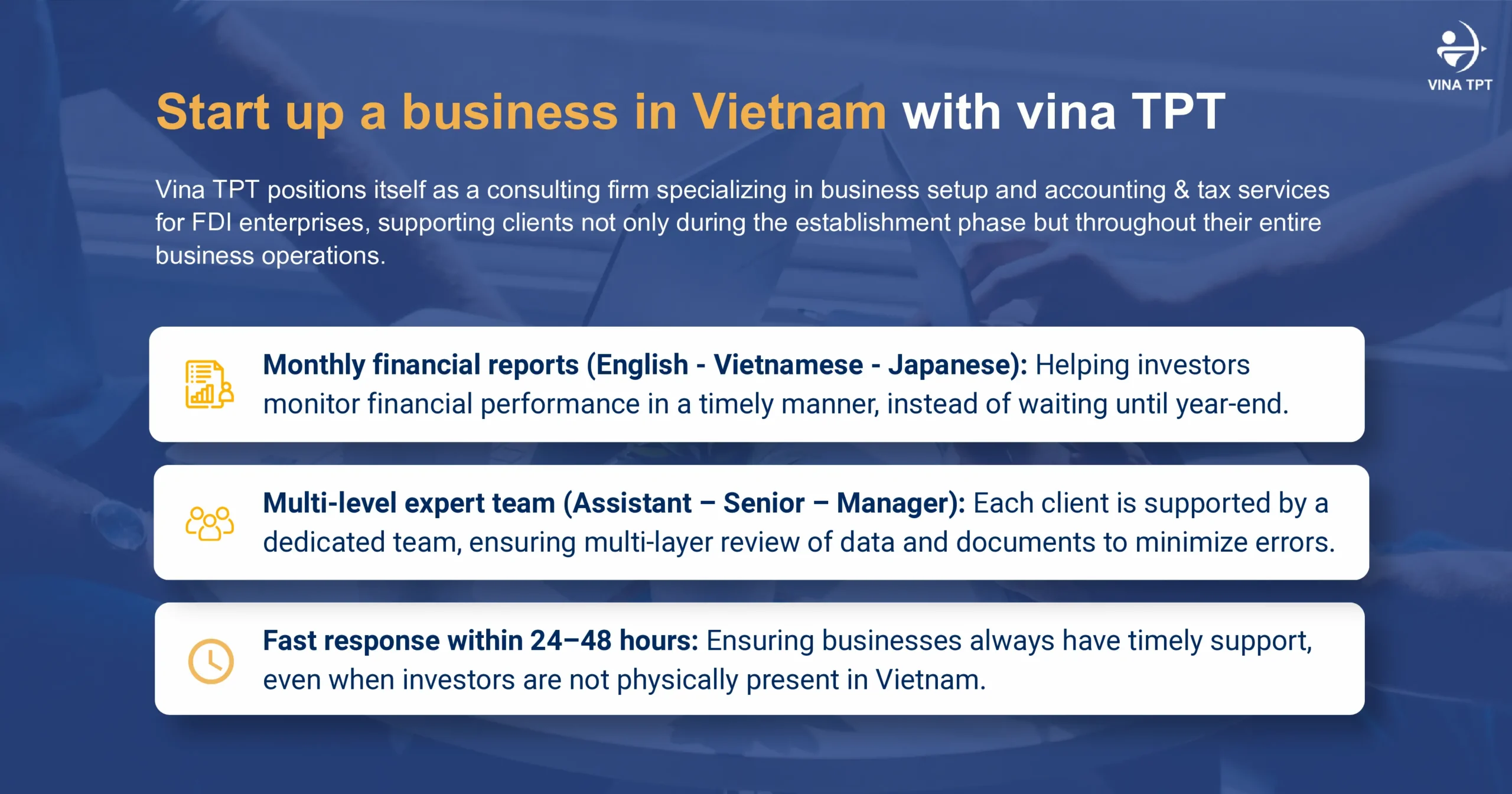
At VINA TPT, we support clients throughout every step—tracking the progress, handling all paperwork, and collecting the license as soon as the application is approved.

setting-up-a-representative-office-in-vietnam

4. Common Challenges and Tips

To ensure your 2026 application is processed without delays, please consider these essential points:

  • Legalization: Start document legalization early to avoid common administrative bottlenecks.
  • Office Lease: Ensure a valid lease agreement is signed before submitting your dossier.

Work Permits: Foreign Chief Representatives may require a work permit to stay compliant.

5. Ready to Establish Your Representative Office in Vietnam?

Establishing a representative office is a strategic move for foreign companies to expand and engage with the Vietnamese market. However, success requires deep legal insight and meticulous preparation. To overcome language barriers and administrative complexities, partnering with a professional service is the most effective solution.

With over 20 years of expertise, VINA TPT is proud to be the trusted partner for international businesses entering Vietnam. With Vina TPT’s one-stop support, foreign investors can navigate this process seamlessly, ensuring 100% data protection and transparent costs. Contact us today for expert consultation and a seamless start to your investment journey.

BOOK A FREE CONSULTATION

start a business in vietnam with vina tpt

How to Start a Business in Vietnam: 2026 Guide for Investors 

start a business in vietnam with vina tpt

start a business in vietnam with vina tpt

How to Start a Business in Vietnam as a Foreigner: A Comprehensive 2026 Guide 

Choosing to start a business in Vietnam has become a strategic move for international investors, thanks to the country’s consistent economic growth and increasingly transparent regulatory environment. This guide provides a precise roadmap to help you optimize the setup process and ensure full legal compliance from day one.

1. Strategic Reasons to Start a Business in Vietnam in 2026

2026 marks a pivotal year as Vietnam solidifies its position as Asia’s “new tiger.” For entrepreneurs, deciding to start a business in Vietnam is not just about tapping into a market of 100 million people, it is about leveraging several macro advantages:

  • Robust Economic Growth & Sustainable FDI: Foreign Direct Investment (FDI) continues to flow into high-tech sectors, green manufacturing, and specialized services.
  • 100% Foreign Ownership: In most manufacturing and trading sectors, investors can own 100% of the equity (with a few exceptions in restricted sectors).
  • ASEAN Competitive Edge: Compared to regional peers, Vietnam offers optimized operating costs, a young and technically skilled workforce, and an extensive network of Free Trade Agreements (FTAs).

2. Selecting the Ideal Structure to Start a Business in Vietnam

Selecting the correct legal entity is a critical step when learning how to start a business in Vietnam. Below are the primary options for foreign investors:

Structure  Best For  Key Characteristic 
Limited Liability Company (LLC)  Startups and SMEs  Simple governance; clear separation of personal and corporate assets. 
Joint-Stock Company (JSC)  Large-scale projects  Suitable for raising capital or future IPOs; requires at least 3 shareholders. 
Branch Office  Specific projects  Allows foreign companies to conduct commercial activities without a full subsidiary. 
Representative Office  Market research  Ideal for brand presence and networking; cannot engage in direct profit-generating activities. 
Joint Venture  Restricted sectors  Collaboration with a local partner to navigate specific regulatory requirements. 

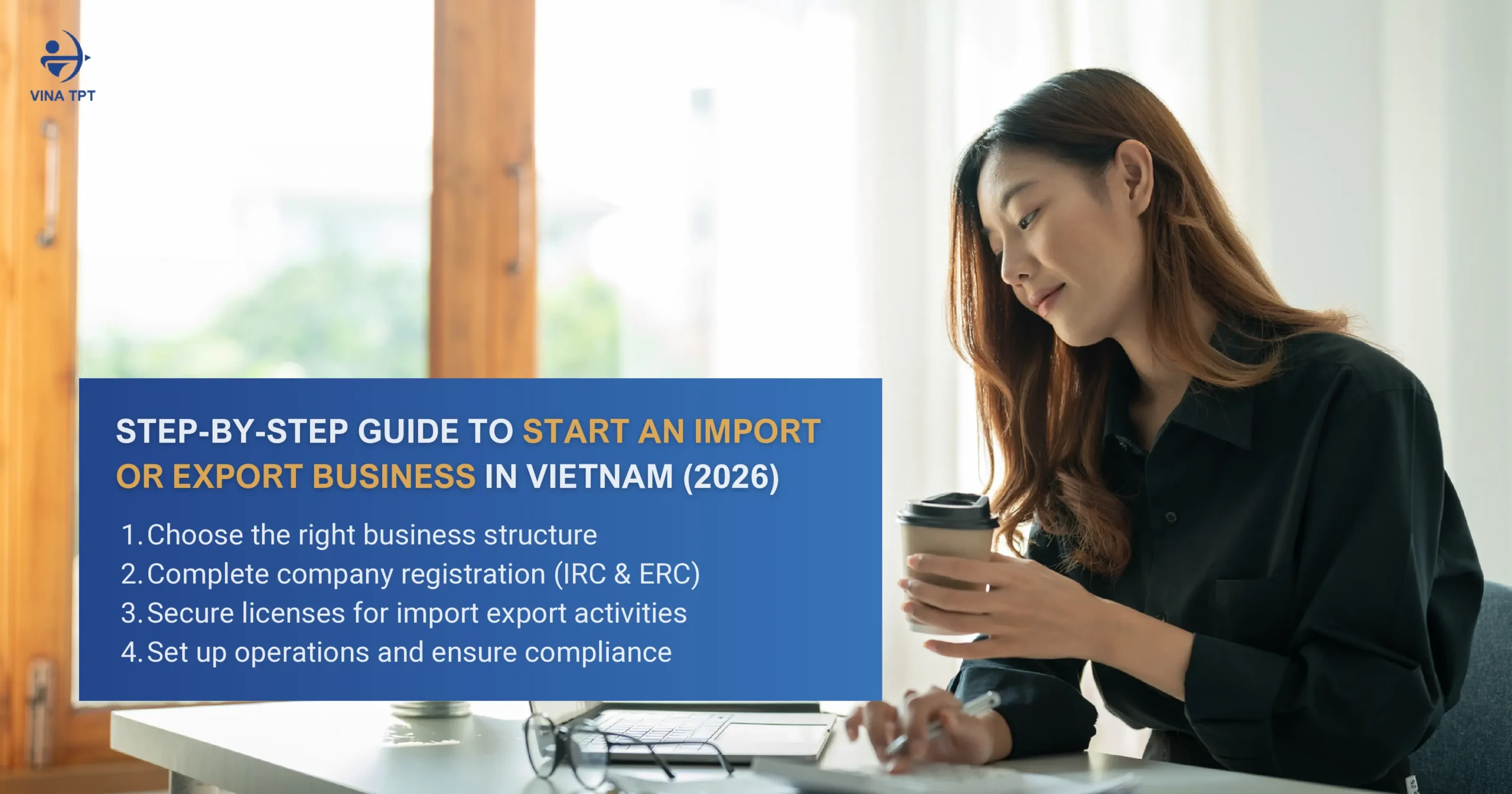
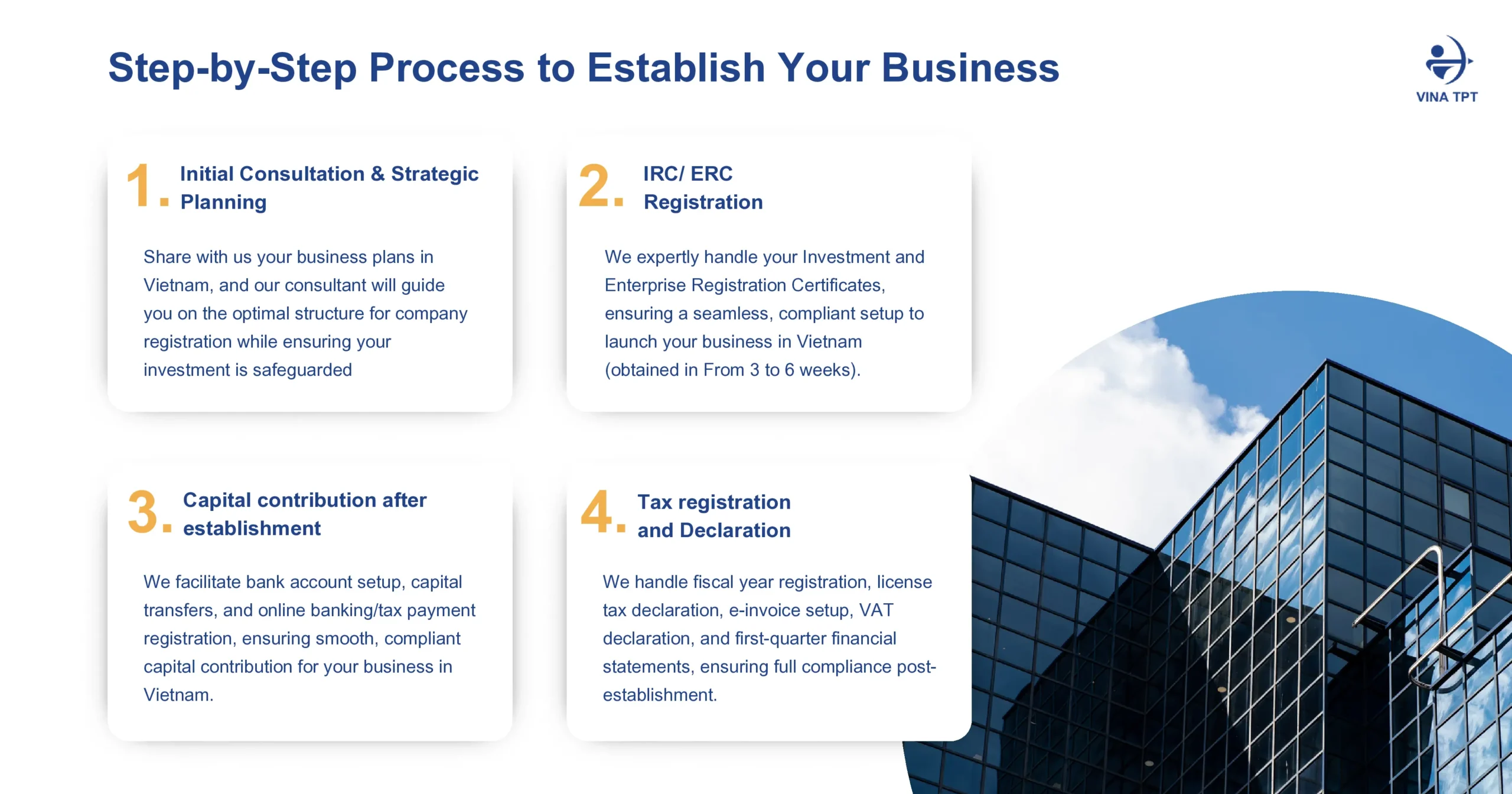
3. The 5-Step Process to Establish a Company in Vietnam (2026 Update)

To successfully start a business in Vietnam, investors must follow this standardized five-step procedure:

Step 1: Define Business Lines & Check Conditions

Verify if your industry falls under “conditional business lines” which may require minimum legal capital, specific professional certificates, or sub-licenses.

Step 2: Obtain the Investment Registration Certificate (IRC)

The IRC is the official approval of your investment project by the authorities, confirming the legitimacy of your capital source and business objectives.

Step 3: Obtain the Enterprise Registration Certificate (ERC)

Once the IRC is issued, you apply for the ERC. This grants your company a tax identification number and official legal status.

Step 4: Post-Incorporation Requirements

After receiving the ERC, you must complete these administrative tasks to become fully operational:

  • Open a Direct Investment Capital Account (DICA): This is mandatory for FDI companies. All capital injections, profit repatriations, and foreign loan repayments must flow through this specific account.
  • Company Seal Carving: Under current Enterprise Law, companies have the autonomy to decide the form and content of their seal. However, consistency is vital for banking and tax transactions.
  • Digital Signature (Token/Smart-OTP): Required for electronic tax filing, Social Insurance (SHUI) declarations, and using the National Single Window portal.
  • Tax Activation & E-Invoicing: You must register your initial tax status and purchase E-invoicing software to issue legal invoices to customers.

Step 5: E-ID Onboarding & Digital Compliance (New for 2026)

The 2026 regulatory framework requires the integration of Electronic Identification (e-ID) for the Legal Representative to manage online filings and administrative procedures seamlessly.

start a business in vietnam with vina tpt

4. Key Post-Setup Compliance Regulations

Once you start a business in Vietnam, you must adhere to strict legal obligations to avoid penalties or suspension:

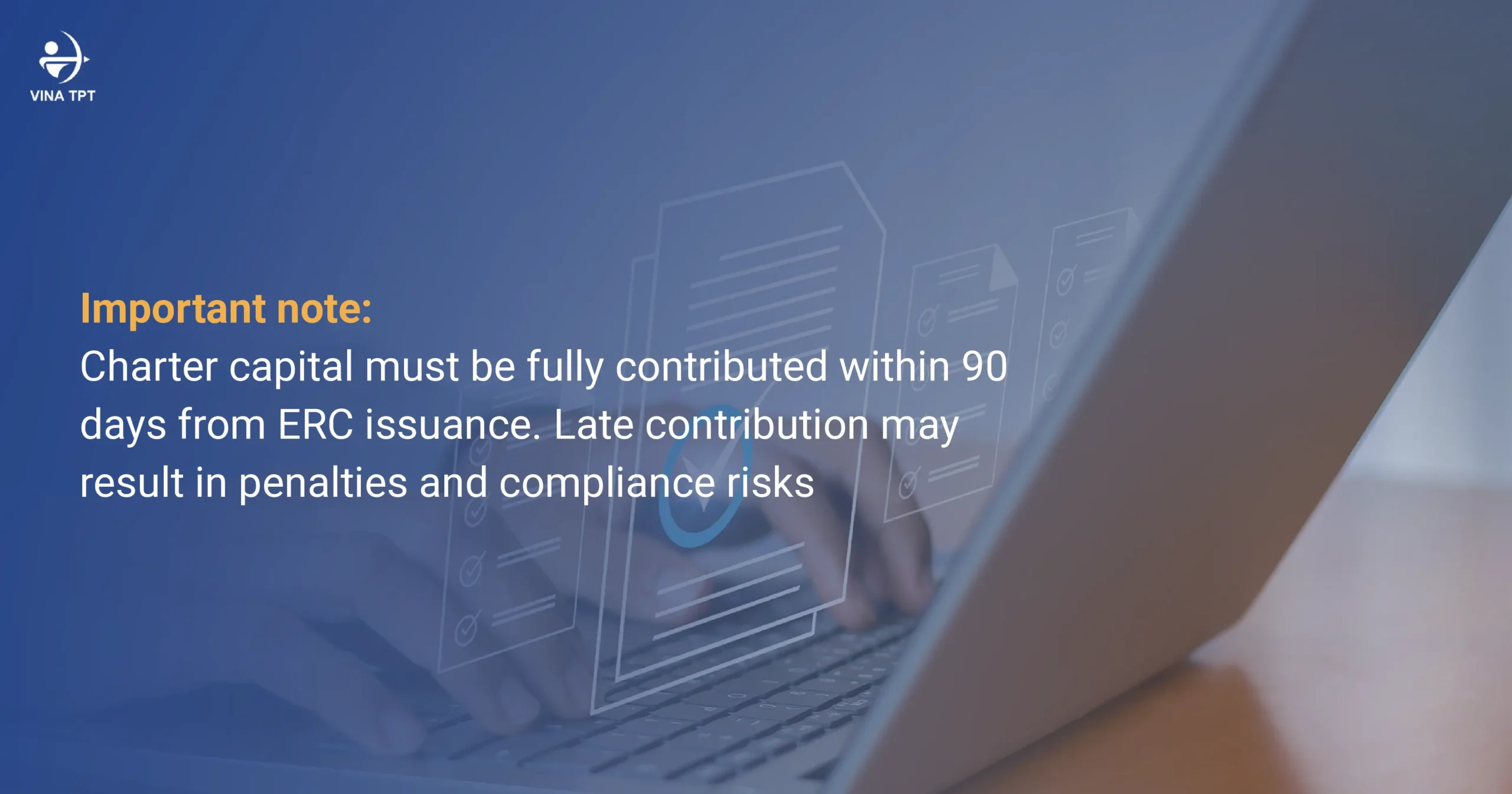
  • Capital Contribution: The total charter capital must be fully paid into the DICA within 90 days from the ERC issuance date.
  • Mandatory Annual Audit: Unlike local companies, 100% of FDI enterprises in Vietnam must have their annual financial statements audited by an independent auditing firm.
  • Investment Reporting: You are required to submit periodic reports (quarterly/annually) via the National Foreign Investment Information System.
  • Labor & Insurance (SHUI): Register for Social, Health, and Unemployment Insurance (SHUI), sign labor contracts, and fulfill monthly contribution requirements.
  • Tax Compliance: Ensure timely filing for:
    (1) Value Added Tax (VAT) – Monthly or Quarterly.
    (2) Corporate Income Tax (CIT) – Provisional quarterly payments.
    (3) Personal Income Tax (PIT) – For employees, filed monthly or quarterly.
    (4) Foreign Contractor Tax (FCT) – If engaging in transactions with overseas entities.

5. Vina TPT: Your Strategic Partner for the Vietnamese Market

Navigating administrative procedures can be challenging due to language barriers and evolving regulations. Vina TPT is a professional consultancy dedicated to helping you start a business in Vietnam smoothly:

  • End-to-End Solutions: From choosing the right structure and drafting IRC/ERC dossiers to full operational setup.
  • Expert Financial Management: We handle your accounting, tax finalization, and mandatory audit coordination.
  • Multilingual Support (EN/JP/VN): We bridge the communication gap between your global headquarters and local authorities.
  • Proactive Advisory: Vina TPT provides early warnings on policy changes, helping you avoid licensing delays or industry misclassifications.

Vina TPT provides the peace of mind you need to focus entirely on growing your business in Vietnam.

Planning to launch or expand your business in Vietnam?

Contact the Vina TPT expert team today for a detailed roadmap and a comprehensive quote for our all-in-one company incorporation services.

Get a Free Consultation

start a business in vietnam with vina tpt

Essential Step For Setting Up a Company in Vietnam| Trading Businesses

setting-up-a-company-in-vietnam-trading-Vina-TPT-Legal

Are you looking for a solution for setting up a company in Vietnam and explore opportunities in one of Asia’s fastest-growing economies? Vietnam, with its strategic geographic location along the South China Sea and borders with China, Laos, and Cambodia, has become a top destination for foreign investors in the trading sector. However, full legal compliance is essential for sustainable success, governed by the Law on Investment 2020 (amended in 2025) and the Law on Enterprises 2020. This comprehensive guide details the essential steps to set up a trading company in Vietnam, from basic concepts to full operations, catering to both informational and transactional search intent. 

  • Key Benefits: Access to FTAs for tariff reductions, excellent logistics positioning, and policies allowing up to 100% foreign ownership in most trading activities. 
  • Challenges to Consider: Administrative procedures can take 1–6 months, and it’s crucial to stay updated on recent changes, such as the 2025 Investment Law amendments permitting company establishment before obtaining the Investment Registration Certificate (IRC). 

By following these steps carefully, you can successfully start a business in Vietnam as a foreigner. 

1/ What is a Trading Company in Vietnam? 

A trading company in Vietnam specializes in buying and selling goods, including import, export, wholesale/retail distribution, and related services, regulated by Decree 09/2018/ND-CP (with a replacement draft under discussion in 2025). Unlike manufacturing companies, which focused on production or service providers offering labor or consulting, trading companies serve as intermediaries in the supply chain, connecting producers with consumers. With Vietnam’s exports surging by 28% in 2025, this sector is booming—especially in electronics, textiles, and agricultural products. According to the Ministry of Industry and Trade, trading contributes 15–20% to GDP, with an average annual growth rate of 9–10% over the past decade, fueled by international integration. 

Key Activities: 

  • Importing goods from abroad for domestic distribution. 
  • Exporting Vietnamese products to global markets. 
  • Wholesale and retail distribution through traditional or online channels. 
  • Logistics, warehousing, and product promotion services. 

Comparison table with other business types: 

Type  Key Characteristics  Example 
Trading  Focuses on buying/selling, no production  Mobile phone importer, apparel distributor 
Manufacturing  Produces goods from raw materials  Textile factory, electronics component maker 
Services  Provides labor or advisory services  Software consulting, management consulting 

2/ Benefits and Challenges of Setting Up Company in Vietnam 

Setting up a trading company in Vietnam offers substantial advantages but also involves challenges. Here is a clear comparison: 

Benefits  Challenges  Illustrative Example 
Young market with 100 million consumers and high demand  Complex and potentially lengthy administrative procedures Textile exports grew by 20% due to young population 
Strategic location near China and major sea routes  A local partner is required hoặc Local partners are required Logistics advantages reduce transport costs by 15% 
FTAs reduce tariffs and open access to EU and US markets  Currency fluctuations and legal risks  EVFTA boosts agricultural exports by 25% 

The benefits clearly outweigh the challenges with proper planning. For example, foreign investors can leverage FTAs to expand markets but must comply with regulatory requirements such as the Economic Needs Test (ENT) for multiple retail outlets. 

3/ Legal Requirements and Foreign Ownership Rules 

Under the Law on Investment 2020 (amended 2025) and the Law on Enterprises 2020, Vietnam permits up to 100% foreign ownership in most trading sectors, except for restricted industries such as pharmaceuticals, oil and gas, and printing. The 2025 amendments (effective from 2026) simplify procedures by allowing company registration before IRC issuance and reducing conditional business lines from 243 to approximately 200. These changes have driven record FDI inflows in 2025. Compliance with Decree 09/2018/ND-CP (a replacement draft pending) remains required for foreign-invested trading operations. 

Key Requirements: 

  • Investment registration with the Department of Finance (DOF) 
  • Compliance with WTO market access commitments. 
  • ENT evaluation for retail operations involving multiple stores. 

Restricted Product Categories and Conditional Business Lines 

Certain products are restricted or required special conditions under the Investment Law and Decree 09/2018/ND-CP, such as explosives, printing materials, and pharmaceuticals. 

Summary table: 

Product Category  VSIC Code  Restrictions 
Explosives  2029  Import prohibited except for national defense purpose
Printing Materials  1811  Requires approval from Ministry of Information 
Pharmaceuticals  2100  Foreign ownership limited to 49% 

Verification checklist: 

  • Check the national portal for conditional business lines. 
  • Assess legal risks with a local lawyer. 
  • Monitor the draft replacement of Decree 09 for 2026 updates. 

setting-up-a-company-in-vietnam-trading-Vina-TPT-Tax-Consultant

4/ Choosing the Right Business Structure 

Selecting the right business structure for your trading company depends on its scale and ownership. Under the Law on Enterprises 2020, the two most common forms are the Limited Liability Company (LLC) and the Joint Stock Company (JSC), with the LLC being ideal for smaller businesses due to its simpler procedures. 

  • LLC Pros & Cons: Flexible, liability limited to contributed capital; drawback: harder to raise large capital. 
  • JSC Pros & Cons: Easier to list on stock exchanges; drawback: more complex structure, requires at least 3 shareholders. 

Comparison table: 

Structure  Number of Members  Legal Liability 
LLC  1–50  Limited to contributed capital 
JSC  Minimum 3  Limited to share capital 

For foreign investors with limited capital, an LLC is the best choice for a fast start. 

LLC vs. JSC: Which is Best for Trading? 

Detailed comparison: 

LLC  JSC  Best for Trading 
Simple procedures, flexible capital  More complex, easier expansion  High for small businesses, local distribution 
No board of directors required  Requires diverse shareholders  Lower if needing large capital for exports 

LLC is generally more suitable for trading due to its flexibility. For example, a foreign agricultural trading company often opts for an LLC to quickly begin import operations. 

Consult a Business Setup Expert

5/ Capital Requirements and Financial Planning 

Vietnam imposes no fixed minimum capital for trading companies, but charter capital must be “reasonable” to demonstrate operational capability. A typical recommendation is USD 10,000–50,000, depending on the business plan. Total investment capital includes charter capital and other expenses, with full contribution required within 90 days of registration. 

Financial preparation checklist: 

  • Estimated setup costs: USD 3,000–10,000 for procedures and office. 
  • Reserve for VND/USD exchange rate risks. 
  • Budget for taxes and employee salaries. 

Estimated capital table: 

Recommended Capital  Purpose 
USD 10,000  Basic operations, small-scale distribution 
USD 50,000  Expansion of import/export activities 

6/ Essential Steps to Setting Up a Company in Vietnam as a Foreign Investor 

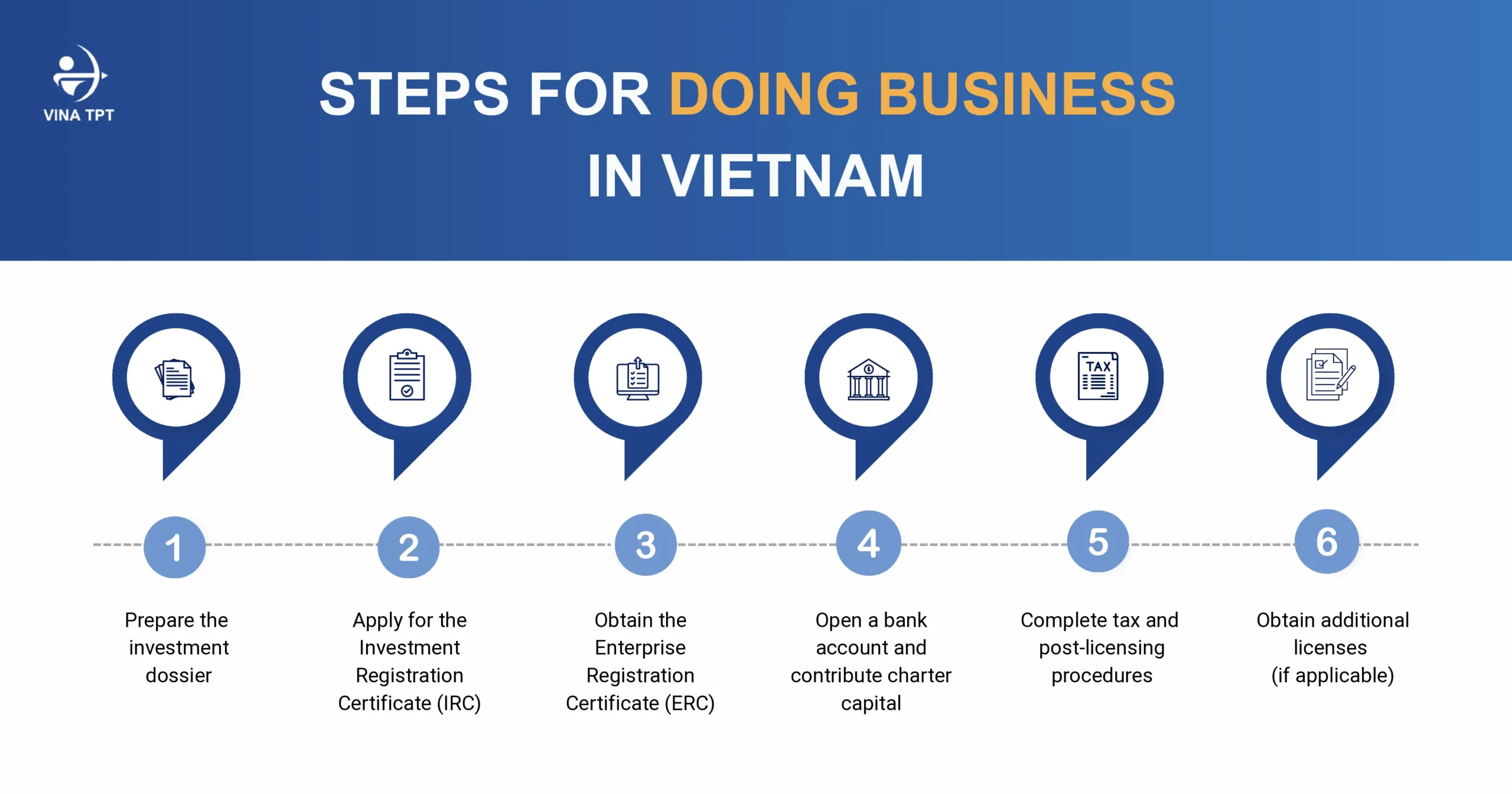
Setting up a foreign-invested company in Vietnam requires following a clear, structured process to ensure full legal compliance and smooth operations. This step-by-step guide is tailored for foreign-owned trading or commercial entities. 

Step 1: Prepare Your Investment Documentation 

Gather all necessary paperwork for your investment project. This includes defining your business model (e.g., Limited Liability Company – LLC, joint venture, or representative office), choosing the right structure, and outlining main activities. Verify that your industry allows foreign ownership under Vietnamese law. 

Step 2: Submit Application for the Investment Registration Certificate (IRC) 

The IRC is the foundational approval for foreign-invested enterprises. It authorizes your project and details the charter capital, scale, location, and business scope. Without an IRC, you cannot proceed to company registration. 

Required documents: 

  • Application form and a detailed project proposal (objectives, scale, capital, location, and timeline). 
  • Proof of financial capability (bank statements, audited financials, or credit agreements). 
  • Legal documents: notarized passport (individuals) or business registration certificate (organizations), both legalized. 
  • Proof of location (lease agreement or land use rights). 
  • Power of attorney (if using a third-party service). 

Foreign documents require consular legalization and official Vietnamese translation. Partnering with a professional company setup service such as Vina TPT is recommended to avoid delays. 

Step 3: Obtain the Enterprise Registration Certificate (ERC) 

After the IRC issuance, register the company to receive the ERC, which establishes its legal identity in Vietnam. 

Step 4: Open a Corporate Bank Account and Inject Charter Capital 

Open a dedicated capital account at a licensed Vietnamese bank. Contribute the full charter capital within 90 days of ERC issuance to avoid penalties and ensure the credibility for future permits. 

Step 5: Complete Tax Registration and Post-Licensing Formalities 

Register for a tax ID, VAT, and fulfill obligations such as social insurance and labor compliance if hiring staff. 

Step 6: Secure Industry-Specific Licenses (If Applicable) 

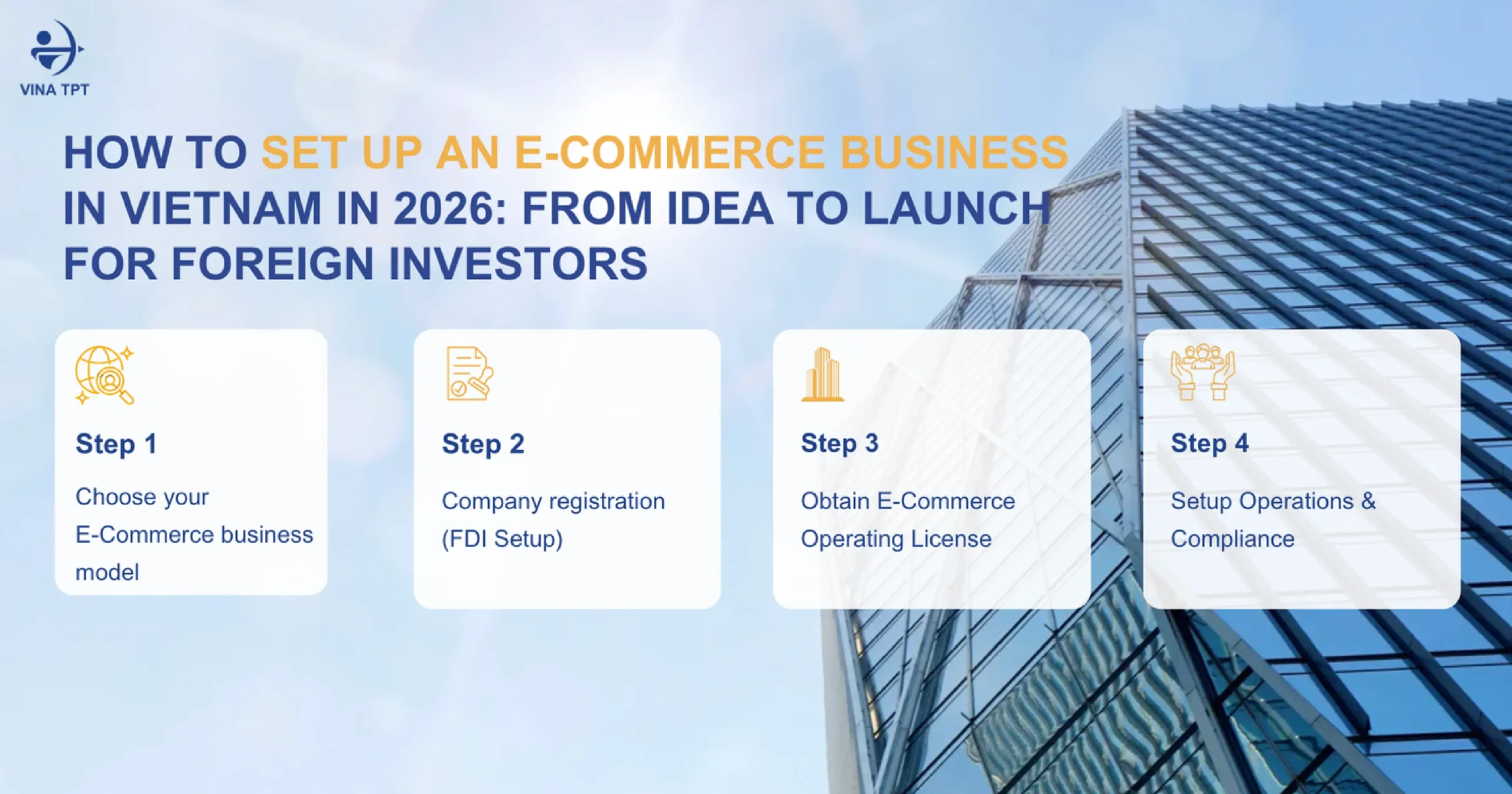
Sectors like trading, retail, F&B, education, or e-commerce may require additional permits. 

By following these steps and staying updated on regulations, foreign investors can successfully set up company in Vietnam.

setting-up-a-company-in-vietnam-trading-Vina-TPT

7/ Taxation, Compliance, and Ongoing Operations 

Foreign-invested trading enterprises (FDIs) in Vietnam must strictly comply with tax, labor, and periodic reporting obligations to avoid penalties and maintain legal standing. 

A – Taxes: 

  • Corporate Income Tax (CIT): 20% (15–17% incentives for SMEs from late 2025 if revenue < VND 50 billion); quarterly provisional payments (at least 80% of annual obligation); due by the 30th of the first month of the following quarter; annual declaration within 90 days after the fiscal year-end. 
  • Value Added Tax (VAT): 8–10% (reduced to 8% until 2026); monthly declaration (revenue > VND 50 billion/year) or quarterly declaration; due by the 20th of the following month or the end of the first month of the next quarter; retain invoices for deductions. 
  • Personal Income Tax (PIT): 5–35% (residents) or 20% (non-residents); withholding and declaration monthly/quarterly, aligned with VAT; annual employee declaration. 
  • Other fees (environmental protection, resource tax, land use): Usually annually or on an event basis, with changes required to be reported within 30 days.

B – Laws and Other Compliance: 

  • Labor Law 2019 (amended): Work permits for foreigners; quarterly labor reports; standard contracts; monthly social insurance contributions (pension, health, unemployment insurance). 
  • Intellectual Property: Registration and monitoring (annual review recommended). 
  • Financial Reporting: Annual audited financial statements for FDI, submitted with final CIT. 
  • Transfer Pricing: Local/master file prepared annually, submitted within 90 days after the fiscal year-end if thresholds are met. 

Compliance Checklist: 

Requirement  Details  Frequency  Deadline  Penalties if Violated 
VAT Declaration & Payment  Input/output, deductions (Form 01/GTGT or 04/GTGT)  Monthly (>50B VND) or quarterly  20th of next month or end of first month of next quarter  0.03%/day interest, disallowed deductions, audits 
PIT Withholding & Declaration  Employee withholding (Form 05/KK-TNCN)  Monthly/quarterly  20th or end of the first month of next quarter; annual within 90 days  Daily fines, criminal liability 
Provisional CIT Payment  Estimated profit-based  Quarterly  30th of the first month of next quarter  Interest if below 80% the annual obligation 
Social Insurance  Contributions and reporting  Monthly  Aligned with PIT monthly/quarterly  Late fees, hiring restrictions 
Labor Usage Report  Employee numbers and changes  Quarterly  End of the quarter  Administrative fines, suspension 
FCT Declaration  Payments to foreign contractors  Monthly or per payment  20th of the next month or 10 days after payment  Employer liability, heavy fines 
Transfer Pricing  Local/master file  Annually  90 days the after fiscal year-end  Audits, tax adjustments 
Audited Financial Statements  VAS-compliant with independent audit  Annually  With final CIT (90 days)  Mandatory audits, penalties for errors 

FDI companies should engage professional accounting services and monitor updates such as Decree 132/2025/ND-CP on CIT, ensuring electronic filing with digital signatures. 

8/ Frequently Asked Questions (FAQs) 

  • Can foreigners own 100% of a trading company in Vietnam? 

Yes, foreign investors can own up to 100% in most sectors, including import-export and distribution. Exceptions apply to restricted sectors such as pharmaceuticals, oil and gas, or printing, where ownership may be limited or may require a local partner. 

  • What is the minimum capital required? 

No fixed minimum capital exists for most trading companies. Charter capital must be reasonable to support operations. Authorities often recommend at least USD 10,000 to show financial capability and avoid delays. The exact amount depends on your business plan and scale. 

  • How long does it take to set up? 

Setting up a business in Vietnam as a foreigner typically takes 1–2 months, depending on the complexity and the province. The IRC usually takes 30–45 working days, the ERC follows in 7–14 days. Additional licenses and post-registration steps may extend the timeline. 

  • Do I need a local partner? 

For general trading (import, export, wholesale, and distribution), no local partner is needed—100% foreign ownership is allowed. In restricted or conditional sectors (e.g., multi-outlet retail, pharmaceuticals, and media), a local partner or joint venture may be required. 

  • How to start a business in Vietnam as a foreigner? 

Follow these key steps: obtain the Investment Registration Certificate (IRC), then the Enterprise Registration Certificate (ERC), secure trading or sector-specific licenses, open a corporate bank account, contribute charter capital, and complete tax registration. Using professional services like Vina TPT’s company setup service ensures accuracy and efficiency. 

Vina TPT – Your Trusted Partner for Foreign Businesses in Vietnam 

Vina TPT is one of Vietnam’s leading company formation consultancies, specializing in helping foreign investors to set up companies in Vietnam for trading, manufacturing, and services. With over 20 years of experience, Vina TPT has assisted hundreds of FDI companies from Europe, the US, Japan, Korea, and Singapore in successfully obtaining IRCs, ERC, and required licenses in minimal time. 

  • Multilingual Expert Team: Lawyers, accountants, and registration specialists fluent in English, Japanese, and more for seamless communication. 
  • Fast and Transparent Process: Commitment to completing the IRC in 30–45 working days and the ERC in 7–14 days, with a near-100% success rate. 
  • Full-Service Package: From company registration to capital advisory, bank account opening, tax filing, work permits, social insurance, and transfer pricing support. 
  • Competitive and Transparent Pricing: Clear quotes with no hidden fees, ideal for SMEs. 
  • Long-Term Post-Setup Support: Daily operational guidance and updates on the latest laws (including the 2025 Investment Law changes) to minimize risks and support sustainable growth. 

We go beyond simply setting up a company in Vietnam – we help you build a strong foundation for success. With our commitment to “Fast – Accurate – Cost-Effective” service, Vina TPT saves time, reduces legal risks, and lets you focus on business growth. Hundreds of satisfied clients trust Vina TPT – contact us today for a free consultation and a personalized quote tailored to your needs. 

BOOK A FREE CONSULTATION

Good-Business-Ideas-to-Start-in-Vietnam_-Company-Setup-Profitable-Opportunities-Vina-TPT


Capital Contribution and Business Setup for Foreign Investment in Vietnam

Capital-Contribution-and-Business-Setup-for-Foreign-Investment-in-Vietnam-Vina-TPT

Capital-Contribution-and-Business-Setup-for-Foreign-Investment-in-Vietnam-Vina-TPT

1. Understanding Capital Contribution Requirements for Foreign investment in vietnam

Capital contribution is the most important step when establishing an FDI enterprise. According to Vietnamese law, foreign investors should note:

  • Minimum capital: Vietnam does not require a general legal capital level, but the charter capital must be appropriate and demonstrate the ability to implement the business model. Some specific industries (education, real estate, e-commerce, etc.) have higher capital requirements.
  • Form of capital contribution: Investors can contribute capital in cash, machinery and equipment, assets, intellectual property rights, or other legal assets.
  • Capital contribution period: Usually must be completed within 90 days from the date of issuance of the Certificate of Business Registration (or according to the period stated in the Investment Registration Certificate).

Determining capital accurately from the beginning helps reduce legal risks and limit capital adjustments later.

2. Types of Foreign Investment in Vietnam

When choosing a form of investment in Vietnam, investors need to consider their business objectives, project scale, level of control and desired scope of operations. Vietnam allows for a variety of flexible legal models, from establishing a new business to opening a branch or representative office. Each form carries different levels of risk, costs and compliance obligations, so choosing the right one at the outset will have a big impact on investment performance and long-term strategy.

Below are the most common forms of FDI in Vietnam:

Type Suitable for Advantages Disadvantages
Limited Liability Company (LLC) Small & medium enterprises

Investors needing strong control

Simple structure

Easy to operate

High control

Fast setup

Hard to raise capital

Extra procedures to convert to JSC

Joint Stock Company (JSC) Businesses expanding strongly

Companies seeking fundraising

Easy capital raising Fit for large/multinational projects

Flexible share transfer

Good for future IPO

Complex governance

More management bodies required

Higher compliance cost

Branch of Foreign Traders Foreign companies in eligible sectors Can conduct profit-making activities

No new legal entity required

Operate under parent company

Limited to specific industries

Dependent on parent company

Hard to scale like an independent entity

Representative Office (RO) Market research stage

Building partner networks

Simple setup

Low cost

No CIT applied

Cannot generate revenue

Cannot sign commercial contracts

Not suitable for long-term investment

Choosing the appropriate form of FDI helps investors optimize costs, reduce legal risks and ensure that their business strategy in Vietnam is effectively implemented. For small and medium-sized projects, LLC is often the optimal choice; for strong expansion plans or many shareholders, JSC is more suitable. Meanwhile, branches and representative offices serve the purpose of market presence without the need to establish a new legal entity.

3. Steps to Set Up a Company with Capital Contribution

When setting up a Foreign investment in Vietnam, investors need to take the following main steps:

Step 1: Prepare investment documents

  • Investor information
  • Financial capacity report
  • Business plan
  • Headquarters lease contract, company charter

Step 2: Apply for Investment Registration Certificate (IRC): Confirm investment project and capital structure. Processing time: 15-30 days.

Step 3: Apply for Enterprise Registration Certificate (ERC): Officially establish the enterprise. Time: 3-5 days.

Step 4: Open an investment capital account: Required for FDI enterprises, used to receive capital from abroad.

Step 5: Make capital contribution: Investors transfer capital on time and complete the report.

Step 6: Post-establishment procedures

  • Tax registration
  • Digital signature
  • Corporate seal
  • Labor and insurance registration (if required)

Capital-Contribution-and-Business-Setup-for-Foreign-Investment-in-Vietnam-Vina-TPT

4. Compliance and Reporting Obligations

Foreign investment in Vietnam must ensure full compliance with the following regulations:

  • Capital contribution progress report
  • Accounting and bookkeeping according to VAS standards
  • Periodic tax declaration (VAT, CIT, PIT)
  • Annual financial report
  • Notification of changes in capital, headquarters, and representative

Non-compliance may result in administrative fines, restrictions on operations, or capital adjustment requirements.

AVOID COSTLY COMPLIANCE RISKS

5. Benefits of Proper Capital Contribution Management

Managing and implementing capital contribution in accordance with regulations is not only a legal requirement but also brings many practical values ​​to FDI enterprises in Vietnam:

Avoid legal risks and penalties

  • Contributing capital on time helps avoid administrative penalties.
  • Avoid being required to reduce charter capital or adjust the Investment Certificate.
  • Limit risks when checking, inspecting or working with banks.

Protecting investors’ ownership rights and capital contribution ratios

  • Clearly record the ownership ratio, voting rights and interests of each shareholder.
  • Avoid internal disputes, especially with investors from many different countries.
  • Increase transparency when planning to transfer shares or raise capital.

Increase the level of trust with banks, partners and management agencies

  • Adequate charter capital is an important factor in expanding credit limits.
  • Demonstrate the financial capacity and long-term commitment of investors in Vietnam.
  • Help partners and suppliers feel secure when signing contracts.

Optimize taxes and cash flow

  • A reasonable capital structure helps reduce the risk of transfer pricing adjustments and avoid tax disputes.
  • Easily control cash flow in and out through investment capital accounts.
  • Increase the ability to plan finances and operating budgets.

Create a solid foundation for expansion

  • Easy to add capital, open more branches or change the scope of the project.
  • Convenient when upgrading the type of business or expanding to a new industry.
  • Support the process of calling for more investors or strategic cooperation.

Increase long-term enterprise value

  • Enterprises with a transparent history of capital contribution are often highly appreciated when evaluating M&A.
  • Increase attractiveness to investment funds and global partners.
  • Create a competitive advantage when negotiating large contracts.

Minimize risks during divestment

  • Easily determine the value of the capital contribution when the investor wants to withdraw capital.
  • Reduce disputes due to the difference between actual capital contribution and registered capital.
  • Optimize tax benefits when transferring capital.

6. How Vina TPT Supports FDI Company Formation

Vina TPT Company Formation provides a complete package of support for the process of establishing and operating FDI enterprises:

  • Consulting on conditions for capital contribution and business lines
  • Preparing and submitting IRC & ERC documents
  • Shareholding structure, ownership ratio, charter
  • Support for opening investment capital accounts, guidance on capital contribution
  • Accounting – tax services – compliance with Vietnamese regulations
  • Consulting throughout for investors in operations and expansion

With experience working with international enterprises, Vina TPT ensures that the investment process in Vietnam becomes clear, safe and effective.

BOOK A FREE CONSULTATION

Laywer-Establish-business-Vietnam-VinaTPT

How to Check Company Name Availability in Vietnam Before Registration

How to Check Company Name Availability in Vietnam Before Registration

Check Your Company Name with Confidence

1. Importance of Checking Company Name Availability

Before registering a company in Vietnam, business name lookup is the first important step. A name that is identical or too similar to another business can lead to legal risks, rejection of registration applications or trademark disputes later.

Checking the name also helps businesses protect their brand from the beginning, creating a professional impression with customers and partners. This is especially important for startups and companies planning to expand their market.

2. Understanding Vietnam’s Business Name Rules

When choosing a company name in Vietnam, businesses must comply with the following legal requirements:

  • Name structure: must include the business type + a distinct proper name. (Based on ArtHow to Check Company Name Availability in Vietnam Before Registrationicle 37, Law on Enterprises 2020)
  • Prohibited or confusing words: the name must not duplicate or cause confusion with existing businesses, nor contain words related to state agencies or political organizations. (Based on Articles 38 & 39, Law on Enterprises 2020)
  • Language & characters: Vietnamese, foreign languages using Latin letters, numbers, and symbols are permitted. (Based on Article 37(3), Law on Enterprises 2020)
  • Consistency with business lines: the name must not create misunderstanding regarding the registered business field. (Specified in Article 38, Law on Enterprises 2020)

Following these regulations increases the likelihood of name approval on the first submission.

VERIFY YOUR BUSINESS NAME NOW

3. Online Tools and Databases for Name Lookup

Vietnam provides several official online systems that help business name lookup availability and avoid conflicts before registration.

3.1 National Business Registration Portal 

The National Business Registration Portal https://dangkykinhdoanh.gov.vn/vn/Pages/Trangchu.aspx  is the primary and most authoritative tool for business name lookup in Vietnam. It offers:

  • Nationwide database access with real-time updates of all registered business names.
  • Detailed legal information, including tax code, business status, and registered address.
  • Name similarity filtering, helping identify identical or confusing names in accordance with the Law on Enterprises 2020.
  • Direct data connection with provincial Departments of Planning and Investment (DPI), ensuring accuracy and consistency.

Using this portal helps businesses ensure name uniqueness, reduce the risk of rejection, and streamline registration procedures.

check your company name in Vietnam

3.2 IP Vietnam Trademark Database

Link: https://www.ipvietnam.gov.vn/en_US/web/english/trademarks 

  • Allows checking existing or pending trademarks related to names, brand identities, or logos.
  • Prevents conflicts between company names and protected intellectual property.
  • Essential for businesses requiring strong brand protection.

3.3 International Trademark Databases (WIPO Global Brand Database)

Link: https://branddb.wipo.int/en/similarname 

  • Supports searches for potential international naming conflicts, especially for brands planning cross-border operations.
  • Useful when the proposed company name is in a foreign language or intended for global use.

4. Tips to Ensure Your Chosen Name Complies

To get your business name approved and avoid the risk of rejection, entrepreneurs need to pay attention to some important points:

1. Choose a name that is easy to recognize and remember:

  • The name should be short, clear and reflect the business field.
  • Avoid naming that is too general and difficult to distinguish from other businesses.

2. Check for duplication or similarity with registered trademarks:

  • Use the National Information Portal and trademark protection databases to look up.
  • Avoid names that are confusing or too similar to large businesses, to limit legal risks and future disputes.

3. Comply with legal regulations on business names:

  • Including business types (LLC, Joint Stock Company, Private Enterprise).
  • Use valid characters (Latin letters, numbers, special characters as prescribed).
  • Do not use prohibited, confusing or offensive words.

4. Consider Vietnamese and foreign language names:

  • If your business plans to operate internationally, you should also check the English or other language versions to avoid duplication in the international market.

Following these tips increases the likelihood of your application being approved the first time and protects your brand in the long term, making it easier for your business to start up.

5. How Vina TPT Supports Company Name Registration

Starting a business in Vietnam can be complicated, especially when it is the first time for an entrepreneur to approach the market. Working with Vina TPT helps reduce legal pressure and optimize time. 

Ensure a legal and prominent business name in the Vietnamese market with comprehensive support from Vina TPT.

Vina TPT's services include

BOOK A FREE CONSULTATION

Fast, compliant and hassle free business name lookup and registration support by Vina TPT

Good Business Ideas to Start in Vietnam: Company Setup & Profitable Opportunities

Good-Business-Ideas-to-Start-in-Vietnam_-Company-Setup-Profitable-Opportunities-Vina-TPT

 Good-Business-Ideas-to-Start-in-Vietnam_-Company-Setup-Profitable-Opportunities-Vina-TPT

1. Current Market Trends Shaping Business Opportunities

Vietnam is becoming an attractive destination for setting up a company in vietnam thanks to its stable economic growth, young population and dynamic workforce. Consumer demand is growing, especially in the technology, services and retail sectors. The booming online market also opens up opportunities for e-commerce and logistics models, while the F&B and tourism industries continue to recover strongly after the pandemic.

In addition, the interest in health, education and high technology also creates many new opportunities. Businesses that exploit this trend can take advantage of rapid growth and sustainable profits in the long term.

2. Emerging Business Models for New Entrepreneurs

The emerging business models in Vietnam today are diverse, suitable for many types of entrepreneurs:

  1. Retail & E-commerce: online sales, e-commerce platforms, dropshipping models.
  2. Logistics services: transportation, warehousing, fulfillment for e-commerce.
  3. Edu-tech: online learning platforms, skills training, specialized education.
  4. High-tech & Startups: AI, IoT, blockchain, enterprise software applications.
  5. Creative F&B: cafes, concept restaurants, organic food.
  6. Production: agricultural processing, processing, industrial equipment manufacturing.
  7. Tourism & Hospitality: experiential tourism, homestay, travel services.
  8. Healthcare & Wellness: clinics, health care, fitness, spa.

These models are growing rapidly thanks to changing consumer needs and the acceptance of new technology in life.

START YOUR BUSINESS JOURNEY

3. Essential Steps to Legally Start a Company

To start a business in Vietnam legally, entrepreneurs need to fully comply with basic legal procedures. Doing it right from the beginning helps avoid legal risks, ensures smooth business operations and easy expansion later.

 Good-Business-Ideas-to-Start-in-Vietnam_-Company-Setup-Profitable-Opportunities-Vina-TPT

3.1 Choose a business type and register a business

The first step is to determine the type of business that is suitable for the business goals:

  • Single-member LLC: suitable for individual business owners or sole investors; limited liability, simple management.
  • Two-member LLC or more: from 2-50 members, limited liability, suitable for small investor groups.
  • Joint Stock Company (JSC): suitable for businesses that want to raise capital from many shareholders; suitable for startups or large projects.
  • Private enterprise: easy to establish, but the business owner has unlimited liability.

After choosing the type, the business needs to name the company uniquely and submit the business registration application to the Department of Planning & Investment. The company name must not be the same as that of registered businesses and must accurately reflect the field of operation.

3.2 Completing additional legal procedures

After registering a business, the enterprise needs to perform the following steps:

  1. Registering a tax code (MST):
    • Required for declaring VAT, CIT and PIT if there are employees.
    • MST is the legal basis for conducting all tax transactions with the management agency.
  2. Applying for necessary business licenses:
    • Depending on the industry, some fields require sub-licenses such as F&B, logistics, education, and healthcare.
    • The license dossier includes conditions on facilities, expertise, and related documents.
  3. Opening a corporate bank account:
    • Needed for financial transactions, obtaining charter capital and managing cash flow.
  4. Complete other procedures:
    • Hanging company signs, registering digital signatures, submitting initial tax reports.
    • Ensuring that businesses fully comply with legal regulations from the beginning.

Fully implementing 3.1 and 3.2 helps businesses operate legally, reduce risks and easily develop long-term in the Vietnamese market.

4. Vina TPT as a Strategic Partner for New Businesses

Starting a business in Vietnam can be complicated, so working with a strategic partner like Vina TPT gives entrepreneurs peace of mind. Vina TPT provides a comprehensive solution from strategic consulting to company registration, including:

  • Choosing the right type of business.
  • Submitting business registration documents to the Department of Planning & Investment.
  • Applying for necessary sub-licenses according to the industry.
  • Instructions on tax management and proper declaration.

Starting a business in Vietnam becomes easier and safer with Vina TPT, a strategic partner providing comprehensive solutions. 

BOOK A FREE CONSULTATION

setting-up-a-company-in-vietnam

Top 20 Sectors for Business Opportunities in Vietnam

Top-20-Sectors-for-Business-Opportunities-in-Vietnam-VTPT

Top-20-Sectors-for-Business-Opportunities-in-Vietnam-VTPT

1. Why Vietnam Is a Hotspot for Business

Business opportunities in Vietnam are abundant as the country emerges as one of Southeast Asia’s most attractive investment destinations, thanks to its consistent GDP growth, rapidly expanding middle class, and strong push toward industrialization. Major cities such as Ho Chi Minh City, Hanoi, Da Nang, and Hai Phong are witnessing rising consumer demand across multiple sectors, creating fertile ground for new business models and foreign startups.

FDI inflows continue to surge, with Vietnam recording one of its highest investment levels in recent years. This momentum is drawing businesses from Japan, South Korea, Singapore, the US, India, and beyond, all seeking opportunities in a market that is young, dynamic, and full of untapped potential.

In the following sections, we’ll explore key industries currently experiencing strong growth – helping foreign entrepreneurs identify where the most promising opportunities lie.

EXPLORE BUSINESS OPPORTUNITIES IN VIETNAM

2. Most Profitable Sectors to Consider

When considering business opportunities in Vietnam, investors should focus on industries with high profit potential, strong market demand and sustainable development trends. Below are 20 prominent industries:

  1. F&B: The food and beverage industry is still leading thanks to strong consumer demand, especially for restaurant, cafe and fast food chains under the franchise model. The market is oriented towards experience, quality and service, bringing stable profits to investors.
  2. Retail: Traditional retail and e-commerce are growing rapidly thanks to the expanding middle class and increasingly popular online shopping habits. Convenience store models, specialty stores and e-commerce are creating high-profit opportunities.
  3. Logistics and Supply Chain: Vietnam is becoming an export manufacturing hub, leading to a large demand for warehousing, transportation and fulfillment for e-commerce. The trend of investing in smart logistics and automated warehouses is prominent.
  4. Education & Training: Foreign language centers, soft skills training, STEM and e-learning are growing strongly, especially with startups targeting Gen Z and the FDI market.
  5. Tech Startups: Fintech, healthtech, applications and enterprise software are global investment trends, with high profit potential thanks to the ability to expand rapidly and integrate new technologies.
  6. Tourism & Hospitality: The tourism and hospitality industry has recovered strongly after the pandemic, especially experiential services, homestays and high-end resorts.
  7. Healthcare & Wellness: International clinics, health care, spas and fitness meet the growing needs of the middle class.
  8. Renewable Energy: Solar power, wind power and clean energy solutions are prioritized by investment incentives, while meeting global sustainability trends.
  9. Real Estate & Property Management: Apartments, urban areas, offices for rent and logistics real estate are increasing in price thanks to high demand for housing and commerce.
  10. Manufacturing & Supporting Industries: Manufacturing components, mechanics, household appliances for FDI and export, in line with preferential policies and supply chain connections.Top-20-Sectors-for-Business-Opportunities-in-Vietnam-VTPT
  11. Automotive & Mobility: Electric vehicles, repair services, logistics and auto parts following the green transformation trend and government support mechanisms.
  12. Agriculture & Agritech: Clean agricultural products, food processing, agricultural technology solutions to increase productivity and meet export needs.
  13. Consumer Electronics: Smart home appliances, smartphones and laptops with a dynamic young market that easily accepts new technology.
  14. Beauty & Cosmetics: Spa, imported cosmetics and skincare are growing strongly thanks to the need for personal beauty and international service standardization.
  15. Fashion & Apparel: Clothing, children’s fashion, online fashion to meet the trend of personalization and online shopping.
  16. Media & Entertainment: Digital content, movies, games, podcasts are booming thanks to the online entertainment habits of young people.
  17. Financial Services: Fintech, electronic payments, personal and business financial management following the digital trend.
  18. Professional Services: Law, accounting, management and tax consulting to meet the growing needs of FDI enterprises and startups.
  19. Green Construction: Environmentally friendly construction materials, smart homes following the sustainable and energy-saving trend.
  20. Food Processing & Export: Food processing, export of specialty agricultural products according to international standards, taking advantage of abundant raw materials and FDI investment in export.

These industries not only bring attractive profits but also suit modern consumption trends, opening up long-term opportunities for investors who know how to grasp the market and combine business strategies in the right direction.

3. Challenges New Investors Must Anticipate

Despite Vietnam’s strong potential, new foreign investors still face two major challenges: legal complexity and language barriers.

FDI enterprises must navigate stricter procedures in company registration, business licensing, and tax compliance, while differences in language and legal interpretation often slow down operations or create unnecessary risks.

However, with Vietnam’s commitment to international integration, investors are not alone. The market now has many professional corporate advisory and legal-compliance service providers that can support businesses from day one  especially those able to work fluently in English and understand the expectations of foreign founders.

Vina TPT Accounting Service is one of the trusted partners in this space, offering end-to-end support in company formation, accounting, financial reporting, and compliance for FDI enterprises. This ensures investors can enter the market smoothly, stay compliant, and focus on growing their business.

Top-20-Sectors-for-Business-Opportunities-in-Vietnam-VTPT

4. Strategic Approaches to Enter These Sectors

When entering the Vietnamese market, foreign investors can choose several effective approaches such as setting up a 100% foreign-owned company, partnering with local businesses, franchising, or pursuing M&A. Each option offers different levels of control, speed, and market access but all require strict compliance with Vietnam’s legal and licensing framework.

To avoid delays and risks, many investors rely on professional business formation and compliance partners. Vina TPT Business Formation supports foreign businesses with investment registration, company establishment, accounting, and licensing procedures, helping investors start operations quickly, stay compliant, and focus on growth.

5. How Vina TPT Supports Smart Market Entry

Vina TPT provide a full range of services:

  • Consulting on suitable investment and company structure
  • Preparing all legal documents for foreign investors
  • Company registration and obtaining required business licenses
  • Accounting, tax, and compliance support for FDI businesses
  • Ongoing advisory to ensure smooth and lawful operations in Vietnam

Turn Vietnam’s top business opportunities into real results.

Partner with Vina TPT Business Formation for fast, smooth, and compliant market entry.

Ready to expand to Vietnam? Explore our business setup services

Top-20-Sectors-for-Business-Opportunities-in-Vietnam-VTPT


Open Business Bank Account in Vietnam for Foreign-Invested Enterprises (FDI)


How to Open Business Bank Account in Vietnam for FDI: Step-by-Step Guide

Are you a foreign investor setting up an FDI company in Vietnam? Opening a business bank account is not just the first essential step—it’s a legal requirement to manage investment capital and daily operations. This comprehensive 2025 guide walks you through every stage, from document prep to account activation, based on the Investment Law 2020 and Enterprise Law 2020. Let’s get your open best business bank account for LLC or corporation up and running—fast and compliant. 

1. Why Foreign Investors Need to Open Business Bank Account in Vietnam 

Opening business bank account in Vietnam is critical for FDI compliance and financial transparency. The State Bank of Vietnam (SBV) mandates that all FDI entities maintain dedicated accounts to contribute charter capital and conduct international transactions. This protects assets and enables legal profit repatriation. Here’s why it matters. 

Strategic Importance 

  • Efficient foreign exchange management: Seamlessly transfer funds globally and access offshore loans.
  • Financial transparency: Track expenses, taxes, and annual audits with ease.
  • Build credibility: A dedicated account boosts trust with partners and Vietnamese authorities.
  • Flexible profit repatriation: Move earnings abroad after tax obligations—via the right account.

The Two Essential Accounts 

FDI companies must open two core accounts:  

  • Direct Investment Capital Account (DICA) – for capital contributions.
  • Current Account – for daily operations.

DICA is opened first and is non-negotiable for receiving registered capital. 

2. Step-by-Step Guide to Open Business Bank Account 

The process typically takes 1 week, depending on the bank and document readiness. We break it into four logical phases: Preparation, Bank Selection, Submission, and Activation—all aligned with the Banking Law 2010 and 2025 forex rules. 

Phase 1: Pre-Registration Requirements 

Complete business registration before approaching any bank. 

Legal Entity Establishment 

  • Register with the Department of Planning and Investment (DPI) to obtain:
  • Investment Registration Certificate (IRC) – for the investment project.
  • Enterprise Registration Certificate (ERC) – for company setup.
  • Secure a tax code and enterprise code.
  • Prepare valid passport and visa for the legal representative.

Capital Commitment 

The capital amount stated in the IRC must be fully contributed within 90 days of ERC issuance. The bank opens a DICA to monitor inflows—ensuring SBV compliance. 

Example: If registered capital is $100,000, the full amount must enter the DICA before the deadline. 

Phase 2: Choosing Your Bank Wisely 

Choosing the best business bank account impacts fees, speed, and English support. Prioritize institutions with proven FDI experience.
Key Selection Criteria 

  • FDI expertise: Banks that have processed thousands of DICA openings.
  • Low forex fees: Competitive VND/USD conversion rates and free large transfers.
  • English digital banking: 24/7 mobile apps for international wires.
  • Branch network: Presence in Ho Chi Minh City, Hanoi, and Da Nang.

Top Recommendations (2025) 

  • HSBC & Standard Chartered: Best for global FDI—fast forex, full English support.
  • Vietcombank & BIDV: State-owned, low fees, strong local DICA experience.

Tip: Consider ACB, UOB, or VietinBank for additional best business bank account options. 

Phase 3: Documentation and Submission 

This is the core phase. All documents must be notarized or translated into Vietnamese if required. 

Mandatory Document Checklist

Document  Requirement 
Investment Registration Certificate (IRC)  Notarized copy 
Enterprise Registration Certificate (ERC)  Notarized copy 
Account Opening Resolution (Board-approved)  Original, signed by legal rep 
Passport & visa of legal representative  Notarized copy 
Proof of company address (lease agreement)  Notarized copy 
Chief Accountant / Finance Manager details  Original (if applicable) 
Specimen signature & company seal  Original 

Note: Requirements follow SBV guidelines and may vary slightly by bank. 

Power of Attorney (POA) 

If the legal representative cannot sign in person, a notarized POA (at a Vietnamese notary or consulate) is required. It must explicitly authorize account opening and management. 

Phase 4: Account Activation and Initial Deposit 

Banks review applications in 3–7 days. Once approved: 

  • Transfer capital from abroad into the DICA.  
  • Activate online banking and access rights.  
  • Set up transaction alerts for forex monitoring. 

Capital Contribution Deadline 

Per the Investment Law, full capital must arrive within 90 days of ERC issuance. Late contributions risk VND 10–50 million fines or license revocation. Banks report violations to the SBV.

3. Understanding the Two Mandatory Account Types for FDI 

FDI firms must maintain separate accounts under SBV forex rules. This ensures transparency and prevents misuse of investment capital.

3.1 Direct Investment Capital Account (DICA) 

A dedicated account for direct investment, opened in the currency registered in the IRC (usually USD or VND).

Purpose and Permitted Transactions 

  • Receive capital contributions from foreign investors.  
  • Accept international loans.  
  • Repatriate profits and dividends (post-tax).  
  • Repay foreign debt. 

Strict Compliance Rules 

Every DICA transaction requires supporting documents (invoices, loan agreements). Violations may trigger account freezes under Decree 88/2019/ND-CP. 

3.2 Current Account (Operating Account) 

Opened after DICA and linked to it—for daily business spending. 

Purpose and Permitted Transactions 

  • Pay salaries and VAT.  
  • Purchase local goods and services.  
  • Receive payments from Vietnamese clients.  
  • Make VND domestic transfers. 

Interplay Between Accounts 

Funds flow one-way only: DICA → Current Account. Reverse transfers are prohibited to protect investment capital. 

Bonus: You may open additional accounts (e.g., payroll, project, escrow, or multi-currency) based on operational needs. 

4. Common Challenges and Expert Solutions 

Based on 2025 FDI consulting experience, here are frequent hurdles—and how to solve them. 

Challenge 1: Foreign Currency Management 

Risk: VND/USD rate fluctuations erode profits. 

Solution: Open a parallel foreign currency account with DICA. Use HSBC’s hedging tools to lock rates. Monitor daily SBV conversion limits. 

Challenge 2: KYC/AML Delays 

Risk: Incomplete Ultimate Beneficial Owner (UBO) data extends review by 2–4 weeks. 

Solution: Submit UBO passports and financial history early. 

Challenge 3: Legal Representative Changes 

Risk: Delays in updating DPI and bank records. 

Solution: File updated resolution + new POA. Takes 5–10 days. 

Challenge 4: Profit Repatriation 

Risk: Complex documentation delays transfers. 

Solution: Prepare audited financials, tax clearance from the Tax Department, and route via DICA. Processing: 15–30 days (Circular 19/2014/TT-NHNN). 

5. Value-Added: Comparison of Top Banks for FDI (2025) 

Bank  DICA Opening Fee  English Support  Processing Time  FDI Experience 
HSBC  Free  High  3–5 days  Excellent (Global) 
Standard Chartered  Low  High  4–7 days  Strong 
Vietcombank  Free  Moderate  5–10 days  High (Local) 
BIDV  Low  Moderate  7–14 days  Good 

6. Simplify the Process with Vina TPT Accounting Services 

As a leading provider of accounting, tax, and FDI consulting in Vietnam, Vina TPT Accounting Services has supported over 200 foreign companies in compliant financial setup—including opening business bank accounts, VAT/PIT/CIT reporting, and multinational HR. 

Our all-in-one support includes: 

  • Bank selection advisory: Match HSBC, Standard Chartered, or Vietcombank to your capital and forex needs.
  • Full document preparation & verification: IRC, ERC, POA, signatures—100% notarized and compliant.
  • Proxy submission & KYC follow-up: Reduce approval time to 3–5 business days.
  • Capital contribution guidance: Ensure 90-day compliance and avoid penalties.

Special: Open DICA + Current Account simultaneously with instant English online banking.

Contact Vina TPT now for consultation on opening a business bank account

accounting service Vietnam for FDI company vtpt


Financial statement preparation and compliance in 2025 for Japanese firms

Financial statement preparation and compliance in 2025 for Japanese firms

Financial statement preparation and compliance in 2025 for Japanese firms

1. Why 2025 Brings New Financial Reporting Challenges for Japanese Companies in Vietnam

2025 is considered an important milestone for Japanese enterprises operating in Vietnam. The constant change in tax and accounting policies, especially the regulations on Value Added Tax (VAT) and Corporate Income Tax (CIT), makes the preparation of financial statements more complicated and requires higher accuracy than ever.

For foreign-invested enterprises (FDI), especially Japanese enterprises, annual financial statements must be independently audited before being submitted to the tax authorities. This process requires early preparation, data must be complete, clear and can be easily compared with the accounting system at the headquarters in Japan. Compared to domestic enterprises, Japanese companies often spend more time on the comparison, consolidation and review stages, especially when there are differences between Vietnamese and Japanese accounting standards.

2. Key Financial Reports Every Japanese Firm Must Prepare

In Vietnam, all enterprises, especially foreign-invested enterprises (FDI), must prepare a complete set of financial statements according to Vietnamese Accounting Standards (VAS). This set of reports is not only a legal requirement to submit to tax authorities and independent auditors, but also a basis for Japanese enterprises to consolidate financial data with their headquarters in Japan.

The three core reports include: Balance Sheet, Income Statement, and Cash Flow Statement.

Compared to J-GAAP (Japanese Generally Accepted Accounting Principles), VAS has some important differences that Japanese enterprises should note. For example, VAS requires depreciation of fixed assets according to the fixed time frame of the Ministry of Finance of Vietnam, while J-GAAP allows more flexibility based on the actual economic life of the asset. In addition, VAS recognizes revenue when ownership is transferred, not when invoices are issued as in some cases in Japan. Regarding consolidated reporting, VAS applies a different calculation method for minority interests and exchange rate differences than the Japanese standard, so if not adjusted in time, the data when consolidated to the parent company can be significantly different.

Therefore, during the financial statement preparation stage, Japanese companies often have to maintain two sets of data in parallel, one according to VAS standards to serve legal obligations in Vietnam, and one according to J-GAAP to serve the consolidated reporting to the head office. Handling this dual standard requires great care, in-depth understanding of both accounting systems, and close coordination between the internal accounting team, auditors, and consulting units such as Vina TPT Accounting service.

Financial statement preparation and compliance in 2025 for Japanese firms

3. Common Pitfalls in Year-End Financial Reporting

When it comes to preparing and submitting financial statements, many Japanese companies in Vietnam often encounter systematic errors that affect the auditing and tax compliance process.

3.1. Consolidation Differences Between Vietnam and Japan

One of the most common issues is the difference in financial statement consolidation between the branch in Vietnam and the headquarters in Japan. Vietnamese Accounting Standards (VAS) have many differences compared to J-GAAP, especially in handling exchange rate differences, classifying fixed assets and recording prepaid expenses.

According to i-Glocal’s analysis (2024), many Japanese FDI enterprises often have to prepare separate financial statements and consolidated reports in parallel, making the data reconciliation process complicated and prone to errors.

3.2. Lack of Valid Expense Documentation

Another common error is the lack of valid documents for deductible expenses. The 2023 report of the General Department of Taxation of Vietnam shows that more than 30% of tax inspection reports of FDI enterprises are related to invalid invoices, documents or incorrect accounting of deductible expenses.

These errors often lead to adjustments to taxable profits, collection of corporate income tax (CIT) and late payment penalties, directly affecting the reputation and financial planning of the parent company.

3.3. Exchange Rate Handling Issues

The handling of exchange rates is also a cause of discrepancies in financial statements. According to Circular 200/2014/TT-BTC, enterprises must use the actual exchange rate at the time of the transaction and prepare financial statements in Vietnamese Dong (VND).

However, many Japanese companies still use internal exchange rates according to Japanese accounting standards, leading to discrepancies when preparing reports to send to Vietnamese tax authorities, especially in the handling of foreign currency revenue and expenses.

3.4. Late Audit Submission and Transparency Requirements

Some Japanese enterprises in Vietnam also have problems submitting audit reports on time or not meeting financial transparency requirements. According to Vietnam Briefing (2024), all FDI enterprises must complete independent audits and submit financial reports within 90 days of the end of the fiscal year.

If the report is submitted late or does not meet standards, the enterprise may be subject to administrative fines, restricted from repatriating profits and face difficulties in renewing its investment license.

These risks not only increase compliance costs, but also directly affect the reputation and progress of consolidated reporting in Japan. Therefore, Japanese enterprises need to focus on controlling documents, complying with VAS and preparing financial records from the beginning to avoid being passive during the audit period.

In summary, full compliance with Vietnamese Accounting Standards (VAS) and financial statement regulations not only helps Japanese enterprises ensure financial transparency and accuracy, but also minimizes tax and audit risks. Proactively reviewing periodically and coordinating with professional accounting units in Vietnam is an important step to maintain stability in financial management and strengthen trust with Japanese management agencies and partners.

EXPERT YEAR-END FINANCIAL REPORTING SUPPORT

4. Outsourced Bookkeeping: The Smart Way to Stay Compliant

Faced with a large volume of accounting work and strict compliance requirements, more and more Japanese enterprises in Vietnam choose outsourced bookkeeping instead of maintaining an in-house accounting team. This solution helps save on personnel costs, ensures accuracy in reporting, and easily coordinates with auditors and tax authorities. Vina TPT Accounting service provides a complete outsourced bookkeeping service exclusively for Japanese enterprises, including: bookkeeping, preparing bilingual financial statements (English – Japanese – Vietnamese), and reviewing data before auditing. Vina TPT’s outstanding strength is its team of experts who can communicate fluently in Japanese, understand Japanese accounting standards (J-GAAP) and Vietnamese regulations (VAS), helping customers easily exchange, compare and consolidate financial data.

5. How Vina TPT Supports Japanese Firms for 2025 Compliance

Entering 2025, when the demand for financial transparency is increasing, Japanese enterprises need a partner who not only does accounting but also accompanies them throughout the entire compliance process.

Financial statement preparation and compliance in 2025 for Japanese firms

Vina TPT Accounting service provides comprehensive solutions including:

  • Preparing and reviewing bilingual financial statements (Japanese – Vietnamese): ensuring easy to understand, accurate and ready for audit.
  • Consulting on consolidated reports for Japanese corporations: supporting data conversion from VAS to J-GAAP or IFRS.
  • Consulting and coordinating audits: working directly with independent auditors, helping to reduce review time and limit post-audit adjustment risks.
  • Monitoring and updating the latest tax – accounting policies: ensuring reports are always in compliance with the regulations of the Ministry of Finance of Vietnam.

With a team of experienced accountants and auditors fluent in three languages ​​(Japanese, English, Vietnamese), Vina TPT helps Japanese enterprises in Vietnam maintain a transparent accounting system, comply with and optimize operating costs in accordance with international standards and Vietnamese law.

For comprehensive advice on financial statement preparation, auditing and tax compliance solutions in 2025, contact VinaTPT.

BOOK A FREE CONSULTATION

Vina TPT Accounting services

Business setup and operational licensing for Chinese hotpot and bubble tea chains in Vietnam

Business setup and operational licensing for Chinese hotpot and bubble tea chains in Vietnam

Business setup and operational licensing for Chinese hotpot and bubble tea chains in Vietnam

1. Why Chinese Hotpot and Bubble Tea Chains Are Eyeing Vietnam Now

In recent years, Vietnam has become a top attractive destination to register a company in the fields of hotpot and bubble tea chains from China. This attraction comes from the impressive growth rate of the F&B market, the strong expansion of the middle class, and the experiential consumption trend of Gen Z in large cities such as Ho Chi Minh City, Hanoi and Da Nang.

According to a report by Vietnam Briefing (2024), the scale of the food service industry in Vietnam has reached 688.8 trillion VND, equivalent to about 27.3 billion USD, an increase of 16.6% compared to the previous year. Similarly, research by iPOS.vn and Nestlé Professional shows that the Vietnamese F&B industry will maintain a growth rate of about 9.6% per year in the period 2024-2025. Looking further ahead, Mordor Intelligence estimates that the Vietnamese food-service market will reach a size of 41.22 billion USD by 2030, with an average growth rate of 10.7%/year.

These figures clearly reflect the huge potential of the Vietnamese culinary industry, where the demand for dine-out and chain models is growing. With advantages in raw material supply, reasonable premises costs and a young population that loves to experience, Vietnam is becoming a “golden land” for hotpot and bubble tea brands from China.

However, opportunities always go hand in hand with challenges. To be successful, brands not only need to understand the procedures for registering a company or the company formation process, but also need to deeply understand local culinary culture, taste and consumer behavior, key factors that help turn the market boom into a sustainable advantage.

2. The Real Challenge: Localization, Not Just Licensing

Many Chinese brands entering Vietnam face difficulties not in licensing, but in adapting to the market (localization).

Vietnamese people prefer lighter, less spicy, less greasy tastes compared to Chinese cuisine. In addition, rental costs in central areas are increasing rapidly, while requirements for experience space, especially for high-end hotpot models, are increasingly strict.

Human resources to operate a chain of many branches is also a big challenge. Chinese brands inherently have a methodical process, but when applied in Vietnam, they need to standardize training, quality control and service processes to ensure consistency.

Therefore, licensing is just the tip of the iceberg. The bigger problem lies in adapting the operating model to suit the consumer culture and legal environment in Vietnam.

register-a-company

3. Choosing the Right Entry Model: Direct Ownership vs. Master Franchise

Before starting to register a company, investors need to determine the market penetration model. There are two popular strategies:

Direct Ownership (Self-investment and operation)

  • Advantages: Full control over the brand, product quality and customer experience.
  • Disadvantages: High investment costs, longer time to apply for licenses and set up operations.
  • Suitable for: Large brands that want to build a high-end image, create the first flagship store in Vietnam.

Master Franchise (Regional franchising)

  • Advantages: Helps brands expand quickly, reduce financial risks and take advantage of local networks.
  • Disadvantages: Requires a clear mechanism for quality monitoring, training and profit sharing.
  • Suitable for: Bubble tea chains or fast-casual hotpots that want to quickly cover the market.

In fact, many Chinese brands have chosen to combine both models: opening the first store directly to control the image, then franchising to expand to other provinces and cities.

Whichever direction is chosen, investors need to follow the company formation process and comply with the legal regulations on franchise business in Vietnam – including registering the franchise contract with the Ministry of Industry and Trade and periodically declaring taxes.

GET EXPERT GUIDANCE ON ENTRY MODELS

4. Building a Compliant but Scalable Operation

For hotpot or bubble tea chains to expand sustainably in Vietnam, building a legal foundation and licensing right from the beginning is a vital factor. Many international F&B brands have encountered difficulties when developing in Vietnam not because of their products or marketing strategies, but because they have not established a tight legal and operational system from the beginning. When starting a business in Vietnam, F&B businesses need to complete the following procedures:

  • Investment Registration Certificate (IRC) if there is a foreign capital element.
  • Enterprise Registration Certificate (ERC) to legally establish a company in Vietnam.
  • Registering conditional business codes: including food and beverage (5610), food processing (1079), and beverages (4722).

The estimated time for completion is:

  • Document preparation: 1-2 weeks, depending on the volume of documents and the level of complexity.
  • IRC appraisal: 20-45 working days.
  • ERC issuance: 10-20 working days after IRC (or similar if the enterprise is a domestic enterprise).

Applying for “sub-licenses” (operational licenses) including:

  • Food Safety Certificate.
  • Fire prevention and fighting license for each facility.
  • Alcohol sales license (if any).
  • Registering environmental and labor hygiene according to the scale of the restaurant.

These licenses are issued by different agencies (Department of Finance, Department of Food Safety, Fire Police…), so it requires smooth coordination in the documents. 

5. Your Strategic Next Step

As the Vietnamese F&B market is entering a period of fierce competition, having a consulting partner with a good understanding of the local legal and business environment will not only help businesses “open a shop”, but also “build a sustainable brand”. This is the value that Vina TPT company registration brings to F&B chains from China.

With more than 20 years of experience in registering a company and consulting on company formation for foreign businesses, Vina TPT has a deep understanding of each stage that a brand must go through – from the initial market survey, choosing an investment model, to completing legal documents and implementing chain operations.

Vina TPT’s team of experts not only handles administrative procedures, but also accompanies businesses as strategic advisors, helping them:

  • Consulting on suitable legal models: choosing between 100% foreign capital, joint ventures, or franchise business to optimize control and cost advantages.
  • Set up a complete investment profile & business registration package: prepare all IRC, ERC documents, register conditional industry codes for F&B, and apply for operating licenses.
  • Ensure compliance with local regulations: detailed guidance on tax, accounting, human resource management, and standardize operating procedures to meet inspection and testing requirements.

With professional support from Vina TPT company registration, businesses no longer have to worry about legal risks or complicated procedures – instead, they can focus all their efforts on developing their brand, improving customer experience and expanding market share in one of the most dynamic F&B markets in Southeast Asia.

Let Vina TPT become your strategic partner to help you start your business journey in Vietnam legally, effectively and sustainably.

CONTACT YOUR EXPERTS

register-a-company