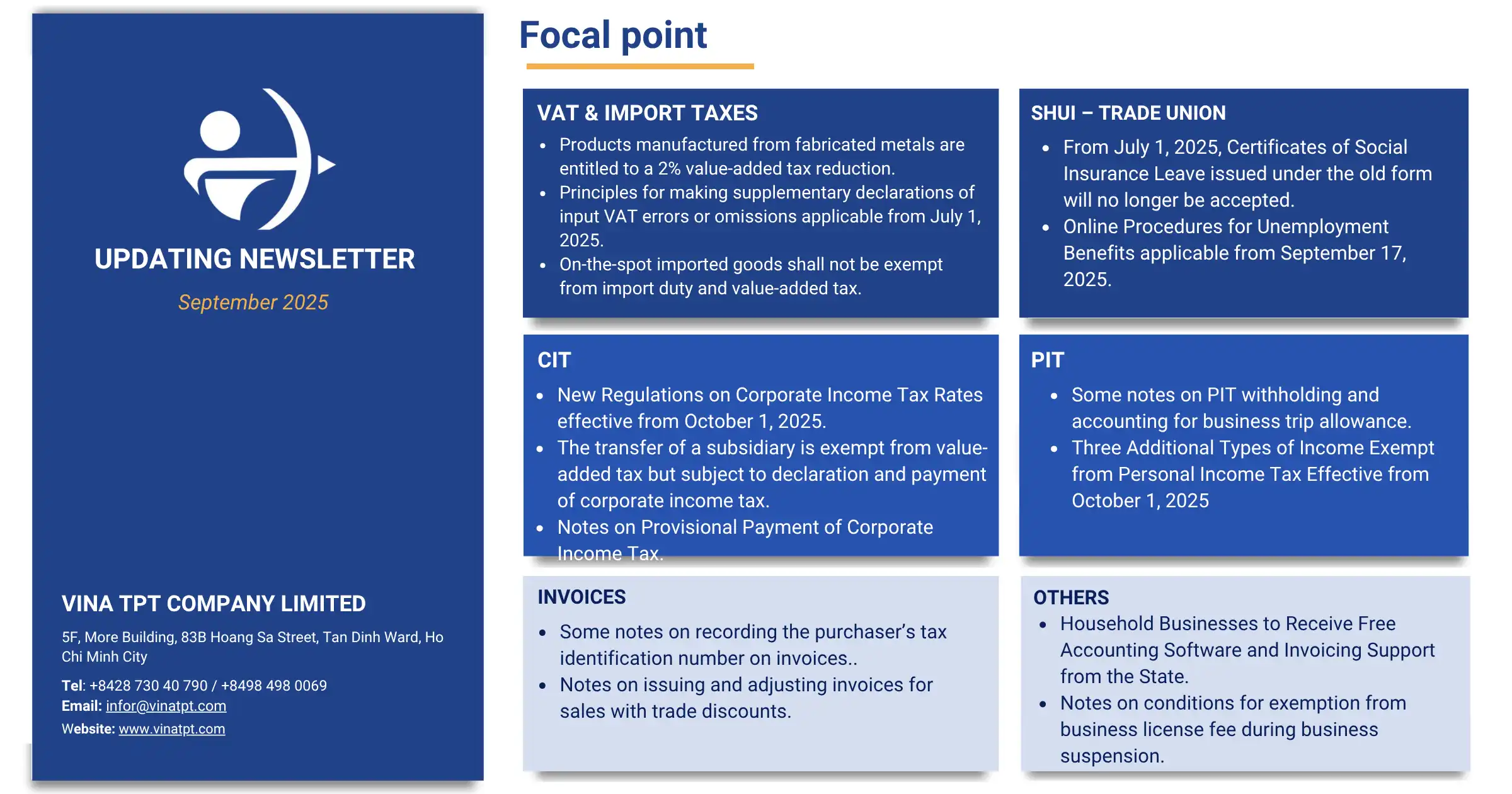
[Newsletter] Vietnam Tax Policy Updates September 2025- CIT, VAT, PIT and Social Insurance

Updates on new regulations regarding tax, e-invoices, and social insurance September 2025 (2)
As part of the Vietnam tax policy updates 2025, several new regulations related to Corporate Income Tax (CIT), Value Added Tax (VAT), Personal Income Tax (PIT), and social insurance are scheduled to take effect starting from September 2025. These changes are expected to directly impact financial reporting, payroll processes, and compliance operations across both Vietnamese and FDI enterprises.
To help businesses stay compliant and proactively adjust their internal procedures, this article provides a clear breakdown of the most important regulatory updates you need to be aware of.
In this article, we break down the most important tax regulations businesses need to prepare for in 2025.

1. Value-Added-Tax & IMPORT TAXES

1.a. Products manufactured from fabricated metals are entitled to a 2% value-added tax reduction.

Official Letter No. 6099/TCS3-QLDN2 dated September 11, 2025 of Dong Nai Tax Department regarding the case where a company manufactures and processes metal products, in which the determination of VAT reduction on sold products is made in accordance with Circular No. 174/2025/TT-BTC, specifically as follows:
  • The company shall identify its products based on the product codes, names, and descriptions provided in the Appendix issued together with Decision No. 43/2018/QD-TTg, and compare them with the List of goods and services not eligible for value-added tax (VAT) reduction issued together with Circular No. 174/2025/TT-BTC. In cases where the products fall under the List of goods attached to Circular No. 174/2025/TT-BTC, they shall not be entitled to VAT reduction.
  • For products manufactured from fabricated metals classified under Section 25, which are not included in the List of goods and services issued together with Circular No. 174/2025/TT-BTC, a VAT reduction shall apply.

1.b. Principles for making supplementary declarations of input VAT errors or omissions applicable from July 1, 2025.

Official Letter No. 3915/CT-CS dated September 18, 2025 of the Tax Department regarding VAT policies, specifically as follows:
  • The Tax Department stated that, from July 1, 2025, the Law on Value-Added Tax No. 48/2024/QH15 and Decree No. 181/2025/ND-CP have specifically provided regulations on the declaration and deduction of input VAT in cases of errors or omissions. Enterprises are therefore requested to study and comply with these provisions. Accordingly, under Point đ, Clause 1, Article 14 of Law No. 48/2024/QH15 and Clauses 5 and 6, Article 23 of Decree No. 181/2025/ND-CP, when errors or omissions in input VAT are detected, business establishments shall make supplementary declarations in accordance with the following principles:
  • A supplementary declaration shall be made in the month or quarter in which the error or omission in input VAT arises, if such error or omission results in an increase in tax payable or a reduction in refundable tax for that month or quarter.
  • A supplementary declaration shall be made in the month or quarter when the error or omission is detected, if such error or omission results in a decrease in tax payable, or only increases or decreases the amount of VAT to be carried forward to the subsequent period.

1.c. On-the-spot imported goods shall not be exempt from import duty and value-added tax.

Official Letter No. 22303/CHQ-GSQL dated September 5, 2025 of the Customs Department regarding on-the-spot imported goods, specifically as follows:
  • Clause 3 Article 3 of Law No. 90/2025/QH15 supplements Article 47a of the Customs Law, stipulating that on-the-spot import and export goods are goods delivered and received in Viet Nam under the designation of a foreign trader pursuant to sale, processing, leasing, or borrowing contracts. Cases that meet these conditions shall carry out customs procedures under Article 35 of Circular No. 08/2015/TT-BTC (as amended by Circular No. 167/2025/TT-BTC) and Article 86 of Circular No. 38/2015/TT-BTC (as amended by Circular No. 39/2018/TT-BTC).
  • According to Circular No. 134/2016/TT-BTC (as amended by Circular No. 18/2021/TT-BTC), in cases where on-the-spot imports are not registered under the processing type, the importer must declare and pay import duty based on the applicable duty rate and customs value at the time of registration. If import duty has been paid for production or business purposes and the imported products have been actually exported abroad or to a non-tariff zone, the paid duty shall be refunded in accordance with Article 36 of this Circular
  • On-the-spot import and export goods remain subject to VAT. Where goods are registered under other types (not processing), the taxpayer shall use code A11 (commercial import) or A12 (import for production and business) to declare and pay import duty and VAT.

2. Personal Income Tax (PIT)

2a. Some notes on PIT withholding and accounting for business trip allowance.

Official Letter No. 2284/CTH-QLDN1 dated September 15, 2025 of the Can Tho City Tax Department regarding taxable personal income (PIT) on business trip allowances, specifically as follows:
  • Taxable PIT income with respect to lump-sum business trip allowances: This is the portion of business trip allowances exceeding the limits prescribed by the State. Specifically: For employees working in business organizations and representative offices, the limit on business trip allowances shall be applied consistently with the level determined for corporate income tax (CIT) purposes. For employees working in international organizations or representative offices of foreign organizations, the limit on business trip allowances shall be applied in accordance with the regulations of such international organizations or representative offices of foreign organizations (see Point đ.4, Clause 2, Article 2 of Circular No. 111/2013/TT-BTC).
Travel expenses and accommodation costs for employees on business trips shall be deductible if supported by sufficient invoices and documents.
  • Where the enterprise has a financial/internal regulation stipulating allowances for travel, accommodation, and per diem for employees on business trips, and such regulation is properly implemented, these expenses shall be deductible.
  • Payment by employees’ personal bank cards for business trip expenses of VND 20 million or more (including airfares):
  • Such expenses shall be deductible if the following conditions are met:
  • Valid invoices and supporting documents are available.
  • A decision or written authorization for the employee’s business trip is issued.
  • The enterprise’s financial/internal regulation permits employees to pay using personal bank cards, with subsequent reimbursement by the enterprise.
  • Purchase of air tickets via e-commerce websites: The documents serving as the basis for deductibility include the electronic air ticket, boarding pass, and the enterprise’s non-cash payment vouchers showing the individual undertaking the transportation service.

Explore Tax Services in Viet Nam

2b. Three Additional Types of Income Exempt from Personal Income Tax Effective from October 1, 2025

According to the new provisions in the Law on Science, Technology and Innovation 2025 (No. 93/2025/QH15), effective from October 1, 2025, Clause 3, Article 71 of this Law supplements Points 18, 19, and 20 after Point 17 of Article 4 on tax-exempt income under the Law on Personal Income Tax 2007, as amended and supplemented.
Accordingly, from October 1, 2025, three additional types of income will be exempt from Personal Income Tax (PIT), including:
  • Income from salaries and wages received from performing science, technology, and innovation tasks.
  • Income from copyright related to science, technology, and innovation tasks when the results of such tasks are commercialized in accordance with the laws on science, technology, innovation, and intellectual property.
  • Income of individual investors and experts working for start-up innovation projects, founders of start-up enterprises, and individual investors contributing capital to venture capital funds.

3. Corporate Income Tax (CIT)
Corporate-income-tax-VinaTPT

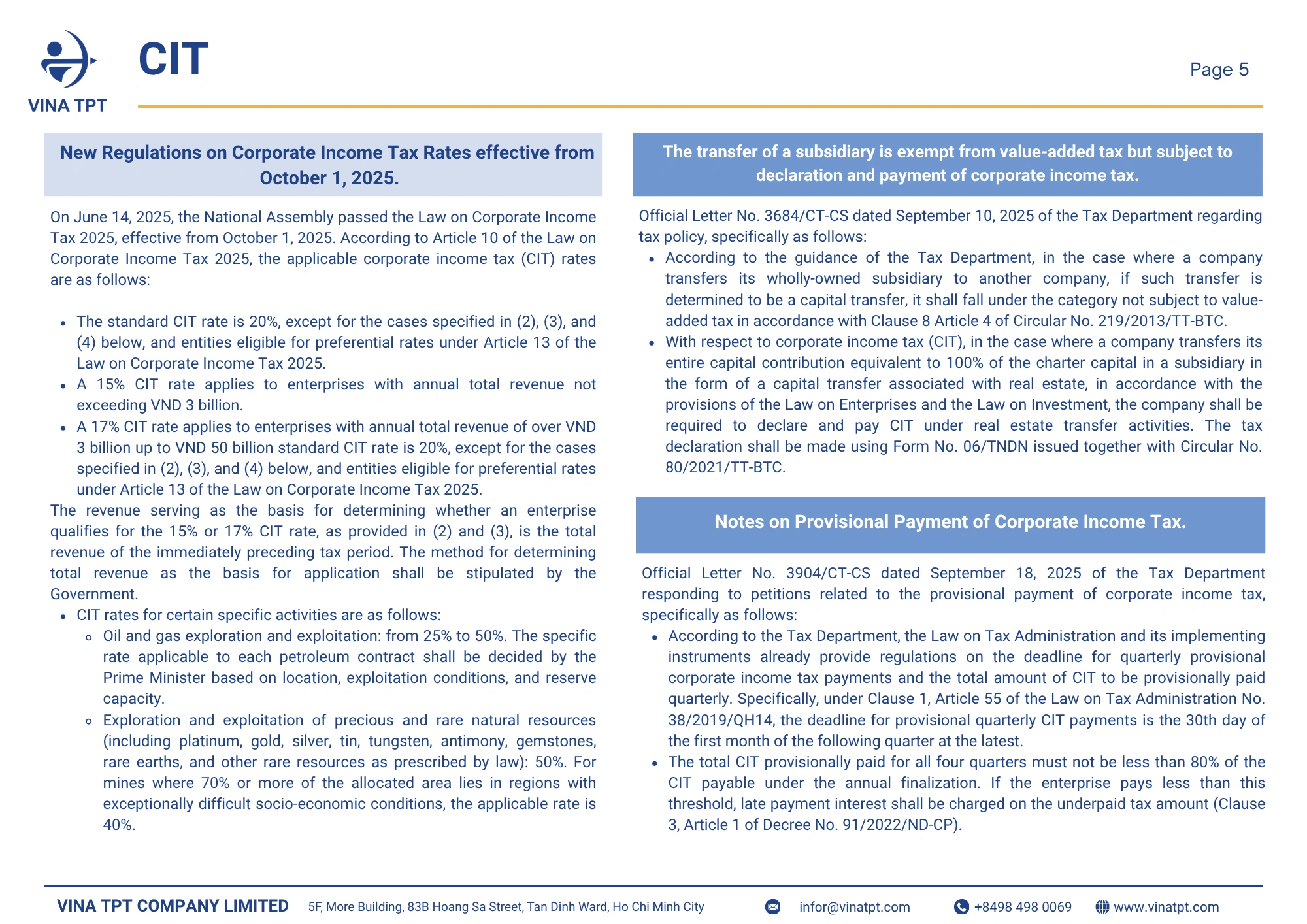
3a. New Regulations on Corporate Income Tax Rates effective from October 1, 2025.

On June 14, 2025, the National Assembly passed the Law on Corporate Income Tax 2025, effective from October 1, 2025. According to Article 10 of the Law on Corporate Income Tax 2025, the applicable corporate income tax (CIT) rates are as follows:
  • The standard CIT rate is 20%, except for the cases specified in (2), (3), and (4) below, and entities eligible for preferential rates under Article 13 of the Law on Corporate Income Tax 2025.
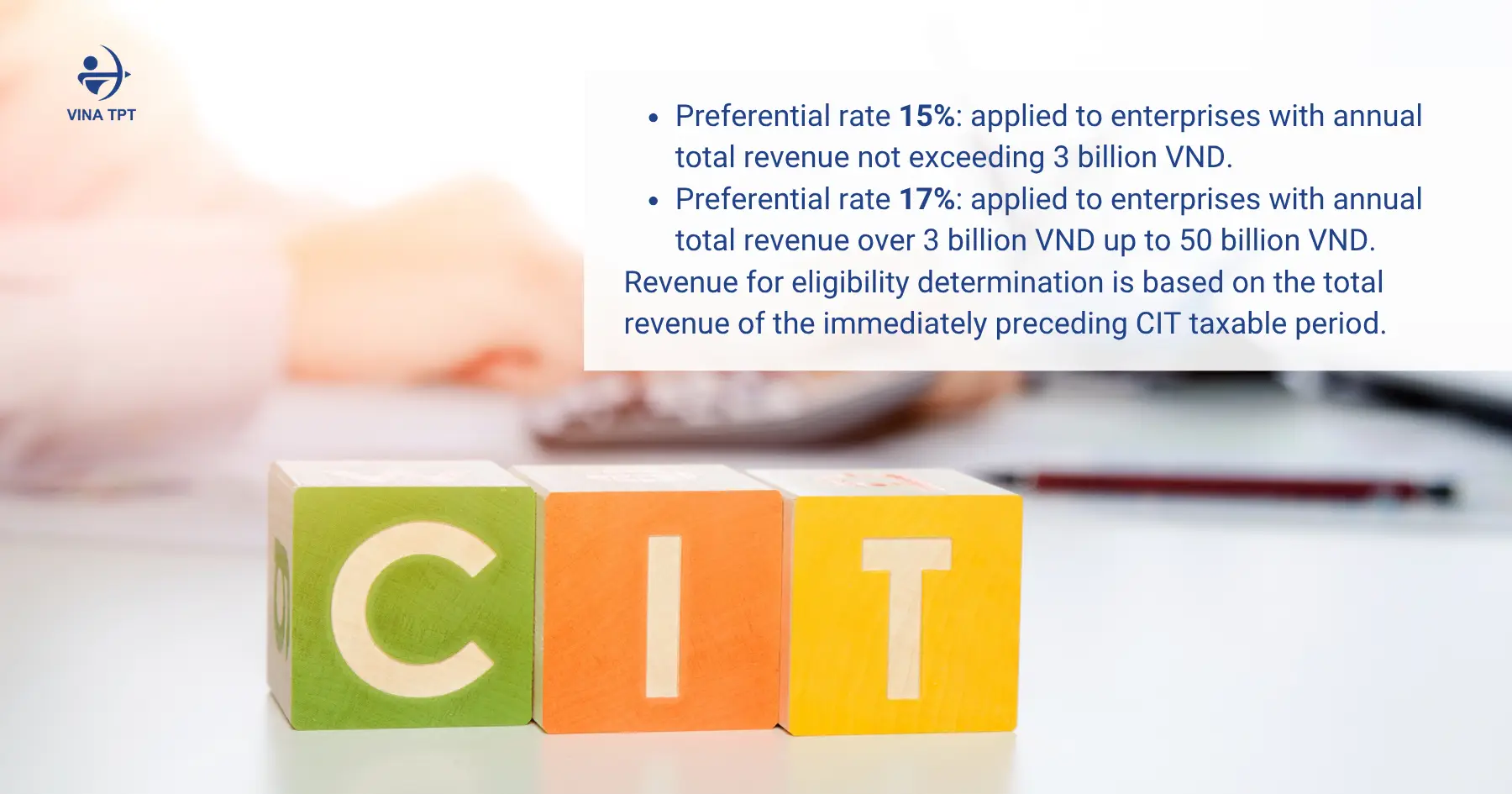
  • A 15% CIT rate applies to enterprises with annual total revenue not exceeding VND 3 billion.
  • A 17% CIT rate applies to enterprises with annual total revenue of over VND 3 billion up to VND 50 billion standard CIT rate is 20%, except for the cases specified in (2), (3), and (4) below, and entities eligible for preferential rates under Article 13 of the Law on Corporate Income Tax 2025
The revenue serving as the basis for determining whether an enterprise qualifies for the 15% or 17% CIT rate, as provided in (2) and (3), is the total revenue of the immediately preceding tax period. The method for determining total revenue as the basis for application shall be stipulated by the Government.
CIT rates for certain specific activities are as follows:
  • Oil and gas exploration and exploitation: from 25% to 50%. The specific rate applicable to each petroleum contract shall be decided by the Prime Minister based on location, exploitation conditions, and reserve capacity.
  • Exploration and exploitation of precious and rare natural resources (including platinum, gold, silver, tin, tungsten, antimony, gemstones, rare earths, and other rare resources as prescribed by law): 50%. For mines where 70% or more of the allocated area lies in regions with exceptionally difficult socio-economic conditions, the applicable rate is 40%.

3b. The transfer of a subsidiary is exempt from value-added tax but subject to declaration and payment of corporate income tax.

Official Letter No. 3684/CT-CS dated September 10, 2025 of the Tax Department regarding tax policy, specifically as follows:
  • According to the guidance of the Tax Department, in the case where a company transfers its wholly-owned subsidiary to another company, if such transfer is determined to be a capital transfer, it shall fall under the category not subject to value-added tax in accordance with Clause 8 Article 4 of Circular No. 219/2013/TT-BTC.
  • With respect to corporate income tax (CIT), in the case where a company transfers its entire capital contribution equivalent to 100% of the charter capital in a subsidiary in the form of a capital transfer associated with real estate, in accordance with the provisions of the Law on Enterprises and the Law on Investment, the company shall be required to declare and pay CIT under real estate transfer activities. The tax declaration shall be made using Form No. 06/TNDN issued together with Circular No. 80/2021/TT-BTC.

3c. Notes on Provisional Payment of Corporate Income Tax.

Official Letter No. 3904/CT-CS dated September 18, 2025 of the Tax Department responding to petitions related to the provisional payment of corporate income tax, specifically as follows:
  • According to the Tax Department, the Law on Tax Administration and its implementing instruments already provide regulations on the deadline for quarterly provisional corporate income tax payments and the total amount of CIT to be provisionally paid quarterly. Specifically, under Clause 1, Article 55 of the Law on Tax Administration No. 38/2019/QH14, the deadline for provisional quarterly CIT payments is the 30th day of the first month of the following quarter at the latest.
  • The total CIT provisionally paid for all four quarters must not be less than 80% of the CIT payable under the annual finalization. If the enterprise pays less than this threshold, late payment interest shall be charged on the underpaid tax amount (Clause 3, Article 1 of Decree No. 91/2022/ND-CP).

4. Social Insurance – Trade Union

a. From July 1, 2025, Certificates of Social Insurance Leave issued under the old form will no longer be accepted.

Official Letter No. 5761/BYT-KCB dated August 27, 2025 of the Ministry of Health regarding the settlement of difficulties in implementing social insurance regimes for employees, specifically as follows:
  • Accordingly, the Ministry of Health notes that Certificates of Social Insurance Leave issued prior to the effective date of Circular No. 25/2025/TT-BYT (July 1, 2025) shall remain valid as the basis for entitlement to social insurance benefits. For Certificates issued after July 1, 2025, it is mandatory to use the new form promulgated under Circular No. 25/2025/TT-BYT. The difference between the new form and the old form (issued under Circular No. 18/2022/TT-BYT) lies in the addition of information on the employee’s citizen identification number/identity card number/passport number/personal identification number; other contents remain unchanged from the old form.
  • During the initial implementation of Circular No. 25/2025/TT-BYT, for documents issued by hospitals still using the old form and not yet switched to the new form, in order to ensure employees’ rights and avoid inconvenience, the Ministry of Health has requested that enterprises prepare a list of employees whose documents were issued by hospitals in non-compliance with regulations, and submit an official letter to the Department of Health or the health authority of the relevant ministries/agencies managing such hospitals, requesting the supplementation of information on the documents already issued, as prescribed in Point b, Clause 4, Article 28 of Circular No. 25/2025/TT-BYT.
As for Certificates of Social Insurance Leave without the hospital’s seal due to the seal not yet being updated to the new address following a merger, the Ministry of Health has stated that, under Clause 8, Article 69 of Decree No. 188/2025/ND-CP, medical examination and treatment establishments are permitted to continue using their old seals until new seals are issued.

b. Online Procedures for Unemployment Benefits applicable from September 17, 2025.

Decision No. 1295/QD-TTPVHCC dated September 17, 2025 of the People’s Committee of Hanoi City announcing the List of administrative procedures on unemployment insurance to be piloted on the National Public Service Portal under the management competence of the Department of Home Affairs of Hanoi City, specifically as follows:
This Decision announces six procedures concerning the entitlement to and termination of unemployment benefits to be piloted by the Hanoi Department of Home Affairs on the National Public Service Portal as from September 17, 2025, including:
  • Settlement of entitlement to unemployment benefits
  • Monthly notification of job search activities.
  • Settlement of entitlement to unemployment benefits
  • Settlement of entitlement to unemployment benefits
  • Transfer of entitlement to unemployment benefits (integrated procedure for transfer-out and transfer-in).
  • Termination of entitlement to unemployment benefits.
This Decision takes effect from the date of signing.

5. OTHER

a. Household Businesses to Receive Free Accounting Software and Invoicing Support from the State.

Official Letter No. 3914/CT-CS dated September 18, 2025 of the Tax Department regarding the response to the petition of the Vietnam Banks Association:
  • With respect to the use of invoices by household businesses, the Tax Department notes that, pursuant to the provisions of Decree No. 70/2025/NĐ-CP, from June 1, 2025, when selling goods or providing services directly to consumers, household businesses under the lump-sum tax regime with annual revenue exceeding VND 1 billion must issue electronic invoices generated from cash registers connected to and transmitting data to the tax authority, and deliver such invoices to buyers. The electronic invoice data is already available on the tax authority’s system, allowing both sellers and buyers to look up invoices on the system without the need to print paper copies.
  • Under the current guidance provided in Circular No. 40/2021/TT-BTC, there is no provision requiring lump-sum household businesses to retain purchase invoices or supporting documents.
  • As stipulated at Point b, Clause 4, Article 13 of Circular No. 40/2021/TT-BTC, in cases where a lump-sum household business changes its business scale (premises size, labor use, or revenue), it must declare adjustments and supplements to the Tax Return using Form No. 01/CNKD. The tax authority, based on the household business’s tax return and the tax sector’s database, shall issue a Notice of adjustment of lump-sum tax if it determines that declared revenue has changed by 50% or more compared to the previously assessed lump-sum revenue, effective from the time of such change within the tax year.
Furthermore, pursuant to Clause 3, Article 12 of Resolution No. 198/2025/QH15, the State shall allocate funding to provide free shared digital platforms and accounting software for small and micro enterprises, household businesses, and individual business households. At present, the Ministry of Finance is drafting a Decree guiding the implementation of this Resolution, which will include provisions on the measures to support the free provision of shared digital platforms and accounting software for small and micro enterprises, household businesses, and individual businesses.

b. Notes on conditions for exemption from business license fee during business suspension.

Official Letter No. 1355/QNG-QLDN1 dated September 4, 2025, of the Quang Ngai Provincial Tax Department on guidance regarding business license fees
  • The conditions for exemption from the business license fee during business suspension are stipulated in Clause 2, Article 1 of Decree No. 22/2020/NĐ-CP and Clause 4, Article 1 of Circular No. 65/2020/TT-BTC, as follows: a written request for suspension of production and business operations must be submitted to the tax authority or the business registration authority before the deadline for payment of the business license fee (January 30 each year), and the business license fee of the year in which suspension is requested has not yet been paid.
  • Accordingly, if a Company has submitted a written request to the business registration authority to suspend production and business operations in the calendar year 2025 (from January 1 to December 31) before the license fee payment deadline (before January 30) and has not yet paid the 2025 business license fee, then the Company is not required to pay the license fee for 2025.
However, if the above conditions are not satisfied, the Company must pay the business license fee for 2025.

6. INVOICES

a. Some notes on recording the purchaser’s tax identification number on invoices.

Official Letter No. 3955/CT-CS dated September 19, 2025 of the Tax Department regarding e-invoices, specifically as follows:
  • The presentation of the buyer’s name, address, and taxpayer identification number on e-invoices shall comply with the provisions of Clause 5 and Point c, Clause 14, Article 10 of Decree No. 123/2020/ND-CP (as amended and supplemented at Points a and d, Clause 7, Article 1 of Decree No. 70/2025/ND-CP). Accordingly, in cases where the buyer is a business establishment with a TIN, the buyer’s name, address, and TIN stated on the invoice must be consistent with the information on the enterprise/branch registration certificate, household business registration certificate, tax registration certificate, or TIN notification
  • If the purchaser does not have a tax identification number, the TIN is not required to be shown on the e-invoice. In addition, in cases specified at Point c, Clause 14 , Article 10, it is not mandatory to indicate the purchaser’s name, address, or TIN on the invoice. As from June 1, 2025, where the purchaser provides a TIN or personal identification number, the invoice must also include such TIN or personal identification number.
  • For e-invoices generated from cash registers, the invoice must show the purchaser’s name, address, tax identification number/personal identification number/telephone number if so requested by the purchaser (see Clause 3, Article 11 of Decree No. 123/2020/ND-CP, as amended and supplemented under Clause 8, Article 1 of Decree No. 70/2025/ND-CP).

b. Notes on issuing and adjusting invoices for sales with trade discounts.

Official Letter No. 1802/CTH-QLDN3 dated September 3, 2025, of the Can Tho City Tax Department regarding trade discount invoices, specifically as follows:
In this document, the Can Tho City Tax Department provided guidance on determining VAT taxable prices in cases of trade discounts, how to present discount amounts on invoices, and how to handle adjustment invoices when discounts are based on quantity or sales volume. Specifically:
VAT taxable price: The VAT taxable price is the selling price after deducting the trade discount given to customers, excluding VAT (Clause 2, Article 14 of Decree No. 181/2025/NĐ-CP).
Presentation on invoices: The invoice must clearly indicate the trade discount amount (Point đ, Clause 6, Article 10 of Decree No. 123/2020/NĐ-CP.
Discounts based on quantity or sales volume:
  • Adjustment on the last purchase/next period invoice: The discount amount shall be adjusted on the sales/service invoice of the last purchase or subsequent period, ensuring the discount amount does not exceed the value of goods or services recorded on that invoice.
  • Issuing an adjustment invoice: An adjustment invoice may be issued together with a list of the invoices subject to adjustment, including amounts and tax adjustments. The list must be kept at the entity and presented upon request by the tax authority or other competent state authority (Clause 13, Article 1 of Decree No. 70/2025/NĐ-CP amending and supplementing Article 19 of Decree No. 123/2020/NĐ-CP.
  • Tax return adjustments: Based on the adjustment invoice and related records, both the buyer and the seller shall declare adjustments to sales revenue, purchase revenue, input and output VAT in the period when the adjustment invoice is issued.
  • Adjustment invoice for trade discounts: This is an adjustment invoice for previously issued invoices, used to adjust differences in amounts only; it is not used to declare sales revenue already incurred. Accordingly, in the electronic invoice system of the General Department of Taxation, the line “Total amount before tax” will display the trade discount amount, while the line “Total trade discount amount” will display as 0.

Contact us for support

📞 (+84) 984 980 069

📧 infor@vinatpt.com

🌐www.vinatpt.com

🏢 5th Floor, More Building, 83B Hoang Sa, Tan Dinh Ward, Ho Chi Minh City

accounting service Vietnam for FDI company vtpt

Entering Vietnam’s Clothing Market: A Practical Guide for Chinese Manufacturers

Vina TPT company registration service supporting Chinese clothing investors in Vietnam

business-license-in-vietnam-for-chinese-manufacturer

1. Why Vietnam Is the Next Stop for China’s Clothing Giants

Vietnam is emerging as one of the most dynamic consumer markets in Southeast Asia, especially in the fashion and retail sectors. The middle class is growing rapidly, average incomes are rising, and young people’s shopping trends are gradually shifting towards brands with unique styles and reasonable prices.

For foreign investors and Chinese fashion brands, obtaining a business license in Vietnam is the first important step to legally enter this fast-growing market. With proper licensing and strategic market entry, businesses can take full advantage of Vietnam’s expanding retail opportunities and rising consumer demand.

Vietnamese consumers, especially Gen Z and Millennials, prefer modern fashion that quickly updates global trends while maintaining high practicality. This creates a great advantage for Chinese businesses, which have the ability to produce quickly, flexibly, and at competitive costs.

Not only does Vietnam have great purchasing power, it is also a politically stable market, transparent in investment, and benefits from many free trade agreements (CPTPP, RCEP, EVFTA). In addition, obtaining a business license in Vietnam for fashion or retail activities has become increasingly streamlined, making importing, distributing, or opening Chinese fashion brands in Vietnam easier and more compliant than ever. business license in vietnam

2. Choosing the Right Market Entry Strategy

Chinese businesses can choose one of three popular models when expanding into the Vietnamese market:

  • Establishing a 100% foreign-owned company (WFOE): Suitable for brands that want to control the entire import-distribution-retail process. This model allows for opening physical stores or doing business online after obtaining the required business license in Vietnam.
  • Cooperating with local distributors: helps save costs, quickly access the market, and take advantage of the existing retail network.
  • Joint Venture: Cooperating with Vietnamese businesses to combine local knowledge with goods sources and management capacity from China.

Each form has its own advantages in terms of control level, cost and risk, so it is necessary to consult carefully before choosing.

3. Beyond Paperwork: Setting the Foundation for Operations

To open a business in Vietnam, businesses need to carry out some important legal procedures to have business license in Vietnam:

Investment Registration Certificate (IRC) if there is foreign capital. IRC is the first license allowing the investor to implement the project in Vietnam.

The required documents usually include:

  • Application for investment project implementation and Project proposal: stating the objectives, scale, location, investment capital, progress.
  • Proof of the investor’s financial capacity: bank statement, credit contract or collateral.
  • Legal documents of the investor:
    • Individual: Notarized passport, consular legalization.
    • Organization: Business registration certificate or equivalent document, consular legalization.
  • Project location: lease contract or land/office use rights certificate.

After the IRC is granted (or for 100% domestic-owned enterprises), the investor applies for an ERC – an official license for the enterprise to operate, and also the tax code of the company.

Enterprise Registration Certificate (ERC) at the Department of Planning & Investment. The ERC dossier usually includes:

  • Application for enterprise registration.
  • Company Charter: stipulates the organizational structure, powers of members/shareholders, capital ratio and management method.
  • List of members/shareholders and legal representatives: clearly state information, ownership ratio, voting rights.
  • Appointment decision and authorization letter (if any).
  • Capital contribution plan & financial evidence: bank statement or credit contract (especially important for large capital projects).

Register appropriate business lines, for example:

  • Wholesale and retail of garments and fashion accessories.
  • Import and export of fashion goods.
  • E-commerce business (if selling online).

The good news is that the fashion trade and distribution industry does not require any special sub-licenses, so the establishment procedure is quite simple and the processing time is fast.

After obtaining the business license in Vietnam, the business needs to register a tax code, open a bank account, issue electronic invoices and declare taxes periodically to operate legally.

CONSULT ON BUSINESS LICENSE IN VIETNAM

4. Workforce and Culture Integration

The Vietnamese market is diverse and can be divided into 3 key areas:

  • Ho Chi Minh City: a vibrant commercial center, suitable for young, dynamic fashion.
  • Hanoi: a traditional market, favoring brands with reliability and elegant designs.
  • Da Nang, Can Tho: emerging markets, low cost, easy to test retail models.

In addition to choosing a strategic business location, businesses need to:

  • Cooperate with logistics units to optimize shipping costs from China to Vietnam.
  • Build a localized marketing strategy, combining platforms such as TikTok, Shopee, Lazada and Facebook, which currently account for the majority of online fashion sales channels in Vietnam.
  • Understand Vietnamese fashion tastes: prioritize light, airy, easy-to-match and highly applicable products.

5. Local Compliance and Ethical Manufacturing

When operating in Vietnam, recruiting and managing local human resources is an important factor.

Chinese enterprises need to clearly understand the regulations on labor contracts, social insurance, and personal income tax (PIT) to avoid violations.

In addition, cultural differences should also be noted:

  • Vietnamese people value respect, gentleness, and collaboration in the working environment.
  • A team of dedicated employees, paid on time and transparently will help operations run smoothly, especially in the retail and customer care sectors.

Many foreign enterprises choose to outsource payroll and HR services to ensure compliance, optimize costs, and reduce administrative risks. In addition, working with a professional consulting partner also helps businesses handle legal procedures such as applying for a business license in Vietnam, registering employees, and setting up a compliant payroll system, ensuring smooth and lawful operations from the start.

6. How Vina TPT Helps You Scale Smoothly

Vina TPT Company Registration is a consulting and implementation unit for comprehensive services for foreign investors in Vietnam, especially Chinese enterprises in the fields of fashion, trade and light manufacturing.

We provide:

  • Investment consulting & legal structure according to the desired business model.
  • Business registration services (ERC, IRC), opening bank accounts, tax codes and electronic invoices.
  • Accounting, tax, payroll, periodic compliance management, ensuring transparent and legal operations.
  • Bilingual support in English – Vietnamese, helping businesses easily exchange and process documents.

With a team of experts with more than 2015 years of experience in the fields of foreign investment, finance and law, Vina TPT has accompanied hundreds of Chinese FDI companies to successfully expand in Vietnam – from establishment to stable operation.

7. From Setup to Growth: Building a Sustainable Clothing Brand in Vietnam

Vietnam is not only a “production hub” but also a booming consumer market with long-term potential.

Chinese businesses can take advantage of this market to build their brands, develop distribution channels, and expand into Southeast Asia.

With a deep understanding of Vietnam’s legal framework, tax regulations, and consumer market, Vina TPT helps you take every step with confidence – from setting up a legal entity and applying for business licenses in Vietnam, to managing finances and ensuring smooth operations.

Want to bring a Chinese fashion brand to Vietnam quickly and legally? 

Let Vina TPT accompany you through the entire process of company registration, compliance and tax accounting, helping you focus on developing your brand.

BOOK A FREE CONSULTATION

business-license-in-vietnam-for-chinese-manufacturer

Business Established in Vietnam for Korean Electronics Manufacturers

Korean investor receiving business license in Vietnam

setting-up-electronics-business-in-Vietnam

1. Vietnam – The Next Hub for Korean Electronics Manufacturers

As Korean companies continue to look for new growth opportunities across Asia, Vietnam has become one of the most attractive destinations for manufacturing expansion. With a favorable investment climate and a streamlined business license in Vietnam process for foreign enterprises, Vietnam offers Korean electronics manufacturers an ideal entry point to establish long-term operations. Supported by government incentives and a robust supply chain ecosystem, the country is quickly evolving into a major production hub in the region.

Major corporations such as Samsung, LG, and Hanwha have established large-scale production complexes in Bac Ninh, Thai Nguyen, and Hai Phong, regions that are rapidly becoming Vietnam’s key electronics hubs, supported by modern logistics networks, seaports, and government investment incentives.

Moreover, Vietnam’s active participation in free trade agreements such as CPTPP and EVFTA has unlocked significant tariff advantages, enhancing its competitiveness in the global supply chain. A young, skilled workforce combined with the nation’s push for digital transformation positions Vietnam as the “new manufacturing base” for the global electronics industry, much like South Korea’s industrial rise in the 1990s.

For Korean investors, establishing a business in Vietnam not only optimizes production costs but also opens access to ASEAN, China, and India markets. By obtaining the appropriate business license in Vietnam and leveraging professional strategic consulting, Korean electronics enterprises can streamline the enterprise registration process and transform Vietnam into a sustainable hub for manufacturing and innovation in the region.

2. Strategic Considerations Before Enterprise Registration in Vietnam

Before starting the registration process, investors need to carefully consider strategic factors.

Location is key: Northern regions such as Bac Ninh, Hai Phong, Thai Nguyen currently have many Korean electronics factories, convenient for connecting and sharing the supply chain.

Legal form also directly affects the right to operate and tax obligations. Enterprises can choose to establish a 100% foreign-owned company, joint venture with a Vietnamese partner or open a representative office.

In addition, the domestic supply chain in Vietnam is expanding rapidly, providing components and logistics services suitable for electronics production. Understanding these factors helps Korean enterprises optimize costs and limit risks when entering new markets.

Book a Free Consultation on Your Business License

3. Understanding Business License in Vietnam and Compliance for Electronics Companies

After being granted the Investment Registration Certificate (IRC) and Enterprise Registration Certificate (ERC), the electronics enterprise needs to apply for a business license appropriate to the field of operation.

The electronics manufacturing industry has its own requirements on environmental safety, technology standards and fire prevention.

The estimated time for completion is:

Document preparation: 1-2 weeks, depending on the volume of documents and the level of complexity.

  • IRC appraisal: 20-45 working days.
  • ERC issuance: 10-20 working days after IRC (or similar if the enterprise is a domestic enterprise).

In fact, if the enterprise cooperates with a reputable company registration service, it will help the enterprise quickly handle the consular legalization, translation and submission of documents, shortening the time and increasing the possibility of being licensed the first time.

setting-up-electronics-business-in-Vietnam

4. How to Establish Business in Vietnam and Maintain Legal Compliance

To successfully establish a business in Vietnam, investors need to take the following important steps:

Step 1: Complete the application and apply for Business License in Vietnam IRC, ERC.

If the project has FDI capital, IRC is the first license allowing the investor to implement the project in Vietnam.

The required documents usually include:

  • Application for investment project implementation and Project proposal: stating the objectives, scale, location, investment capital, progress.
  • Proof of the investor’s financial capacity: bank statement, credit contract or collateral.
  • Legal documents of the investor:
    • Individual: Notarized passport, consular legalization.
    • Organization: Business registration certificate or equivalent document, consular legalization.
  • Project location: lease contract or land/office use rights certificate.

After the IRC is granted (or for 100% domestic-owned enterprises), the investor applies for an ERC – an official license for the enterprise to operate, and also the tax code of the company.

The ERC dossier usually includes:

  • Application for enterprise registration.
  • Company Charter: stipulates the organizational structure, powers of members/shareholders, capital ratio and management method.
  • List of members/shareholders and legal representatives: clearly state information, ownership ratio, voting rights.
  • Appointment decision and authorization letter (if any).
  • Capital contribution plan & financial evidence: bank statement or credit contract (especially important for large capital projects).

Step 2: Open a bank account and contribute charter capital within 90 days from the date of issuance of ERC.

Step 3: Register a tax code and set up an accounting system according to Vietnamese standards.

Step 4: Sign a labor contract, pay social insurance and manage payroll according to regulations.

5. Vina TPT Company Registration – Partnering with Korean Electronics Manufacturers for a Sustainable Setup

With more than a decade of experience in investment consulting and business registration services, Vina TPT has successfully assisted hundreds of FDI enterprises, including a large number of Korean electronics manufacturers in establishing and expanding their operations in Vietnam.

Our comprehensive service scope covers every stage of the process — from investment model consulting and legal documentation, to business license application in Vietnam, business license renewal, and regulatory compliance. This integrated approach ensures a smooth and compliant market entry for Korean investors.

Backed by a team of seasoned professionals with in-depth knowledge of Vietnam’s business, tax, and labor laws, Vina TPT provides end-to-end business license advisory and compliance support, helping investors confidently execute their projects while focusing on production growth and long-term success.

Partnering with Vina TPT Business Advisory and Company Registration means more than saving time and costs. It’s about having a trusted local partner who truly understands how to help Korean investors establish, operate, and sustain successful ventures in Vietnam.

Contact Vina TPT for consultation and support on business registration in Vietnam quickly, legally and at optimal cost.

BOOK A FREE CONSULTATION

setting-up-electronics-business-in-Vietnam

Tax Breaks in Vietnam 2025 | Key CIT, VAT & PIT Updates

1/ Overview of Tax Breaks and Their Importance for FDI Businesses 

Tax breaks, also known as tax incentives, are government measures that reduce or exempt taxes to support businesses and individuals. These aim to boost investment, drive economic growth, and ease financial burdens. In Vietnam, tax breaks typically include exemptions, reduced rates, or deductible expenses. They help companies lower operating costs, boost net profits, and expand operations—especially amid post-pandemic recovery and global competition. 

For foreign direct investment (FDI) businesses, tax breaks serve as both financial tools and strategic advantages to attract capital. Under the 2025 Corporate Income Tax Law (No. 67/2025/QH15), these policies align with international commitments like the 15% global minimum tax. This creates competitive edges, encourages reinvestment, and generates jobs in Vietnam. 

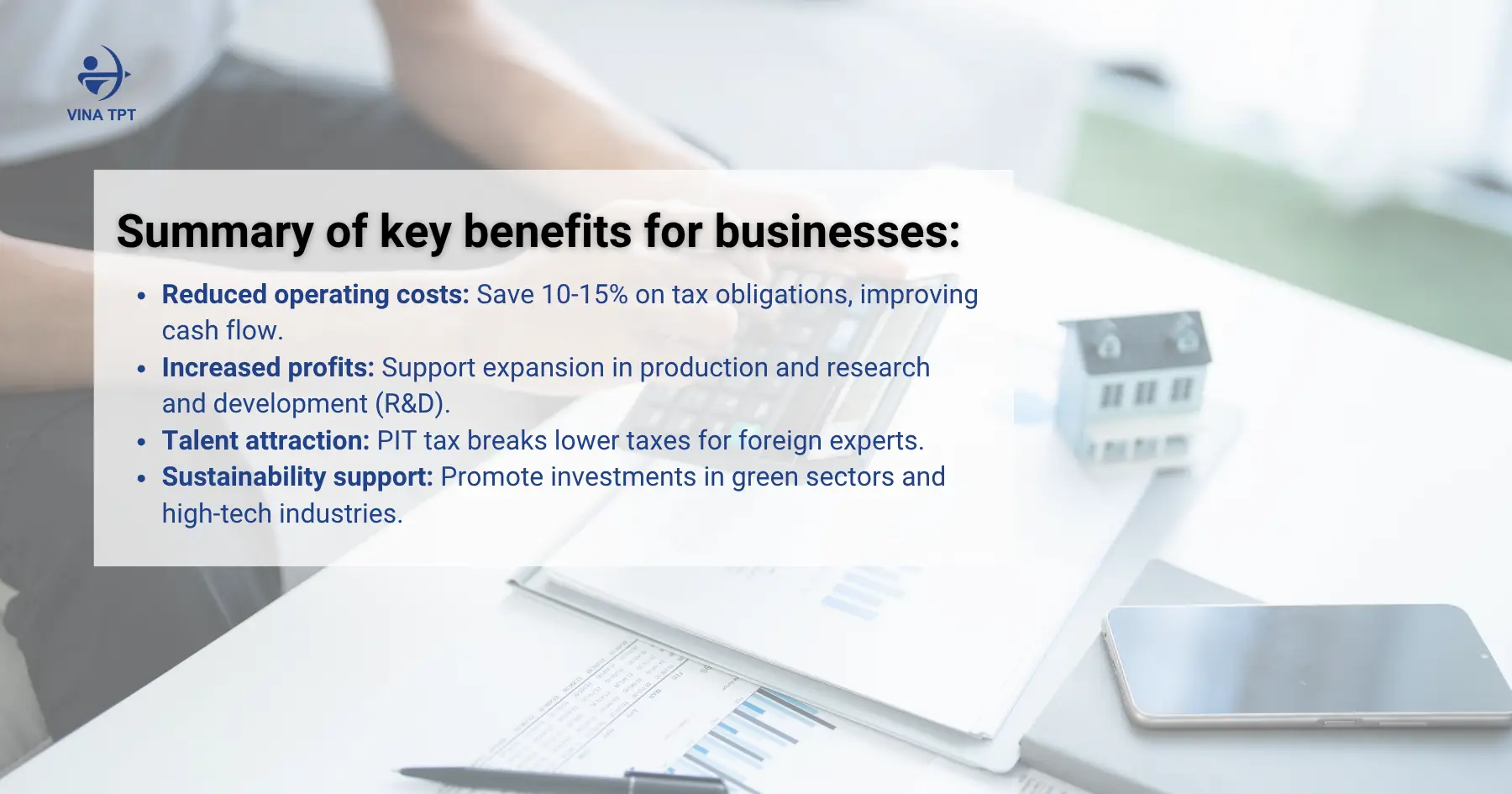
Here’s a summary of key benefits for FDI businesses: 

  • Reduced operating costs: Save 10-15% on tax obligations, improving cash flow. 
  • Increased profits: Support expansion in production and research and development (R&D). 
  • Talent attraction: PIT tax breaks lower taxes for foreign experts. 
  • Sustainability support: Promote investments in green sectors and high-tech industries. 

Explore the common tax breaks available in Vietnam to maximize benefits for your FDI enterprise. 

2/ Common Types of Tax Breaks Currently Available 

Vietnam’s government is refining tax policies to aid businesses during economic recovery, focusing on priority sectors like technology, green manufacturing, and exports. Starting in 2025, incentives apply to key taxes: Corporate Income Tax (CIT), Value-Added Tax (VAT), and Personal Income Tax (PIT). Each targets different groups and goals, helping FDI businesses cut financial loads and enhance competitiveness. Below is a comparison table: 

Tax Type  Main Incentives  Applicable Entities  Duration 
CIT  Exemption for 2-4 years, 50% reduction thereafter  FDI businesses in priority sectors  6-15 years 
VAT  Reduction from 10% to 8%  Goods and services (exclusions apply)  Until December 31, 2026 
PIT  Family deduction of VND 11 million/month (rising to VND 15.5 million/month from 2026)  Individuals and foreign experts as residents  Annual 

2.1 Corporate Income Tax (CIT) Incentives Effective from October 1, 2025 

Corporate Income Tax (CIT) directly impacts FDI business profits. From October 1, 2025, the 2025 CIT Law (No. 67/2025/QH15) expands incentives to attract high-quality investments. FDI enterprises starting new projects in high-tech fields, disadvantaged areas, or economic zones qualify for CIT exemptions for 2-4 initial years and a 50% reduction for the next 4-9 years. Preferential rates can drop to 10% for specially prioritized projects, 15% for small and medium enterprises, or 17% for investments in favored locations. 

Incentives are categorized by: 

  • Sector: High-tech, education, healthcare—exemption for 4 years, 50% reduction for 9 years. 
  • Location: Disadvantaged areas—10% rate for 15 years. 
  • Investment scale: Projects over EUR 750 million apply the 15% global minimum tax. 

Summary table: 

Incentive Type  Conditions  Duration  Reduction Level 
Exemption  High-tech projects  4 years  100% 
Rate reduction  Favored locations  15 years  10-17% 
50% reduction  New investment projects  4-9 years  50% 

Impact on FDI businesses: 

  • Cost savings up to 20-30%, boosting net profits and reinvestment. 
  • Encourages production growth and local job creation. 

Example: An FDI company investing USD 100 million in a high-tech zone could save tens of millions in taxes over the first 10 years. 

FDI enterprises should consult tax experts early to ensure proper reporting, legal workforce use, and eligibility maintenance. Compliance from the start avoids audits, penalties, and maximizes legal tax breaks. 

Maximize Your Tax Incentives Today

2.2 Value-Added Tax (VAT) Incentives Effective from July 1, 2025 

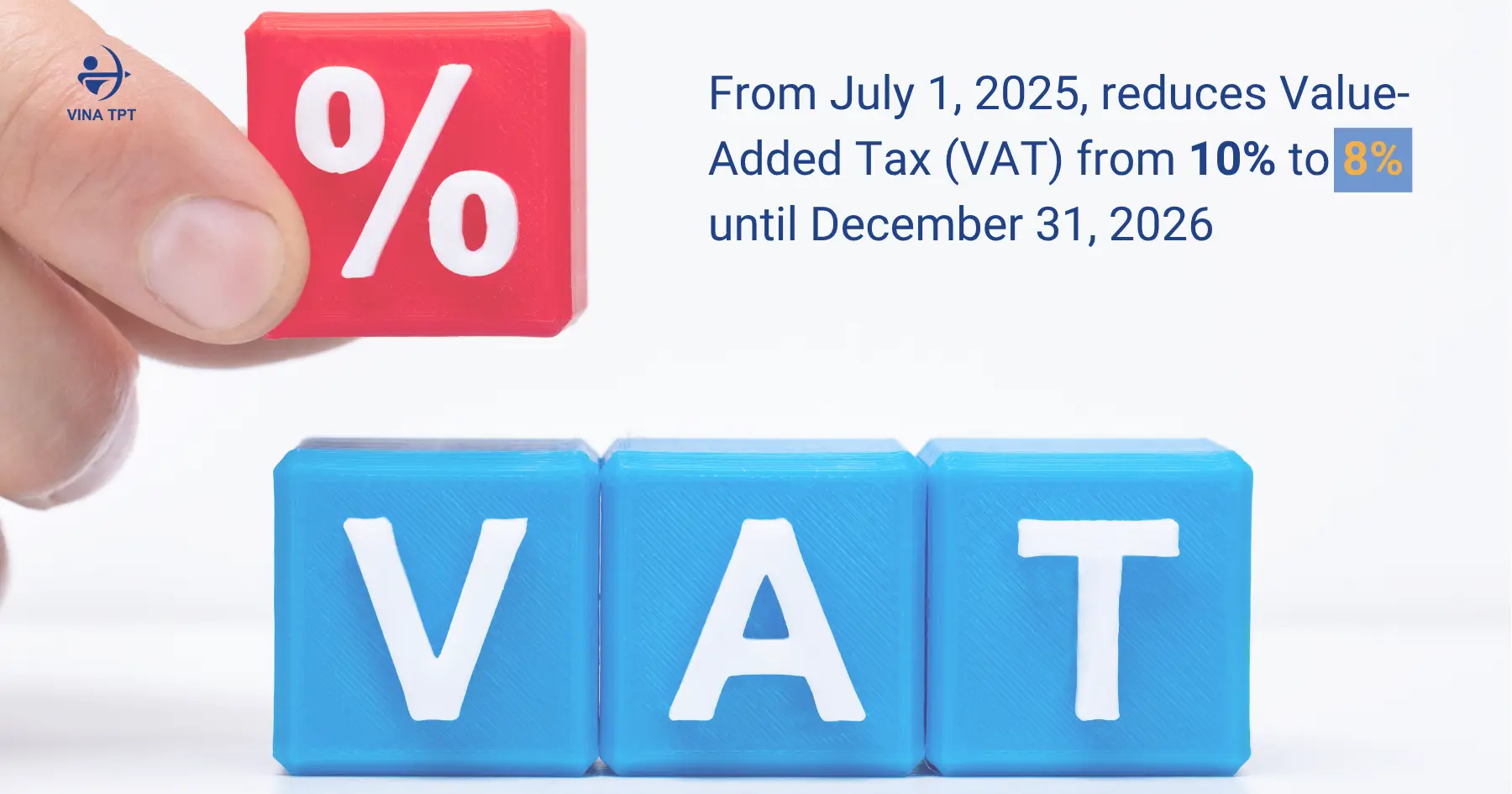
From July 1, 2025, Decree 174/2025/ND-CP reduces Value-Added Tax (VAT) from 10% to 8% until December 31, 2026, to stimulate consumption and support business recovery. This applies to most goods and services, excluding telecommunications, finance, and real estate. For FDI businesses, VAT tax breaks lower input costs, enhance cash flow, and strengthen export competitiveness. 

Specific benefits: 

  • Lower production costs: Imported materials face reduced VAT. 
  • Export support: Exported goods at 0% VAT, plus 8% reduction on related services. 

Example: An FDI firm exporting high-tech software enjoys full VAT exemption, saving 8-10% on costs. 

Key procedures: 

  • Declare VAT using new forms and electronic invoices. 
  • Collect valid documents for deductions or refunds. 
  • Note: Does not apply to specially taxed imports. 

2.3 Personal Income Tax (PIT) Incentives 

Personal Income Tax (PIT) continues to directly impact the income of workers, especially foreign experts in FDI enterprises.
From 2026, the personal allowance has been adjusted upwards to VND 15.5 million/month for the taxpayer themselves and VND 6.2 million/month for each dependent. This increase in allowances helps reduce tax obligations, improve disposable income, and enhance the attractiveness of the Vietnamese labor market.
At the same time, the PIT tax schedule has been simplified, reduced from 7 brackets to 5, with progressive tax rates.

PIT tax breaks for FDI businesses: 

  • Reduced taxes for foreign experts: Residents (present in Vietnam 183+ days/year) get deductions, cutting personnel costs. 
  • Exemptions for certain income: Stock transfers (if qualified) and foreign allowances. 

Notes: 

  • Register dependents electronically with tax authorities. 
  • Update income regularly to prevent back taxes. 

From 2026, updated policies will help FDI firms attract top global talent more easily. 

Download Vietnam Tax Handbook For Investor

3/ Key Benefits: How Tax Breaks Help Save Costs and Expand Business 

Tax breaks directly cut tax liabilities, increasing net profits and providing capital for FDI businesses to reinvest. Experts estimate savings of 10-20% on overall costs, enabling scale-up and global competition. 

Analysis from three angles: 

  • Financial: CIT and VAT reductions improve cash flow and reduce quarterly tax debts. 
  • Strategic: Encourage investments in priority areas like green technology, enhancing brand value. 
  • Human resources: PIT incentives lower salary costs, aiding recruitment of international and local experts. 

In summary, tax breaks not only save costs but also unlock business growth, allowing FDI enterprises to contribute sustainably to Vietnam’s economy. 

4/ Leveraging Tax Breaks with Vina TPT Tax Services 

To fully utilize tax breaks, FDI businesses need professional guidance from firms like Vina TPT—a Vietnam-based expert in tax and accounting. With experience supporting hundreds of FDI clients, Vina TPT identifies suitable incentives, prepares compliant files, and handles timely declarations to avoid audits. 

Standout advantages: 

  • Expertise across industries, from manufacturing to technology. 
  • Team knowledgeable in Vietnamese and international tax laws, with multilingual support. 
  • Transparent reporting and competitive fees for cost optimization. 

Support process: 

  • Assess your business and identify applicable incentives. 
  • Recommend tax plans and prepare registration documents. 
  • Implement declarations and monitor policy updates. 
  • Conduct regular reviews for ongoing compliance. 

Tax breaks are essential for FDI businesses in Vietnam to optimize costs, boost profits, and expand investments—especially with 2025 updates like the 8% VAT reduction and CIT incentives for priority sectors. These changes support economic recovery and position Vietnam as an attractive destination for foreign investment. 

Has your business maximized current tax incentives? Contact Vina TPT Tax Services today for a detailed analysis and tailored tax solutions—ensuring compliance and maximum savings! 

Talk to a Tax Specialist

Vina TPT Accounting services


Avoiding Accounting Errors in FDI Companies: A Practical Guide for Vietnam

accounting errors

accounting errors

1. Why Accounting Errors Are Risky for FDI Companies

Foreign Direct Investment (FDI) enterprises operating in Vietnam face a unique regulatory and business environment. While global companies may already be familiar with International Financial Reporting Standards (IFRS), compliance with Vietnamese Accounting Standards (VAS) introduces an additional layer of complexity. Small errors in accounting can escalate into serious consequences, such as tax penalties, reputational damage, and even restrictions on business activities.

For example, the Vietnam Ministry of Finance (MOF) has emphasized in its guidelines that misreporting revenue or late submission of tax returns can lead to administrative fines and limit access to future incentives. This is why proper accounting practices are not just about bookkeeping but are vital to protecting long-term business success in Vietnam.

2. Misclassifying Expenses and Revenues

2.1 Common misclassifications

A frequent error in FDI operations is the misclassification of expenses and revenues. Under VAS, certain costs such as staff training, marketing, or research may need to be classified differently compared to IFRS. Multinational managers often apply their global practices directly, only to discover later that these classifications conflict with local rules.

2.2 Consequences

Such mistakes can distort profit and loss statements, affect taxable income, and trigger audits by the General Department of Taxation (GDT). Incorrect expense recognition may either inflate profit – leading to higher taxes – or reduce profit – attracting suspicion from regulators.

2.3 Correction approach

Correcting these errors requires both retrospective adjustment and updated policies for future transactions. Companies must train their internal teams on VAS guidelines and, where needed, consult an expert like Vina TPT Accounting Service to review compliance.

3. Inaccurate Foreign Currency Conversions

3.1 Complexity of multi-currency

Many FDI enterprises in Vietnam transact in multiple currencies, especially USD, EUR, and JPY. VAS requires specific rules for translating foreign currency into VND. Failure to apply the correct exchange rate – spot, average, or official – can lead to serious inconsistencies in financial reports.

3.2 Risks and penalties

A World Bank report highlights that emerging markets face elevated risk of misreporting due to currency volatility. In Vietnam, regulators may impose penalties for discrepancies that result from inaccurate conversion, particularly if these errors understate taxable income.

3.3 Best practice

Companies must ensure that exchange rates are updated from official sources and applied consistently. Automated accounting systems can help, but human oversight remains crucial. External reviews by service providers such as Vina TPT guarantee that conversion practices remain compliant with both VAS and investor expectations.

accounting errors

4. Delayed or Missing Compliance Reports

4.1 Regulatory reporting challenges

FDI businesses in Vietnam are required to submit various reports: annual financial statements, quarterly tax declarations, and occasional disclosures for foreign investment registration. Delays or missing reports are among the most visible accounting errors.

4.2 Impact on business

Non-compliance does not only result in fines; it can also block access to tax incentives and financial support programs designed for FDI companies. In some cases, failure to report on time has led to suspension of investment licenses.

4.3 How to address

Creating an internal compliance calendar, supported by technology, is critical. Backed by more than 20 years of experience supporting FDI companies, we know that adopting automated compliance tools helps businesses cut reporting errors by as much as 40%. Partnering with local experts ensures that reports are not only timely but also accurate and aligned with both Vietnamese and international standards.

SCHEDULE A FINANCIAL HEALTH CHECK

5. Weak Internal Controls and Data Inconsistencies

5.1 Gaps in internal control

FDI firms often rely on global accounting systems that may not be fully adapted to Vietnam’s regulatory requirements. Weak internal controls, such as lack of segregation of duties or inadequate audit trails, increase the likelihood of data inconsistencies.

5.2 Risks of weak systems

Without strong internal audits, discrepancies may go unnoticed until an external review or tax inspection. These lapses not only create compliance risks but also undermine investor trust. The OECD stresses the importance of robust internal audit functions in supporting sustainable FDI operations.

5.3 Solutions

Strengthening internal controls requires training, technology upgrades, and independent reviews. Regular internal audits, aligned with VAS, help ensure that accounting data remains reliable. This is an area where Vina TPT’s professional services add measurable value.

6. How Vina TPT Accounting Service Helps FDI Companies Correct and Prevent Errors

Vina TPT Accounting Service offers comprehensive solutions tailored for FDI enterprises in Vietnam. The firm goes beyond bookkeeping by providing proactive troubleshooting, corrections, and preventive strategies.

By integrating knowledge of VAS with international best practices, Vina TPT helps companies:

  • Identify and correct misclassified expenses and revenues.
  • Implement accurate foreign currency conversion processes.
  • Establish compliance calendars to avoid reporting delays.
  • Strengthen internal audit and control systems.

Clients benefit from a smoother relationship with regulators, improved investor confidence, and reduced financial risk. For more details, explore Vina TPT Accounting Service.

Explore Vina TPT’s professional accounting and compliance services to keep your FDI company on the right track in Vietnam.

BOOK A FREE CONSULTATION

accounting skills

[HCM] Accounting & Tax Consultant Intern Recruitment

Accounting & Tax Consultant Intern

Accounting & Tax Consultant Intern

Accounting & Tax Consultant Intern at VTPT provides the chance to gain hands-on experience in accounting and tax, support professional teams, and build a solid foundation for your career. Perfect for final-year students or recent graduates eager to start their journey in accounting and tax advisory.

About VINA TPT

VINA TPT is a professional service company specializing in Accounting, Tax, HR, and Business Advisory. We are committed to delivering high-quality solutions that help businesses thrive in a competitive environment. Our team combines professional expertise with a collaborative work culture, creating a dynamic environment where ideas are welcomed and innovation is encouraged.

Accounting & Tax Consultant Intern at VINA TPT focuses on nurturing young talent and providing meaningful opportunities for learning and growth. By joining VINA TPT as an Accounting & Tax Consultant Intern, you will develop your skills in accounting, tax reporting and client advisory, while gaining insight into the workings of a professional service company.

Position

As an Accounting & Tax Consultant Intern at VINA TPT, you will assist the team in reviewing accounting documents, entering data into accounting software, and supporting the preparation of tax reports, including VAT, PIT, and CIT. You will help organize and maintain client accounting records, participate in real client servicing processes, especially with FDI companies and provide support in various administrative and professional tasks as assigned.

This internship offers hands-on experience in a professional environment, allowing you to develop practical accounting and tax skills while learning directly from experienced professionals.

Location

VINA TPT Office at 83B Hoang Sa Street, Tan Dinh Ward, Ho Chi Minh City

Responsibilities

As an Accounting & Tax Consultant Intern, your key responsibilities will include:

  • Assisting in reviewing accounting documents and entering data into accounting software
  • Supporting the preparation of tax reports, including VAT, PIT, CIT, and others as required
  • Helping organize and maintain client accounting records and documents
  • Participating in real client servicing processes, especially with FDI companies
  • Providing support in various administrative and professional tasks as assigned

During the internship, you will gain hands-on experience in accounting and tax processes, learn to work with professional teams, and build a solid foundation for your career. This role allows you to explore real-world accounting and tax operations, develop practical skills, and understand the workings of a professional services company.

Requirements

We are looking for candidates who:

  • Final-year student or recent graduate in Accounting, Finance, or Auditing; 
  • Strong interest in developing a career in Accounting – Tax – Business Advisory; 
  • Basic knowledge of accounting principles and related fields; 
  • Eagerness to learn, attention to detail and a proactive attitude; 
  • English communication skills (spoken and written) is a plus; 
  • Proficiency in Microsoft Office (Excel, Word, etc.). 

This Accounting & Tax Consultant Intern role is ideal for anyone who wants to gain hands-on experience, develop professional accounting and tax skills, and contribute to a collaborative and supportive team environment.

Benefits

As an Accounting & Tax Consultant Intern at VINA TPT, you will receive:

  • Internship allowance/support (if applicable) or other negotiated benefits; 
  • On-the-job training and hands-on experience with professional teams; 
  • Opportunity to be considered for full-time employment upon successful internship completion; 
  • Friendly and professional working environment with high learning potential; 
  • Internship certificate issued after program completion. 

By joining our team as an Accounting & Tax Intern, you will not only gain practical experience but also develop a clear understanding of accounting and tax processes, client advisory, and the role of professional services in supporting business growth and compliance in a dynamic market.

How to Apply

If you are passionate about content creation and want to start your marketing career with real-world experience, please send your CV and a short cover letter (if available) to:

📩 Email: infor@vinatpt.com
📌 Email Subject: [Intern Accounting & Tax Consultant] – Full Name

For any questions, please contact our hotline/Zalo: 0984 980 069 or fanpage

Apply Now

Contact VINA TPT for Support

📞 (+84) 984 980 069
📧 infor@vinatpt.com
🌐 www.vinatpt.com
🏢 5th Floor, More Building, 83B Hoang Sa, Da Kao Ward, District 1, HCMC 

[Assistant] Accountant Jobs for Tax & Accounting Officer

Assistant Accounting & Tax Consultant

Accountant Jobs

Assistant Accounting & Tax Consultant at Vina TPT – a great choice for those looking for accountant jobs in Vietnam. This role offers the opportunity to work with FDI companies, gain hands-on experience in accounting and tax advisory, and build your career in a professional, dynamic environment.

About Vina TPT

Vina TPT is a reputable and professional Accounting, Tax, HR, and Business Advisory Services company in Vietnam. Our mission is to deliver value-added financial consulting services that help clients achieve a strong competitive advantage in a rapidly changing business environment. We specialize in providing tailored solutions for FDI companies in Vietnam, helping them navigate complex tax regulations, streamline accounting processes, and ensure compliance with local laws.

By joining Vina TPT, you will become part of a dynamic and professional team, working alongside industry experts and gaining experience across multiple sectors.

Job Overview

We are looking for motivated talents to join our Accounting & Tax Advisory Department. This position is a great entry point for candidates seeking accountant jobs and eager to build a career in finance, accounting, and tax advisory.

👉 What you’ll do:

  • Support the delivery of high-quality accounting and tax services for FDI companies in Vietnam.

  • Ensure accurate financial records and compliance with Vietnamese regulations.

  • Assist in providing timely financial reports and basic tax guidance to help clients make informed decisions.

This role offers practical experience, professional growth, and the chance to work directly with international businesses in Vietnam.

Key Responsibilities

As an Assistant Accounting & Tax Consultant at Vina TPT, you will:

  • Support the delivery of professional accounting and tax services to FDI companies in Vietnam.
  • Receive, review, and process client documents; perform bookkeeping and update accounting software under supervision.
  • Assist in preparing tax reports, including VAT, PIT, CIT, FCT, and other applicable taxes.
  • Help compile financial statements and maintain complete records for assigned clients.
  • Ensure accuracy and compliance with Vietnamese accounting standards and tax regulations.
  • Support the team with other accounting, tax, or advisory tasks as required.
  • Communicate with clients to understand their business needs and provide basic financial guidance.

Requirements

  • Bachelor’s degree in Accounting, Finance, or a related field.
  • Good command of English (both written and spoken).
  • Preferably 1–2 years of experience in accounting, finance, or taxation (fresh graduates with internship experience are also welcome).
  • Basic understanding of accounting, taxation, and corporate law in Vietnam.
  • Strong teamwork and communication skills, careful, logical thinking, and attention to detail.
  • Professional certifications (CPA, ACCA, Chief Accountant, etc.) are a plus.

Benefits

Salary & Bonuses:

  • Gross salary = Basic Salary + Allowances (Negotiable based on experience)
  • Basic salary: 70% of gross salary (social insurance contributions based on basic salary)
  • Allowances: 30%
  • 13th-month salary + performance-based bonus (KPI & company results)

Performance Evaluation:

  • Annual performance review
  • Salary review once per year based on performance evaluation and company results

Insurance & Leave:

  • Social, health, and unemployment insurance according to law
  • Supplementary private health insurance for employees and their families
  • 12 annual leave days
  • Annual health check-up

Training & Career Development:

  • Access to professional training programs to improve skills
  • Training cost support per company policy
  • Opportunities for career growth and promotion within Vina TPT

Working Environment & Culture:

  • Professional, dynamic, and friendly workplace
  • Work with leading industry experts
  • Participate in team-building events and company activities

Other Benefits:

  • Travel and business trip allowance (if applicable)
  • Additional employee benefits according to company policy

How to Apply

If you are a motivated and experienced professional seeking a accountant jobs yet rewarding career, send your CV to join Vina TPT as a Assistant Accounting & Tax Consultant in Ho Chi Minh City.

📩 Email: infor@vinatpt.com
📌 Email Subject: [Assistant Consultant] – Full Name

For any questions, please contact our hotline/Zalo: 0984 980 069 or fanpage of Vina TPT

Contact VINA TPT for Support

📞 (+84) 984 980 069
📧 infor@vinatpt.com
🌐 www.vinatpt.com
🏢 5th Floor, More Building, 83B Hoang Sa, Tan Dinh Ward, HCMC 

Senior Accounting & Tax Consultant

[HCM] Senior Accounting & Tax Consultant Recruitment

Senior Accounting & Tax Consultant

Senior Accounting & Tax Consultant

Senior Accounting & Tax Consultant at Vina TPT offers a unique chance to work with FDI companies in Vietnam, gain hands-on experience in accounting and tax advisory, and advance your career in a professional, dynamic environment.

About Vina TPT

Vina TPT is a reputable and professional Accounting, Tax, HR, and Business Advisory Services company in Vietnam. Our mission is to deliver value-added financial consulting services that help clients achieve a strong competitive advantage in a rapidly changing business environment. We specialize in providing tailored solutions for FDI companies in Vietnam, helping them navigate complex tax regulations, streamline accounting processes, and ensure compliance with local laws.

By joining Vina TPT, you will become part of a dynamic and professional team, working alongside industry experts and gaining experience across multiple sectors.

Job Overview

We are looking for a Senior Accounting & Tax Consultant who will play a key role in our Accounting & Tax Advisory Department. This role is ideal for candidates with solid experience in finance, accounting, and tax advisory services, looking to develop their skills further and take on leadership responsibilities.

As a Senior Accounting & Tax Consultant, you will provide high-quality accounting and tax services for FDI companies in Vietnam, ensuring that all financial records are accurate and compliant with Vietnamese laws. You will also support strategic decision-making for clients by providing timely financial insights and tax planning advice.

Key Responsibilities

As a Senior Accounting & Tax Consultant at VTPT, you will:

  • Provide professional accounting and tax advisory services to FDI companies in Vietnam.
  • Receive, review, and process client documents; perform bookkeeping and update accounting software.
  • Prepare tax reports, including VAT, PIT, CIT, FCT, and other applicable taxes.
  • Compile financial statements and maintain complete records for assigned clients.
  • Ensure compliance with Vietnamese accounting standards and tax regulations.
  • Assist management with other accounting, tax, or advisory tasks as required.
  • Communicate effectively with clients to understand their business needs and provide strategic financial advice.

Requirements

  • Bachelor’s degree in Accounting, Auditing, Finance, or related fields (Master’s degree preferred).
  • At least 2 years of experience in Finance & Accounting; experience in Accounting & Tax advisory preferred.
  • In-depth knowledge of Accounting, Tax, Contracts, and Vietnamese corporate laws.
  • VACPA or equivalent certification is a plus.
  • Strong leadership, team management, and communication skills.
  • Ability to work independently, manage multiple clients, and solve problems efficiently.
  • Proficiency in English (speaking, reading, writing) and accounting software.

Benefits

Salary & Bonuses:

  • Gross salary = Basic Salary + Allowances (Negotiable based on experience)
  • Basic salary: from 60% or more of the Gross Salary (social insurance contributions based on basic salary).
  • Allowances: around 40% 
  • 13th-month salary + performance-based bonus (KPI & company results)

Performance Evaluation:

  • Annual performance review
  • Salary review once per year based on performance evaluation and company results

Insurance & Leave:

  • Social, health, and unemployment insurance according to law
  • Supplementary private health insurance for employees and their families
  • 12 annual leave days
  • Annual health check-up

Training & Career Development:

  • Access to professional training programs to improve skills
  • Training cost support per company policy
  • Opportunities for career growth and promotion within Vina TPT

Working Environment & Culture:

  • Professional, dynamic, and friendly workplace
  • Work with leading industry experts
  • Participate in team-building events and company activities

Other Benefits:

  • Travel and business trip allowance (if applicable)
  • Additional employee benefits according to company policy

How to Apply

If you are a motivated and experienced professional seeking a challenging yet rewarding career, send your CV to join Vina TPT as a Senior Accounting & Tax Consultant in Ho Chi Minh City.

📩 Email: infor@vinatpt.com
📌 Email Subject: [Senior Consultant] – Full Name

For any questions, please contact our hotline/Zalo: 0984 980 069 or fanpage of Vina TPT

Contact VINA TPT for Support

📞 (+84) 984 980 069
📧 infor@vinatpt.com
🌐 www.vinatpt.com
🏢 5th Floor, More Building, 83B Hoang Sa, Tan Dinh Ward, HCMC 

Senior Accounting & Tax Consultant