[Hiring] SENIOR HUMAN RESOURCES CONSULTANT

1. ABOUT VINA TPT

Vina TPT is an Accounting – Tax – HR – Business Advisory services company. We focus on providing value-added financial consulting services which aim at creating a strong competitive advantage for our clients in a rapidly changing environment. 

2. Recruitment position

We are currently seeking a Senior Human Resource Consultant to join our team. This role offers an excellent opportunity for experienced HR professionals to work closely with FDI companies in Vietnam and deliver comprehensive HR solutions in a dynamic, international business environment.

As a Senior Human Resource Consultant, you will be involved in end-to-end HR service delivery, including recruitment support, labor contract management, payroll and benefits administration, and handling employee relations matters. You will also play a key role in ensuring compliance with Vietnamese labor regulations while supporting clients in their day-to-day HR operations.

This position is ideal for candidates who are detail-oriented, proactive, and eager to further develop their expertise in HR consulting, while building long-term career growth in a professional services setting.

3. Working location: 

Vina TPT office – 83B Hoang Sa, Tan Dinh Ward, HCMC 

4. Job description / Main responsibility: 

As a Senior Human Resources Consultant, you will be able to participate in providing HR services for FDI companies in Vietnam. You will have the opportunity to gain critical skills that are essential to advance career paths in the field of HR services. 

  • Receive and process recruitment-related documents, including posting job openings, screening candidates, scheduling interviews, and tracking results; 
  • Perform procedures related to labor contracts, including drafting contracts, managing employee records, and monitoring contract expiration dates; 
  • Manage the salary and benefits system, including calculating salaries, bonuses, allowances, and insurance benefits; 
  • Resolve labor relations issues, including disciplinary actions, handling complaints, and advising employees on labor law-related matters; 
  • Perform other HR administrative tasks, including managing employee records, tracking leave days, and updating employee information; 
  • Other tasks/duties as requested by clients/service team leaders, etc. 

5. Requirements: 

Educational Background: 

– Bachelor’s degree in Human Resource Management, Law, Economics, or related fields; 

– Professional certifications such as SHRM-CP, SHRM-SCP, or equivalent are preferred. 

Work Experience: 

– At least 03 years of experience in Human Resources, including at least 02 years in a similar position; 

– Experience working in a multinational corporation or FDI company is preferred; 

– Experience working in HR consulting firms, global management consulting firms, or specialized consulting firms, or internal experience in large-scale projects is a plus. 

Skills and Knowledge: 

– Proficient in English (both speaking and writing); 

– Excellent communication, presentation, and negotiation skills; 

– Knowledge of Vietnam Labor Law and regulations related to FDI companies; 

– Comprehensive HR management skills, including recruitment, training, performance management, compensation and benefits, and labor relations; 

– Problem-solving, critical thinking, and effective teamwork skills; 

– Ability to work independently and under high pressure; 

– Proficient in HR management software and office productivity tools; 

– Experience in change management and HR transformation is a plus; 

– Demonstrated success in current role and experience in one or more of the company’s core capabilities. 


6. Benefits: 

Salary and Bonuses: 

  • Gross Salary: Basic Salary + Allowances à NEGOTIABLE 

+ Basic Salary: From 60% or more of Gross Salary (social insurance contributions based on the Basic Salary) 

+ Allowances: about 40% 

  • Bonuses: 13th-month salary + performance-based bonus (based on individual KPI evaluation and company business performance). 

Evaluation: 

  • Performance evaluation: one per year; 
  • Salary review: one per year (based on evaluation results and company business performance). 

Other Benefits: 

  • Insurance:
    • Social insurance, health insurance, unemployment insurance in accordance with the law; 
    • Supplementary health insurance (private insurance) for employees and their families (depending on position and seniority). 
  • Leave: 12 annual leave days. 
  • Health check-up: Annual health check-up. 
  • Training and Development:
    • Opportunities to participate in professional training courses to improve skills; 
    • Training cost support (depending on the program and company regulations); 
    • Career development and promotion opportunities within the company. 
  • Working Environment:
    • Professional, dynamic, and friendly working environment; 
    • Opportunities to work with leading experts in the industry; 
    • Participation in team-building activities and company events. 
  • Other Benefits:
    • Travel and business trip allowance (if applicable); 
    • Other employee benefits policies. 

How to Apply

If you are passionate about content creation and want to start your marketing career with real-world experience, please send your CV and a short cover letter (if available) to:

📩 Email: trunghieunhi@vinatpt.com (CC email: infor@vinatpt.com)
📌 Email Subject: [Senior HR Consultant] – Full Name

For any questions, please contact our hotline/Zalo: 0984 980 069

Contact VINA TPT for Support

📞 (+84) 984 980 069
📧 infor@vinatpt.com
🌐 www.vinatpt.com
🏢 5th Floor, More Building, 83B Hoang Sa, Da Kao Ward, District 1, HCMC 

Payroll Outsourcing Services in Vietnam: Benefits and Choosing the Right Provider

payroll-outsourcing-services-in-vietnam-benefits-for-fdi-enterprises-and-how-to-choose-a-reliable-provider

It is not uncommon for FDI enterprises to face penalties due to payroll management errors during their first years of operation in Vietnam. Payroll often becomes one of the biggest challenges for foreign investors entering the market, given the differences in labor regulations, tax policies, and the local operating environment.

In this context, payroll outsourcing services are increasingly chosen by businesses to ensure compliance and optimize internal resources. So, what are payroll outsourcing services, which businesses should use them, and how can companies select a reliable service provider? The article below clarifies these issues.

payroll-outsourcing-services-in-vietnam-benefits-for-fdi-enterprises-and-how-to-choose-a-reliable-provider


1. Why is payroll management challenging for FDI enterprises in Vietnam?

Labor law and social insurance regulations are frequently updated

Regulations relating to salaries, social insurance, health insurance, and unemployment insurance in Vietnam are regularly revised to align with labor and social welfare policies. As a result, many FDI enterprises face difficulties in tracking and promptly applying new rules when managing payroll.

The legal framework for salary and personal income tax is relatively complex

Vietnam’s salary-related regulations go beyond base salary and also involve personal income tax (PIT), allowances, employee benefits, and mandatory insurance obligations. Accurately calculating and declaring these items requires businesses to have a solid understanding of the law and the relevant reporting procedures.

Language barriers and differences in the legal environment

In addition to legal factors, language barriers and differences in working culture can make HR and payroll management even more complicated for FDI enterprises. In many cases, an incomplete understanding of local regulations or the application of unsuitable HR processes may result in errors in payroll management, employee benefits, and compliance obligations.

Because of these challenges, many FDI enterprises choose payroll outsourcing services to ensure legal compliance and optimize internal resources.

2. What are payroll outsourcing services? How is the service implemented?

2.1. What is payroll outsourcing?

Payroll outsourcing services refer to the arrangement in which a company hires a professional third-party provider to handle all or part of the activities related to payroll administration and labor compliance obligations. Instead of building an internal team to manage complex issues related to salaries, taxes, and insurance, businesses can transfer these functions to a specialized service provider.

In practice, payroll outsourcing services usually include activities such as:

  • Preparing and calculating monthly payroll
  • Declaring personal income tax for employees
  • Registering and managing mandatory insurance contributions (social insurance, health insurance, and unemployment insurance)
  • Preparing and submitting labor reports as required by law
  • Supporting the company in complying with labor and tax regulations

By using payroll outsourcing services, businesses can reduce administrative workload, minimize payroll errors, and improve compliance, especially in a legal environment like Vietnam where labor and tax regulations contain many detailed requirements.

2.2. Payroll outsourcing service implementation process

In practice, payroll management goes far beyond simply calculating employee salaries. It also includes multiple steps related to HR data, tax and insurance obligations, and reporting to competent authorities.

Typically, payroll outsourcing services are implemented through the following process:

Step 1: Collecting and verifying payroll data

At the initial stage of payroll outsourcing services, the service provider will coordinate with the enterprise to collect the information necessary for payroll calculation, including:

  • Employment contract information
  • Salary levels and allowances
  • Attendance records or working hour data
  • Employee movement information (new hires/resignations)
  • Relevant deductions or employee benefits

After collection, the data is reviewed and verified to ensure accuracy before payroll calculation begins.

Step 2: Preparing and calculating payroll

Based on the verified data, the payroll provider will:

  • Calculate the monthly payroll for employees
  • Determine the amount of personal income tax (PIT) to be withheld
  • Calculate mandatory insurance contributions such as social insurance, health insurance, and unemployment insurance

Once completed, the payroll statement is sent to the company for review and approval before proceeding to the next stage.

Step 3: Issuing payslips and supporting salary payment

After the payroll is approved, the payroll provider will prepare and issue payslips for each employee. Payslip distribution must be handled confidentially and sent to the correct recipients.

Step 4: Handling tax and insurance obligations

An important part of payroll outsourcing services is ensuring that the company fulfills its obligations to state authorities. These tasks commonly include:

  • Declaring and paying personal income tax
  • Registering and paying mandatory insurance contributions for employees
  • Registering dependents for tax deductions, where applicable
  • Supporting the processing of insurance benefits such as maternity leave, sick leave, or occupational accident benefits

You may also be interested in: Personal Income Tax 2026: Key Changes Directly Affecting Employees

Step 5: Labor reporting and legal compliance

In addition to payroll processing, payroll outsourcing services also help enterprises fulfill their legal reporting obligations, such as:

  • Reporting labor usage status (increase/decrease in headcount)
  • Updating employee information with the social insurance authority
  • Preparing periodic labor- and salary-related reports

Following these steps helps enterprises maintain a transparent, accurate, and compliant payroll system while minimizing HR administration errors.

3. Why do FDI enterprises in Vietnam prefer payroll outsourcing services?

For foreign-invested enterprises, managing payroll in a new market like Vietnam often creates many challenges related to labor law, taxation, and mandatory insurance systems. In addition, differences in legal frameworks and operating practices between countries can make it difficult to establish an effective internal payroll system.

In this context, many FDI enterprises choose payroll outsourcing services as a solution to improve operations, ensure legal compliance, and strengthen HR management efficiency.

3.1. Focusing on core business activities

When using payroll outsourcing services, enterprises do not need to allocate excessive resources to administrative tasks such as payroll calculation, tax filing, or insurance administration.

This allows management teams and HR departments to focus on strategic activities such as market expansion, business development, and workforce management.

3.2. Saving costs and improving operational efficiency

Building an in-house payroll system often requires investment in payroll software, IT systems, and personnel with expertise in tax and insurance matters.

For FDI enterprises, these costs can be considerable in the early stages of operation. Payroll outsourcing services help reduce initial investment costs while allowing businesses to leverage the expertise of professional service providers.

3.3. Strengthening compliance and minimizing legal risks

Payroll management is directly linked to a wide range of regulations, including labor law, personal income tax rules, and mandatory insurance obligations. These regulations are updated regularly and may differ significantly from the legal framework in the investor’s home country.

As a result, ensuring full compliance with local rules can become a major challenge for FDI enterprises. By using payroll outsourcing services, businesses can reduce the risk of errors in filings and reporting while ensuring that all legal obligations are handled properly.

3.4. Improving employee experience and retaining talent

A transparent and accurate payroll system plays an important role in building employee trust. When salaries, taxes, and insurance contributions are calculated clearly and paid on time, employees feel more secure about their entitlements.

For FDI enterprises competing for talent in Vietnam, maintaining a professional and transparent payroll process is also a key factor in improving employee experience and retaining high-quality staff.

EXPLORE OUR SERVICES

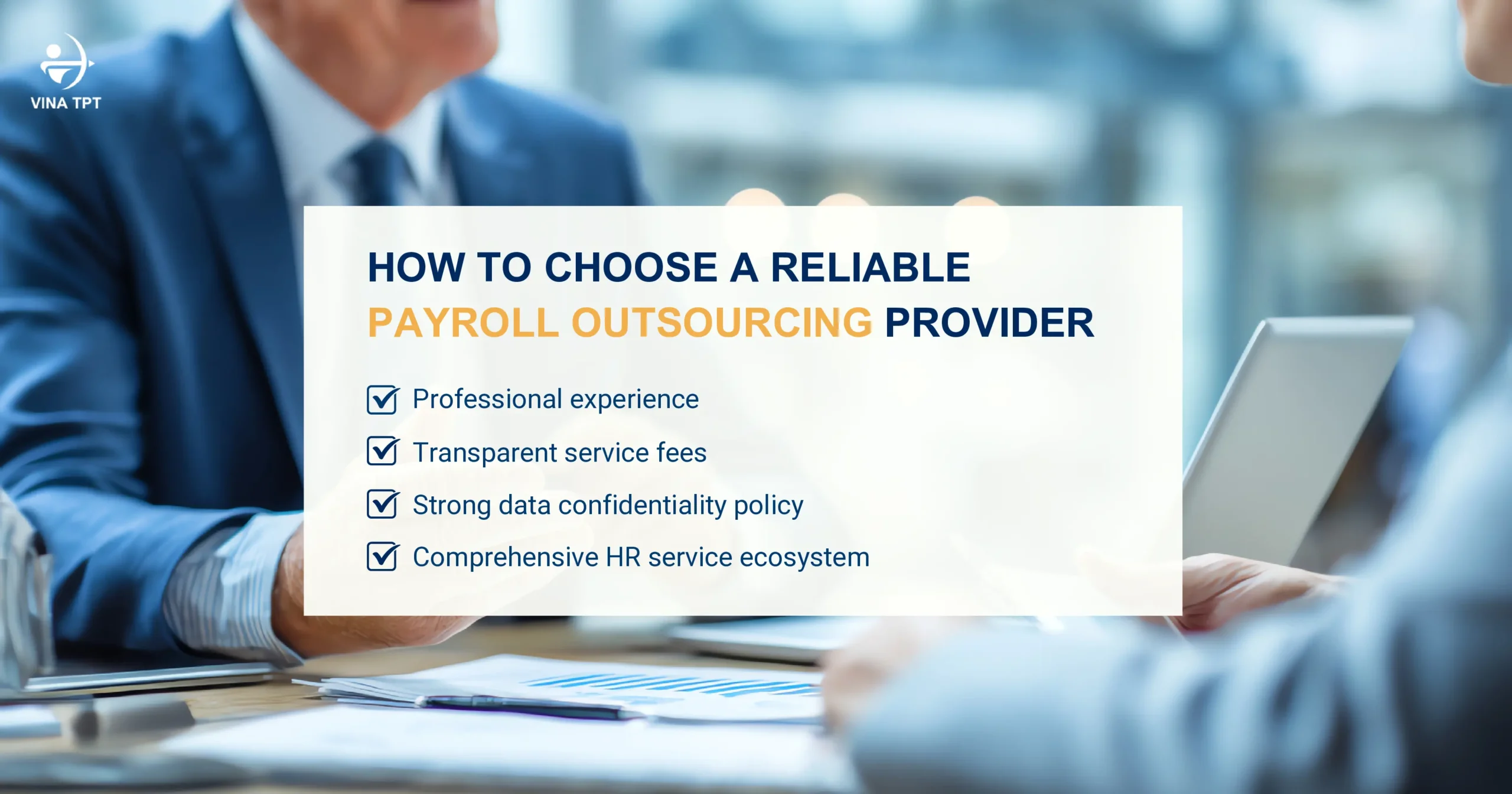
4. Four criteria for choosing a reliable payroll outsourcing services provider in Vietnam

Selecting the right payroll outsourcing services provider is especially important for FDI enterprises, as payroll is not only about paying employees but also closely tied to tax obligations, insurance contributions, and compliance with Vietnamese labor law.

Below are four key criteria businesses should consider when selecting a payroll service partner.

4.1. Experience and professional capability

A reliable provider of payroll outsourcing services is usually reflected through the following factors:

  • Proven track record and successful client base: Providers with many years of experience generally have a solid understanding of labor law, tax, and insurance regulations, and are better equipped to handle practical issues flexibly. Long operating history and a strong client portfolio are two important indicators when assessing a provider’s capability and reliability.

  • A clear payroll management system: Payroll statements should have a transparent structure, be easy to review, and be managed through a suitable payroll system. Components such as salaries, bonuses, allowances, and employee benefits should be clearly defined to ensure both accuracy and transparency.

  • An experienced team of specialists: A service provider should have specialists who understand labor law and taxation in depth. In particular, experience working with FDI enterprises is a significant advantage, because such specialists not only understand Vietnam’s legal environment but are also familiar with the working practices of international businesses. This helps ensure effective implementation and timely updates on legal changes.

4.2. Transparent and reasonable service fees

Service fees often reflect the professionalism of payroll outsourcing services. If the fees are too high, the enterprise may bear unnecessary operating costs. On the other hand, fees that are too low may indicate risks in service quality or a lack of transparency in the service agreement.

A professional provider typically offers a clear and transparent pricing structure that corresponds to the scope of services delivered. Therefore, businesses should prioritize providers that offer transparent quotations, clearly drafted service contracts, and specific commitments regarding the scope of work.

4.3. Data confidentiality policy

Payroll involves sensitive data relating to both the enterprise and its employees, including:

  • Employees’ personal information
  • Salary details and employee benefits
  • Personal income tax and insurance data

For this reason, a payroll outsourcing services provider must have a clear confidentiality policy and a secure data management system to ensure that such information is protected throughout the cooperation period.

Businesses should also prioritize providers that maintain strict data control procedures and include confidentiality commitments in the service contract.

4.4. A comprehensive HR service ecosystem

In practice, FDI enterprises often have broader HR administration and labor compliance needs beyond payroll management alone. Therefore, choosing a payroll service provider with a comprehensive HR service ecosystem can bring substantial benefits.

Additional services commonly provided alongside payroll outsourcing services may include:

  • Support for visas and work permits for foreign experts
  • Consulting on HR policies and employee benefits
  • Support for personal income tax finalization and periodic labor reporting

This allows businesses to simplify HR administration, optimize operating costs, and maintain better legal compliance.

payroll-outsourcing-services-in-vietnam-benefits-for-fdi-enterprises-and-how-to-choose-a-reliable-provider

5. Why is Vina TPT a leading payroll outsourcing services partner for FDI enterprises?

Based on the provider selection criteria outlined above, Vina TPT not only meets the required standards of expertise, experience, and data security, but also brings added value to businesses.

With more than 20 years of experience in business consulting, HR, and accounting services, Vina TPT has supported thousands of domestic and foreign enterprises in establishing and operating in Vietnam. Notably, more than 80% of Vina TPT’s clients are Japanese enterprises, a group of investors well known for their high standards in accuracy, process discipline, and compliance.

In addition, Vina TPT is currently supporting many international enterprises from Germany, Taiwan, the United States, the United Kingdom, Russia, Canada, Australia, Singapore, and many other countries, helping them build payroll systems that are transparent, accurate, and aligned with Vietnamese law.

Thanks to its practical experience and a team of specialists with strong knowledge of labor law and tax regulations, Vina TPT provides effective payroll services in Vietnam, helping enterprises optimize payroll administration, minimize compliance risks, and allocate more resources to core business operations.

payroll-outsourcing-services-in-vietnam-benefits-for-fdi-enterprises-and-how-to-choose-a-reliable-provider

BOOK A FREE CONSULTATION

Americans Doing Business in Vietnam (2026): Legal Guidance & Detailed Procedures

americans-doing-business-in-vietnam-2026-legal-guidance-detailed-procedures

In recent years, Vietnam has continued to strengthen its position as a strategic destination for U.S. investors thanks to a stable economic environment, competitive costs, and an extensive network of free trade agreements. However, doing business in Vietnam requires foreign investors to comply with strict legal regulations and tax obligations.

The article below provides detailed guidance on key conditions, procedures, and important legal matters when doing business in Vietnam.

americans-doing-business-in-vietnam-2026-legal-guidance-detailed-procedures

1. What are the conditions for Americans doing business in Vietnam?

Legal eligibility of investment business lines

Before doing a business in Vietnam, investors need to determine whether their intended business activities are permitted for investment. Under the Investment Law 2020, business sectors are classified into several main categories with different levels of accessibility and regulatory conditions.

Typically, investment sectors can be classified into four main groups:

No.

Category Definition

Typical Examples

1 Unconditional business sectors (80% of all sectors) Sectors that are not included in the list of conditional or market-restricted business lines. Businesses only need to complete business registration and comply with general legal regulations (tax, environment, safety, etc.). General manufacturing, wholesale trading, management consulting, IT (software), F&B, certain domestic logistics services…
2 Investment incentive sectors Sectors encouraged by the government. Incentives (such as Corporate Income Tax (CIT) benefits, land rental incentives, etc.) depend on the industry, location, and project scale. High technology, R&D, renewable energy, high-tech agriculture, supporting industries, digital transformation, semiconductors…
3 Conditional business sectors Sectors that are permitted to operate but must meet specific conditions (such as sub-licenses, legal capital, technical standards, or professional certificates). These are regulated under Appendix IV of the Investment Law and its amendments. Education, healthcare, real estate, logistics, food services, transportation, cosmetics manufacturing…
4 Market access restricted sectors for foreign investors Sectors where foreign investors are subject to restrictions on ownership ratio, investment form, or scope of operations. The list is issued by the Government (currently under Decree 31/2021/ND-CP and its amendments). Retail distribution, telecommunications, aviation, advertising, financial services, media…
5 Prohibited business sectors Activities that are strictly prohibited for reasons of national security, social ethics, or public health under Article 6 of the Investment Law. Applicable to both domestic and foreign investors. Drug trafficking, human/organ trafficking, prostitution, explosives, human cloning, trading endangered wildlife…

Note:
The majority of business sectors in Vietnam fall under unconditional sectors (accounting for approximately 80%). However, some industries may simultaneously belong to multiple categories (for example, renewable energy can be both an incentivized sector and a conditional business sector).

To avoid confusion and streamline the licensing process, investors are advised to check the relevant business codes and applicable conditions on the Business Line Code Lookup page before submitting their applications.

Meeting investment capital and financial capacity requirements

Vietnam’s enterprise law does not set a general minimum charter capital when foreign investors do business in Vietnam; however, certain conditional business lines require statutory capital under specialized regulations.

Therefore, the investment registration authority requires investors to demonstrate sufficient financial capacity to implement the project. This is commonly evidenced by:

  • Bank statements of the parent company/investing entity
  • Audited financial statements for the most recent year
  • A financial guarantee letter from a bank

Having a lawful company head office in Vietnam

The company must have a clear and lawful head office address within Vietnam. When doing business in Vietnam, investors need to prove this address with documents such as:

  • A lease agreement for office premises with a valid lease term
  • Documents proving the lessor’s land use/ownership rights, such as a Land Use Right Certificate

The enterprise must record this address on the Enterprise Registration Certificate, as government authorities will send notices and may conduct inspections at this address.

However, if the enterprise has not yet found a suitable office location, using a Virtual Office is also a common solution when doing business in Vietnam, provided that: the virtual office address is not located in a residential apartment building or a prohibited area for business registration; it is able to receive mail and official correspondence from authorities; and the lessor has sufficient documents proving a lawful right to lease.

Within Vina TPT’s Company Setup Services in Vietnam, we provide reputable virtual office solutions suitable for each operating model – helping ensure the dossier is complete from the start and minimizing later amendments.

International legalization of the investor’s legal documents

To do business in Vietnam, investors are required to prepare several legal documents issued in their home country. Common documents include:

  • Passport of the individual investor
  • Business Registration Certificate or Certificate of Incorporation (for corporate investors)
  • Financial documents proving the investor’s financial capacity, if requested by the competent authority
  • Other supporting documents related to the investment project (depending on the specific case)

For these documents to be recognized by the competent authorities in Vietnam, they must undergo a consular legalization process. This process typically includes the following steps:

  • Notarization in the issuing country
  • Consular legalization at the Vietnamese Embassy/Consulate in that country
  • Certified translation into Vietnamese after legalization

Only after completing all of these procedures can the documents be used as part of the investment registration dossier submitted to the competent authorities in Vietnam.

Explore Our Services

Other specific requirements

Depending on the sector, a project for doing business in Vietnam may need to satisfy additional requirements such as:

  • Environmental impact assessment (for projects with potential environmental impacts)
  • Technology solutions and qualified personnel plans
  • Land use plan (if the project requires land allocation/lease from the State)

americans-doing-business-in-vietnam-2026-legal-guidance-detailed-procedures-2

2. Step-by-step procedure for doing business in Vietnam

Doing business in Vietnam with foreign investment requires a clear, structured process to ensure full legal compliance and smooth operations. This step-by-step guide is designed specifically for foreign-invested trading or commercial businesses.

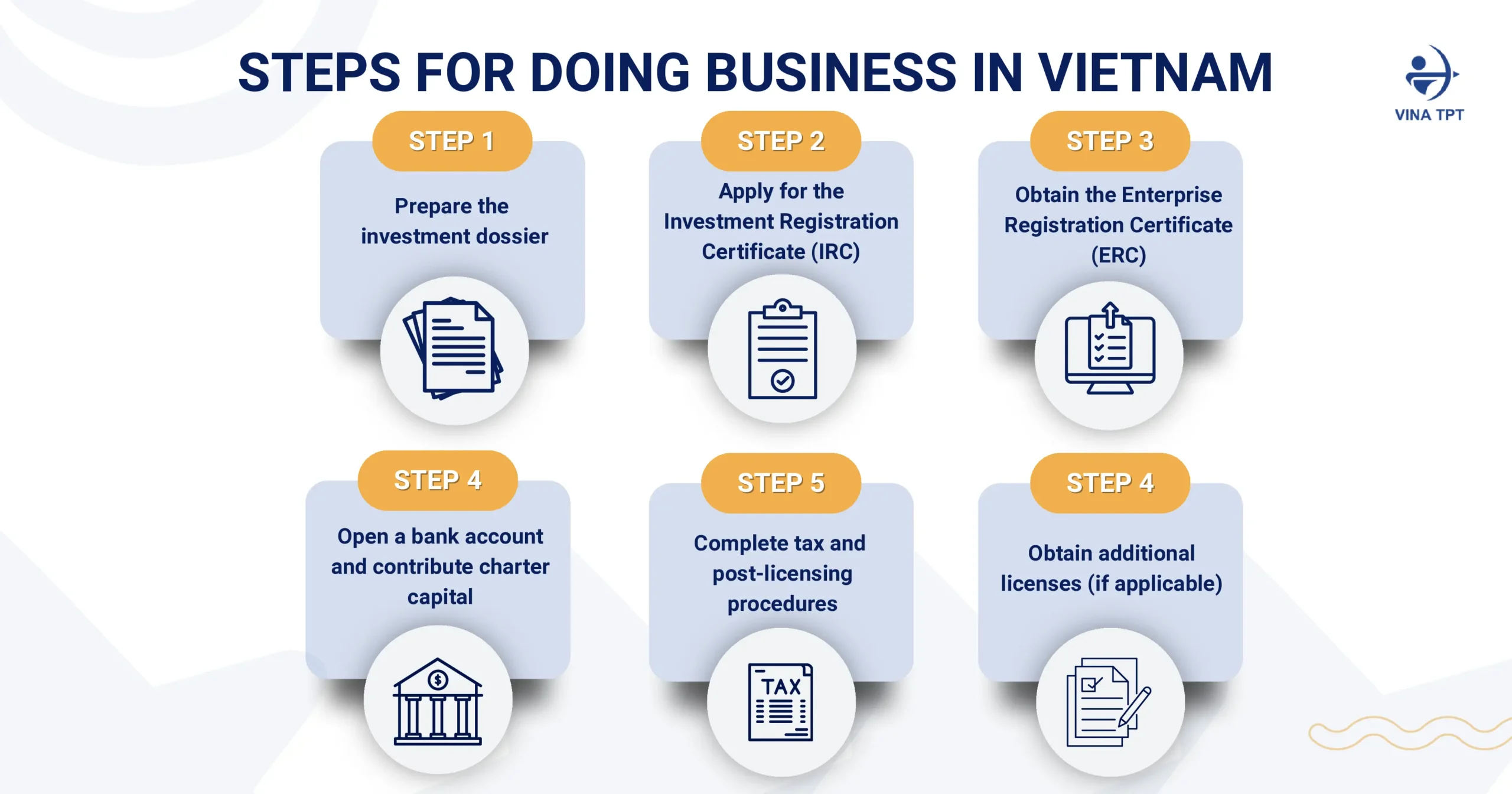
Step 1: Prepare the investment dossier

This is the critical first step in the process of doing business in Vietnam. The dossier must be prepared in accordance with the Investment Law 2025.

  • Written request for implementation of the investment project
  • Documents proving the investor’s legal status:
    • For individuals: Citizen ID/Passport (copy)
    • For organizations: Certificate of incorporation or equivalent legal document (copy)
  • Investment project proposal (including investor information, objectives, investment capital, scale, capital mobilization plan, location, schedule, and socio-economic efficiency assessment)
  • Documents proving financial capacity:
    • Individuals: savings book, bank balance confirmation
    • Organizations: financial statements for the last two years, financial commitment from the parent company or a financial institution
  • Head office lease agreement or documents proving the right to use the project location
  • Technology explanation (for projects subject to technology appraisal)
  • BCC business cooperation contract (if investing under this form)

The dossier is submitted to the Department of Finance in the province/city where the project’s head office is located.

Step 2: Submit the application for the Investment Registration Certificate (IRC)

The IRC is a prerequisite for open new company in Vietnam for foreign investors. The IRC approves the investor’s project and specifies charter capital, scale, location, and business scope. Without an IRC, investors cannot proceed with company registration.

Required documents include:

  • Application form and a detailed project proposal (objectives, scale, investment capital, location, and timeline)
  • Proof of financial capability (bank statements, audited financial reports, or credit agreements)
  • Legal documents: notarized passport (individual) or business registration certificate (organization), both legalized
  • Proof of location (lease agreement or land use rights)
  • Power of attorney (if using a third-party service)

Foreign documents must be consular legalized and officially translated into Vietnamese. The processing time for an IRC application is typically 5-6 weeks , depending on the nature of the project and the review requirements of the investment registration authority. It is recommended to work with a professional service provider such as Vina TPT to avoid delays.

Step 3: Obtain the Enterprise Registration Certificate (ERC)

After the IRC is issued, the next step in doing business in Vietnam is obtaining the ERC to establish the company’s legal entity status. Typically, the ERC is issued within 7-14 days from the submission date.

Step 4: Open a corporate bank account and inject charter capital

Foreign investors who open new company in Vietnam are required to:

  • Open a dedicated investment capital account at a licensed bank in Vietnam
  • Contribute the full charter capital within 90 days from the ERC issuance date to avoid penalties and maintain credibility for future licenses

Step 5: Complete tax registration and post-licensing procedures

Before officially commencing operations, the enterprise must:

  • Register for a tax code and purchase a digital signature
  • Apply for e-invoice issuance/registration
  • Register labor and enroll employees in social insurance

Tax and labor obligations are the final steps in doing business in Vietnam before official operations begin.

Step 6: Apply for sector-specific licenses (if applicable)

Conditional business sectors may require additional sub-licenses such as business licenses, import-export licenses, or environmental permits.

By following these steps and staying updated on regulations, foreign investors can successfully establish operations in Vietnam.

americans-doing-business-in-vietnam-2026-legal-guidance-detailed-procedures

3. Frequently Asked Questions when doing business in Vietnam

Can Americans own 100% of a company in Vietnam?

U.S. investors can fully own up to 100% equity when doing business in Vietnam, except in restricted business lines. Certain conditional sectors such as pharmaceuticals, oil and gas, or printing may impose ownership caps or require a local partner.

How long does the process take?

Doing business in Vietnam for foreign investors typically takes 6-8 weeks (about 1-2 months), depending on the business line, complexity, and the province/city of registration. In particular:

  • The IRC usually takes 30 – 45 working days
  • The ERC takes 7-14 days

What is the minimum capital required to do business in Vietnam?

Under the Enterprise Law 2025, Vietnam does not impose a general minimum capital requirement for enterprises.

However, conditional business lines may require statutory capital (e.g., real estate, banking, insurance, security services). Authorities commonly recommend at least USD 10,000 to demonstrate financial capacity and avoid delays. The exact amount depends on the business plan and scale.

How can a foreigner start doing business in Vietnam?

To officially operate in Vietnam, foreign investors should follow a clear legal roadmap rather than simply registering a company.

In general, the process includes:

  • Obtaining the Investment Registration Certificate (IRC) – recording and approving the investment project
  • Obtaining the Enterprise Registration Certificate (ERC) – establishing the company’s legal entity in Vietnam
  • Completing post-licensing procedures such as opening a corporate bank account and contributing charter capital according to the registered schedule
  • Completing initial tax registration and, if required, applying for a business license or sector-specific licenses before officially operating

In practice, each step has distinct dossier and legal requirements, especially for conditional business lines or special projects. Therefore, preparing correctly from the beginning helps shorten processing time and minimize requests for supplementation.

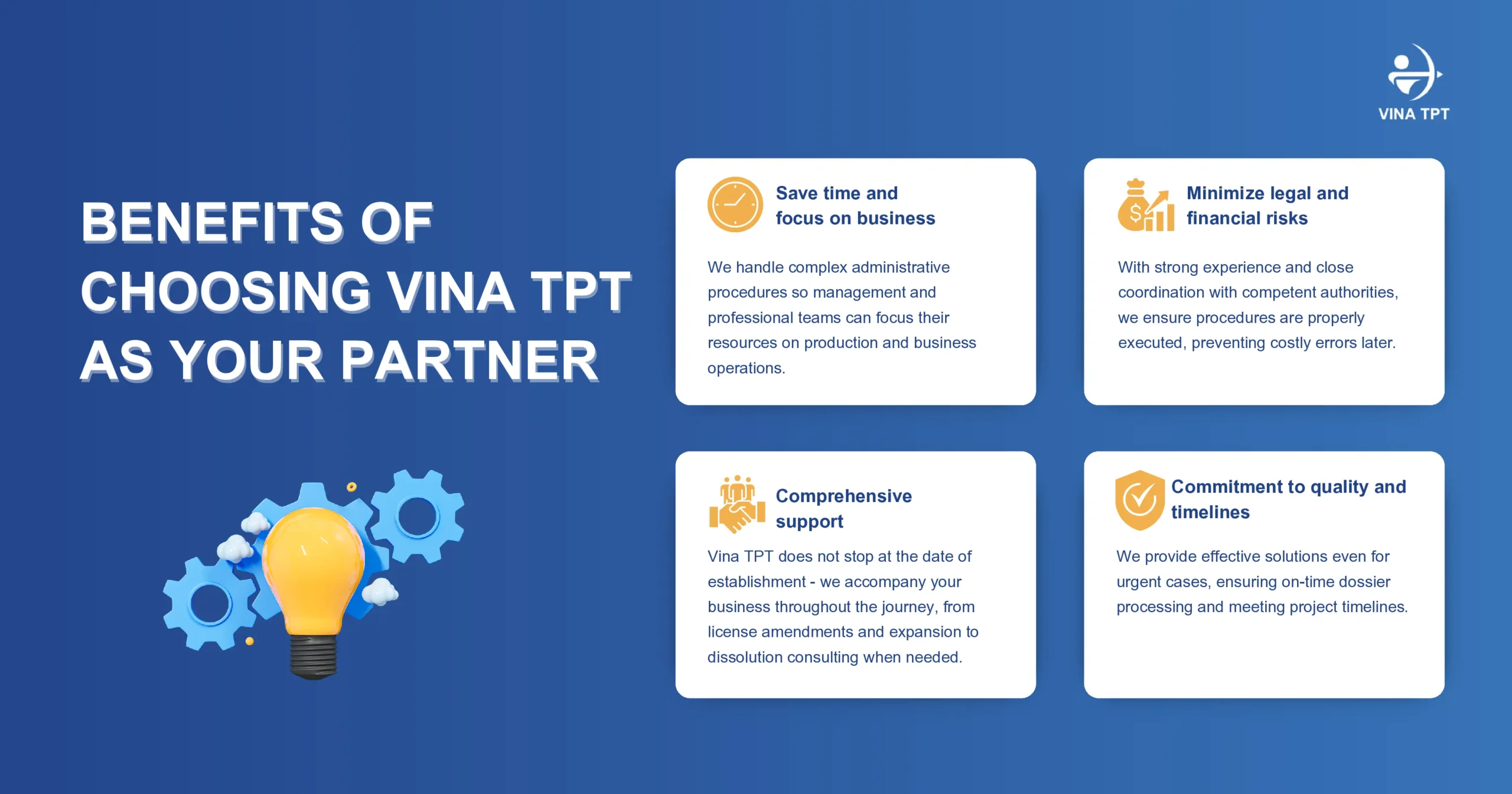
With extensive experience supporting FDI enterprises throughout establishment and operations, Vina TPT provides end-to-end advisory and implementation services to ensure the process is accurate, transparent, and compliant with current regulations.

4. Vina TPT solutions for doing business in Vietnam

Vina TPT’s Company Setup Services in Vietnam for foreign investors include:

  • Orientation consulting & planning: Simply share your business plan in Vietnam, and our specialists will advise the most suitable company registration option – while prioritizing investment safety.
  • Business licensing (IRC/ERC): We support the full preparation and submission of IRC and ERC dossiers, ensuring a smooth and compliant establishment process. Estimated timeline: 3-6 weeks.
  • Post-establishment capital contribution: We assist with bank account opening, capital transfer, and online banking/tax payment registration to ensure charter capital contribution is smooth and compliant for your enterprise in Vietnam.
  • Tax registration and filings: Vina TPT continues to support post-establishment procedures such as fiscal year registration, business license tax declaration, e-invoice setup, VAT filings, and preparation of the first quarter financial report – helping the business operate properly from day one.

americans-doing-business-in-vietnam-2026-legal-guidance-detailed-procedures 

Doing business in Vietnam can be complex and requires careful preparation. If investors lack experience and want to focus more on business operations, you should consider professional advisory services such as Vina TPT. We not only understand the law and possess strong expertise, but also have hands-on experience and deep understanding of corporate culture. Contact Vina TPT today for free consultation.

BOOK A FREE CONSULTATION

FDI Company Setup in Vietnam: Business License & Complete 2026 Guide

setting up company in Vietnam

setting up company in Vietnam

Why Setting up Company in Vietnam is the Strategic Choice for 2026?

The year 2026 marks a pivotal turning point for foreign investors in Vietnam. With significant reforms in the Law on Investment and a roadmap to reduce conditional business lines, the process for setting up a company in Vietnam is becoming more transparent and streamlined than ever.

However, to operate legally in specialized sectors such as retail, distribution, or logistics, investors must follow a structured path from obtaining an IRC and ERC to securing a specific business license.

1. Why Foreign Investors Need a Clear Roadmap in 2026

Starting a business in Vietnam as a foreigner offers immense potential, but understanding the 2026 regulatory landscape is crucial to avoiding delays or rejected applications.

a. FDI Opportunities in 2026

Vietnam maintains its position as Southeast Asia’s “global factory” based on four key pillars:

  • Extensive FTA Network: Leverage tariff incentives from the CPTPP, EVFTA, and RCEP.
  • New Incentive Policies: Strong focus on high-tech projects, circular economy, and renewable energy.
  • Flexible Ownership Structures: 100% foreign ownership is permitted in most sectors, including manufacturing, IT, consulting, and trading.
  • Digitalized Procedures: Significant reduction in waiting times through the National Business Registration Portal.

b. When is a Business License (Trading License) Mandatory?

While many sectors are open, a Business License (Trading License or Retail Distribution License) is still mandatory for foreign investors in “conditional” sectors under WTO commitments and Vietnamese Law.

Even with eased regulations, a separate Business License is required after company formation for:

  • Retail Sales: Directly providing goods to end consumers.
  • Distribution & Import: Applied to restricted or specialized commodity groups.
  • Specialized Services: Logistics, education, healthcare, and F&B.
  • Important Note: By July 1, 2026, sectors like accounting and insurance brokerage will see further liberalization. However, for Retail & Distribution, investors must still seek approval from the Ministry/Department of Industry and Trade.

c. Distinguishing IRC vs. ERC vs. Business License

Understanding these three acronyms is vital for any foreigner setting up a company in Vietnam:

Permit Type Issuing Authority Primary Role
IRC (Investment Registration Certificate) Department of Planning and Investment (DPI) Approves the investment project (capital, objectives, location).
ERC (Enterprise Registration Certificate) Business Registration Office Creates the legal entity and issues the Tax ID.
Business License Relevant Ministry or Department Grants permission to operate in conditional sectors (Retail, etc.).

The Standard Sequence: IRC (Project Approval) → ERC (Company Formation) → Business License (For specific sectors).

2. 5-Step Process for Setting Up Company in Vietnam in 2026

The average timeline for completion ranges from 1 to 2 months, depending on the complexity of your business lines.

Step 1: Choose a Legal Structure & Check Ownership Limits

The most common choice is a Limited Liability Company (LLC) due to its flexibility and limited liability protection. Foreigners must verify if their specific sector requires a Joint Venture (JV) with a Vietnamese partner.

Step 2: Obtain the Investment Registration Certificate (IRC)

Investors submit the application to the DPI. Key documents include:

  • Detailed Investment Project Proposal.
  • Proof of Financial Capacity (Bank statements or audited reports).
  • Office Lease Agreement or Memorandum of Understanding (MOU).
  • Timeline: 15 – 35 working days.

Step 3: Obtain the Enterprise Registration Certificate (ERC)

Once the IRC is issued, the ERC application is typically processed within 3 – 7 working days. This step officially grants your business its legal status.

Step 4: Post-Registration Procedures (Operational Compliance)

Obtaining the ERC is only the beginning. Within 90 days, investors must fulfill these mandatory obligations:

  • Open a Direct Investment Capital Account (DICA): This is the most critical step. All capital contributions, profit repatriations, and share transfers must flow through this account.
  • Capital Contribution: Ensure the total committed capital is transferred into the DICA within 90 days of ERC issuance.
  • Online Investment Reporting: Businesses must report project progress quarterly and annually on the National Investment Information System. Missing these deadlines can lead to heavy administrative fines.
  • Initial Tax & Accounting Setup: Register digital signatures, set up e-invoice templates, and pay Business License Tax (License Fees). Appointing a Chief Accountant or an outsourced accounting representative is a legal requirement for signing financial statements.

Step 5: Specialized Business License (If applicable)

For retail and distribution entities, authorities will assess the application based on local planning and socio-economic impact. Note the Economic Needs Test (ENT) requirement if you plan to open a second retail outlet or more.

setting up company in Vietnam

Get a free 30-minutes consultation

3. Required Documents & Checklist

All foreign documents must be Consularly Legalized, translated into Vietnamese, and notarized.

  • Individual Investors: Notarized passport + Bank balance confirmation.
  • Corporate Investors: Parent company’s Certificate of Incorporation + Audited financial statements (last 2 years) + Resolution appointing the authorized representative.
  • Project Documents: Detailed Business Plan and proof of right to use the business location.

4. Vina TPT: Your Trusted Partner for FDI Success in Vietnam

Establishing a legal entity is just the start. To thrive in the Vietnamese market, businesses need a solid foundation in Accounting, Tax, and HR from day one.

Vina TPT is proud to be a strategic partner, helping foreign investors remove language barriers and navigate local legal complexities:

  • Expert Consulting: From initial setup to tax structure optimization. We keep you updated on the latest regulations, including Global Minimum Tax and 2026 tax incentives.
  • Payroll & HR Management: We handle labor contracts, Social Health & Unemployment Insurance (SHUI), and Personal Income Tax (PIT) finalization for both expats and locals, ensuring absolute confidentiality.
  • Lifecycle Partnership: With over 20 years of experience, Vina TPT provides an “All-in-one” ecosystem. You focus on growth; we handle the administration.
  • No Language Barrier: Our trilingual team (English – Japanese – Vietnamese) ensures transparent communication and seamless management reporting.

Optimize your resources and minimize legal risks with Vina TPT. Contact us today for a 1-on-1 specialized consultation for your 2026 project.

Start your journey in vietnam

setting up company in Vietnam

Top 10 | Ideas for small business in Vietnam for Foreign Investors

1. Overview of Business Opportunities for Foreigners

If you’re exploring ideas for small business in emerging markets, Vietnam stands out as one of the fastest-growing economies in Southeast Asia, backed by a young population, a dynamic workforce and rising consumer demand. Foreign investors can tap into numerous developing sectors.

The Vietnamese market is particularly attractive due to the growth of the middle class, new consumer habits and high demand for quality services. Large cities such as Hanoi, Ho Chi Minh City, Da Nang are ideal destinations to test small business models and implement innovative ideas.

2. Profitable Ideas for Small Business

Below are ideas for small business suitable for foreign investors in Vietnam, detailed implementation so that customers can evaluate the potential:

F&B (Food & Beverage):

  • Coffee shops, restaurants, milk tea stalls with creative concepts.
  • Delivery services, processing organic food, healthy food.
  • Business in foreign specialties or combining local culinary culture.

Education services:

  • Foreign language centers, skills training, teaching STEM or coding for children.
  • Online classes, edu-tech models combined with offline.

E-commerce:

  • Online retail, dropshipping, or specialized sales platforms.
  • Providing unique imported products, targeting middle-class customers.

Light Manufacturing:

  • Processing agricultural products, packaged foods, manufacturing handmade products.
  • Producing small consumer products, souvenirs or fashion accessories.

Support and logistics:

  • Transportation, warehousing, fulfillment for e-commerce.
  • Business consulting, marketing, or office rental services.

Tourism & Travel:

  • Boutique travel agencies, guided tours, eco-tourism, and adventure trips.
  • Services combining local culture, culinary experiences, and foreign-language support.

Health & Wellness:

  • Fitness studios, yoga centers, spas, wellness retreats.
  • Health coaching, organic/natural product shops, or dietary consultation services.

Tech & Digital Solutions

  • App or software development for small businesses, fintech solutions.
  • Digital marketing agencies, social media management, or website development.

Creative & Arts Services

  • Photography studios, interior design, handmade crafts, or art workshops.
  • Event planning, wedding services, or cultural experience workshops for foreigners.

Green & Sustainable Businesses

  • Eco-friendly products, recycling services, sustainable packaging, or zero-waste shops.
  • Solar energy solutions or small-scale environmental consulting for local businesses.

These ideas for small business are suitable for small and medium investment capital, flexible in implementation and can be tested in big cities or niche markets.

4. Key Considerations for Compliance and Operations

When planning to implement ideas for small business in Vietnam, foreign investors need to understand some basic factors about operations and legal compliance. Although you do not need to go into the details of the law, understanding these points will help avoid future risks and ensure the company operates smoothly.

4.1 Tax compliance and financial reporting

Every business in Vietnam must declare value-added tax (VAT), corporate income tax (CIT) and personal income tax (if it has employees). Preparing accounting books from the beginning will help businesses easily prepare monthly, quarterly and year-end financial reports, and avoid tax arrears or administrative fines.

4.2 Social insurance and employee benefits

If a business hires local workers, paying social insurance, health insurance and unemployment insurance is mandatory. This is an important factor to ensure employee benefits and compliance with Vietnamese labor laws.

4.3 Compliance with basic industry and legal regulations

Some industries, such as F&B, education or logistics, require specific business licenses or sub-licenses. A basic understanding of these requirements will help investors choose the right business model and avoid legal risks.

GET LEGAL SUPPORT

4.4 Manage operations and administrative records

Preparing basic procedures such as registering for a tax code, opening a corporate bank account and keeping complete records will help businesses operate effectively right from the start.

In short, understanding the above notes helps investors plan in advance, minimize risks and focus on implementing business ideas, without having to go too deep into detailed regulations on laws and taxes.

5. How Vina TPT Supports Foreign Investors

Vina TPT provides comprehensive services for foreign investors, including:

  • Company setup & registration at state agencies and corporate bank account opening.
  • Accounting & tax compliance: bookkeeping, financial reports, tax registration, declarations, and handling tax inquiries.
  • Payroll & social insurance: payroll calculation, insurance registration, and labor report submissions.
  • Work permit & visa support for foreign employees.
  • Ongoing legal compliance to ensure smooth operations.

With more than 20 years of experience supporting startups and FDI enterprises in Vietnam, Vina TPT commits to providing fast, transparent and legally compliant services, helping investors feel secure from the company setup step to initial operation, optimizing time and costs, while ensuring the business operates effectively and safely.

Explore business opportunities in Vietnam and start your investment journey with Vina TPT

BOOK A FREE CONSULTATION

Top-20-Sectors-for-Business-Opportunities-in-Vietnam-VTPT

[HCM] Hiring | Human Resources Consultant Assistant

Human Resources Consultant Assistant at Vina TPT – a great choice for those looking for jobs in Vietnam. This role offers the opportunity to work with FDI companies, gain hands-on experience in accounting and tax, HR advisory, and build your career in a professional, dynamic environment.

About Vina TPT

Vina TPT is a reputable and professional Accounting, Tax, HR, and Business Advisory Services company in Vietnam. Our mission is to deliver value-added financial consulting services that help clients achieve a strong competitive advantage in a rapidly changing business environment. We specialize in providing tailored solutions for FDI companies in Vietnam, helping them navigate complex tax regulations, streamline accounting processes, and ensure compliance with local laws.

By joining Vina TPT, you will become part of a dynamic and professional team, working alongside industry experts and gaining experience across multiple sectors.

Job description / Main responsibility:

As a Human Resources Consultant Assistant, you will be able to participate in providing HR services for FDI companies in Vietnam. You will have the opportunity to gain critical skills that are essential to advance career paths in the field of HR consulting.

  • Support the salary and benefits system for Clients, including calculating salaries, bonuses, allowances, insurance benefits, Personal Income Tax (PIT) declarations;
  • Support performing procedures related to labor contracts for Clients, including drafting contracts, managing employee records, and monitoring contract expiration dates;
  • Support receiving and processing recruitment-related documents for Clients, including posting job openings, screening candidates, scheduling interviews, and tracking results;
  • Support resolving labor relations issues for Clients, including disciplinary actions, handling complaints, and advising employees on labor law-related matters;
  • Perform other HR administrative tasks for Clients, including managing employee records, tracking leave days, and updating employee information;
  • Other tasks/duties as requested by Clients/HR team leaders, etc.

Working location: Company Office – 83B Hoang Sa, Tan Dinh Ward, Ho Chi Minh City

Requirements:

Educational Background:

– Bachelor’s degree in Human Resource Management, Law, Economics, Accounting or related fields;

Work Experience:

– At least 02 years of experience in Human Resources, specifically Compensation and Benefits (C&B);

– Experience working in the field of HR consulting is preferred.

Skills and Knowledge:

– Proficient in English (both speaking and writing);

– Good communication skills;

– Knowledge of Compensation and benefits and regulations related Vietnam Labor Law;

– Problem-solving, critical thinking, and effective teamwork skills;

– Ability to work independently and under high pressure;

– Proficient in office productivity tools.

Benefits:

Salary and Bonuses:

  • Gross Salary: Basic Salary + Allowances à NEGOTIABLE

+ Basic Salary: 70% of Gross Salary (social insurance contributions based on 70% of Gross Salary)

+ Allowances: 30%

  • Bonuses: 13th-month salary + performance-based bonus (based on individual KPI evaluation and company business performance).

Evaluation:

  • Performance evaluation: one per year;
  • Salary review: one per year (based on evaluation results and company business performance).

Other Benefits:

Insurance:

  • Social insurance, health insurance, unemployment insurance in accordance with the law;
  • Supplementary health insurance (private insurance) for employees and their families (depending on position and seniority).
  • Leave: 12 annual leave days.
  • Health check-up: Annual health check-up.

Training and Development:

  • Opportunities to participate in professional training courses to improve skills;
  • Training cost support (depending on the program and company regulations);
  • Career development and promotion opportunities within the company.

Working Environment:

  • Professional, dynamic, and friendly working environment;
  • Opportunities to work with leading experts in the industry;
  • Participation in team-building activities and company events.

Other Benefits:

  • Travel and business trip allowance (if applicable);
  • Other employee benefits policies.

How to Apply

If you are a motivated and experienced professional seeking a challenging yet rewarding career, send your CV to join Vina TPT as a Human Resource Consultant Assistant in Ho Chi Minh City.

📩 Email: trung.hieu.nhi@vinatpt.com
📌 Email Subject: [HR Assistant] – Full Name

For any questions, please contact our hotline/Zalo: 0984 980 069

Apply Now

Company registration service for Japanese mechanical manufacturing

Company-registration-service-for-Japanese-mechanical-manufacturing

register-a-company-service-for-japanese

1. Vietnam – A Strategic Base for Japanese Mechanical Manufacturers

Register a company in Vietnam has become increasingly appealing, as the country has emerged over the past decade as a new manufacturing hub in Asia, particularly attractive to Japanese mechanical engineering companies. The reasons come from reasonable operating costs, highly skilled technical human resources and a favorable geographical location for connecting the regional supply chain. In addition, the Vietnamese government has also implemented many tax incentives and infrastructure support policies to attract FDI, especially in the field of mechanical engineering and supporting industries.

For Japanese enterprises, setting up a business in Vietnam not only helps reduce costs but also expands access to the ASEAN market, while maintaining production quality according to Japanese standards. This is the reason why more and more mechanical corporations choose Vietnam as a strategic production base in Southeast Asia.

2. Legal Requirements to Register a Mechanical Manufacturing Company

To register a mechanical manufacturing company in Vietnam, businesses need to carry out some important legal procedures:

2.1 Investment Registration Certificate (IRC) if there is foreign capital.

IRC is the first license allowing the investor to implement the project in Vietnam.

The required documents usually include:

  • Application for investment project implementation and Project proposal: stating the objectives, scale, location, investment capital, progress.
  • Proof of the investor’s financial capacity: bank statement, credit contract or collateral.
  • Legal documents of the investor:
    • Individual: Notarized passport, consular legalization.
    • Organization: Business registration certificate or equivalent document, consular legalization.
  • Project location: lease contract or land/office use rights certificate.

After the IRC is granted (or for 100% domestic-owned enterprises), the investor applies for an ERC – an official license for the enterprise to operate, and also the tax code of the company.

2.2 Enterprise Registration Certificate (ERC) at the Department of Finance.

The ERC dossier usually includes:

  • Application for enterprise registration.
  • Company Charter: stipulates the organizational structure, powers of members/shareholders, capital ratio and management method.
  • List of members/shareholders and legal representatives: clearly state information, ownership ratio, voting rights.
  • Appointment decision and authorization letter (if any).
  • Capital contribution plan & financial evidence: bank statement or credit contract (especially important for large capital projects).

For the mechanical industry, some activities such as heavy metal processing, precision mechanical equipment manufacturing or industrial machinery assembly may require additional specialized licenses or technical safety certificates.

Using a professional service to register a company helps investors avoid legal errors and ensures that documents are processed in accordance with the regulations of Vietnamese authorities.

REGISTER YOUR COMPANY IN VIETNAM NOW

3. Site Selection and Industrial Licensing for Manufacturing Facilities

Choosing a factory location is one of the most important strategic decisions when Japanese mechanical enterprises register a company in Vietnam. A suitable location not only affects the initial investment cost but also determines production efficiency and future expansion.

In terms of location, northern regions such as Bac Ninh, Hai Phong, Hung Yen have the advantage of being close to seaports, convenient for exporting to Japan and ASEAN. Meanwhile, southern regions such as Binh Duong, Dong Nai, Long An have good industrial infrastructure and support services, suitable for domestic supply chains. In addition to land rental costs, businesses also need to consider the ability to recruit technical workers – industrial parks near training centers in Hanoi or Ho Chi Minh City help reduce personnel costs.

register-a-company-service-for-japanese

Investment incentives are also a factor worth considering: corporate income tax exemption for the first 2-4 years, 50% reduction in the following years, support for infrastructure costs or land rental. Many localities also have their own promotion programs for Japanese investors.

After selecting a location, businesses must complete the factory operation licenses, including:

  • Construction license according to the approved industrial park planning.
  • Environmental impact assessment (EIA) report according to regulations of the Ministry of Natural Resources and Environment.
  • Certificate of safety of machinery and equipment, especially for imported mechanical lines.
  • Fire safety certification, ensuring safety systems and labor standards.

Completing all these procedures helps businesses operate legally, avoid interruptions in the production process and facilitate future expansion or investment incentives.

4. Understanding Vietnam’s Regulatory Standards for Mechanical Production to Register a Company 

For Japanese mechanical enterprises, establishing a factory in Vietnam involves not only investment and location but also compliance with local technical, safety, and quality standards, a key factor to maintain reputation and meet global requirements.

4.1. Technical Standards System

Vietnam applies two main groups of standards:

  • TCVN (Vietnam National Standards): Recommended standards based on ISO and JIS, used to control quality and production processes.
  • QCVN (Technical Regulations): Mandatory standards on safety, emissions, and energy use. Non-compliance can lead to fines or suspension.

For export-oriented firms, applying ISO 9001, ISO 14001, ISO 45001, and JIS standards ensures product quality equivalent to factories in Japan.

4.2. Equipment Inspection and Product Certification

All imported machinery are CNCs, lathes, welding, or lifting equipment, and must pass technical safety inspections before operation. Products supplied to FDI projects or exports require CR/CQ certificates, and some industries also need IATF 16949 certification.

Proactive inspection and certification reduce technical risks and enhance global competitiveness.

4.3. Environmental and Workplace Safety

Mechanical factories must install air, wastewater, and waste treatment systems meeting national standards. Enterprises also need regular safety training, inspection of lifting equipment and electrical systems, and proper protective gear.

Strict compliance not only fulfills legal requirements but reflects the Japanese values of safety, discipline, and quality.

4.4. Advantages of Japanese Enterprises

By maintaining JIS or Kaizen-5S management models, Japanese enterprises can:

  • Transfer technology easily
  • Build trust with authorities and partners
  • Access programs from JETRO, JBIC, and Vietnam-Japan cooperation projects

This foundation supports stable, long-term investment with optimized costs and minimal legal risk.

5. How Vina TPT Company Registration Service Simplifies the Setup Process

In the context of the increasingly complex Vietnamese legal system, register a company for foreign enterprises, especially in the mechanical field, requires in-depth knowledge of investment, accounting, tax and technical standards. Vina TPT company registration service was established with the mission of supporting foreign investors, especially Japanese enterprises, to set up business operations in Vietnam quickly, legally and effectively.

Vina TPT provides comprehensive solutions for the process of setting up a business in Vietnam, including:

  • Consulting on investment strategies and choosing a business model suitable for the scale of mechanical production.
  • Preparing documents and applying for an Investment Registration Certificate (IRC) and Enterprise Registration Certificate (ERC) according to the provisions of the Investment Law and the Enterprise Law.
  • Consulting on construction permits, environmental permits, equipment safety certificates and mechanical factory operation procedures.

register-a-company-service-for-japanese

Thanks to a closed service system, Vina TPT helps Japanese enterprises save maximum time, reduce legal risks and ensure the factory launch progress on schedule.

The biggest difference of Vina TPT company registration lies in the team of experts with over 20 years of practical experience in the field of corporate law, accounting, tax in Vietnam.

How Vina TPT Supports Japanese Manufacturing Enterprises: 

  • .Proven FDI Experience: Advised many Japanese projects in mechanics, electronics, and supporting industries, fully understanding local licensing and compliance.
  • Cultural Alignment: Operates with Japanese-style precision, transparency, and discipline in all documentation and processes.
  • End-to-End Support: A strategic partner from setup to operation and expansion.
  • Bilingual Team: Fluent Japanese communication ensures smooth coordination and minimized barriers.
  • Focused on Results: Ensures legal compliance, cost efficiency, and sustainable growth for every project.

Contact Vina TPT today for free consultation on the process register a company and setting up a mechanical factory in Vietnam.

CONTACT US NOW

register-a-company-service-for-japanese

[Newsletter] Vietnam Tax Policy Updates September 2025- CIT, VAT, PIT and Social Insurance

Updates on new regulations regarding tax, e-invoices, and social insurance September 2025 (2)
As part of the Vietnam tax policy updates 2025, several new regulations related to Corporate Income Tax (CIT), Value Added Tax (VAT), Personal Income Tax (PIT), and social insurance are scheduled to take effect starting from September 2025. These changes are expected to directly impact financial reporting, payroll processes, and compliance operations across both Vietnamese and FDI enterprises.
To help businesses stay compliant and proactively adjust their internal procedures, this article provides a clear breakdown of the most important regulatory updates you need to be aware of.
In this article, we break down the most important tax regulations businesses need to prepare for in 2025.

1. Value-Added-Tax & IMPORT TAXES

1.a. Products manufactured from fabricated metals are entitled to a 2% value-added tax reduction.

Official Letter No. 6099/TCS3-QLDN2 dated September 11, 2025 of Dong Nai Tax Department regarding the case where a company manufactures and processes metal products, in which the determination of VAT reduction on sold products is made in accordance with Circular No. 174/2025/TT-BTC, specifically as follows:
  • The company shall identify its products based on the product codes, names, and descriptions provided in the Appendix issued together with Decision No. 43/2018/QD-TTg, and compare them with the List of goods and services not eligible for value-added tax (VAT) reduction issued together with Circular No. 174/2025/TT-BTC. In cases where the products fall under the List of goods attached to Circular No. 174/2025/TT-BTC, they shall not be entitled to VAT reduction.
  • For products manufactured from fabricated metals classified under Section 25, which are not included in the List of goods and services issued together with Circular No. 174/2025/TT-BTC, a VAT reduction shall apply.

1.b. Principles for making supplementary declarations of input VAT errors or omissions applicable from July 1, 2025.

Official Letter No. 3915/CT-CS dated September 18, 2025 of the Tax Department regarding VAT policies, specifically as follows:
  • The Tax Department stated that, from July 1, 2025, the Law on Value-Added Tax No. 48/2024/QH15 and Decree No. 181/2025/ND-CP have specifically provided regulations on the declaration and deduction of input VAT in cases of errors or omissions. Enterprises are therefore requested to study and comply with these provisions. Accordingly, under Point đ, Clause 1, Article 14 of Law No. 48/2024/QH15 and Clauses 5 and 6, Article 23 of Decree No. 181/2025/ND-CP, when errors or omissions in input VAT are detected, business establishments shall make supplementary declarations in accordance with the following principles:
  • A supplementary declaration shall be made in the month or quarter in which the error or omission in input VAT arises, if such error or omission results in an increase in tax payable or a reduction in refundable tax for that month or quarter.
  • A supplementary declaration shall be made in the month or quarter when the error or omission is detected, if such error or omission results in a decrease in tax payable, or only increases or decreases the amount of VAT to be carried forward to the subsequent period.

1.c. On-the-spot imported goods shall not be exempt from import duty and value-added tax.

Official Letter No. 22303/CHQ-GSQL dated September 5, 2025 of the Customs Department regarding on-the-spot imported goods, specifically as follows:
  • Clause 3 Article 3 of Law No. 90/2025/QH15 supplements Article 47a of the Customs Law, stipulating that on-the-spot import and export goods are goods delivered and received in Viet Nam under the designation of a foreign trader pursuant to sale, processing, leasing, or borrowing contracts. Cases that meet these conditions shall carry out customs procedures under Article 35 of Circular No. 08/2015/TT-BTC (as amended by Circular No. 167/2025/TT-BTC) and Article 86 of Circular No. 38/2015/TT-BTC (as amended by Circular No. 39/2018/TT-BTC).
  • According to Circular No. 134/2016/TT-BTC (as amended by Circular No. 18/2021/TT-BTC), in cases where on-the-spot imports are not registered under the processing type, the importer must declare and pay import duty based on the applicable duty rate and customs value at the time of registration. If import duty has been paid for production or business purposes and the imported products have been actually exported abroad or to a non-tariff zone, the paid duty shall be refunded in accordance with Article 36 of this Circular
  • On-the-spot import and export goods remain subject to VAT. Where goods are registered under other types (not processing), the taxpayer shall use code A11 (commercial import) or A12 (import for production and business) to declare and pay import duty and VAT.

2. Personal Income Tax (PIT)

2a. Some notes on PIT withholding and accounting for business trip allowance.

Official Letter No. 2284/CTH-QLDN1 dated September 15, 2025 of the Can Tho City Tax Department regarding taxable personal income (PIT) on business trip allowances, specifically as follows:
  • Taxable PIT income with respect to lump-sum business trip allowances: This is the portion of business trip allowances exceeding the limits prescribed by the State. Specifically: For employees working in business organizations and representative offices, the limit on business trip allowances shall be applied consistently with the level determined for corporate income tax (CIT) purposes. For employees working in international organizations or representative offices of foreign organizations, the limit on business trip allowances shall be applied in accordance with the regulations of such international organizations or representative offices of foreign organizations (see Point đ.4, Clause 2, Article 2 of Circular No. 111/2013/TT-BTC).
Travel expenses and accommodation costs for employees on business trips shall be deductible if supported by sufficient invoices and documents.
  • Where the enterprise has a financial/internal regulation stipulating allowances for travel, accommodation, and per diem for employees on business trips, and such regulation is properly implemented, these expenses shall be deductible.
  • Payment by employees’ personal bank cards for business trip expenses of VND 20 million or more (including airfares):
  • Such expenses shall be deductible if the following conditions are met:
  • Valid invoices and supporting documents are available.
  • A decision or written authorization for the employee’s business trip is issued.
  • The enterprise’s financial/internal regulation permits employees to pay using personal bank cards, with subsequent reimbursement by the enterprise.
  • Purchase of air tickets via e-commerce websites: The documents serving as the basis for deductibility include the electronic air ticket, boarding pass, and the enterprise’s non-cash payment vouchers showing the individual undertaking the transportation service.

Explore Tax Services in Viet Nam

2b. Three Additional Types of Income Exempt from Personal Income Tax Effective from October 1, 2025

According to the new provisions in the Law on Science, Technology and Innovation 2025 (No. 93/2025/QH15), effective from October 1, 2025, Clause 3, Article 71 of this Law supplements Points 18, 19, and 20 after Point 17 of Article 4 on tax-exempt income under the Law on Personal Income Tax 2007, as amended and supplemented.
Accordingly, from October 1, 2025, three additional types of income will be exempt from Personal Income Tax (PIT), including:
  • Income from salaries and wages received from performing science, technology, and innovation tasks.
  • Income from copyright related to science, technology, and innovation tasks when the results of such tasks are commercialized in accordance with the laws on science, technology, innovation, and intellectual property.
  • Income of individual investors and experts working for start-up innovation projects, founders of start-up enterprises, and individual investors contributing capital to venture capital funds.

3. Corporate Income Tax (CIT)

Corporate-income-tax-VinaTPT

3a. New Regulations on Corporate Income Tax Rates effective from October 1, 2025.

On June 14, 2025, the National Assembly passed the Law on Corporate Income Tax 2025, effective from October 1, 2025. According to Article 10 of the Law on Corporate Income Tax 2025, the applicable corporate income tax (CIT) rates are as follows:
  • The standard CIT rate is 20%, except for the cases specified in (2), (3), and (4) below, and entities eligible for preferential rates under Article 13 of the Law on Corporate Income Tax 2025.
  • A 15% CIT rate applies to enterprises with annual total revenue not exceeding VND 3 billion.
  • A 17% CIT rate applies to enterprises with annual total revenue of over VND 3 billion up to VND 50 billion standard CIT rate is 20%, except for the cases specified in (2), (3), and (4) below, and entities eligible for preferential rates under Article 13 of the Law on Corporate Income Tax 2025
The revenue serving as the basis for determining whether an enterprise qualifies for the 15% or 17% CIT rate, as provided in (2) and (3), is the total revenue of the immediately preceding tax period. The method for determining total revenue as the basis for application shall be stipulated by the Government.
CIT rates for certain specific activities are as follows:
  • Oil and gas exploration and exploitation: from 25% to 50%. The specific rate applicable to each petroleum contract shall be decided by the Prime Minister based on location, exploitation conditions, and reserve capacity.
  • Exploration and exploitation of precious and rare natural resources (including platinum, gold, silver, tin, tungsten, antimony, gemstones, rare earths, and other rare resources as prescribed by law): 50%. For mines where 70% or more of the allocated area lies in regions with exceptionally difficult socio-economic conditions, the applicable rate is 40%.

3b. The transfer of a subsidiary is exempt from value-added tax but subject to declaration and payment of corporate income tax.

Official Letter No. 3684/CT-CS dated September 10, 2025 of the Tax Department regarding tax policy, specifically as follows:
  • According to the guidance of the Tax Department, in the case where a company transfers its wholly-owned subsidiary to another company, if such transfer is determined to be a capital transfer, it shall fall under the category not subject to value-added tax in accordance with Clause 8 Article 4 of Circular No. 219/2013/TT-BTC.
  • With respect to corporate income tax (CIT), in the case where a company transfers its entire capital contribution equivalent to 100% of the charter capital in a subsidiary in the form of a capital transfer associated with real estate, in accordance with the provisions of the Law on Enterprises and the Law on Investment, the company shall be required to declare and pay CIT under real estate transfer activities. The tax declaration shall be made using Form No. 06/TNDN issued together with Circular No. 80/2021/TT-BTC.

3c. Notes on Provisional Payment of Corporate Income Tax.

Official Letter No. 3904/CT-CS dated September 18, 2025 of the Tax Department responding to petitions related to the provisional payment of corporate income tax, specifically as follows:
  • According to the Tax Department, the Law on Tax Administration and its implementing instruments already provide regulations on the deadline for quarterly provisional corporate income tax payments and the total amount of CIT to be provisionally paid quarterly. Specifically, under Clause 1, Article 55 of the Law on Tax Administration No. 38/2019/QH14, the deadline for provisional quarterly CIT payments is the 30th day of the first month of the following quarter at the latest.
  • The total CIT provisionally paid for all four quarters must not be less than 80% of the CIT payable under the annual finalization. If the enterprise pays less than this threshold, late payment interest shall be charged on the underpaid tax amount (Clause 3, Article 1 of Decree No. 91/2022/ND-CP).

4. Social Insurance – Trade Union

a. From July 1, 2025, Certificates of Social Insurance Leave issued under the old form will no longer be accepted.

Official Letter No. 5761/BYT-KCB dated August 27, 2025 of the Ministry of Health regarding the settlement of difficulties in implementing social insurance regimes for employees, specifically as follows:
  • Accordingly, the Ministry of Health notes that Certificates of Social Insurance Leave issued prior to the effective date of Circular No. 25/2025/TT-BYT (July 1, 2025) shall remain valid as the basis for entitlement to social insurance benefits. For Certificates issued after July 1, 2025, it is mandatory to use the new form promulgated under Circular No. 25/2025/TT-BYT. The difference between the new form and the old form (issued under Circular No. 18/2022/TT-BYT) lies in the addition of information on the employee’s citizen identification number/identity card number/passport number/personal identification number; other contents remain unchanged from the old form.
  • During the initial implementation of Circular No. 25/2025/TT-BYT, for documents issued by hospitals still using the old form and not yet switched to the new form, in order to ensure employees’ rights and avoid inconvenience, the Ministry of Health has requested that enterprises prepare a list of employees whose documents were issued by hospitals in non-compliance with regulations, and submit an official letter to the Department of Health or the health authority of the relevant ministries/agencies managing such hospitals, requesting the supplementation of information on the documents already issued, as prescribed in Point b, Clause 4, Article 28 of Circular No. 25/2025/TT-BYT.
As for Certificates of Social Insurance Leave without the hospital’s seal due to the seal not yet being updated to the new address following a merger, the Ministry of Health has stated that, under Clause 8, Article 69 of Decree No. 188/2025/ND-CP, medical examination and treatment establishments are permitted to continue using their old seals until new seals are issued.

b. Online Procedures for Unemployment Benefits applicable from September 17, 2025.

Decision No. 1295/QD-TTPVHCC dated September 17, 2025 of the People’s Committee of Hanoi City announcing the List of administrative procedures on unemployment insurance to be piloted on the National Public Service Portal under the management competence of the Department of Home Affairs of Hanoi City, specifically as follows:
This Decision announces six procedures concerning the entitlement to and termination of unemployment benefits to be piloted by the Hanoi Department of Home Affairs on the National Public Service Portal as from September 17, 2025, including:
  • Settlement of entitlement to unemployment benefits
  • Monthly notification of job search activities.
  • Settlement of entitlement to unemployment benefits
  • Settlement of entitlement to unemployment benefits
  • Transfer of entitlement to unemployment benefits (integrated procedure for transfer-out and transfer-in).
  • Termination of entitlement to unemployment benefits.
This Decision takes effect from the date of signing.

5. OTHER

a. Household Businesses to Receive Free Accounting Software and Invoicing Support from the State.

Official Letter No. 3914/CT-CS dated September 18, 2025 of the Tax Department regarding the response to the petition of the Vietnam Banks Association:
  • With respect to the use of invoices by household businesses, the Tax Department notes that, pursuant to the provisions of Decree No. 70/2025/NĐ-CP, from June 1, 2025, when selling goods or providing services directly to consumers, household businesses under the lump-sum tax regime with annual revenue exceeding VND 1 billion must issue electronic invoices generated from cash registers connected to and transmitting data to the tax authority, and deliver such invoices to buyers. The electronic invoice data is already available on the tax authority’s system, allowing both sellers and buyers to look up invoices on the system without the need to print paper copies.
  • Under the current guidance provided in Circular No. 40/2021/TT-BTC, there is no provision requiring lump-sum household businesses to retain purchase invoices or supporting documents.
  • As stipulated at Point b, Clause 4, Article 13 of Circular No. 40/2021/TT-BTC, in cases where a lump-sum household business changes its business scale (premises size, labor use, or revenue), it must declare adjustments and supplements to the Tax Return using Form No. 01/CNKD. The tax authority, based on the household business’s tax return and the tax sector’s database, shall issue a Notice of adjustment of lump-sum tax if it determines that declared revenue has changed by 50% or more compared to the previously assessed lump-sum revenue, effective from the time of such change within the tax year.
Furthermore, pursuant to Clause 3, Article 12 of Resolution No. 198/2025/QH15, the State shall allocate funding to provide free shared digital platforms and accounting software for small and micro enterprises, household businesses, and individual business households. At present, the Ministry of Finance is drafting a Decree guiding the implementation of this Resolution, which will include provisions on the measures to support the free provision of shared digital platforms and accounting software for small and micro enterprises, household businesses, and individual businesses.

b. Notes on conditions for exemption from business license fee during business suspension.

Official Letter No. 1355/QNG-QLDN1 dated September 4, 2025, of the Quang Ngai Provincial Tax Department on guidance regarding business license fees
  • The conditions for exemption from the business license fee during business suspension are stipulated in Clause 2, Article 1 of Decree No. 22/2020/NĐ-CP and Clause 4, Article 1 of Circular No. 65/2020/TT-BTC, as follows: a written request for suspension of production and business operations must be submitted to the tax authority or the business registration authority before the deadline for payment of the business license fee (January 30 each year), and the business license fee of the year in which suspension is requested has not yet been paid.
  • Accordingly, if a Company has submitted a written request to the business registration authority to suspend production and business operations in the calendar year 2025 (from January 1 to December 31) before the license fee payment deadline (before January 30) and has not yet paid the 2025 business license fee, then the Company is not required to pay the license fee for 2025.
However, if the above conditions are not satisfied, the Company must pay the business license fee for 2025.

6. INVOICES

a. Some notes on recording the purchaser’s tax identification number on invoices.

Official Letter No. 3955/CT-CS dated September 19, 2025 of the Tax Department regarding e-invoices, specifically as follows:
  • The presentation of the buyer’s name, address, and taxpayer identification number on e-invoices shall comply with the provisions of Clause 5 and Point c, Clause 14, Article 10 of Decree No. 123/2020/ND-CP (as amended and supplemented at Points a and d, Clause 7, Article 1 of Decree No. 70/2025/ND-CP). Accordingly, in cases where the buyer is a business establishment with a TIN, the buyer’s name, address, and TIN stated on the invoice must be consistent with the information on the enterprise/branch registration certificate, household business registration certificate, tax registration certificate, or TIN notification
  • If the purchaser does not have a tax identification number, the TIN is not required to be shown on the e-invoice. In addition, in cases specified at Point c, Clause 14 , Article 10, it is not mandatory to indicate the purchaser’s name, address, or TIN on the invoice. As from June 1, 2025, where the purchaser provides a TIN or personal identification number, the invoice must also include such TIN or personal identification number.
  • For e-invoices generated from cash registers, the invoice must show the purchaser’s name, address, tax identification number/personal identification number/telephone number if so requested by the purchaser (see Clause 3, Article 11 of Decree No. 123/2020/ND-CP, as amended and supplemented under Clause 8, Article 1 of Decree No. 70/2025/ND-CP).

b. Notes on issuing and adjusting invoices for sales with trade discounts.

Official Letter No. 1802/CTH-QLDN3 dated September 3, 2025, of the Can Tho City Tax Department regarding trade discount invoices, specifically as follows:
In this document, the Can Tho City Tax Department provided guidance on determining VAT taxable prices in cases of trade discounts, how to present discount amounts on invoices, and how to handle adjustment invoices when discounts are based on quantity or sales volume. Specifically:
VAT taxable price: The VAT taxable price is the selling price after deducting the trade discount given to customers, excluding VAT (Clause 2, Article 14 of Decree No. 181/2025/NĐ-CP).
Presentation on invoices: The invoice must clearly indicate the trade discount amount (Point đ, Clause 6, Article 10 of Decree No. 123/2020/NĐ-CP.
Discounts based on quantity or sales volume:
  • Adjustment on the last purchase/next period invoice: The discount amount shall be adjusted on the sales/service invoice of the last purchase or subsequent period, ensuring the discount amount does not exceed the value of goods or services recorded on that invoice.
  • Issuing an adjustment invoice: An adjustment invoice may be issued together with a list of the invoices subject to adjustment, including amounts and tax adjustments. The list must be kept at the entity and presented upon request by the tax authority or other competent state authority (Clause 13, Article 1 of Decree No. 70/2025/NĐ-CP amending and supplementing Article 19 of Decree No. 123/2020/NĐ-CP.
  • Tax return adjustments: Based on the adjustment invoice and related records, both the buyer and the seller shall declare adjustments to sales revenue, purchase revenue, input and output VAT in the period when the adjustment invoice is issued.
  • Adjustment invoice for trade discounts: This is an adjustment invoice for previously issued invoices, used to adjust differences in amounts only; it is not used to declare sales revenue already incurred. Accordingly, in the electronic invoice system of the General Department of Taxation, the line “Total amount before tax” will display the trade discount amount, while the line “Total trade discount amount” will display as 0.

Contact us for support

📞 (+84) 984 980 069

📧 infor@vinatpt.com

🌐www.vinatpt.com

🏢 5th Floor, More Building, 83B Hoang Sa, Tan Dinh Ward, Ho Chi Minh City

accounting service Vietnam for FDI company vtpt

Entering Vietnam’s Clothing Market: A Practical Guide for Chinese Manufacturers

Vina TPT company registration service supporting Chinese clothing investors in Vietnam

business-license-in-vietnam-for-chinese-manufacturer

1. Why Vietnam Is the Next Stop for China’s Clothing Giants

Vietnam is emerging as one of the most dynamic consumer markets in Southeast Asia, especially in the fashion and retail sectors. The middle class is growing rapidly, average incomes are rising, and young people’s shopping trends are gradually shifting towards brands with unique styles and reasonable prices.

For foreign investors and Chinese fashion brands, obtaining a business license in Vietnam is the first important step to legally enter this fast-growing market. With proper licensing and strategic market entry, businesses can take full advantage of Vietnam’s expanding retail opportunities and rising consumer demand.

Vietnamese consumers, especially Gen Z and Millennials, prefer modern fashion that quickly updates global trends while maintaining high practicality. This creates a great advantage for Chinese businesses, which have the ability to produce quickly, flexibly, and at competitive costs.

Not only does Vietnam have great purchasing power, it is also a politically stable market, transparent in investment, and benefits from many free trade agreements (CPTPP, RCEP, EVFTA). In addition, obtaining a business license in Vietnam for fashion or retail activities has become increasingly streamlined, making importing, distributing, or opening Chinese fashion brands in Vietnam easier and more compliant than ever. business license in vietnam

2. Choosing the Right Market Entry Strategy

Chinese businesses can choose one of three popular models when expanding into the Vietnamese market:

  • Establishing a 100% foreign-owned company (WFOE): Suitable for brands that want to control the entire import-distribution-retail process. This model allows for opening physical stores or doing business online after obtaining the required business license in Vietnam.
  • Cooperating with local distributors: helps save costs, quickly access the market, and take advantage of the existing retail network.
  • Joint Venture: Cooperating with Vietnamese businesses to combine local knowledge with goods sources and management capacity from China.

Each form has its own advantages in terms of control level, cost and risk, so it is necessary to consult carefully before choosing.

3. Beyond Paperwork: Setting the Foundation for Operations

To open a business in Vietnam, businesses need to carry out some important legal procedures to have business license in Vietnam:

Investment Registration Certificate (IRC) if there is foreign capital. IRC is the first license allowing the investor to implement the project in Vietnam.

The required documents usually include:

  • Application for investment project implementation and Project proposal: stating the objectives, scale, location, investment capital, progress.
  • Proof of the investor’s financial capacity: bank statement, credit contract or collateral.
  • Legal documents of the investor:
    • Individual: Notarized passport, consular legalization.
    • Organization: Business registration certificate or equivalent document, consular legalization.
  • Project location: lease contract or land/office use rights certificate.

After the IRC is granted (or for 100% domestic-owned enterprises), the investor applies for an ERC – an official license for the enterprise to operate, and also the tax code of the company.

Enterprise Registration Certificate (ERC) at the Department of Planning & Investment. The ERC dossier usually includes:

  • Application for enterprise registration.
  • Company Charter: stipulates the organizational structure, powers of members/shareholders, capital ratio and management method.
  • List of members/shareholders and legal representatives: clearly state information, ownership ratio, voting rights.
  • Appointment decision and authorization letter (if any).
  • Capital contribution plan & financial evidence: bank statement or credit contract (especially important for large capital projects).

Register appropriate business lines, for example:

  • Wholesale and retail of garments and fashion accessories.
  • Import and export of fashion goods.
  • E-commerce business (if selling online).

The good news is that the fashion trade and distribution industry does not require any special sub-licenses, so the establishment procedure is quite simple and the processing time is fast.

After obtaining the business license in Vietnam, the business needs to register a tax code, open a bank account, issue electronic invoices and declare taxes periodically to operate legally.

CONSULT ON BUSINESS LICENSE IN VIETNAM

4. Workforce and Culture Integration

The Vietnamese market is diverse and can be divided into 3 key areas:

  • Ho Chi Minh City: a vibrant commercial center, suitable for young, dynamic fashion.
  • Hanoi: a traditional market, favoring brands with reliability and elegant designs.
  • Da Nang, Can Tho: emerging markets, low cost, easy to test retail models.

In addition to choosing a strategic business location, businesses need to:

  • Cooperate with logistics units to optimize shipping costs from China to Vietnam.
  • Build a localized marketing strategy, combining platforms such as TikTok, Shopee, Lazada and Facebook, which currently account for the majority of online fashion sales channels in Vietnam.
  • Understand Vietnamese fashion tastes: prioritize light, airy, easy-to-match and highly applicable products.

5. Local Compliance and Ethical Manufacturing

When operating in Vietnam, recruiting and managing local human resources is an important factor.

Chinese enterprises need to clearly understand the regulations on labor contracts, social insurance, and personal income tax (PIT) to avoid violations.

In addition, cultural differences should also be noted:

  • Vietnamese people value respect, gentleness, and collaboration in the working environment.
  • A team of dedicated employees, paid on time and transparently will help operations run smoothly, especially in the retail and customer care sectors.

Many foreign enterprises choose to outsource payroll and HR services to ensure compliance, optimize costs, and reduce administrative risks. In addition, working with a professional consulting partner also helps businesses handle legal procedures such as applying for a business license in Vietnam, registering employees, and setting up a compliant payroll system, ensuring smooth and lawful operations from the start.

6. How Vina TPT Helps You Scale Smoothly

Vina TPT Company Registration is a consulting and implementation unit for comprehensive services for foreign investors in Vietnam, especially Chinese enterprises in the fields of fashion, trade and light manufacturing.

We provide:

  • Investment consulting & legal structure according to the desired business model.
  • Business registration services (ERC, IRC), opening bank accounts, tax codes and electronic invoices.
  • Accounting, tax, payroll, periodic compliance management, ensuring transparent and legal operations.
  • Bilingual support in English – Vietnamese, helping businesses easily exchange and process documents.

With a team of experts with more than 2015 years of experience in the fields of foreign investment, finance and law, Vina TPT has accompanied hundreds of Chinese FDI companies to successfully expand in Vietnam – from establishment to stable operation.

7. From Setup to Growth: Building a Sustainable Clothing Brand in Vietnam

Vietnam is not only a “production hub” but also a booming consumer market with long-term potential.

Chinese businesses can take advantage of this market to build their brands, develop distribution channels, and expand into Southeast Asia.

With a deep understanding of Vietnam’s legal framework, tax regulations, and consumer market, Vina TPT helps you take every step with confidence – from setting up a legal entity and applying for business licenses in Vietnam, to managing finances and ensuring smooth operations.

Want to bring a Chinese fashion brand to Vietnam quickly and legally? 

Let Vina TPT accompany you through the entire process of company registration, compliance and tax accounting, helping you focus on developing your brand.

BOOK A FREE CONSULTATION

business-license-in-vietnam-for-chinese-manufacturer

Business Established in Vietnam for Korean Electronics Manufacturers

Korean investor receiving business license in Vietnam

setting-up-electronics-business-in-Vietnam

1. Vietnam – The Next Hub for Korean Electronics Manufacturers

As Korean companies continue to look for new growth opportunities across Asia, Vietnam has become one of the most attractive destinations for manufacturing expansion. With a favorable investment climate and a streamlined business license in Vietnam process for foreign enterprises, Vietnam offers Korean electronics manufacturers an ideal entry point to establish long-term operations. Supported by government incentives and a robust supply chain ecosystem, the country is quickly evolving into a major production hub in the region.

Major corporations such as Samsung, LG, and Hanwha have established large-scale production complexes in Bac Ninh, Thai Nguyen, and Hai Phong, regions that are rapidly becoming Vietnam’s key electronics hubs, supported by modern logistics networks, seaports, and government investment incentives.

Moreover, Vietnam’s active participation in free trade agreements such as CPTPP and EVFTA has unlocked significant tariff advantages, enhancing its competitiveness in the global supply chain. A young, skilled workforce combined with the nation’s push for digital transformation positions Vietnam as the “new manufacturing base” for the global electronics industry, much like South Korea’s industrial rise in the 1990s.

For Korean investors, establishing a business in Vietnam not only optimizes production costs but also opens access to ASEAN, China, and India markets. By obtaining the appropriate business license in Vietnam and leveraging professional strategic consulting, Korean electronics enterprises can streamline the enterprise registration process and transform Vietnam into a sustainable hub for manufacturing and innovation in the region.

2. Strategic Considerations Before Enterprise Registration in Vietnam

Before starting the registration process, investors need to carefully consider strategic factors.

Location is key: Northern regions such as Bac Ninh, Hai Phong, Thai Nguyen currently have many Korean electronics factories, convenient for connecting and sharing the supply chain.

Legal form also directly affects the right to operate and tax obligations. Enterprises can choose to establish a 100% foreign-owned company, joint venture with a Vietnamese partner or open a representative office.

In addition, the domestic supply chain in Vietnam is expanding rapidly, providing components and logistics services suitable for electronics production. Understanding these factors helps Korean enterprises optimize costs and limit risks when entering new markets.

Book a Free Consultation on Your Business License

3. Understanding Business License in Vietnam and Compliance for Electronics Companies

After being granted the Investment Registration Certificate (IRC) and Enterprise Registration Certificate (ERC), the electronics enterprise needs to apply for a business license appropriate to the field of operation.

The electronics manufacturing industry has its own requirements on environmental safety, technology standards and fire prevention.

The estimated time for completion is:

Document preparation: 1-2 weeks, depending on the volume of documents and the level of complexity.

  • IRC appraisal: 20-45 working days.
  • ERC issuance: 10-20 working days after IRC (or similar if the enterprise is a domestic enterprise).

In fact, if the enterprise cooperates with a reputable company registration service, it will help the enterprise quickly handle the consular legalization, translation and submission of documents, shortening the time and increasing the possibility of being licensed the first time.

setting-up-electronics-business-in-Vietnam

4. How to Establish Business in Vietnam and Maintain Legal Compliance

To successfully establish a business in Vietnam, investors need to take the following important steps:

Step 1: Complete the application and apply for Business License in Vietnam IRC, ERC.

If the project has FDI capital, IRC is the first license allowing the investor to implement the project in Vietnam.

The required documents usually include:

  • Application for investment project implementation and Project proposal: stating the objectives, scale, location, investment capital, progress.
  • Proof of the investor’s financial capacity: bank statement, credit contract or collateral.
  • Legal documents of the investor:
    • Individual: Notarized passport, consular legalization.
    • Organization: Business registration certificate or equivalent document, consular legalization.
  • Project location: lease contract or land/office use rights certificate.

After the IRC is granted (or for 100% domestic-owned enterprises), the investor applies for an ERC – an official license for the enterprise to operate, and also the tax code of the company.

The ERC dossier usually includes:

  • Application for enterprise registration.
  • Company Charter: stipulates the organizational structure, powers of members/shareholders, capital ratio and management method.
  • List of members/shareholders and legal representatives: clearly state information, ownership ratio, voting rights.
  • Appointment decision and authorization letter (if any).
  • Capital contribution plan & financial evidence: bank statement or credit contract (especially important for large capital projects).

Step 2: Open a bank account and contribute charter capital within 90 days from the date of issuance of ERC.

Step 3: Register a tax code and set up an accounting system according to Vietnamese standards.

Step 4: Sign a labor contract, pay social insurance and manage payroll according to regulations.

5. Vina TPT Company Registration – Partnering with Korean Electronics Manufacturers for a Sustainable Setup

With more than a decade of experience in investment consulting and business registration services, Vina TPT has successfully assisted hundreds of FDI enterprises, including a large number of Korean electronics manufacturers in establishing and expanding their operations in Vietnam.

Our comprehensive service scope covers every stage of the process — from investment model consulting and legal documentation, to business license application in Vietnam, business license renewal, and regulatory compliance. This integrated approach ensures a smooth and compliant market entry for Korean investors.

Backed by a team of seasoned professionals with in-depth knowledge of Vietnam’s business, tax, and labor laws, Vina TPT provides end-to-end business license advisory and compliance support, helping investors confidently execute their projects while focusing on production growth and long-term success.

Partnering with Vina TPT Business Advisory and Company Registration means more than saving time and costs. It’s about having a trusted local partner who truly understands how to help Korean investors establish, operate, and sustain successful ventures in Vietnam.

Contact Vina TPT for consultation and support on business registration in Vietnam quickly, legally and at optimal cost.

BOOK A FREE CONSULTATION

setting-up-electronics-business-in-Vietnam