TRC Vietnam 2026: Guide to applying for a Temporary Residence Card for Foreign Investors

TRC-Vietnam-2026

As a foreign investor operating an FDI project in Vietnam, do you often face difficulties with short-term visas? Frequent entry and exit not only disrupts your work but also increases costs and affects long-term business management.

The Temporary Residence Card (TRC) offers a practical solution. It allows foreign investors to reside legally in Vietnam for an extended period, from 2 to 10 years, without repeatedly renewing short-term visas. The TRC provides flexible multiple-entry/exit privileges and supports essential procedures such as opening bank accounts, signing contracts, and proving residency.

This article delivers a detailed guide on eligibility, required documents, application process, processing time, fees, and key considerations for obtaining a TRC in Vietnam. It also explains how Vina TPT can support your company throughout the entire process.

TRC-Vietnam-2026

1. What is a TRC Vietnam?

A Temporary Residence Card (TRC Vietnam) is a residency document issued by the Vietnam Immigration Department (under the Ministry of Public Security) to eligible foreigners. It replaces a visa and allows continuous legal residence in Vietnam for the period stated on the card (typically 2 to 10 years, depending on the visa category).

Important clarification: TRC (Temporary Residence Card) is completely different from a Tax Residency Certificate. The TRC relates to immigration and residency rights, while the Tax Residency Certificate is issued by tax authorities to apply double tax avoidance agreements (DTAs).

2. Benefits of obtaining a TRC Vietnam

Holding a TRC Vietnam delivers significant practical advantages for foreign investors:

  • Business benefits: Stable residency enables you to focus on project management, operations, and oversight without visa-related interruptions.
  • Personal benefits: Freedom to enter and exit Vietnam multiple times, plus easier sponsorship of family members.
  • Legal and tax benefits: Helps prove residency duration when needed, especially for double taxation avoidance agreements.
  • Cost benefits: Substantially reduces expenses and time compared to repeatedly renewing short-term visas.

In practice, many FDI investors report significantly improved operational efficiency and greater focus on long-term business development after obtaining their TRC.

3. Who can apply for a TRC Vietnam as a foreign investor?

Not every foreign investor qualifies for a TRC. To be eligible, you generally need to meet these conditions:

  • Have capital contribution or investment in a Vietnamese enterprise
  • Hold a valid DT visa (DT1, DT2, DT3, or DT4)
  • Possess a passport valid for at least 13 months
  • Provide legal documents of the company (Enterprise Registration Certificate – ERC and/or Investment Registration Certificate – IRC)
  • Have valid temporary residence registration with local police

The table below compares DT visa types and corresponding TRC eligibility (updated according to the Law on Investment 2025):

DT Visa Type

Minimum Capital Contribution Maximum Visa Duration Maximum TRC Duration

Notes

DT1

≥ 100 billion VND or incentivized sectors Up to 10 years Up to 10 years Highest priority for large-scale projects

DT2

50 – under 100 billion VND or incentivized sectors Up to 5 years Up to 5 years Applies to encouraged investment projects

DT3

3 – under 50 billion VND Up to 3 years Up to 3 years Most common for medium-sized investors

DT4

Under 3 billion VND 12 months Not eligible Short-term visa only


Note on the Law on Investment 2025 (effective March 1, 2026): The new law allows greater flexibility. In many cases (especially non-restricted sectors), foreign investors can obtain the Enterprise Registration Certificate (ERC) before the Investment Registration Certificate (IRC). This change helps investors prove capital contribution, business address, and investment status earlier, making the TRC application smoother and faster.

EXPLORE OUR SERVICES

4. Step-by-step guide to apply for a TRC Vietnam

The application process for a TRC in Vietnam typically includes the following steps:

  1. Prepare eligibility: Ensure you hold a valid DT visa and your company has completed legal procedures (ERC and/or IRC), along with proof of capital contribution.
  2. Prepare documents: Gather all required paperwork. Foreign documents must be notarized, translated into Vietnamese, and consular legalized as needed.
  3. Submit the application: File in person or online at the Immigration Department office where your company is headquartered.
  4. Receive the result: Standard processing time is about 5 working days once the file is complete and valid. Additional time may be required if supplementary documents are needed.
  5. Renewal (if necessary): Apply for renewal before the TRC expires.

TRC-Vietnam-2026

5. Frequently asked questions about TRC Vietnam

Foreign investors often have many practical questions when preparing to apply for a TRC Vietnam (Temporary Residence Card). Below are the most common questions with clear, concise, and realistic answers.

5.1 How long does it take to obtain a TRC in Vietnam?

The official processing time for TRC application is 5 working days from the date the Immigration Department receives a complete and valid dossier.

In practice:

  • If your dossier is perfect with no missing documents, you can typically receive the TRC within 5-7 working days.
  • If additional documents are required, the process may take 10-15 working days.

5.2 What documents are required to apply for a TRC Vietnam?

The TRC application requires a detailed set of documents. Here is the standard list:

  • Original passport valid for at least 13 months and a valid DT visa
  • Application form NA6 (sponsored by organization) or NA8 (individual)
  • Two 2×3 cm passport photos with white background
  • Temporary residence confirmation issued by local police
  • Notarized copies of ERC and/or IRC
  • Documents proving capital contribution
  • Company seal-related documents (if required)
  • Sponsorship letter from the company

All foreign documents must be consular legalized, notarized, and officially translated into Vietnamese. Failure to meet these requirements is one of the most common reasons for application rejection or delays.

5.3 How much does a TRC Vietnam cost?

The fee for issuing a TRC depends on the validity period of the card (updated for 2026):

  • Up to 2 years: approximately 145 USD
  • From over 2 years to 5 years: approximately 155 USD
  • From over 5 years to 10 years: approximately 165 USD

This fee is paid directly at the Immigration Department when submitting the application.

5.4 What are the most common mistakes to avoid when applying for a TRC Vietnam?

Submitting incomplete or invalid documents: Many applicants submit foreign documents that have not been consular legalized, translations that are not properly notarized, incorrectly completed NA6/NA8 forms, or photos that fail to meet the strict requirements (size, background, or recency).

  • Consequence: The dossier is returned multiple times, turning a simple 5-day process into weeks or months of delay.
  • How to avoid it: Create a detailed checklist and have your entire application reviewed by a professional before submission.

Using the wrong type of investment visa (DT visa)

  • Consequence: The Immigration Department may reject the TRC application outright or require you to apply for a new visa, significantly delaying the entire process.
  • How to avoid it: Determine the correct DT visa type (DT1, DT2, or DT3) from the very beginning based on your investment capital and industry.

Delays in obtaining temporary residence confirmation: Failing to secure the temporary residence confirmation (Form NA17) on time due to unclear lease agreements or lack of coordination with the landlord.

  • Consequence: This step often becomes a major bottleneck, stalling the entire application.
  • How to avoid it: Prepare a legally compliant office address early and work closely with the landlord to complete the temporary residence confirmation promptly.

Insufficient proof of capital contribution: Missing bank statements, capital contribution minutes, or discrepancies between the actual contributed amount and the registered capital in the ERC/IRC.

  • Consequence: The application is either sent back for supplementation or rejected due to failure to prove financial capacity.
  • How to avoid it: Keep complete and clear records of all capital transfers and contribution documents from the moment the investment is made.

Most mistakes stem from inadequate preparation or lack of familiarity with Vietnam’s immigration procedures. Working with an experienced consulting firm from the early stages can help you avoid these risks, minimize delays, and obtain your TRC smoothly and on time.

6. How Vina TPT can help you secure your TRC smoothly

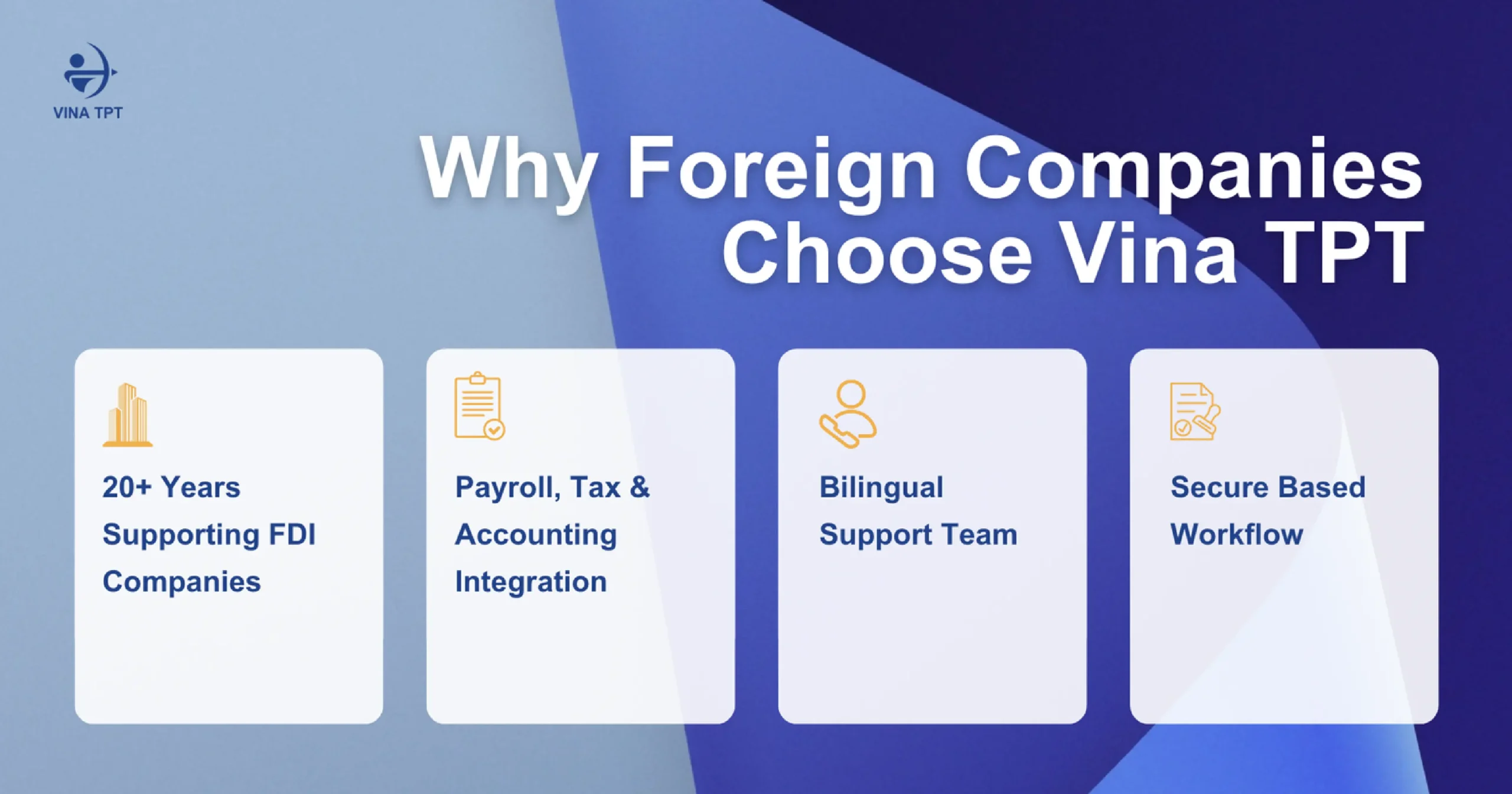
With over 20 years of experience supporting FDI enterprises, Vina TPT provides a comprehensive approach to TRC applications, from initial advisory to final approval. 

We support businesses in structuring their investment to meet visa and TRC requirements, while handling the entire documentation process, including notarization, translation, and consular legalization. Our team works directly with the Immigration Department to ensure smooth processing, while also integrating related services such as company establishment, work permit exemption, and finance and tax support. This end-to-end approach helps minimize risks, ensure compliance, and significantly reduce processing time for investors.

TRC-Vietnam-2026

We are committed to accuracy, speed, and efficiency so you can focus on your business instead of administrative procedures.

Contact Vina TPT today for personalized advice and professional support tailored to your investment needs in Vietnam.

BOOK A FREE CONSULTATION

Overview of Vietnam public holidays for Employees in 2026

Vietnam public holidays in 2026: updated holiday schedule, paid leave rules, and key labor law considerations for employers and employees

Starting from 2026, employees in Vietnam may be entitled to 12 Vietnam public holidays with paid leave each year, an increase of one day compared to previous regulations. These changes in Vietnam public holidays not only affect employees’ holiday plans but also directly impact human resource management and operational costs for businesses, particularly foreign-invested enterprises (FDIs).

The article below provides a comprehensive overview of Vietnam public holidays in 2026 and highlights important regulations that companies should consider when managing their workforce.

overview-of-vietnam-public-holidays-for-employees-in-2026

1. Latest regulations and updates on Vietnam public holidays

Under the Labor Code 2019, employees in Vietnam are entitled to days off with full salary during Vietnam public holidays as prescribed by the State. This is a mandatory benefit applicable to all employees working under labor contracts.

If a Vietnam public holiday coincides with a weekly day off, employees are entitled to a substitute day off on the following working day.

Previously, the system of Vietnam public holidays included 11 paid days off per year, including:

  • New Year’s Day: 1 day (January 1)
  • Lunar New Year (Tet): 5 days
  • Hung Kings’ Commemoration Day: 1 day (10th day of the 3rd lunar month)
  • Reunification Day: 1 day (April 30)
  • International Labor Day: 1 day (May 1)
  • National Day: 2 days (September 2 and one adjacent day)

However, on March 3, 2026, the Politburo approved Resolution No. 80-NQ/TW on the development of Vietnamese culture, officially designating November 24 each year as “Vietnam Culture Day.” This day is expected to become an official holiday to encourage cultural activities and improve the spiritual life of citizens.

For foreign employees working in Vietnam, in addition to the above Vietnam public holidays, they are entitled to two additional days off:

  • 1 traditional holiday of their home country
  • 1 national day of their home country

Both days are granted as paid leave under their labor contracts.

overview-of-vietnam-public-holidays-for-employees-in-2026

2. List of Vietnam public holidays in 2026

Based on the Labor Code and the tentative holiday schedule announced by the government, Vietnam public holidays in 2026 may include the following periods:

Holiday Date Total Days Off Notes
New Year Holiday From Jan 1 to Jan 4, 2026 4 days Including weekend days
Lunar New Year (Tet) From Feb 14 to Feb 22, 2026 9 days Including weekends
Hung Kings’ Commemoration Day Apr 26, 2026 1 day Substitute holiday on Apr 27, 2026
Reunification Day & Labor Day From Apr 30 to May 3, 2026 4 days Including weekend days
Vietnam National Day From Aug 29 to Sep 2, 2026 5 days Including weekend days
Vietnam Culture Day (new) Nov 24, 2026 1 day Official paid holiday

3. Other paid leave regimes besides Vietnam public holidays

In addition to Vietnam public holidays, employees are also entitled to other paid leave regimes under the Labor Code. These include annual leave, maternity leave, and several other special leave cases.

3.1 Annual paid leave in Vietnam

Under the Labor Code, employees who work for the same employer for 12 months are entitled to annual paid leave as follows:

  • 12 days for employees working under normal conditions
  • 14 days for minors, employees with disabilities, or those working in hazardous conditions
  • 16 days for employees performing extremely hazardous or dangerous work

Other important provisions include:

  • Employees who have not completed 12 months of service receive leave calculated proportionally based on months worked
  • Employees working for the same company for over 5 years receive one additional leave day per year
  • When terminating a labor contract, employers must compensate employees for unused annual leave days

3.2 Maternity leave and adoption leave

Under Vietnamese labor and social insurance regulations:

  • Female employees are entitled to 6 months of maternity leave
  • In the case of multiple births, an additional 30 days of leave is granted for each additional child starting from the second child
  • Female employees with children under 12 months old are entitled to 60 minutes of paid break per working day for childcare

3.3 Paternity leave

Male employees participating in social insurance are entitled to paternity leave within 30 days after childbirth, including:

  • 5 days for natural birth
  • 7 days for cesarean delivery
  • 10-14 days in cases of multiple births

Male employees are also eligible for a one-time social insurance allowance for each child.

EXPLORE OUR SERVICES

4. Recommendations for FDI enterprises regarding Vietnam Public Holidays

For foreign-invested enterprises, managing Vietnam public holidays is not merely about scheduling time off. It also directly affects payroll obligations, overtime costs, and compliance with Vietnamese labor regulations. Mistakes in calculating holiday pay or arranging substitute leave may lead to labor disputes or compliance risks during inspections.

Therefore, companies should standardize HR processes from the early stage of building their HR system, including:

  • Establishing mechanisms to calculate holiday pay and other paid leave in compliance with regulations
  • Controlling overtime costs during major holidays such as Tet
  • Managing additional holiday entitlements for foreign employees
  • Regularly updating regulatory changes related to Vietnam public holidays

For FDI enterprises operating in Vietnam, working with a knowledgeable HR consultant who understands local labor laws can help build a transparent payroll system, reduce compliance risks, and optimize long-term operational costs.

At Vina TPT, our team of HR and legal experts supports businesses in establishing structured systems for holiday management, payroll processing, and labor law compliance. Vina TPT currently provides HR and legal consulting services for many FDI companies operating in Vietnam. Standardizing HR processes from the beginning helps businesses minimize legal risks and focus on sustainable growth strategies in the Vietnamese market.

overview-of-vietnam-public-holidays-for-employees-in-2026

BOOK A FREE CONSULTATION

Vietnam Representative Office Compliance Obligations Guide

Vietnam-Representative-Office-Compliance-Obligations-Guide-vina-tpt-2

Vietnam-Representative-Office-Compliance-Obligations-Guide-Vina-tpt

Are you a foreign investor eyeing Vietnam’s dynamic market but wary of full-scale commitments? Establishing a Representative Office (RO) offers a low-risk entry point for market research, networking, and promotion without generating revenue. However, navigating compliance is crucial to avoid fines, license revocation, or unintended tax liabilities like Permanent Establishment (PE) risks. This comprehensive guide, updated for 2026 regulations, draws from key laws such as the Commercial Law 2005, Enterprise Law 2020, and Decree 07/2016/ND-CP (with procedural tweaks noted in recent updates).  

Key benefits of staying compliant include: 

  • Protecting your parent company’s reputation and avoiding penalties  
  • Leveraging Vietnam’s FDI incentives while minimizing bureaucratic hurdles. 
  • Ensuring seamless extensions or closures without disruptions. 

By the end, you’ll have actionable insights, checklists, and expert tips to thrive. Let’s dive in, starting with the basics. 

1. What is a Representative Office in Vietnam? 

A Representative Office (RO) in Vietnam serves as a non-commercial extension of a foreign company, ideal for exploring opportunities without direct business activities. Governed by evolving regulations, it’s a popular choice for FDI firms in 2026, with over 2,000 active ROs contributing to Vietnam’s economic growth. This section builds a foundational understanding, comparing it to other structures for informed decisions. 

Permitted and Prohibited Activities 

ROs are strictly limited to non-revenue-generating roles to prevent PE triggers. Permitted activities include: 

  • Market surveys and research. 
  • Promoting parent company products/services. 
  • Liaison with local partners. 
  • Attending trade fairs and seminars. 

Prohibited activities encompass: 

  • Direct sales or contract signing. 
  • Revenue generation or invoicing. 
  • Manufacturing or service provision for profit. 
  • Sub-leasing office space. 

For example, an RO can host promotional events but cannot close deals—violations could lead to audits or shutdowns. 

Comparison with Branches and Subsidiaries 

Structure  Legal Status  Activities  Taxation  Liability 
Representative Office  Dependent unit, no legal personality  Non-commercial (research, promotion)  No CIT/VAT; PIT on staff  Limited to parent company 
Branch  Dependent, but operational  Commercial trading possible  CIT (20%), VAT applicable  Parent liable 
Subsidiary (LLC/JSC)  Independent entity  Full business operations  CIT (20%), VAT, audits  Limited to invested capital 

ROs offer simpler compliance for initial market entry, unlike branches which require more reporting or subsidiaries needing capital injection (minimum varies by sector). Choose RO if your goal is testing waters without financial exposure. 

2. Key Conditions for Establishing a Representative Office 

Setting up an RO in Vietnam is straightforward but requires meeting eligibility thresholds to ensure alignment with national interests. This process, handled by the Department of Industry and Trade (DOIT), emphasizes transparency and typically completes in 4-6 weeks. Here’s a logical breakdown from requirements to execution. 

Eligibility Requirements for Foreign Companies 

Foreign entities must fulfill these criteria: 

  • Parent company operational for at least 1 year in home country. 
  • Activities compliant with Vietnam’s WTO and international treaties (e.g., no restricted sectors without ministerial approval). 
  • Proof of good standing and financial stability via audited statements. 
  • No prior violations in Vietnam. 

These ensure only reputable firms enter, reducing risks for local markets. 

Required Documents and Application Process 

Follow these numbered steps: 

  1. Prepare legalized documents: Certificate of incorporation, audited financials (last year), and parent company charter. 
  2. Draft application form (Form I-1 from Decree 07/2016/ND-CP). 
  3. Secure office lease agreement in Vietnam. 
  4. Notarize and translate all docs into Vietnamese. 
  5. Submit to provincial DOIT or relevant ministry. 

Include a letter of appointment for the Chief Representative. Digital submissions are encouraged in 2026 for faster processing. 

3. Post-Registration Compliance Procedures 

Once licensed, immediate actions are vital to operationalize your RO legally. This phase focuses on administrative setups within 30-45 days, preventing delays in hiring or banking. Overlooking these can trigger inspections—follow this timeline-driven guide. 

Initial Setup Steps (Stamp, Tax Code, Bank Account) 

  1. Register official seal (stamp) with Public Security within 15 days. 
  2. Obtain tax identification number (TIN) from local tax authority. 
  3. Open a foreign currency bank account for operational expenses (e.g., salaries, rent). 
  4. Register with social insurance if hiring staff. 

These steps enable daily functions; use banks like HSBC for RO-specific accounts. 

Notifying Authorities and Publishing Announcements 

  • Notify DOIT of operations start within 7 days. 
  • Publish establishment announcement in three consecutive newspaper issues (print or online). 
  • Inform tax and labor departments of Chief Representative details. 

This publicizes your presence, ensuring transparency per Decree 07. 

Common Pitfalls to Avoid 

  • Delaying seal registration: Leads to invalid contracts. 
  • Ignoring TIN: Blocks payroll processing. 
  • Incomplete publications: Fines up to 10 million VND. 
  • Tip: Engage local consultants for seamless compliance.

Establishment Representative Office with Vina TPT

Establishment Representative Office with Vina TPT

4. Tax Compliance Obligations for Representative Offices

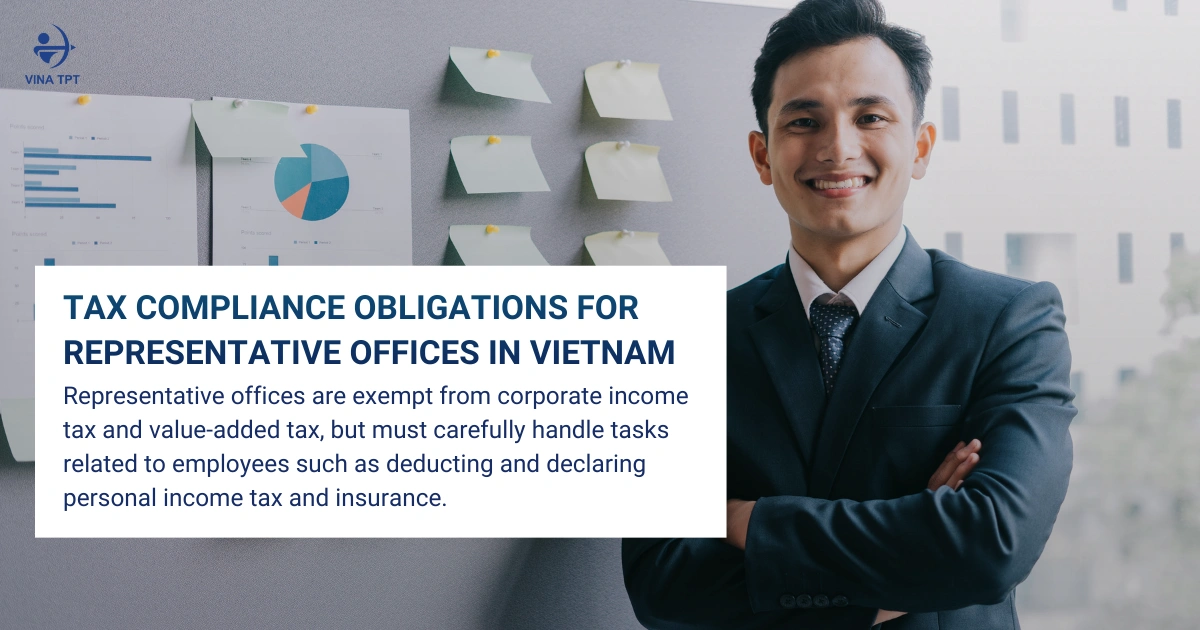
ROs enjoy tax exemptions but must handle employee-related duties diligently. No CIT or VAT applies since no revenue is generated, but PIT withholding is mandatory. This section outlines exemptions and filings with practical examples. 

Personal Income Tax (PIT) Withholding and Reporting 

  • Withhold PIT on salaries (progressive rates: 5-35%). 
  • File monthly/quarterly declarations; annual finalization by March 31. 
  • Example: For a 20 million VND salary, withhold ~10% PIT plus insurances. 

Report via e-tax portal for efficiency. 

Other Taxes and Filings 

  • Business license tax: Pay if operations exceed thresholds. 
  • Monthly filings: PIT and insurances. 
  • Deadlines: Quarterly by end of month following quarter. 
Vietnam-Representative-Office-Compliance-Obligations-Guide-vina-tpt-3

5. Labor and Payroll Compliance Requirements 

Hiring staff for your Representative Office (RO) in Vietnam must align with the Labor Code 2019 (amended) and Social Insurance Law 2024 to ensure fair treatment and avoid penalties. This includes drafting compliant contracts, managing payroll deductions, and handling insurances. With employer contributions totaling approximately 21.5% of the salary base (as per 2026 rates), budgeting is essential. Below, we clarify employee contributions to social insurance (SHUI) and expand on requirements for foreign workers, including the Temporary Residence Card (TRC). 

Hiring Employees and Labor Contracts 

  • Draft bilingual (English-Vietnamese) contracts detailing job terms, salary, benefits, working hours (up to 48 hours/week), and probation periods (up to 60 days for skilled roles). 
  • Register contracts with the local Department of Labor, Invalids, and Social Affairs (DOLISA) within 30 days of signing. 
  • Limit staffing to roles essential for RO functions like market research or liaison; there’s no strict cap, but justify headcount in annual reports to authorities. 

Consider including non-compete clauses for sensitive positions, but ensure they comply with Vietnamese law limits (e.g., no more than 1 year post-employment). For all employees, emphasize transparency to build trust and reduce disputes. 

Social, Health, and Unemployment Insurance Contributions 

All employees, including locals and foreigners (with some exemptions), must participate in mandatory insurances under the Social Insurance Law 2024. Contributions are calculated on the salary base (minimum regional wage or actual salary, capped at 20 times the base salary—approximately 36 million VND/month in 2026 for most cases). Here’s the breakdown for 2026 rates, clarifying both employer and employee shares: 

Insurance Type  Employer Share (%)  Employee Share (%)  Base  Notes 
Social Insurance (BHXH) – Pension and Death  14  8  Salary  Covers retirement and survivor benefits. 
Social Insurance (BHXH) – Sickness and Maternity  3  0  Salary  Employer-funded for sick leave and maternity (up to 6 months paid). 
Social Insurance (BHXH) – Occupational Accident and Disease  0.5  0  Salary  Covers work-related injuries; optional for low-risk ROs but mandatory in practice. 
Health Insurance (BHYT)  3  1.5  Salary  Provides medical coverage; integrated with national health system. 
Unemployment Insurance (BHTN)  1  1  Salary  Supports job loss benefits (up to 60% salary for 3-12 months). 
Total  21.5  10.5  Salary  Overall cap: 32% combined. 

Explore Payroll & Insurance Services

Work Permits and Visas for Foreign Staff 

Foreign staff (expats) add expertise but require extra steps for legal work and residency. Process these early to avoid operational delays. 

  1. Apply for a work permit via DOLISA (exemptions available for intra-company transfers, managers, or short-term experts under 30 days). 
  2. Secure a visa (e.g., LĐ1/LĐ2 for labor) upon entry or conversion. 
  3. Requirements: Health certificate (issued in Vietnam or legalized abroad), clean criminal record (from home country), and professional qualifications (e.g., degree + 3 years experience for skilled roles). 

The process typically takes 15-30 days; renew permits annually (up to 2 years max). For long-term stays, obtain a Temporary Residence Card (TRC) to replace frequent visa runs—it’s mandatory for expats residing over 1 year and simplifies travel in/out of Vietnam. 

6. Annual Reporting and Record-Keeping Duties 

Sustained compliance hinges on timely reports and audits. ROs must document activities for potential inspections every 3-5 years. Use templates for efficiency. 

Representative office annual performance report 

  • Submit to DOIT by January 30: Detail operations, staff, expenses. 
  • Include financial summaries (no audits required). 
  • Template: Cover achievements, challenges, future plans. 

Statistical and Labor Reports 

Report Type  Frequency  Deadline 
Annual performance report  Annual  Jan 30 
Labor Changes  Monthly  End of month 
Statistical  Semi-annual  Jul/Jan 

7. Ready to Ensure Full Compliance for Your Representative Office in Vietnam? 

Navigating the compliance landscape for a Representative Office (RO) in Vietnam can be complex, with evolving regulations, strict deadlines, and potential risks like fines, license revocation, or Permanent Establishment (PE) issues. By following the detailed guidance in this article you can operate confidently and focus on market growth. 

At Vina TPT, we specialize in supporting foreign investors and FDI enterprises with comprehensive, reliable solutions tailored to Vietnam’s business environment. With over 20 years of experience and a team of certified experts in Vietnamese Accounting Standards (VAS), IFRS, international tax law, and FDI regulations, we have successfully assisted more than 200 international clients in establishing and maintaining compliant operations. 

Our Key Services for Representative Offices and FDI Businesses 

  • Tax advisory and compliance — including PIT withholding/finalization, business license tax handling, and PE risk assessments. 
  • Labor and HR support — contract drafting, social/health/unemployment insurance registration (BHXH/BHYT/BHTN), work permit/TRC applications for foreign staff, and monthly labor reports. 
  • RO setup, extension, and closure consulting — handling all paperwork, DOIT submissions, seal/tax code/bank account setups, and termination clearances. 
  • Annual reporting and audit preparation — ensuring timely activity/statistical reports and readiness for government inspections. 

We prioritize 100% data protection, transparent pricing, and personalized service to help your RO thrive without unnecessary stress. Whether you’re just starting market research or managing an established office in Ho Chi Minh City or beyond, our one-stop approach saves time and minimizes risks. 

Let Vina TPT be your trusted partner in Vietnam – ensuring seamless compliance so you can focus on business growth in one of Asia’s most promising markets. Reach out now, we’re here to help! 

BOOK A FREE CONSULTATION

How Foreign Companies Reduce HR Costs in Vietnam with HR Outsourcing in 2026

As Vietnam’s economy continues to surge in 2026, driven by a robust influx of foreign direct investment (FDI), international businesses are increasingly eyeing this dynamic Southeast Asian market. With steady GDP growth and a young, highly skilled workforce, Vietnam offers outstanding opportunities across manufacturing, technology, and service industries

However, for foreign companies new to the scene, navigating the complexities of human resources and payroll management can be a daunting and costly endeavor. From stringent labor laws to evolving tax regulations, the administrative overhead often diverts focus from core operations and inflates expenses.

HR outsourcing is a strategic solution to reduce HR costs and effectively answer how to reduce HR cost. Also known as payroll outsourcing or Employer of Record (EOR) services, it allows foreign companies to outsource non-core HR tasks to local experts in Vietnam, ensuring full legal compliance while significantly cutting expenses. With over 20 years of experience supporting more than 200 foreign clients, Vina TPT provides specialized HR outsourcing tailored for FDI businesses. This guide explains how HR outsourcing optimizes operating costs in Vietnam with the latest 2026 updates, real-world examples, and practical tips on how to reduce HR cost for sustainable growth.

the-rising-challenge-of-HR-management-in-Vietnam

1. The Rising Challenges of HR Management for Foreign Companies in Vietnam

Foreign investors entering Vietnam in 2026 face a unique set of HR hurdles that can significantly impact the bottom line. The country’s labor market is competitive, with a talent shortage in specialized sectors like IT and engineering pushing up salaries. According to recent data, the average monthly salary for a mid-level employee ranges from VND 10-15 million (approximately USD 400-600), but for expats or skilled locals, it can climb to VND 30-50 million or more.

Key challenges include:

  • Compliance with Evolving Labor Laws: Vietnam’s labor regulations continue to evolve, requiring strict compliance with minimum wage adjustments, overtime rules, and electronic employment contracts. Non-compliance can lead to financial penalties and reputational risks.
  • Payroll and Tax Complexities: Ongoing personal income tax reforms increase the complexity of payroll management, particularly for expatriate employees. Employers must accurately manage tax withholding, annual tax finalization, and mandatory social insurance contributions.
  • Administrative Overload: Building an in-house HR function demands significant investment in specialized staff, payroll systems, and recurring regulatory reporting, driving up operating costs for growing businesses.
  • Cultural and Language Barriers: Foreign firms often struggle with local recruitment nuances, leading to high turnover rates and additional onboarding expenses.

Without proper management, these issues can erode up to 20-30% of operational budgets, delaying profitability in a market where quick scalability is key.

2. How HR Outsourcing Drives Cost Optimization in 2026

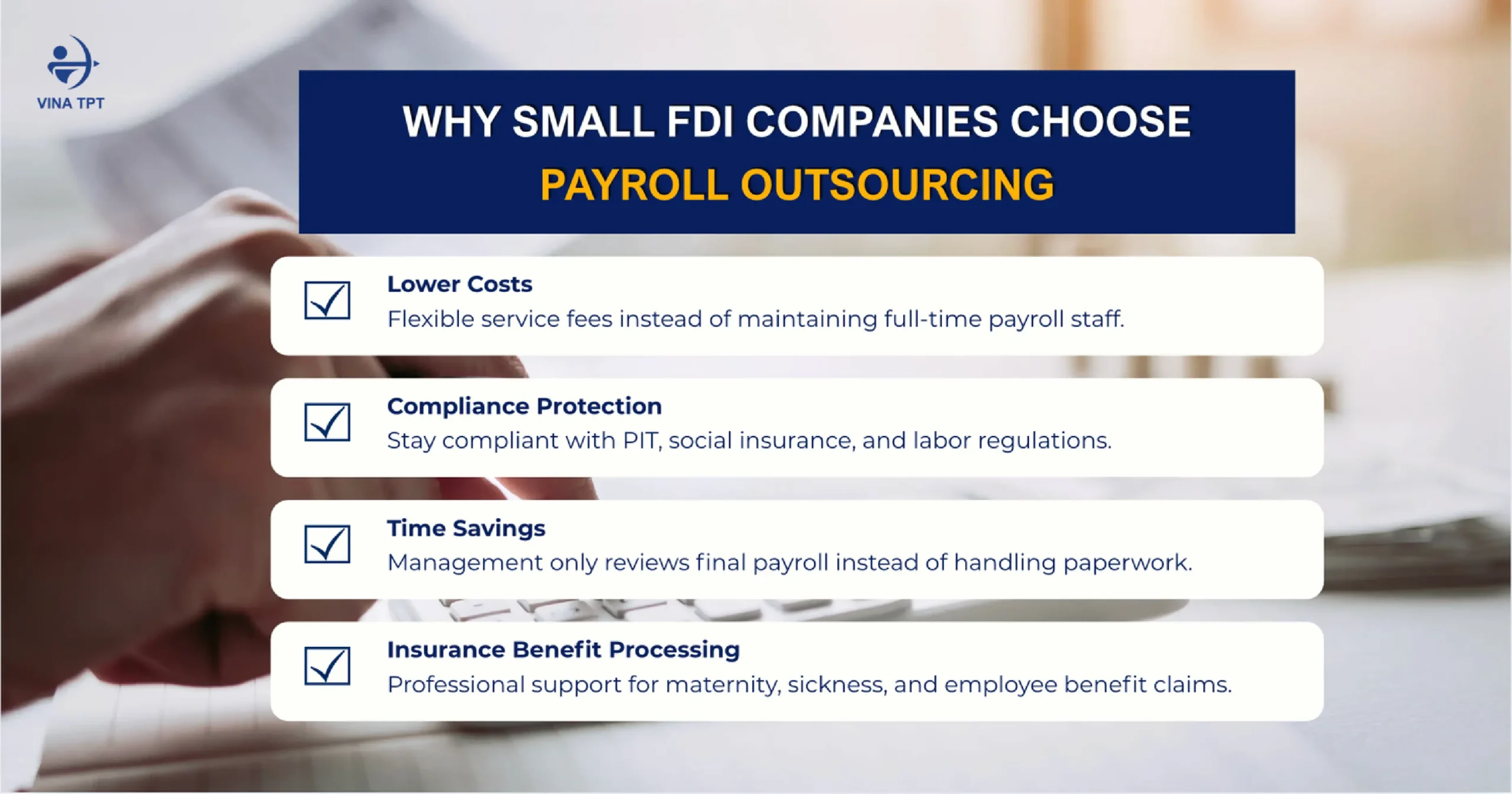
HR outsourcing transfers these burdens to specialized providers, allowing companies to pay a fixed, predictable fee while gaining access to expert systems and local knowledge. In Vietnam, EOR services start from as low as USD 298 per employee per month (all-inclusive), covering everything from payroll to compliance.

Here’s a detailed breakdown of cost savings:

Cost Category

In-House HR (Estimated Annual Cost for 50 Employees)

HR Outsourcing (e.g., with Vina TPT)

Potential Savings (Percentage)

HR & Payroll Staff Salaries VND 200-350 million (2-3 full-time specialists) Included in fee 100% (Outsourced expertise)
Payroll Software & Tools VND 10 – 50 million (Systems + Maintenance) Included 100%
Compliance & Legal Fees VND 30-100 million (Audits, Fines, Consultants) Managed with zero penalties Up to 80-90%
Social Insurance & Benefits VND 100 – 200 million (Contributions + Admin) Automated and optimized 20-30% (Efficient calculations)
Total Estimated VND 340 -700 million VND 120 – 400 million Up to 40% Overall

These figures are based on 2026 market averages, where outsourcing can reduce total HR costs by up to around two-thirds for FDI firms. Beyond direct savings, it also minimizes risks – for example, helping companies avoid personal income tax compliance issues such as incorrect deductions, which could otherwise result in back taxes and interest penalties.

core-benefits-of-hr-outsourcing

3. Core Benefits of HR Outsourcing for New Market Entrants

Enhanced Compliance in a Changing Landscape
In 2026, several important regulatory updates come into effect. Minimum wage increases impact social insurance contribution caps, while personal income tax reforms introduce additional deductions for high-income expatriates, such as housing allowances. HR outsourcing enables companies to adapt in real time through automated systems, including electronic labor contracts and periodic regulatory reporting.

Scalability and Flexibility
Companies can start with a small team and scale up smoothly as operations grow. Cloud-based platforms using SaaS models integrate easily with global systems, supporting hybrid workforces that combine local employees and expatriates.

Access to Local Talent and Market Insights
Providers such as Vina TPT leverage strong local networks to accelerate recruitment and shorten time-to-hire. They also provide guidance on cultural integration, helping improve employee engagement and retention.

Data Security and Transparency
With strict data protection requirements under Vietnam’s data privacy regulations, outsourcing providers rely on secure, centralized payroll systems to ensure data integrity, transparency, and reduced error risk.

Stronger Strategic Focus
By offloading administrative and compliance tasks, executives can focus on strategic priorities, such as expanding into high-tech industries that qualify for corporate income tax incentives.

4. Vina TPT’s HR Outsourcing Services: A Tailored Approach

At Vina TPT, our HR outsourcing encompasses:

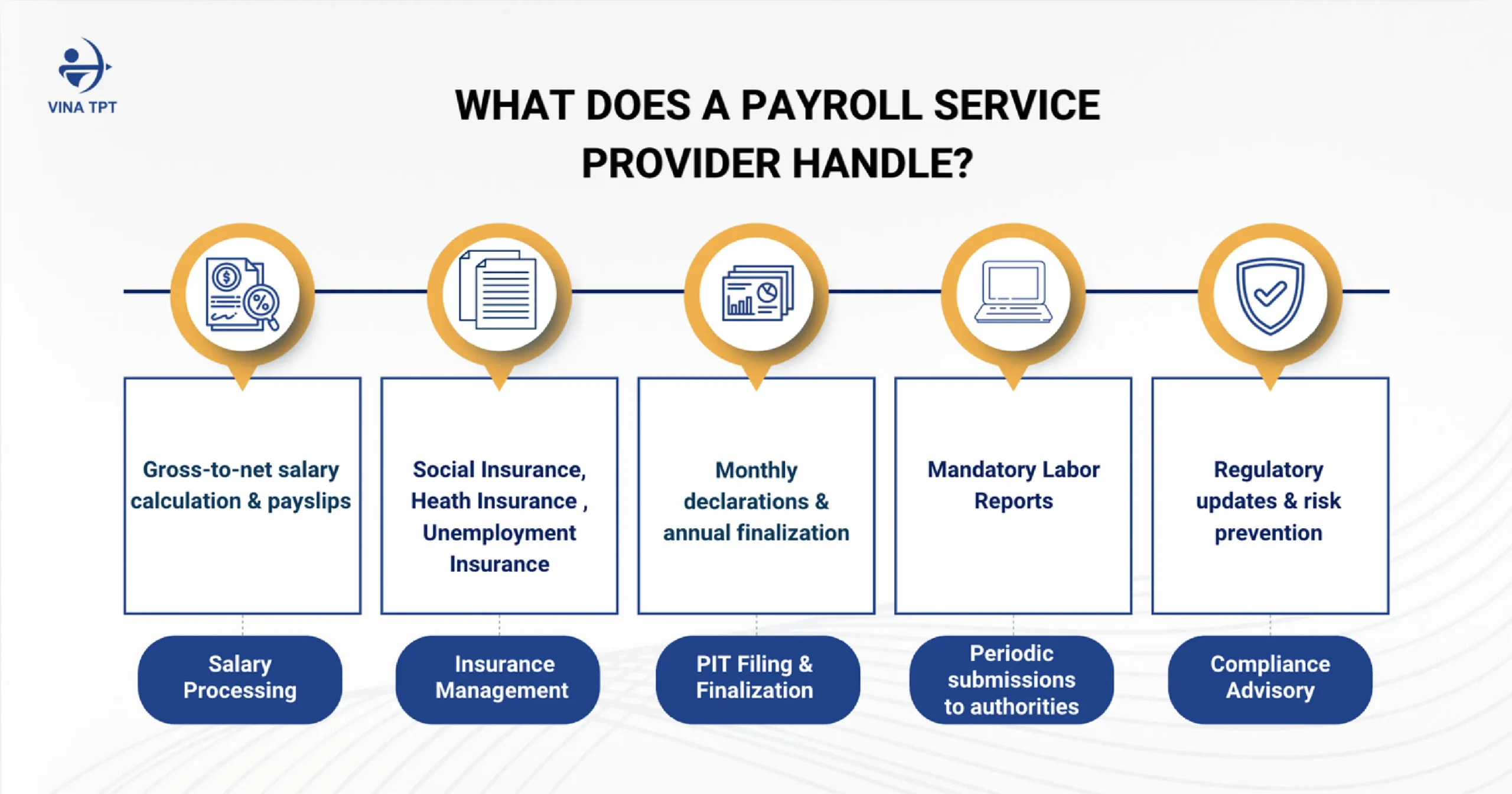
  • Payroll Processing: Gross-to-net calculations, payslips, and multi-currency support for expats.
  • Insurance and Tax Management: SHUI registrations, PIT withholding, and annual finalizations compliant with 2026 reforms.
  • Labor Contract Services: Drafting electronic contracts per Decree 337, managing terminations, and handling disputes.
  • HR Advisory: Guidance on work permits, salary scales, and employee development under the new emphasis on workforce training.
  • Custom Reporting: Real-time dashboards for cost tracking and compliance audits.

Our fees are transparent, starting at competitive rates aligned with market standards, ensuring no hidden costs.

5. Ready to Streamline Your HR and Cut Costs in Vietnam?

In 2026, smart FDI companies are leveraging HR outsourcing to thrive amid regulatory changes. Vina TPT’s HR Outsourcing stands ready as your trusted partner, offering expert, compliant solutions that let you focus on what matters – growing your business.

We offer truly flexible pricing policies tailored to newly established FDI enterprises, even those with just 1–2 employees, while larger companies with hundreds of staff also receive customized, mutually agreeable fee structures that best suit their scale and needs.

Schedule a free consultation today for a personalized cost-saving assessment.

BOOK A FREE CONSULTATION

start a business in vietnam with vina tpt

How to Calculate Personal Income Tax 2026 in Vietnam

how-to-calculate-personal-income-tax-2026-vinatpt

Vietnam’s Personal Income Tax 2026 law was amended Law No. 109/2025/QH15 and officially takes effect from July 1, 2026. Key rules for salary, wages, and business income, however, apply right from January 1, 2026. These updates significantly reduce the tax burden for employees and business owners amid rising living costs. 

This guide explains exactly how to calculate PIT in 2026, highlights the major changes (increased family deductions, simplified progressive rates, expanded exemptions), and provides clear, real-world examples so you can compute your tax accurately and stay fully compliant. 

1. Major Changes to Personal Income Tax from 2026 

2026 introduces the biggest PIT reforms since 2012, driven by the amended PIT Law 2025 and Resolution 110/2025/UBTVQH15. The goal is to ease pressure on middle-income earners, support digital businesses, and attract high-tech investment while keeping pace with economic growth and inflation. 

Change  Main Benefit 
Increased family deductions  Lower tax for individuals and families 
Simplified progressive brackets  Easier calculation, reduced tax for average incomes 
Expanded exemptions  Support for high-tech, agriculture, and green sectors 

These reforms make the tax system more modern, transparent, and easier to comply with. 

1.1 Increased Family Deductions Effective January 1, 2026 

From January 1, 2026, family circumstance deductions are raised to better match higher living costs, helping millions of taxpayers pay less personal income tax The personal deduction increases from VND 11 million to VND 15.5 million per month (VND 186 million per year), and the deduction per dependent rises from VND 4.4 million to VND 6.2 million per month. 

Type of Deduction  2025 Amount  2026 Amount 
Personal deduction  11 million/month  15.5 million/month 
Per dependent  4.4 million/month  6.2 million/month 

Who qualifies as a dependent? 

  • Children: Under 18; over 18 if disabled and unable to work; full-time students (university, college, vocational) under 22 with low or no income. 
  • Spouse: Unable to work or with very low/no income. 
  • Parents, grandparents, siblings: Elderly or disabled individuals with insufficient income, directly supported by the taxpayer. 

Key conditions 

  • Each dependent can be claimed by only one taxpayer. 
  • Proof is required (birth certificate, household registration, disability certificate, school enrollment, support commitment letter). 
  • Register with your employer or tax office (usually via Form 20-ĐK-TNCN) before tax is calculated. 

1.2 New Progressive Personal Income Tax 2026 Rates – Reduced from 7 to 5 Brackets 

Effective January 1, 2026, the progressive tax scale is simplified from 7 brackets to 5, with wider income ranges to reduce the effective tax rate for middle earners. The top rate remains 35%, now applying only to monthly taxable income over VND 100 million (previously VND 80 million). 

Bracket  Monthly Taxable Income (VND million)  Annual Taxable Income (VND million)  Tax Rate (%) 
1  Up to 10  Up to 120  5 
2  Over 10 to 30  Over 120 to 360  10 
3  Over 30 to 50  Over 360 to 600  20 
4  Over 50 to 100  Over 600 to 1,200  30 
5  Over 100  Over 1,200  35 

Old vs. new comparison The old 7-bracket system had narrower bands, pushing many middle-income earners into higher rates. The new structure is simpler and saves 5–15% in tax for most employees, while encouraging extra work without jumping brackets quickly. 

1.3 Expanded Exemptions, Reductions & Special Incentives 

The updated law adds 21 new exempt income categories starting in 2026, focusing on education, healthcare, green projects, and high-tech sectors. Additional benefits include a 50% reduction on certain investment income and a 5-year exemption for high-tech professionals. 

  • New exempt items: Certain overtime pay, scholarships, income from green bonds, organic agriculture, gifts under VND 10 million, disaster relief support. 
  • Special incentives: 5-year PIT exemption for experts in AI, semiconductors, and R&D; 50% reduction on income from investments in tech startups. 
Incentive Type  Condition  Duration 
Scholarship exemption  Full-time formal education  Indefinite 
5-year high-tech exemption  Experts in AI, semiconductors, R&D  5 years from 2026 
50% investment reduction  Green/technology startups  Applies to 2026+ income 

Proof (contracts, certificates) is required, often from the Ministry of Science and Technology. 

personal-incom-tax-2026-vina-tpt

2. How to Calculate Personal Income Tax in 2026 – Step-by-Step Guide 

Core formula Tax payable = Taxable income × Progressive tax rate Taxable income = Total income – Exempt items – Deductions (family + mandatory insurance + charity + eligible medical/education expenses) 

This applies to tax residents. Non-residents pay a flat 20% on Vietnam-sourced income. 

Step 1: Determine Your Tax Residency Status 

Start by confirming whether you are a tax resident or non-resident, as this determines what income is taxable. 

Under Vietnam’s PIT law: 

  • Tax resident: Present in Vietnam ≥183 days in the calendar year, or maintaining a permanent residence (owned home or long-term rental with registered address). 
  • Non-resident: Taxed only on income sourced from Vietnam. 

Tax implications 

  • Residents: Taxed on worldwide income using the 5-bracket progressive scale (5%–35%). 
  • Non-residents: Flat 20% on Vietnam-sourced salary and wages (other rates apply to specific types). 

Step 2: Calculate Taxable Income 

Basic formula: Taxable income = Total income – Exempt items – Deductions 

  1. Total income includes salary, bonuses, taxable allowances, business profits, investment returns, etc. 
  2. Exempt items include scholarships, certain overtime pay, small gifts, etc. 
  3. Deductions include: 
  • Family deduction (VND 15.5 million/month personal + VND 6.2 million/month per dependent) 
  • Mandatory social, health, unemployment insurance (BHXH, BHYT, BHTN) 
  • Charitable donations (with receipts) 
  • Medical & education expenses (new in 2026, up to VND 10 million/year – detailed guidance pending) 

Example In January 2026, Mr. A receives: 

  • Salary: VND 70,000,000 
  • Meal allowance (per company policy): VND 1,000,000 
  • Sales commission: VND 2,000,000 

No charitable contributions. Mr. A has one registered dependent (child under 18). 

Calculation: 

  • Total income: 70,000,000 + 1,000,000 + 2,000,000 = VND 73,000,000
  • Exempt: VND 1,000,000 (meal allowance) 
  • Deductions: 15,500,000 (personal) + 6,200,000 (dependent) + 4,200,000 (mandatory insurance) = VND 24,850,000
  • Taxable income = 73,000,000  – 1,000,000 – 24,850,000 = VND 47,150,000 per month 

Step 3: Apply the 2026 Progressive Rates

new-progressive-personal-income-tax-rates-vina-tpt

Apply the 5-bracket scale to taxable income, calculating tax portion by portion and adding them up. 

Continuing Mr. A’s example (monthly taxable income: VND 47,150,000): 

  • Bracket 1: VND 10,000,000 × 5% = VND 500,000 
  • Bracket 2: (30,000,000 – 10,000,000) × 10% = VND 2,000,000 
  • Bracket 3: (47,150,000 – 30,000,000) × 20% = VND 3,430,000 

Total PIT payable: 500,000 + 2,000,000 + 3,430,000 = VND 5,930,000 

Net take-home pay: 73M – 4.2M (insurance) – 5.93M (PIT) = VND 62,870,000 

3. Special Rules for Foreigners and Expatriates in Vietnam 

Foreign nationals (expats) and overseas workers follow specific PIT rules in 2026. 

  • Non-residents: Flat 20% on Vietnam-sourced income, withheld at source. 
  • Residents: Subject to the same progressive rates as Vietnamese citizens. 

Double Taxation Agreements (DTAs) Vietnam has over 80 DTAs (with the US, EU countries, Japan, Singapore, etc.). To claim relief: 

  • Submit Form NT5/TNCN 
  • Provide proof of tax residency in your home country 
  • Claim credit for taxes already paid abroad 

Example: A non-resident expat earning VND 50 million/month pays VND 10 million (20%) PIT. With a DTA, the rate may drop to 10–15%. 

These rules, plus the 5-year exemption for high-tech experts, make Vietnam attractive for skilled international professionals. 

4. Filing and Finalizing Personal Income Tax in Vietnam 

PIT filing and finalization are fully online via the General Department of Taxation portal (thuedientu.gdt.gov.vn) or eTax Mobile app. 

General deadlines (apply every year): 

  • Employer finalization (for authorized employees): By the last day of the 3rd month after year-end (usually March 31). 
  • Individual self-finalization: By the last day of the 4th month after year-end (usually April 30). → If the deadline falls on a holiday or weekend, it shifts to the next working day. 

Who must self-file? Individuals with income from two or more sources who do not meet authorization conditions, or those seeking refunds or adjustments. 

5. Vina TPT – Your 2026 PIT Solution for Expats & Businesses in Vietnam 

Vina TPT is a leading tax advisory firm in Vietnam specializing in Personal Income Tax services for expatriates and foreign-invested companies. Our experienced team provides full support, from 2026 PIT forecasting and calculation to DTA claims and maximum deduction optimization. 

Why choose Vina TPT? 

  • Free initial consultation with clear guidance 
  • Fast, accurate filing and deadline reminders 
  • Full compliance with 2026 regulations to minimize risks 

Key services 

  • PIT finalization for expats with multi-source income 
  • Assistance with high-tech and investment incentives 
  • HR training on payroll updates and withholding 

Need help with your 2026 Personal Income Tax in Vietnam? Contact Vina TPT today for expert, hassle-free support.

BOOK A FREE CONSULTATION

Regional Minimum Wage 2026 in Vietnam: Latest Updates and Key Changes

Regional-Minimum-Wage-2026-in-Vietnam_-Latest-Updates-and-Key-Changes-Vina-TPT

Regional-Minimum-Wage-2026-in-Vietnam_-Latest-Updates-and-Key-Changes-Vina-TPT

1. Entities Subject to the 2026 Regional Minimum Wage Adjustment

According to Article 2 of Decree No. 293/2025/ND-CP, the scope of entities subject to the application of the regional minimum wage has been clearly defined and expanded to include the following groups: 

  • Employees working under labor contracts in accordance with the current Labor Code of Vietnam. 
  • Employers as stipulated under the Labor Code, including: 
  • Enterprises established and operating in compliance with the Law on Enterprises; 
  • Agencies, organizations, cooperatives, households, and individuals that employ workers under lawful labor agreements. 
  • Other relevant agencies, organizations, and individuals involved in the implementation and application of the regional minimum wage in accordance with Decree No. 293/2025/ND-CP. 

2. Application of the New Regional Minimum Wage from January 1, 2026

On November 10, 2025, the Government issued Decree No. 293/2025/ND-CP regulating the regional minimum wage applicable to employees working under labor contracts. This adjustment represents a significant policy update aimed at safeguarding employees’ livelihoods while remaining aligned with Vietnam’s economic growth and productivity trends. 

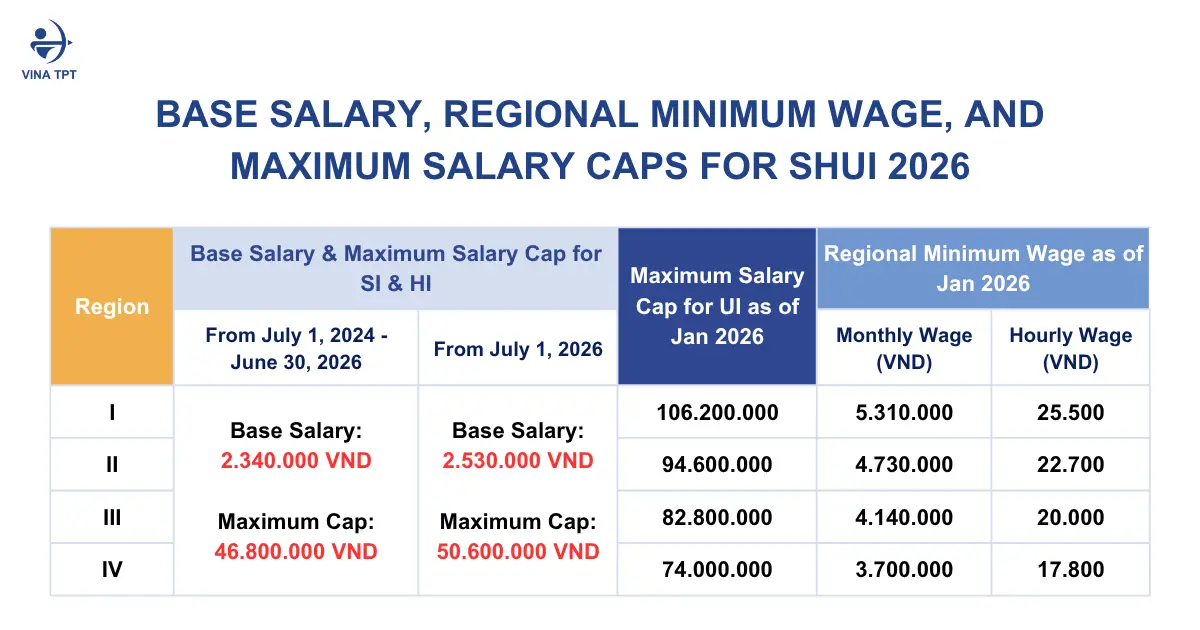
Regional Minimum Wage Rates on a Monthly Basis 

According to Decree No. 293/2025/ND-CP, the monthly regional minimum wage levels have been revised upward by region as follows: 


 Minimum Wage Rates by Month 

(Unit: VND/month) 

Region 

2025    2026 

Region I 

4.960.000  5.310.000 

Region II 

4.410.000 

4.730.000 

Region III  3.860.000 

4.140.000 

Region IV  3.450.000 

3.700.000 

The regional minimum wage has been adjusted upward by approximately 7.2% compared to 2025, contributing to higher income levels and stronger social security for employees, particularly in the manufacturing and service sectors. 

Regional Minimum Wage Table by Hour 


Minimum Wage Rate by Hour 

(Unit: VND/hour) 

Region 

2025  2026  

Region I 

23.800  25.500 

Region II 

21.200 

22.700 

Region III  18.600 

20.000 

Region IV  16.600 

17.800 

The adjustment of the hourly minimum wage enhances flexibility for seasonal and part-time employment arrangements, while ensuring the protection of workers’ rights in an increasingly diverse labor market.

3. Regulations on the Application of the Minimum Wage

According to the Decree, the monthly minimum wage represents the lowest level used as the basis for wage agreements between employers and employees. Specifically: 

  • Employees who work full standard working hours and fulfill their assigned duties must be paid no less than the applicable regional minimum wage. 
  • For employees paid on an hourly basis, the hourly wage must not be lower than the minimum hourly wage applicable to the corresponding region. 
  • In cases where wages are paid by day, week, output, or lump-sum basis, the converted monthly or hourly wage must ensure compliance with at least the regional minimum wage level. 

Wage Conversion Methods: 

  • Monthly wage = (Weekly wage × 52) / 12, or Daily wage × Number of normal working days in the month 
  • Hourly wage = Weekly wage (or daily wage) / Number of normal working hours in the week (or day)

Regional-Minimum-Wage-2026-in-Vietnam_-Latest-Updates-and-Key-Changes-Vina-TPT

4. Employer Responsibilities When Applying the Minimum Wage

According to Clause 4, Article 5 of Decree No. 293/2025/NĐ-CP on effectiveness and implementation responsibilities, employers are required to fulfill the following obligations when applying the minimum wage to employees: 

  • Employers must review and adjust the provisions in labor contracts, collective labor agreements, and internal regulations to ensure compliance with the new regulations. At the same time, they are not permitted to abolish or reduce employees’ lawful wage and benefit entitlements, including overtime pay, night-shift pay, in-kind allowances, and other benefits prescribed under labor laws. 
  • For agreements that are more favorable to employees and were previously established (for example, wage levels higher than the minimum wage for trained workers or those working in hazardous, arduous, or dangerous conditions), enterprises are required to continue implementing such agreements, unless otherwise mutually agreed by the parties involved.

5. Why Vina TPT Is the Trusted Partner for HR Outsourcing in Vietnam?

Vina TPT is a trusted partner for many FDI enterprises and SMEs, delivering professional HR outsourcing and payroll services supported by a team of experts with over 15 years of experience. Vina TPT helps businesses effectively manage human resources, ensure accurate payroll processing, and maintain full compliance with Vietnam’s labor and employment regulations. 

Vina TPT’s HR & Payroll services stand out through: 

  • Experienced legal and HR specialists with up-to-date regulatory knowledge: Our experts stay continuously updated on the latest regulations regarding labor law, wages, social insurance, personal income tax, and international standards, helping businesses minimize compliance risks. 
  • Accurate and transparent payroll processing: We manage payroll calculations, tax withholdings, social insurance contributions, and employee benefits with precision, confidentiality, and on-time execution. 
  • Bilingual Vietnamese – English – Japanese reporting: Designed to meet the governance and reporting requirements of FDI enterprises, supporting communication with parent companies and regulatory authorities in Vietnam. 
  • Integrated end-to-end solutions: By synchronizing HR, payroll, and financial data, Vina TPT reduces errors, saves time, and optimizes operating costs for businesses. 

With Vina TPT’s HR outsourcing and payroll solutions, enterprises can focus on their core business activities while all HR and payroll processes are handled professionally, accurately, and transparently. This is a key factor in ensuring legal compliance and building a strong, professional image with employees and international investors. 

Reach out to Vina TPT for professional HR outsourcing and payroll solutions that help your business optimize human resource management, payroll administration, and overall operational efficiency.

BOOK A FREE CONSULTATION

start a business in vietnam with vina tpt

Vietnam to Implement Mandatory Electronic Employment Contracts from July 1, 2026

Vietnam to Implement Mandatory Electronic Employment Contracts from July 1, 2026

vietnam-electronic-employment-contracts-vinatpt

1- Overview of Decree 337/2025/ND-CP (Electronic Employment Contracts)

Decree 337/2025/ND-CP, issued by the Government of Vietnam on December 24, 2025, marks an important milestone in the digitalization of labor relations. This Decree focuses on providing detailed regulations on electronic employment contracts, aiming to promote digital transformation in human resources and labor management.

Although the Decree takes effect on January 1, 2026, the specific regulations on the conclusion and implementation of electronic employment contracts will be fully applied from July 1, 2026, coinciding with the official operation of the National Electronic Employment Contract Platform.

The Decree consists of 5 chapters and 30 articles, developed based on the 2019 Labor Code and the 2023 Law on Electronic Transactions. Its main contents focus on the following aspects:

Definition and legal validity 

An electronic employment contract is defined as an employment contract concluded in the form of electronic data messages and has the same legal validity as a traditional paper-based employment contract. This ensures that electronic employment contracts are fully legally enforceable, provided that they comply with regulations on digital signatures, trusted timestamps, and data security
(Source: Decree 337/2025/ND-CP, Article 4).

Principles of application 

The parties involved must strictly comply with laws on labor, electronic transactions, cybersecurity, personal data protection, and electronic data storage. The Decree emphasizes voluntariness, equality, and protection of employees’ rights, while encouraging the use of electronic employment contracts to gradually replace traditional paper-based contracts, thereby reducing administrative burdens.

National platform 

Developed and managed by the Ministry of Home Affairs, the national platform will assign a unique identification code (ID) to each electronic employment contract, enabling state authorities to easily search, manage, and supervise employment relationships. This not only enhances transparency but also supports enterprises in periodic labor reporting
(Source: Government News Portal).

Scope of application 

The Decree applies to all enterprises, employers, and employees in Vietnam, including foreign employees working in Vietnam. It also clearly regulates the conversion of paper-based employment contracts into electronic form, requiring digital signatures to confirm the accuracy and authenticity.

2- How does this impact businesses? 

The issuance of Decree 337/2025/ND-CP will bring significant changes to businesses in Vietnam, especially in the context of accelerating digital transformation. Electronic employment contracts are not only a modernization tool but also offer substantial practical benefits, while also posing certain challenges that businesses must address. 

2.1 Key benefits for businesses 

  • Cost and time savings:
    Instead of printing, storing, and physically transferring documents, businesses can conclude electronic employment contracts remotely via digital platforms. For example, a multi-branch company can sign contracts with employees in different provinces without face-to-face meetings, potentially reducing administrative costs by up to 50%, according to HR experts.
  • Greater flexibility and management efficiency:
    With identification codes assigned on the national platform, businesses can easily search, update, and report employment data. This is particularly beneficial for large companies managing thousands of employment contracts. In addition, electronic employment contracts can be integrated with internal HR systems, helping to automate recruitment, payroll, and attendance processes. 
  • Enhanced transparency and legal compliance:
    Electronic contracts protected by digital signatures and trusted timestamps reduce the risk of forgery or document loss. Businesses can easily demonstrate compliance with the Labor Code during inspections by state authorities while protecting the rights and interests of both parties. 
  • Competitive advantage:
    Enterprises that adopt electronic employment contracts early are more attractive to young, tech-savvy talent and are better aligned with modern remote-working trends. 

2.2 Challenges and potential risks 

  • High technical requirements:
    Businesses must invest in digital signatures, security systems, and connectivity with the national platform. Without timely preparation, companies may face difficulties from July 1, 2026, leading to delays in signing new employment contracts. 
  • Data security risks:
    Electronic storage increases the risk of personal data breaches if cybersecurity measures are inadequate. Although the Decree requires compliance with the 2018 Cybersecurity Law, many small businesses may lack sufficient resources. 
  • Transition from existing contracts:
    Existing paper-based employment contracts need to be converted into electronic form in oder to be integrated into the national platform, requiring time and costs for digital signature authentication. 
  • Impact on employees:
    Some older employees or workers in remote areas may not be familiar with digital tools, requiring additional training and support from employers. 

Overall, Decree 337/2025/ND-CP promotes deeper integration of Vietnamese businesses into the digital economy but requires careful preparation to maximize benefits while minimizing risks. 

Decree-3372025ND-CP-Electronic-Employment-Contracts-VinaTPT

3 – What should businesses prepare for electronic employment contracts before 01 July 2026? 

To comply with Decree 337/2025/ND-CP and effectively implement electronic employment contracts, businesses should develop a detailed preparation plan as early as possible. The following practical steps are recommended: 

  • Build technical infrastructure:
    Register digital signatures for legal representatives and HR staff with licensed public certification authorities (CAs) such as Viettel CA or VNPT CA. Ensure that internal systems support secure digital signing and data storage, in compliance with ISO 27001 standards. 
  • Select an eContract service provider:
    Choose reputable providers licensed to authenticate electronic data messages, such as FPT, Viettel, or VNPT. Providers must meet 13 technical requirements stipulated in the Decree, including API connectivity with the national platform and robust data security measures. 
  • Prepare digital identification documents:
    Collect electronic citizen IDs, business registration certificates, and Level-2 electronic identification accounts for both individuals and enterprises. Employees should be encouraged to use biometric authentication (fingerprints or facial recognition) to enhance security. 
  • Training and internal process updates:
    Organize training sessions for HR teams on electronic employment contract workflows, including sending and receiving contracts, dispute handling, and reporting via the national platform. Update internal HR manuals to incorporate the new regulations. 

To support businesses in implementation, companies such as Vina TPT—a professional provider of HR, payroll, and labor compliance services in Vietnam—can serve as an ideal partner. With extensive experience in payroll outsourcing, Vina TPT helps enterprises integrate electronic employment contracts effectively and in compliance with regulations. 

Decree 337/2025/ND-CP is not only a legal requirement but also an opportunity for Vietnamese businesses to modernize HR management. Early preparation will help minimize risks and maximize the benefits of electronic employment contracts.

If you need advice tailored to your company’s specific situation, please contact Vina TPT for prompt and professional support. 

EXPLORE OUR HR SERVICES

[Newsletter] Vietnam Tax Policy Updates November 2025 – VAT, PIT and Labor

Vietnam-Tax-Policy-Updates-November-2025-VAT-PIT-and-Labor-Vina-TPT

Vietnam-Tax-Policy-Updates-November-2025-VAT-PIT-and-Labor-Vina-TPT

The November 2025 newsletter highlights key Vietnam tax policy updates that businesses need to closely monitor. The focus is on important VAT regulations related to export activities, VAT refund mechanisms, invoice usage during enforcement periods, and compliance requirements for export processing enterprises (EPEs). In addition, the update addresses notable Personal Income Tax (PIT) changes, particularly policies on employee meal allowances, as well as labor regulations governing salary payments for foreign employees transferring within an enterprise. These developments have significant implications for business compliance, operations, and tax planning in Vietnam.

1. VALUE ADDED TAX (VAT)

1.1. VAT amount has not been refunded because it exceeds 10% of the exported revenue shall be deducted in the next refund period.

Official dispatch No. 5094/CT-CS dated November 11, 2025 of the Tax Department on Notes on VAT refund policy for exported goods
Regulations related to VAT refunds for exported goods and services were previously stated in Article 2 of Circular 25/2018/TT-BTC (amending and supplementing Clause 4, Article 18 of Circular 219/2013/TT-BTC) and are now applied according to the provisions of Clause 1, Article 15 of VAT Law No. 48/2024/QH15, Clause 2, Article 29 of Decree 181/2025/ND-CP and Appendix II of Circular No. 69/2025/TT-BTC.
According to Vietnam tax policy updates, in case a business establishment exports goods and services in a month or quarter, if the input VAT amount that has not been fully deducted is 300 million VND or more, it will be entitled to a VAT refund on a monthly or quarterly basis. However, the maximum refunded input VAT amount of exported goods and services must not exceed 10% of the revenue of exported goods and services in the tax refund period.
For the input VAT amount of exported goods and services that has not been refunded because it exceeds 10% of the revenue of exported goods and services of the previous tax refund period, the enterprise is allowed to deduct it in the next tax period to determine the VAT amount to be refunded for exported goods and services of the next tax refund period.
1.2. Notes for VAT for export activities:

Official dispatch No. 5489/CT-CS dated November 25, 2025 of the Tax Department on value added tax policy.

According to the Tax Department’s note, the principle of input VAT deduction for goods and services used for production and trading of goods and services subject to VAT is to be fully deducted (Article 14 of the Law on VAT No. 48/2024/QH15, Clause 1, Article 23 of Decree No.181/2025/ND-CP, Clause 4, Article 24 of Decree No. 181/2025/ND-CP).

In case an enterprise has both export and domestic consumption activities, it is necessary to separately account for input VAT for export activities (Clause 1, Article 15 of VAT Law No.48/2024/QH15, Clause 2, Article 29 of Decree No. 181/2025/ND-CP). If it is not possible to account separately, the input VAT for exported goods will be determined according to the ratio of export revenue to total taxable revenue (Appendix II of Circular No. 69/2025/TT-BTC).

1.3. Regarding the use of invoices during the enforcement period

According to Official dispatch No. 5282/CT-CS dated November 18, 2025 of the Tax Department on the conditions for allowing invoice issuance during the period of enforcement, Tax Department has based on the provisions of Article 4, Article 13 of Decree 123/2020/ND-CP (amended in Clause 3, Clause 10, Article 1 of Decree 70/2025/ND-CP) and Article 34 of Decree 126/2020/ND-CP to respond as follows:

  • Under the latest Vietnam tax policy updates, in cases where an enterprise is subject to compulsory measures to stop using invoices but submits a written request to continue invoice usage and falls under situations where the tax authority issues invoices on a per-occurrence basis, the enterprise will be issued electronic invoices with codes from the tax authority for each occurrence. The enterprise bears full responsibility for the accuracy of all information stated on these electronic invoices. The issuance and declaration of related tax obligations for invoices issued per occurrence by the tax authority must be carried out in accordance with Clause 10, Article 1 of Decree No. 70/2025/ND-CP.
  • In case an enterprise is being forced to stop using invoices and has a written request to use invoices to have a source of payment for workers’ salaries and expenses to ensure continuous production and business, the tax authority will continue to allow the enterprise to use invoices each time they arise, on the condition that the enterprise must immediately pay at least 18% of the revenue on the used invoices to the state budget according to the provisions of Point d, Clause 4, Article 34 of Decree No. 126/2020/ND-CP mentioned above.

1.4. Regarding VAT declaration and payment of export processing enterprises (EPEs)

Official dispatch No. 3905/HYE-QLDN3 dated October 31, 2025 of Hung Yen Provincial Tax Department has provided the instructions regarding VAT declaration and payment of export processing enterprises (EPEs) as below:

  1. VAT payers:
  • The enterprise is not a VAT payer for production activities for export (export processing activities) and is not required to declare VAT for this activity.
  • Export processing enterprises must pay VAT if they carry out business activities other than export processing activities, for example:

-Purchase domestic goods for export (exercise export rights).

-Import goods for domestic sale (exercise import rights).

  1. Conditions for declaring and paying VAT (for business activities other than manufacturing activities):
  • Separate accounting: Export processing enterprises must separately account for transactions of buying and selling goods that are not part of export processing activities (for example, import-export activities).
  • Tax registration: The enterprise needs to register for tax with the domestic tax authority to declare and pay VAT separately for these other business activities.
  • Arrangement of separate areas: The arrangement of the storage area for goods serving processing activities must ensure separation from the storage area for goods serving other production and business activities.
  1. VAT declaration period:
  • Monthly declaration: According to the provisions of Point a, Clause 1, Article 8 of Decree No. 126/2020/ND-CP, the enterprise shall declare VAT monthly.
  • Quarterly declaration: If the enterprise meets the criteria specified in Point a, Clause 1, Article 9 of Decree No.126/2020/ND-CP (total revenue from sales of goods and provision of services of the previous year is 50 billion VND or less), the enterprise can choose to declare VAT quarterly.
  1. Using invoices:
  • If the enterprise declares VAT using the deduction method, use VAT invoices.
  • If the enterprise declares VAT using the direct method, use sales invoices.
  • When selling goods and providing services domestically and when selling goods and providing services between organizations and individuals in duty-free zones, exporting goods and providing services abroad, the invoice must clearly state “For organizations and individuals in duty-free zones”.

In short, under the latest Vietnam tax policy updates, export processing enterprises are only required to declare and pay VAT for business activities other than export processing activities (production of export goods). These enterprises must separately account for such activities and register for tax to declare and pay VAT in accordance with regulations. The VAT declaration period may be monthly or quarterly, depending on the revenue of the previous year.

Vietnam-Tax-Policy-Updates-November-2025-VAT-PIT-and-Labor-Vina-TPT

2. PERSONAL INCOME TAX (PIT)

2.1. The Personal income tax policy regarding the limit on spending money for lunch and mid-shift meals

As part of the Vietnam tax policy updates, Official Dispatch No. 5106/CT-CS dated November 12, 2025, issued by the Tax Department, provides guidance on personal income tax policy regarding the limits on lunch and mid-shift meal expenses used as a basis for determining personal income tax. In this dispatch, the Tax Department cites the following regulations and instructions for reference:

  • Article 103 of the Labor Code No. 45/2019/QH14 stipulates that “The regime of salary increase, promotion, allowances, subsidies and incentives for employees is agreed upon in the labor contract, collective labor agreement or regulations of the employer”.
  • Clause 1, Article 33, Clause 9, Article 34 of Decree No. 44/2025/ND-CP on salary and bonus regimes in state-owned enterprises stipulates: “This Decree takes effect from April 15, 2025 and the regimes in this Decree are implemented from January 1, 2025”. “The mid-shift meal regime or fixed-quantity meal regime for employees, Executive Board, Board Members, and Supervisors is implemented according to the agreement in the collective labor agreement or the internal rules and regulations of the enterprise according to the provisions of the Labor Code”.
  • Article 10 of Decree No. 248/2025/ND-CP on salary and bonus regimes in state-owned enterprises stipulates: “This Decree takes effect from September 15, 2025 and the regimes in this Decree are implemented from August 1, 2025. Decree No. 44/2025/ND-CP is abolished”.
  • Section g.5, Clause 2, Article 2 of Circular No. 111/2013/TT-BTC stipulates: “In case the employer does not organize mid-shift meals or lunch but pays for the employee, it is not included in the taxable income of the individual if the level of expenditure is in accordance with the guidance of the Ministry of Labor – Invalids and Social Affairs. In case the level of expenditure is higher than the guidance of the Ministry of Labor – Invalids and Social Affairs, the excess expenditure must be included in the taxable income of the individual. The specific expenditure level applicable to state-owned enterprises… shall not exceed the guidance of the Ministry of Labor – Invalids and Social Affairs. For non-state-owned enterprises… the expenditure level shall be decided by the head of the unit in agreement with the chairman of the trade union but shall not exceed the level applicable to state-owned enterprises”.
  • In Vietnam tax policy updates: Official Dispatch No. 1387/CTL&BHXH-TLSXKD dated September 29, 2025 of the Ministry of Home Affairs, it is instructed: “According to the provisions of Article 103 of the Labor Code, incentive regimes for employees are agreed upon in the labor contract, collective labor agreement or regulations of the employer. The mid shift meal regime for employees, Executive Board, Council members, and Controllers in state-owned enterprises from January 1, 2025 to July 31, 2025 is implemented according to the provisions of Clause 9, Article 34 of Decree No. 44/2025/ND-CP on salary and bonus regimes in state-owned enterprises; from August 1, 2025, it is implemented according to the provisions of the Labor Code”.

According to Vietnam tax policy updates, the current allowance of VND 730,000 per month for mid-shift meals has been abolished. Instead, enterprises may determine a reasonable allowance level based on the agreements in the collective labor agreement or in the company’s internal rules and regulations. In the case where the Company incurs expenses for mid-shift meals for employees working at the company, if this allowance is specifically stipulated regarding eligibility conditions and allowance levels in the labor contract, the collective labor agreement, or the company’s internal rules and regulations, it shall not be included in taxable personal income (PIT). If the allowance exceeds the stipulated level, the excess amount will be included in taxable PIT income.

Vietnam-Tax-Policy-Updates-November-2025-VAT-PIT-and-Labor-Vina-TPT

3. LABOR 

3.1. Regarding Salary payment for foreign employees moving within the enterprise

Official dispatch No. 10861/BNV-CVL dated November 19, 2025 of the Ministry of Home Affairs on domestic salary payment for foreign employees moving within the enterprise.

The Ministry of Home Affairs notes that, in the case of “foreign workers being paid (in Vietnam)”, before the expected working date, the enterprise employing the foreign worker must request a work permit and sign a labor contract as prescribed (Clause 1, Article 13, Point d, Clause 1, Article 21 of the Labor Code No. 45/2019/QH14 and Point a, Clause 1, Article 2, Clause 4, Article 22 of Decree 219/2025/ND-CP), and must also participate in compulsory social insurance in Vietnam for this person as prescribed (Point a, Clause 2, Article 2 of the Law on Social Insurance No. 41/2024/QH15).

The case of “foreign employees being paid in Vietnam” (performing procedures to request a work permit) and the case of “foreign employees transferring within the enterprise” (performing procedures to request a certificate of not being subject to a work permit under Article 8 of Decree 219/2025/ND-CP) are two different cases according to the provisions of the Labor Code No. 45/2019/QH14 and guiding documents on foreign employees working in Vietnam.

BOOK A FREE CONSULTATION

Vina TPT Accounting services


Best Bookkeeping Services for Startups in Vietnam

Best-Bookeeping-Services-for-Startups-in-Vietnam-Vina-TPT

Best-Bookeeping-Services-for-Startups-in-Vietnam-Vina-TPT

1. Common Accounting Challenges Faced by Startups

Bookkeeping services are essential because startups in Vietnam often face many difficulties in accounting and financial management. First is the limited human resources, as many new businesses only have a few employees or do not have a dedicated accounting department.

Second is the high cost of hiring full-time staff or hiring an unsuitable accounting service company. Startups often have to consider limited budgets, while maintaining an internal team is expensive in terms of salary, benefits and training.

Finally, many startups lack experience in financial management and tax compliance. Errors in VAT, CIT, PIT declarations or social insurance payments can lead to legal risks, tax arrears or administrative fines. This is why many startups choose outsourced accounting services to ensure accurate financial operations and compliance with Vietnamese law.

SOLVE YOUR ACCOUNTING CHALLENGES

2. Core Accounting Services for Startups

Startups need essential accounting services to operate effectively and remain compliant with the law. Key services include:

Bookkeeping:

    • Record all transactions, invoices, and documents according to Vietnamese accounting standards. Classify and organize financial data, making it easy to track cash flow.

Monthly & Year-End Reporting:

    • Prepare monthly/quarterly financial reports to evaluate business performance. 
    • Prepare year-end reports to meet audit and tax requirements.

Tax Compliance:

Businesses must ensure full and timely compliance with Vietnam’s tax regulations, including Value Added Tax (VAT), Corporate Income Tax (CIT), Personal Income Tax (PIT), and Foreign Contractor Tax (FCT). Key responsibilities include:

  • Preparing accurate tax reports in accordance with current tax laws.
  • Submitting monthly, quarterly, and annual tax declarations to avoid penalties or late-filing fines.
  • Maintaining clear, consistent accounting records to support all reported figures.
  • Providing explanations and supporting documentation to tax authorities when required, including clarifying discrepancies or responding to official notices.
  • Handling tax audits and inspections professionally to ensure consistency between records and declarations.

Ensuring compliance with all tax obligations not only minimizes legal risks but also builds long-term credibility with regulatory authorities.

Payroll & Insurance Management:

This service ensures accurate and compliant management of employee compensation and social insurance obligations. Key responsibilities include:

  • Preparing payroll and calculating Personal Income Tax (PIT) for all employees.
  • Paying social insurance, health insurance, and unemployment insurance contributions in accordance with Vietnamese law.
  • Registering new employees for social insurance and processing all related insurance documents. 
  • Submitting labor reports and mandatory filings to relevant authorities as required by labor regulations.
  • Ensuring compliance with labor laws and personal income tax obligations for all employees.

Effective payroll and insurance management helps businesses minimize legal risks, maintain employee satisfaction, and ensure smooth operations in accordance with Vietnamese regulations.

Financial Consulting:

  • Cash flow analysis, cost optimization and budget planning.
  • Support startups to make accurate and timely financial decisions.

These services help startups operate transparently financially, save time and focus on product and market development instead of struggling with complicated accounting.

Best-Bookeeping-Services-for-Startups-in-Vietnam-Vina-TPT

4. How Outsourced Bookkeeping Ensures Accuracy

Vina TPT’s outsourced accounting service helps startups standardize all books and financial reports in accordance with Vietnamese accounting standards. All transactions, invoices and documents are systematically recorded, classified and checked, helping to ensure that all financial data is accurate and transparent. This process not only minimizes human errors but also creates clear and complete records, serving monthly, quarterly and year-end reporting. Thanks to that, startups can grasp cash flow, manage costs and evaluate business performance in a timely manner, thereby making more accurate financial decisions.

Moreover, Vina TPT also ensures full compliance with legal regulations on tax and financial reporting. Each report is cross-checked, compared with original documents and accurately calculates taxes payable, limiting the risk of being overcharged or administratively fined. In addition, the service also provides transparent, easy-to-read reports, helping investors, banks or partners clearly understand the financial situation of startups. Thanks to that, businesses not only feel secure about accuracy but also save operating time, focus on product and market development, and build credibility with business partners.

5. Why Vina TPT Is the Go-To Accounting Firm for Startups

Vina TPT Accounting Service is an ideal partner for startups in Vietnam thanks to:

  • Comprehensive services: bookkeeping, monthly/quarterly/annual reports, tax declarations, payroll management, financial consulting.
  • High expertise for startups: understanding the specifics of limited budgets, simple but legal processes.
  • Transparent processes: clear reports, easy to check and manage cash flow.
  • Reduced operational load: startups do not have to worry about accounting staff or legal errors, focus on business development.
  • Language advantage : services are available in both Vietnamese, English & Japanese, facilitating communication for foreign founders and easing compliance with local regulations.

Vina TPT helps startups operate finances effectively, comply with the law and develop sustainably.

BOOK A FREE CONSULTATION

bookkeeping-services


[Newsletter] Vietnam Tax Policy Updates October 2025- CIT, VAT, PIT and Social Insurance

October-2025-Newsletter-CIT-VAT-PIT-and-Social-Insurance-Vina-TPT

Newsletter-October-2025-Vina-TPT

Vietnam is implementing a series of new tax, accounting, insurance, and labour regulations effective from October 2025. Notable updates include reduced export duty rates, clarified rules for input VAT deduction, higher PIT family circumstance deductions, a shift to non-resident taxation for certain foreign individuals, new CIT rates and deductible expense rules, and stricter sanctions on late or unpaid insurance contributions. These updates will reshape compliance requirements and influence core business operations, particularly in finance, payroll, and reporting functions.

This article outlines the essential policy changes businesses need to prepare for to ensure smooth compliance and operational continuity.

1. VAT & IMPORT/EXPORT DUTIES 

1.a. Export duty on gold jewellery, fine art articles (from 8K) and other precious metal products reduced to 0%  

Decree No. 260/2025/NĐ-CP dated 10/10/2025 of the Government amends the export duty rates for certain commodity lines under groups 71.13, 71.14 and 71.15 in the Export Tariff Schedule issued together with Decree No. 26/2023/NĐ-CP dated 31/05/2023. 

The Decree reduces the export duty rate from 1% to 0% for the following items: 

  • Jewellery and parts thereof, of other precious metal, whether or not plated or clad with precious metal (HS codes 7113.19.10 and 7113.19.90); 
  • Articles of goldsmiths’ or silversmiths’ wares and parts thereof, of other precious metal, whether or not plated or clad with precious metal (HS code 7114.19.00); 
  • Other articles of gold or silver (HS code 7115.90.10). 

Products that are currently subject to the 0% export duty rate will continue to enjoy the existing 0% rate. 

1.b. Input VAT deduction when payment is made via third-party authorisation  

Official Letter No. 4850/DON-QLDN1 dated 15/10/2025 of Đồng Nai Provincial Tax Department provides guidance on the deduction of input VAT in cases where non-cash payment is made through authorisation to a third party. 

According to the regulations, for the enterprise to be eligible for input VAT deduction, it must fully satisfy the general conditions prescribed in Clause 2, Article 14 of Law No. 48/2024/QH15: 

  • Possession of a VAT invoice for the purchase of goods and services or VAT payment document. 
  • Availability of non-cash payment evidence. 
  • For exported goods and services, additional documents are required: contract, invoice, non-cash payment evidence, customs declaration, and other related documents. 

In addition, when making payment through authorisation to a third party, the enterprise must comply with the further conditions stipulated in Decree No. 181/2025/NĐ-CP: 

  • The authorisation for payment to the third party must be specifically stipulated in a written contract. 
  • The third party must be an organisation or individual lawfully operating. 

If the company fully satisfies all the above conditions and other relevant legal provisions, it will be entitled to deduct the input VAT. 

2. PERSONAL INCOME TAX (PIT)

2.a. Increase in family circumstance deductions effective from 01/01/2026  

On 17 October 2025, the Standing Committee of the National Assembly issued Resolution No. 110/2025/UBTVQH15 adjusting the family circumstance deductions for personal income tax. This Resolution takes effect from 01 January 2026 and applies to the 2026 tax period. 

  • The deduction for the taxpayer himself/herself is increased from VND 11 million to VND 15.5 million per month (VND 186 million per year) (Article 1, point a). This means the taxpayer may deduct this amount when calculating taxable income, thereby reducing the tax payable. 
  • The deduction for each dependant is increased from VND 4.4 million to VND 6.2 million per month (Article 1, point b). Accordingly, taxpayers with dependants will enjoy an additional deduction corresponding to the number of dependants, further easing the tax burden. 

2.b. Foreign individuals – switch to non-resident PIT (20%) before departure  

On 03 October 2025, the Tax Department issued Official Letter No. 4221/CT-CS providing guidance on PIT for foreign individuals working in Vietnam for less than 183 days and required to finalise their tax obligations before leaving the country. Specifically, where a foreign individual has previously been subject to resident PIT withholding and has self-declared PIT on overseas-paid income arising from work performed in Vietnam, but the actual number of days present in Vietnam is less than 183 days, such individual must re-determine their PIT obligations under the non-resident regime. 

  • PIT is calculated at 20% on total Vietnam-sourced income, irrespective of where the income is paid or received. 
  • Tax finalisation must be completed prior to departure from Vietnam.

3. CORPORATE INCOME TAX (CIT) 

3.a. Key new points of Corporate Income Tax Law No. 67/2025/QH15 (effective 01/10/2025)  

Official Letter No. 2244/QNG-NVDTPC dated 13 October 2025 of Quảng Ngãi Provincial Tax Department introduces the key new points of the Corporate Income Tax Law No. 67/2025/QH15 (effective from 01 October 2025). The main changes are as follows: 

  1. Expanded scope of taxpayers:  

Addition of foreign enterprises that do not have a permanent establishment in Vietnam (including those engaged in e-commerce and digital platforms). 

      2. Taxable income:  

Additional provision stipulating that taxable income arising in Vietnam for foreign enterprises is income derived from Vietnam, regardless of where the business activities are conducted. 

      3.New CIT rates based on revenue: 

  • Standard rate: 20% 
  • Enterprises with total annual revenue not exceeding VND 3 billion: 15% 
  • Enterprises with total annual revenue exceeding VND 3 billion but not exceeding VND 50 billion: 17% 
  • Oil and gas exploration and production activities: 25% – 50% depending on the project. 

      4.Determination of taxable income: 

  • Taxable income from business activities is the total income from all business activities. 
  • Loss carry-forward is allowed between activities, except for real estate transfer activities, investment projects, and participation rights in investment projects when the entity is enjoying tax incentives. 
  • Income from the transfer of mineral exploration, extraction, and processing projects must be accounted for separately and may not be offset against other activities. 

       5.Tax exemption and reduction: 

  • Public-service entities providing public services in socio-economically disadvantaged areas are entitled to a 50% reduction of CIT payable. 
  • Enterprises converted from household businesses are exempt from CIT for two consecutive years from the year taxable income first arises. 

       6.Science and technology development fund:  

Maximum contribution rate increased to 20%. 

       7.New tax calculation method:  

Application of CIT as a percentage of revenue for enterprises with annual revenue ≤ VND 3 billion when revenue can be determined but costs and income cannot be determined. 

      8.Additional deductible expenses: 

  • Expenses related to seconded personnel participating in management, administration, and control at credit institutions under special control or commercial banks subject to mandatory transfer. 
  • Certain expenses incurred for business and production purposes but not yet generating corresponding revenue in the period, as stipulated by the Government. 
  • Expenses for supporting the construction of public infrastructure that simultaneously serves business and production activities. 
  • Expenses related to greenhouse gas emission reduction, carbon neutrality, net-zero initiatives, and environmental pollution reduction linked to business and production activities. 
  • Certain contributions to funds established by decision of the Prime Minister or the Government.


3.b. Temporary CIT payment of 1% on progress payments received for housing projects  

Official Letter No. 5129/CT-CS dated 12 November 2025 of the Tax Department on tax policies: 

  • For housing investment projects intended for transfer/sale: If the investor collects advance payments according to progress, it must make provisional quarterly Corporate Income Tax (CIT) payments equal to 1% of the amounts collected, pursuant to Point b, Clause 6, Article 8 of Decree No. 126/2020/NĐ-CP. 
  • Regarding interest expense for enterprises with related-party transactions: Deductible interest expense is subject to the cap under Clause 3, Article 16 of Decree No. 132/2020/NĐ-CP and applies to all enterprises with related-party transactions, irrespective of whether they are domestic or foreign-invested enterprises. 


4. SOCIAL, HEALTH & UNEMPLOYMENT INSURANCE – TRADE UNION 

4.a. Three major changes to unemployment insurance effective from 01/01/2026 (Law on Employment 2025) 

On 16 June 2025, the National Assembly passed the Law on Employment 2025, which officially takes effect from 01 January 2026. Accordingly, unemployment insurance policies will undergo significant changes, with the following three key updates to unemployment insurance effective from 01/01/2026: 

(1) No entitlement to unemployment benefits upon eligibility for pension 

From 01/01/2026, under point a, clause 1, Article 39 of the Law on Employment 2025, employees who terminate employment or end their labour contract upon reaching eligibility for pension benefits will not be entitled to unemployment benefits. Thus, effective from 01/01/2026, unemployment benefits will not be payable to individuals who meet pension eligibility criteria, regardless of whether pension procedures have been initiated. 

(2) Faster receipt of unemployment benefits with reduced waiting period to 10 days 

From 2025, pursuant to clause 3, Article 39 of the Law on Employment 2025, the commencement date for unemployment benefits effective from 01/01/2026 will be the 11th working day following the submission of a complete application dossier for unemployment benefits. This represents a reduction of 5 days from the current regulation, under which benefits commence from the 16th day after dossier submission. 

(3) Maximum level of unemployment benefits 

Pursuant to clause 1, Article 39 of the Law on Employment 2025, the maximum monthly unemployment benefit for all employees shall not exceed 5 times the regional minimum wage at the time of contract termination. 

4.b. Penalties for late or evaded compulsory social/health/unemployment insurance contributions – effective 30/11/2025  

On 16 October 2025, the Government issued Decree No. 274/2025/NĐ-CP detailing certain provisions of the Social Insurance Law regarding late payment, evasion of compulsory social insurance and unemployment insurance contributions; complaints and denunciations related to social insurance. This Decree takes effect from 30 November 2025. 

  • Late payment interest rate: 0.03% per day calculated on the amount and number of days of late or evaded payment (Article 3, Clause 1, Point d; Article 7, Clause 2). 
  • Conversion period to evasion: An act of late payment shall be converted to an act of evasion after 60 days from the expiry of the latest payment deadline, provided that the Social Insurance Agency has issued a written reminder (Article 6, Clause 1, Point c). 
  • Evasion by understating salary: The act of registering a salary base for social insurance contributions lower than prescribed under the Social Insurance Law shall be deemed evasion (Article 6, Clause 1, Point b). 
  • Exemption from evasion classification (force majeure): Specific enumeration of 4 force majeure cases not to be considered as evasion (such as storms, floods, dangerous epidemics, emergency situations) as announced by competent authorities (Article 4).


5. ACCOUNTING REGIME 

5.a. Circular 99/2025/TT-BTC guiding the accounting regime for enterprises  

On 27 October 2025, the Ministry of Finance issued Circular No. 99/2025/TT-BTC regulating the accounting regime for enterprises, replacing Circular No. 200/2014/TT-BTC dated 22 December 2014. Circular No. 99/2025/TT-BTC takes effect from 01 January 2026 and applies to financial years beginning on or after 01 January 2026. Pursuant to the regulations, Circular No. 99/2025/TT-BTC simultaneously repeals and replaces the following documents: 

  • Circular No. 200/2014/TT-BTC guiding the accounting regime for enterprises; 
  • Circular No. 75/2015/TT-BTC (amending Article 128 of Circular 200); 
  • Circular No. 53/2016/TT-BTC (amending and supplementing certain provisions of Circular 200); 
  • Circular No. 195/2012/TT-BTC dated 15 November 2012 guiding accounting for main investors. 

However, certain provisions related to the accounting for the equitisation of State-owned enterprises under Circular 200 shall continue to apply until the Ministry of Finance issues a new replacement document. 

Below are some key differences between Circular No. 99/2025/TT-BTC and Circular No. 200/2014/TT-BTC regarding the accounting regime for enterprises: 

Method of converting financial statements prepared in foreign currency to Vietnamese Dong: 

  • Assets and liabilities shall be converted to Vietnamese Dong at the average transfer buying/selling exchange rate of the commercial bank where the enterprise regularly conducts transactions as at the end of the accounting period; 
  • Owner’s equity (owner’s contributed capital, capital surplus, other capital, convertible bond options) shall be converted to Vietnamese Dong at the actual transaction exchange rate on the date of capital contribution; 
  • Revaluation differences of assets shall be converted to Vietnamese Dong at the actual transaction exchange rate on the revaluation date; ….. 

Chart of accounts: Reduced to 71 level-1 accounts, abolishing 6 accounts, including 4 accounts related to non-business funding sources, capital construction investments, and 2 accounts (611 and 631). 

Addition of accounts: Renaming of accounts and addition of new accounts (e.g., Account 215 – Biological assets, etc.). Abolition of certain accounts: 621 – Purchase costs, 631 – Production costs, etc. 

Accounting forms and financial statement templates: Enterprises may also design additional or amend and supplement accounting forms and financial statement templates compared to those guided under this Circular to suit the characteristics of production and business activities and management requirements. Renaming of the “Balance Sheet” template to “Statement of Financial Position”. 


6. OTHER 

6.a. 2025 Labour Utilisation Report for Ho Chi Minh City – Must be submitted before 05 December 2025 

Official Letter No. 9002/SNV-VLATLĐ dated 13 November 2025 of the Ho Chi Minh City Department of Home Affairs on the implementation of Article 4 of Decree No. 145/2020/NĐ-CP regarding labour utilisation reporting. 

The Ho Chi Minh City Department of Home Affairs provides the following guidance on the submission of the 2025 labour utilisation report by establishments within the territory of Ho Chi Minh City: 

  1. Entities required to submit the report: 
  • Agencies, organisations, enterprises, cooperatives, households, and individuals that hire, employ, or utilise labour. 
  • Those with headquarters or places of operation within the territory of Ho Chi Minh City. 

      2. Content of the report: 

  • To be completed in accordance with Form No. 01/PLI in Appendix I issued together with Decree No. 145/2020/NĐ-CP. 

      3. Method of submission (select one of the two options): 

  • Submission via the National Public Service Portal: Perform the “Integrated procedure for registering adjustments to compulsory social insurance, health insurance, unemployment insurance contributions and labour utilisation reporting”: https://dichvucong.gov.vn/. 

      4. Submission deadline: To be completed before 05 December 2025. 

      5. Important notes: 

  • After the prescribed deadline, the Department of Home Affairs will not accept any reports. 
  • The Department of Home Affairs will compile the implementation status as a basis for confirming compliance with legal regulations upon request from relevant agencies. 
  • Failure to submit the report on time may result in administrative violations under Clause 2, Article 8 of Decree No. 12/2022/NĐ-CP. 


CONTACT US FOR SUPPORT

Expert-Vietnam-VinaTPT