How to Calculate Personal Income Tax 2026 in Vietnam

how-to-calculate-personal-income-tax-2026-vinatpt

Vietnam’s Personal Income Tax 2026 law was amended Law No. 109/2025/QH15 and officially takes effect from July 1, 2026. Key rules for salary, wages, and business income, however, apply right from January 1, 2026. These updates significantly reduce the tax burden for employees and business owners amid rising living costs. 

This guide explains exactly how to calculate PIT in 2026, highlights the major changes (increased family deductions, simplified progressive rates, expanded exemptions), and provides clear, real-world examples so you can compute your tax accurately and stay fully compliant. 

1. Major Changes to Personal Income Tax from 2026 

2026 introduces the biggest PIT reforms since 2012, driven by the amended PIT Law 2025 and Resolution 110/2025/UBTVQH15. The goal is to ease pressure on middle-income earners, support digital businesses, and attract high-tech investment while keeping pace with economic growth and inflation. 

Change  Main Benefit 
Increased family deductions  Lower tax for individuals and families 
Simplified progressive brackets  Easier calculation, reduced tax for average incomes 
Expanded exemptions  Support for high-tech, agriculture, and green sectors 

These reforms make the tax system more modern, transparent, and easier to comply with. 

1.1 Increased Family Deductions Effective January 1, 2026 

From January 1, 2026, family circumstance deductions are raised to better match higher living costs, helping millions of taxpayers pay less personal income tax The personal deduction increases from VND 11 million to VND 15.5 million per month (VND 186 million per year), and the deduction per dependent rises from VND 4.4 million to VND 6.2 million per month. 

Type of Deduction  2025 Amount  2026 Amount 
Personal deduction  11 million/month  15.5 million/month 
Per dependent  4.4 million/month  6.2 million/month 

Who qualifies as a dependent? 

  • Children: Under 18; over 18 if disabled and unable to work; full-time students (university, college, vocational) under 22 with low or no income. 
  • Spouse: Unable to work or with very low/no income. 
  • Parents, grandparents, siblings: Elderly or disabled individuals with insufficient income, directly supported by the taxpayer. 

Key conditions 

  • Each dependent can be claimed by only one taxpayer. 
  • Proof is required (birth certificate, household registration, disability certificate, school enrollment, support commitment letter). 
  • Register with your employer or tax office (usually via Form 20-ĐK-TNCN) before tax is calculated. 

1.2 New Progressive Personal Income Tax 2026 Rates – Reduced from 7 to 5 Brackets 

Effective January 1, 2026, the progressive tax scale is simplified from 7 brackets to 5, with wider income ranges to reduce the effective tax rate for middle earners. The top rate remains 35%, now applying only to monthly taxable income over VND 100 million (previously VND 80 million). 

Bracket  Monthly Taxable Income (VND million)  Annual Taxable Income (VND million)  Tax Rate (%) 
1  Up to 10  Up to 120  5 
2  Over 10 to 30  Over 120 to 360  10 
3  Over 30 to 50  Over 360 to 600  20 
4  Over 50 to 100  Over 600 to 1,200  30 
5  Over 100  Over 1,200  35 

Old vs. new comparison The old 7-bracket system had narrower bands, pushing many middle-income earners into higher rates. The new structure is simpler and saves 5–15% in tax for most employees, while encouraging extra work without jumping brackets quickly. 

1.3 Expanded Exemptions, Reductions & Special Incentives 

The updated law adds 21 new exempt income categories starting in 2026, focusing on education, healthcare, green projects, and high-tech sectors. Additional benefits include a 50% reduction on certain investment income and a 5-year exemption for high-tech professionals. 

  • New exempt items: Certain overtime pay, scholarships, income from green bonds, organic agriculture, gifts under VND 10 million, disaster relief support. 
  • Special incentives: 5-year PIT exemption for experts in AI, semiconductors, and R&D; 50% reduction on income from investments in tech startups. 
Incentive Type  Condition  Duration 
Scholarship exemption  Full-time formal education  Indefinite 
5-year high-tech exemption  Experts in AI, semiconductors, R&D  5 years from 2026 
50% investment reduction  Green/technology startups  Applies to 2026+ income 

Proof (contracts, certificates) is required, often from the Ministry of Science and Technology. 

personal-incom-tax-2026-vina-tpt

2. How to Calculate Personal Income Tax in 2026 – Step-by-Step Guide 

Core formula Tax payable = Taxable income × Progressive tax rate Taxable income = Total income – Exempt items – Deductions (family + mandatory insurance + charity + eligible medical/education expenses) 

This applies to tax residents. Non-residents pay a flat 20% on Vietnam-sourced income. 

Step 1: Determine Your Tax Residency Status 

Start by confirming whether you are a tax resident or non-resident, as this determines what income is taxable. 

Under Vietnam’s PIT law: 

  • Tax resident: Present in Vietnam ≥183 days in the calendar year, or maintaining a permanent residence (owned home or long-term rental with registered address). 
  • Non-resident: Taxed only on income sourced from Vietnam. 

Tax implications 

  • Residents: Taxed on worldwide income using the 5-bracket progressive scale (5%–35%). 
  • Non-residents: Flat 20% on Vietnam-sourced salary and wages (other rates apply to specific types). 

Step 2: Calculate Taxable Income 

Basic formula: Taxable income = Total income – Exempt items – Deductions 

  1. Total income includes salary, bonuses, taxable allowances, business profits, investment returns, etc. 
  2. Exempt items include scholarships, certain overtime pay, small gifts, etc. 
  3. Deductions include: 
  • Family deduction (VND 15.5 million/month personal + VND 6.2 million/month per dependent) 
  • Mandatory social, health, unemployment insurance (BHXH, BHYT, BHTN) 
  • Charitable donations (with receipts) 
  • Medical & education expenses (new in 2026, up to VND 10 million/year – detailed guidance pending) 

Example In January 2026, Mr. A receives: 

  • Salary: VND 70,000,000 
  • Meal allowance (per company policy): VND 1,000,000 
  • Sales commission: VND 2,000,000 

No charitable contributions. Mr. A has one registered dependent (child under 18). 

Calculation: 

  • Total income: 70,000,000 + 1,000,000 + 2,000,000 = VND 73,000,000
  • Exempt: VND 1,000,000 (meal allowance) 
  • Deductions: 15,500,000 (personal) + 6,200,000 (dependent) + 4,200,000 (mandatory insurance) = VND 24,850,000
  • Taxable income = 73,000,000  – 1,000,000 – 24,850,000 = VND 47,150,000 per month 

Step 3: Apply the 2026 Progressive Rates

new-progressive-personal-income-tax-rates-vina-tpt

Apply the 5-bracket scale to taxable income, calculating tax portion by portion and adding them up. 

Continuing Mr. A’s example (monthly taxable income: VND 47,150,000): 

  • Bracket 1: VND 10,000,000 × 5% = VND 500,000 
  • Bracket 2: (30,000,000 – 10,000,000) × 10% = VND 2,000,000 
  • Bracket 3: (47,150,000 – 30,000,000) × 20% = VND 3,430,000 

Total PIT payable: 500,000 + 2,000,000 + 3,430,000 = VND 5,930,000 

Net take-home pay: 73M – 4.2M (insurance) – 5.93M (PIT) = VND 62,870,000 

3. Special Rules for Foreigners and Expatriates in Vietnam 

Foreign nationals (expats) and overseas workers follow specific PIT rules in 2026. 

  • Non-residents: Flat 20% on Vietnam-sourced income, withheld at source. 
  • Residents: Subject to the same progressive rates as Vietnamese citizens. 

Double Taxation Agreements (DTAs) Vietnam has over 80 DTAs (with the US, EU countries, Japan, Singapore, etc.). To claim relief: 

  • Submit Form NT5/TNCN 
  • Provide proof of tax residency in your home country 
  • Claim credit for taxes already paid abroad 

Example: A non-resident expat earning VND 50 million/month pays VND 10 million (20%) PIT. With a DTA, the rate may drop to 10–15%. 

These rules, plus the 5-year exemption for high-tech experts, make Vietnam attractive for skilled international professionals. 

4. Filing and Finalizing Personal Income Tax in Vietnam 

PIT filing and finalization are fully online via the General Department of Taxation portal (thuedientu.gdt.gov.vn) or eTax Mobile app. 

General deadlines (apply every year): 

  • Employer finalization (for authorized employees): By the last day of the 3rd month after year-end (usually March 31). 
  • Individual self-finalization: By the last day of the 4th month after year-end (usually April 30). → If the deadline falls on a holiday or weekend, it shifts to the next working day. 

Who must self-file? Individuals with income from two or more sources who do not meet authorization conditions, or those seeking refunds or adjustments. 

5. Vina TPT – Your 2026 PIT Solution for Expats & Businesses in Vietnam 

Vina TPT is a leading tax advisory firm in Vietnam specializing in Personal Income Tax services for expatriates and foreign-invested companies. Our experienced team provides full support, from 2026 PIT forecasting and calculation to DTA claims and maximum deduction optimization. 

Why choose Vina TPT? 

  • Free initial consultation with clear guidance 
  • Fast, accurate filing and deadline reminders 
  • Full compliance with 2026 regulations to minimize risks 

Key services 

  • PIT finalization for expats with multi-source income 
  • Assistance with high-tech and investment incentives 
  • HR training on payroll updates and withholding 

Need help with your 2026 Personal Income Tax in Vietnam? Contact Vina TPT today for expert, hassle-free support.

BOOK A FREE CONSULTATION

Regional Minimum Wage 2026 in Vietnam: Latest Updates and Key Changes

Regional-Minimum-Wage-2026-in-Vietnam_-Latest-Updates-and-Key-Changes-Vina-TPT

Regional-Minimum-Wage-2026-in-Vietnam_-Latest-Updates-and-Key-Changes-Vina-TPT

1. Entities Subject to the 2026 Regional Minimum Wage Adjustment

According to Article 2 of Decree No. 293/2025/ND-CP, the scope of entities subject to the application of the regional minimum wage has been clearly defined and expanded to include the following groups: 

  • Employees working under labor contracts in accordance with the current Labor Code of Vietnam. 
  • Employers as stipulated under the Labor Code, including: 
  • Enterprises established and operating in compliance with the Law on Enterprises; 
  • Agencies, organizations, cooperatives, households, and individuals that employ workers under lawful labor agreements. 
  • Other relevant agencies, organizations, and individuals involved in the implementation and application of the regional minimum wage in accordance with Decree No. 293/2025/ND-CP. 

2. Application of the New Regional Minimum Wage from January 1, 2026

On November 10, 2025, the Government issued Decree No. 293/2025/ND-CP regulating the regional minimum wage applicable to employees working under labor contracts. This adjustment represents a significant policy update aimed at safeguarding employees’ livelihoods while remaining aligned with Vietnam’s economic growth and productivity trends. 

Regional Minimum Wage Rates on a Monthly Basis 

According to Decree No. 293/2025/ND-CP, the monthly regional minimum wage levels have been revised upward by region as follows: 


 Minimum Wage Rates by Month 

(Unit: VND/month) 

Region 

2025    2026 

Region I 

4.960.000  5.310.000 

Region II 

4.410.000 

4.730.000 

Region III  3.860.000 

4.140.000 

Region IV  3.450.000 

3.700.000 

The regional minimum wage has been adjusted upward by approximately 7.2% compared to 2025, contributing to higher income levels and stronger social security for employees, particularly in the manufacturing and service sectors. 

Regional Minimum Wage Table by Hour 


Minimum Wage Rate by Hour 

(Unit: VND/hour) 

Region 

2025  2026  

Region I 

23.800  25.500 

Region II 

21.200 

22.700 

Region III  18.600 

20.000 

Region IV  16.600 

17.800 

The adjustment of the hourly minimum wage enhances flexibility for seasonal and part-time employment arrangements, while ensuring the protection of workers’ rights in an increasingly diverse labor market.

3. Regulations on the Application of the Minimum Wage

According to the Decree, the monthly minimum wage represents the lowest level used as the basis for wage agreements between employers and employees. Specifically: 

  • Employees who work full standard working hours and fulfill their assigned duties must be paid no less than the applicable regional minimum wage. 
  • For employees paid on an hourly basis, the hourly wage must not be lower than the minimum hourly wage applicable to the corresponding region. 
  • In cases where wages are paid by day, week, output, or lump-sum basis, the converted monthly or hourly wage must ensure compliance with at least the regional minimum wage level. 

Wage Conversion Methods: 

  • Monthly wage = (Weekly wage × 52) / 12, or Daily wage × Number of normal working days in the month 
  • Hourly wage = Weekly wage (or daily wage) / Number of normal working hours in the week (or day)

Regional-Minimum-Wage-2026-in-Vietnam_-Latest-Updates-and-Key-Changes-Vina-TPT

4. Employer Responsibilities When Applying the Minimum Wage

According to Clause 4, Article 5 of Decree No. 293/2025/NĐ-CP on effectiveness and implementation responsibilities, employers are required to fulfill the following obligations when applying the minimum wage to employees: 

  • Employers must review and adjust the provisions in labor contracts, collective labor agreements, and internal regulations to ensure compliance with the new regulations. At the same time, they are not permitted to abolish or reduce employees’ lawful wage and benefit entitlements, including overtime pay, night-shift pay, in-kind allowances, and other benefits prescribed under labor laws. 
  • For agreements that are more favorable to employees and were previously established (for example, wage levels higher than the minimum wage for trained workers or those working in hazardous, arduous, or dangerous conditions), enterprises are required to continue implementing such agreements, unless otherwise mutually agreed by the parties involved.

5. Why Vina TPT Is the Trusted Partner for HR Outsourcing in Vietnam?

Vina TPT is a trusted partner for many FDI enterprises and SMEs, delivering professional HR outsourcing and payroll services supported by a team of experts with over 15 years of experience. Vina TPT helps businesses effectively manage human resources, ensure accurate payroll processing, and maintain full compliance with Vietnam’s labor and employment regulations. 

Vina TPT’s HR & Payroll services stand out through: 

  • Experienced legal and HR specialists with up-to-date regulatory knowledge: Our experts stay continuously updated on the latest regulations regarding labor law, wages, social insurance, personal income tax, and international standards, helping businesses minimize compliance risks. 
  • Accurate and transparent payroll processing: We manage payroll calculations, tax withholdings, social insurance contributions, and employee benefits with precision, confidentiality, and on-time execution. 
  • Bilingual Vietnamese – English – Japanese reporting: Designed to meet the governance and reporting requirements of FDI enterprises, supporting communication with parent companies and regulatory authorities in Vietnam. 
  • Integrated end-to-end solutions: By synchronizing HR, payroll, and financial data, Vina TPT reduces errors, saves time, and optimizes operating costs for businesses. 

With Vina TPT’s HR outsourcing and payroll solutions, enterprises can focus on their core business activities while all HR and payroll processes are handled professionally, accurately, and transparently. This is a key factor in ensuring legal compliance and building a strong, professional image with employees and international investors. 

Reach out to Vina TPT for professional HR outsourcing and payroll solutions that help your business optimize human resource management, payroll administration, and overall operational efficiency.

BOOK A FREE CONSULTATION

start a business in vietnam with vina tpt

Vietnam to Implement Mandatory Electronic Employment Contracts from July 1, 2026

Vietnam to Implement Mandatory Electronic Employment Contracts from July 1, 2026

vietnam-electronic-employment-contracts-vinatpt

1- Overview of Decree 337/2025/ND-CP (Electronic Employment Contracts)

Decree 337/2025/ND-CP, issued by the Government of Vietnam on December 24, 2025, marks an important milestone in the digitalization of labor relations. This Decree focuses on providing detailed regulations on electronic employment contracts, aiming to promote digital transformation in human resources and labor management.

Although the Decree takes effect on January 1, 2026, the specific regulations on the conclusion and implementation of electronic employment contracts will be fully applied from July 1, 2026, coinciding with the official operation of the National Electronic Employment Contract Platform.

The Decree consists of 5 chapters and 30 articles, developed based on the 2019 Labor Code and the 2023 Law on Electronic Transactions. Its main contents focus on the following aspects:

Definition and legal validity 

An electronic employment contract is defined as an employment contract concluded in the form of electronic data messages and has the same legal validity as a traditional paper-based employment contract. This ensures that electronic employment contracts are fully legally enforceable, provided that they comply with regulations on digital signatures, trusted timestamps, and data security
(Source: Decree 337/2025/ND-CP, Article 4).

Principles of application 

The parties involved must strictly comply with laws on labor, electronic transactions, cybersecurity, personal data protection, and electronic data storage. The Decree emphasizes voluntariness, equality, and protection of employees’ rights, while encouraging the use of electronic employment contracts to gradually replace traditional paper-based contracts, thereby reducing administrative burdens.

National platform 

Developed and managed by the Ministry of Home Affairs, the national platform will assign a unique identification code (ID) to each electronic employment contract, enabling state authorities to easily search, manage, and supervise employment relationships. This not only enhances transparency but also supports enterprises in periodic labor reporting
(Source: Government News Portal).

Scope of application 

The Decree applies to all enterprises, employers, and employees in Vietnam, including foreign employees working in Vietnam. It also clearly regulates the conversion of paper-based employment contracts into electronic form, requiring digital signatures to confirm the accuracy and authenticity.

2- How does this impact businesses? 

The issuance of Decree 337/2025/ND-CP will bring significant changes to businesses in Vietnam, especially in the context of accelerating digital transformation. Electronic employment contracts are not only a modernization tool but also offer substantial practical benefits, while also posing certain challenges that businesses must address. 

2.1 Key benefits for businesses 

  • Cost and time savings:
    Instead of printing, storing, and physically transferring documents, businesses can conclude electronic employment contracts remotely via digital platforms. For example, a multi-branch company can sign contracts with employees in different provinces without face-to-face meetings, potentially reducing administrative costs by up to 50%, according to HR experts.
  • Greater flexibility and management efficiency:
    With identification codes assigned on the national platform, businesses can easily search, update, and report employment data. This is particularly beneficial for large companies managing thousands of employment contracts. In addition, electronic employment contracts can be integrated with internal HR systems, helping to automate recruitment, payroll, and attendance processes. 
  • Enhanced transparency and legal compliance:
    Electronic contracts protected by digital signatures and trusted timestamps reduce the risk of forgery or document loss. Businesses can easily demonstrate compliance with the Labor Code during inspections by state authorities while protecting the rights and interests of both parties. 
  • Competitive advantage:
    Enterprises that adopt electronic employment contracts early are more attractive to young, tech-savvy talent and are better aligned with modern remote-working trends. 

2.2 Challenges and potential risks 

  • High technical requirements:
    Businesses must invest in digital signatures, security systems, and connectivity with the national platform. Without timely preparation, companies may face difficulties from July 1, 2026, leading to delays in signing new employment contracts. 
  • Data security risks:
    Electronic storage increases the risk of personal data breaches if cybersecurity measures are inadequate. Although the Decree requires compliance with the 2018 Cybersecurity Law, many small businesses may lack sufficient resources. 
  • Transition from existing contracts:
    Existing paper-based employment contracts need to be converted into electronic form in oder to be integrated into the national platform, requiring time and costs for digital signature authentication. 
  • Impact on employees:
    Some older employees or workers in remote areas may not be familiar with digital tools, requiring additional training and support from employers. 

Overall, Decree 337/2025/ND-CP promotes deeper integration of Vietnamese businesses into the digital economy but requires careful preparation to maximize benefits while minimizing risks. 

Decree-3372025ND-CP-Electronic-Employment-Contracts-VinaTPT

3 – What should businesses prepare for electronic employment contracts before 01 July 2026? 

To comply with Decree 337/2025/ND-CP and effectively implement electronic employment contracts, businesses should develop a detailed preparation plan as early as possible. The following practical steps are recommended: 

  • Build technical infrastructure:
    Register digital signatures for legal representatives and HR staff with licensed public certification authorities (CAs) such as Viettel CA or VNPT CA. Ensure that internal systems support secure digital signing and data storage, in compliance with ISO 27001 standards. 
  • Select an eContract service provider:
    Choose reputable providers licensed to authenticate electronic data messages, such as FPT, Viettel, or VNPT. Providers must meet 13 technical requirements stipulated in the Decree, including API connectivity with the national platform and robust data security measures. 
  • Prepare digital identification documents:
    Collect electronic citizen IDs, business registration certificates, and Level-2 electronic identification accounts for both individuals and enterprises. Employees should be encouraged to use biometric authentication (fingerprints or facial recognition) to enhance security. 
  • Training and internal process updates:
    Organize training sessions for HR teams on electronic employment contract workflows, including sending and receiving contracts, dispute handling, and reporting via the national platform. Update internal HR manuals to incorporate the new regulations. 

To support businesses in implementation, companies such as Vina TPT—a professional provider of HR, payroll, and labor compliance services in Vietnam—can serve as an ideal partner. With extensive experience in payroll outsourcing, Vina TPT helps enterprises integrate electronic employment contracts effectively and in compliance with regulations. 

Decree 337/2025/ND-CP is not only a legal requirement but also an opportunity for Vietnamese businesses to modernize HR management. Early preparation will help minimize risks and maximize the benefits of electronic employment contracts.

If you need advice tailored to your company’s specific situation, please contact Vina TPT for prompt and professional support. 

EXPLORE OUR HR SERVICES

[Newsletter] Vietnam Tax Policy Updates November 2025 – VAT, PIT and Labor

Vietnam-Tax-Policy-Updates-November-2025-VAT-PIT-and-Labor-Vina-TPT

Vietnam-Tax-Policy-Updates-November-2025-VAT-PIT-and-Labor-Vina-TPT

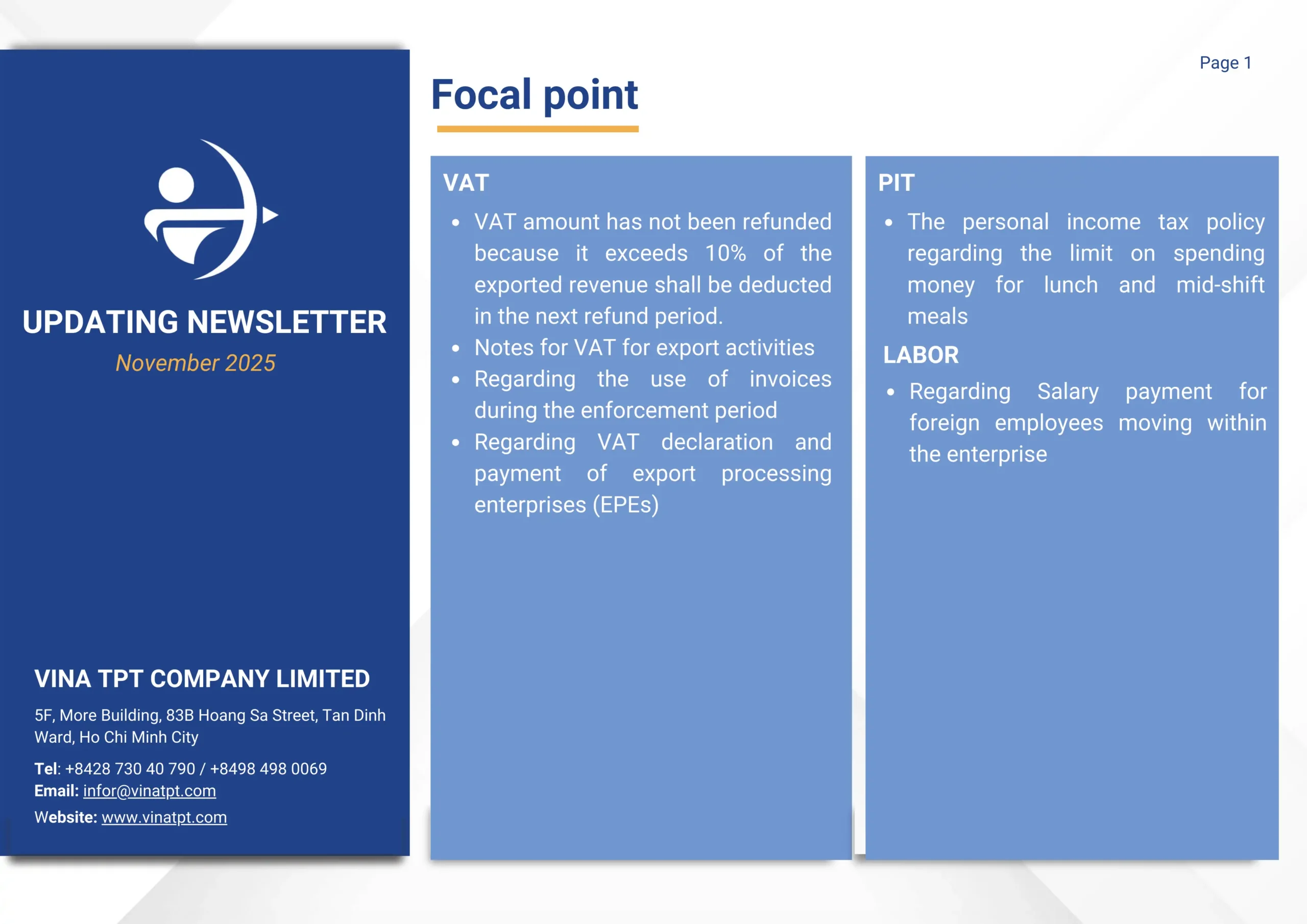
The November 2025 newsletter highlights key Vietnam tax policy updates that businesses need to closely monitor. The focus is on important VAT regulations related to export activities, VAT refund mechanisms, invoice usage during enforcement periods, and compliance requirements for export processing enterprises (EPEs). In addition, the update addresses notable Personal Income Tax (PIT) changes, particularly policies on employee meal allowances, as well as labor regulations governing salary payments for foreign employees transferring within an enterprise. These developments have significant implications for business compliance, operations, and tax planning in Vietnam.

1. VALUE ADDED TAX (VAT)

1.1. VAT amount has not been refunded because it exceeds 10% of the exported revenue shall be deducted in the next refund period.

Official dispatch No. 5094/CT-CS dated November 11, 2025 of the Tax Department on Notes on VAT refund policy for exported goods
Regulations related to VAT refunds for exported goods and services were previously stated in Article 2 of Circular 25/2018/TT-BTC (amending and supplementing Clause 4, Article 18 of Circular 219/2013/TT-BTC) and are now applied according to the provisions of Clause 1, Article 15 of VAT Law No. 48/2024/QH15, Clause 2, Article 29 of Decree 181/2025/ND-CP and Appendix II of Circular No. 69/2025/TT-BTC.
According to Vietnam tax policy updates, in case a business establishment exports goods and services in a month or quarter, if the input VAT amount that has not been fully deducted is 300 million VND or more, it will be entitled to a VAT refund on a monthly or quarterly basis. However, the maximum refunded input VAT amount of exported goods and services must not exceed 10% of the revenue of exported goods and services in the tax refund period.
For the input VAT amount of exported goods and services that has not been refunded because it exceeds 10% of the revenue of exported goods and services of the previous tax refund period, the enterprise is allowed to deduct it in the next tax period to determine the VAT amount to be refunded for exported goods and services of the next tax refund period.
1.2. Notes for VAT for export activities:

Official dispatch No. 5489/CT-CS dated November 25, 2025 of the Tax Department on value added tax policy.

According to the Tax Department’s note, the principle of input VAT deduction for goods and services used for production and trading of goods and services subject to VAT is to be fully deducted (Article 14 of the Law on VAT No. 48/2024/QH15, Clause 1, Article 23 of Decree No.181/2025/ND-CP, Clause 4, Article 24 of Decree No. 181/2025/ND-CP).

In case an enterprise has both export and domestic consumption activities, it is necessary to separately account for input VAT for export activities (Clause 1, Article 15 of VAT Law No.48/2024/QH15, Clause 2, Article 29 of Decree No. 181/2025/ND-CP). If it is not possible to account separately, the input VAT for exported goods will be determined according to the ratio of export revenue to total taxable revenue (Appendix II of Circular No. 69/2025/TT-BTC).

1.3. Regarding the use of invoices during the enforcement period

According to Official dispatch No. 5282/CT-CS dated November 18, 2025 of the Tax Department on the conditions for allowing invoice issuance during the period of enforcement, Tax Department has based on the provisions of Article 4, Article 13 of Decree 123/2020/ND-CP (amended in Clause 3, Clause 10, Article 1 of Decree 70/2025/ND-CP) and Article 34 of Decree 126/2020/ND-CP to respond as follows:

  • Under the latest Vietnam tax policy updates, in cases where an enterprise is subject to compulsory measures to stop using invoices but submits a written request to continue invoice usage and falls under situations where the tax authority issues invoices on a per-occurrence basis, the enterprise will be issued electronic invoices with codes from the tax authority for each occurrence. The enterprise bears full responsibility for the accuracy of all information stated on these electronic invoices. The issuance and declaration of related tax obligations for invoices issued per occurrence by the tax authority must be carried out in accordance with Clause 10, Article 1 of Decree No. 70/2025/ND-CP.
  • In case an enterprise is being forced to stop using invoices and has a written request to use invoices to have a source of payment for workers’ salaries and expenses to ensure continuous production and business, the tax authority will continue to allow the enterprise to use invoices each time they arise, on the condition that the enterprise must immediately pay at least 18% of the revenue on the used invoices to the state budget according to the provisions of Point d, Clause 4, Article 34 of Decree No. 126/2020/ND-CP mentioned above.

1.4. Regarding VAT declaration and payment of export processing enterprises (EPEs)

Official dispatch No. 3905/HYE-QLDN3 dated October 31, 2025 of Hung Yen Provincial Tax Department has provided the instructions regarding VAT declaration and payment of export processing enterprises (EPEs) as below:

  1. VAT payers:
  • The enterprise is not a VAT payer for production activities for export (export processing activities) and is not required to declare VAT for this activity.
  • Export processing enterprises must pay VAT if they carry out business activities other than export processing activities, for example:

-Purchase domestic goods for export (exercise export rights).

-Import goods for domestic sale (exercise import rights).

  1. Conditions for declaring and paying VAT (for business activities other than manufacturing activities):
  • Separate accounting: Export processing enterprises must separately account for transactions of buying and selling goods that are not part of export processing activities (for example, import-export activities).
  • Tax registration: The enterprise needs to register for tax with the domestic tax authority to declare and pay VAT separately for these other business activities.
  • Arrangement of separate areas: The arrangement of the storage area for goods serving processing activities must ensure separation from the storage area for goods serving other production and business activities.
  1. VAT declaration period:
  • Monthly declaration: According to the provisions of Point a, Clause 1, Article 8 of Decree No. 126/2020/ND-CP, the enterprise shall declare VAT monthly.
  • Quarterly declaration: If the enterprise meets the criteria specified in Point a, Clause 1, Article 9 of Decree No.126/2020/ND-CP (total revenue from sales of goods and provision of services of the previous year is 50 billion VND or less), the enterprise can choose to declare VAT quarterly.
  1. Using invoices:
  • If the enterprise declares VAT using the deduction method, use VAT invoices.
  • If the enterprise declares VAT using the direct method, use sales invoices.
  • When selling goods and providing services domestically and when selling goods and providing services between organizations and individuals in duty-free zones, exporting goods and providing services abroad, the invoice must clearly state “For organizations and individuals in duty-free zones”.

In short, under the latest Vietnam tax policy updates, export processing enterprises are only required to declare and pay VAT for business activities other than export processing activities (production of export goods). These enterprises must separately account for such activities and register for tax to declare and pay VAT in accordance with regulations. The VAT declaration period may be monthly or quarterly, depending on the revenue of the previous year.

Vietnam-Tax-Policy-Updates-November-2025-VAT-PIT-and-Labor-Vina-TPT

2. PERSONAL INCOME TAX (PIT)

2.1. The Personal income tax policy regarding the limit on spending money for lunch and mid-shift meals

As part of the Vietnam tax policy updates, Official Dispatch No. 5106/CT-CS dated November 12, 2025, issued by the Tax Department, provides guidance on personal income tax policy regarding the limits on lunch and mid-shift meal expenses used as a basis for determining personal income tax. In this dispatch, the Tax Department cites the following regulations and instructions for reference:

  • Article 103 of the Labor Code No. 45/2019/QH14 stipulates that “The regime of salary increase, promotion, allowances, subsidies and incentives for employees is agreed upon in the labor contract, collective labor agreement or regulations of the employer”.
  • Clause 1, Article 33, Clause 9, Article 34 of Decree No. 44/2025/ND-CP on salary and bonus regimes in state-owned enterprises stipulates: “This Decree takes effect from April 15, 2025 and the regimes in this Decree are implemented from January 1, 2025”. “The mid-shift meal regime or fixed-quantity meal regime for employees, Executive Board, Board Members, and Supervisors is implemented according to the agreement in the collective labor agreement or the internal rules and regulations of the enterprise according to the provisions of the Labor Code”.
  • Article 10 of Decree No. 248/2025/ND-CP on salary and bonus regimes in state-owned enterprises stipulates: “This Decree takes effect from September 15, 2025 and the regimes in this Decree are implemented from August 1, 2025. Decree No. 44/2025/ND-CP is abolished”.
  • Section g.5, Clause 2, Article 2 of Circular No. 111/2013/TT-BTC stipulates: “In case the employer does not organize mid-shift meals or lunch but pays for the employee, it is not included in the taxable income of the individual if the level of expenditure is in accordance with the guidance of the Ministry of Labor – Invalids and Social Affairs. In case the level of expenditure is higher than the guidance of the Ministry of Labor – Invalids and Social Affairs, the excess expenditure must be included in the taxable income of the individual. The specific expenditure level applicable to state-owned enterprises… shall not exceed the guidance of the Ministry of Labor – Invalids and Social Affairs. For non-state-owned enterprises… the expenditure level shall be decided by the head of the unit in agreement with the chairman of the trade union but shall not exceed the level applicable to state-owned enterprises”.
  • In Vietnam tax policy updates: Official Dispatch No. 1387/CTL&BHXH-TLSXKD dated September 29, 2025 of the Ministry of Home Affairs, it is instructed: “According to the provisions of Article 103 of the Labor Code, incentive regimes for employees are agreed upon in the labor contract, collective labor agreement or regulations of the employer. The mid shift meal regime for employees, Executive Board, Council members, and Controllers in state-owned enterprises from January 1, 2025 to July 31, 2025 is implemented according to the provisions of Clause 9, Article 34 of Decree No. 44/2025/ND-CP on salary and bonus regimes in state-owned enterprises; from August 1, 2025, it is implemented according to the provisions of the Labor Code”.

According to Vietnam tax policy updates, the current allowance of VND 730,000 per month for mid-shift meals has been abolished. Instead, enterprises may determine a reasonable allowance level based on the agreements in the collective labor agreement or in the company’s internal rules and regulations. In the case where the Company incurs expenses for mid-shift meals for employees working at the company, if this allowance is specifically stipulated regarding eligibility conditions and allowance levels in the labor contract, the collective labor agreement, or the company’s internal rules and regulations, it shall not be included in taxable personal income (PIT). If the allowance exceeds the stipulated level, the excess amount will be included in taxable PIT income.

Vietnam-Tax-Policy-Updates-November-2025-VAT-PIT-and-Labor-Vina-TPT

3. LABOR 

3.1. Regarding Salary payment for foreign employees moving within the enterprise

Official dispatch No. 10861/BNV-CVL dated November 19, 2025 of the Ministry of Home Affairs on domestic salary payment for foreign employees moving within the enterprise.

The Ministry of Home Affairs notes that, in the case of “foreign workers being paid (in Vietnam)”, before the expected working date, the enterprise employing the foreign worker must request a work permit and sign a labor contract as prescribed (Clause 1, Article 13, Point d, Clause 1, Article 21 of the Labor Code No. 45/2019/QH14 and Point a, Clause 1, Article 2, Clause 4, Article 22 of Decree 219/2025/ND-CP), and must also participate in compulsory social insurance in Vietnam for this person as prescribed (Point a, Clause 2, Article 2 of the Law on Social Insurance No. 41/2024/QH15).

The case of “foreign employees being paid in Vietnam” (performing procedures to request a work permit) and the case of “foreign employees transferring within the enterprise” (performing procedures to request a certificate of not being subject to a work permit under Article 8 of Decree 219/2025/ND-CP) are two different cases according to the provisions of the Labor Code No. 45/2019/QH14 and guiding documents on foreign employees working in Vietnam.

BOOK A FREE CONSULTATION

Vina TPT Accounting services


Best Bookkeeping Services for Startups in Vietnam

Best-Bookeeping-Services-for-Startups-in-Vietnam-Vina-TPT

Best-Bookeeping-Services-for-Startups-in-Vietnam-Vina-TPT

1. Common Accounting Challenges Faced by Startups

Bookkeeping services are essential because startups in Vietnam often face many difficulties in accounting and financial management. First is the limited human resources, as many new businesses only have a few employees or do not have a dedicated accounting department.

Second is the high cost of hiring full-time staff or hiring an unsuitable accounting service company. Startups often have to consider limited budgets, while maintaining an internal team is expensive in terms of salary, benefits and training.

Finally, many startups lack experience in financial management and tax compliance. Errors in VAT, CIT, PIT declarations or social insurance payments can lead to legal risks, tax arrears or administrative fines. This is why many startups choose outsourced accounting services to ensure accurate financial operations and compliance with Vietnamese law.

SOLVE YOUR ACCOUNTING CHALLENGES

2. Core Accounting Services for Startups

Startups need essential accounting services to operate effectively and remain compliant with the law. Key services include:

Bookkeeping:

    • Record all transactions, invoices, and documents according to Vietnamese accounting standards. Classify and organize financial data, making it easy to track cash flow.

Monthly & Year-End Reporting:

    • Prepare monthly/quarterly financial reports to evaluate business performance. 
    • Prepare year-end reports to meet audit and tax requirements.

Tax Compliance:

Businesses must ensure full and timely compliance with Vietnam’s tax regulations, including Value Added Tax (VAT), Corporate Income Tax (CIT), Personal Income Tax (PIT), and Foreign Contractor Tax (FCT). Key responsibilities include:

  • Preparing accurate tax reports in accordance with current tax laws.
  • Submitting monthly, quarterly, and annual tax declarations to avoid penalties or late-filing fines.
  • Maintaining clear, consistent accounting records to support all reported figures.
  • Providing explanations and supporting documentation to tax authorities when required, including clarifying discrepancies or responding to official notices.
  • Handling tax audits and inspections professionally to ensure consistency between records and declarations.

Ensuring compliance with all tax obligations not only minimizes legal risks but also builds long-term credibility with regulatory authorities.

Payroll & Insurance Management:

This service ensures accurate and compliant management of employee compensation and social insurance obligations. Key responsibilities include:

  • Preparing payroll and calculating Personal Income Tax (PIT) for all employees.
  • Paying social insurance, health insurance, and unemployment insurance contributions in accordance with Vietnamese law.
  • Registering new employees for social insurance and processing all related insurance documents. 
  • Submitting labor reports and mandatory filings to relevant authorities as required by labor regulations.
  • Ensuring compliance with labor laws and personal income tax obligations for all employees.

Effective payroll and insurance management helps businesses minimize legal risks, maintain employee satisfaction, and ensure smooth operations in accordance with Vietnamese regulations.

Financial Consulting:

  • Cash flow analysis, cost optimization and budget planning.
  • Support startups to make accurate and timely financial decisions.

These services help startups operate transparently financially, save time and focus on product and market development instead of struggling with complicated accounting.

Best-Bookeeping-Services-for-Startups-in-Vietnam-Vina-TPT

4. How Outsourced Bookkeeping Ensures Accuracy

Vina TPT’s outsourced accounting service helps startups standardize all books and financial reports in accordance with Vietnamese accounting standards. All transactions, invoices and documents are systematically recorded, classified and checked, helping to ensure that all financial data is accurate and transparent. This process not only minimizes human errors but also creates clear and complete records, serving monthly, quarterly and year-end reporting. Thanks to that, startups can grasp cash flow, manage costs and evaluate business performance in a timely manner, thereby making more accurate financial decisions.

Moreover, Vina TPT also ensures full compliance with legal regulations on tax and financial reporting. Each report is cross-checked, compared with original documents and accurately calculates taxes payable, limiting the risk of being overcharged or administratively fined. In addition, the service also provides transparent, easy-to-read reports, helping investors, banks or partners clearly understand the financial situation of startups. Thanks to that, businesses not only feel secure about accuracy but also save operating time, focus on product and market development, and build credibility with business partners.

5. Why Vina TPT Is the Go-To Accounting Firm for Startups

Vina TPT Accounting Service is an ideal partner for startups in Vietnam thanks to:

  • Comprehensive services: bookkeeping, monthly/quarterly/annual reports, tax declarations, payroll management, financial consulting.
  • High expertise for startups: understanding the specifics of limited budgets, simple but legal processes.
  • Transparent processes: clear reports, easy to check and manage cash flow.
  • Reduced operational load: startups do not have to worry about accounting staff or legal errors, focus on business development.
  • Language advantage : services are available in both Vietnamese, English & Japanese, facilitating communication for foreign founders and easing compliance with local regulations.

Vina TPT helps startups operate finances effectively, comply with the law and develop sustainably.

BOOK A FREE CONSULTATION

bookkeeping-services


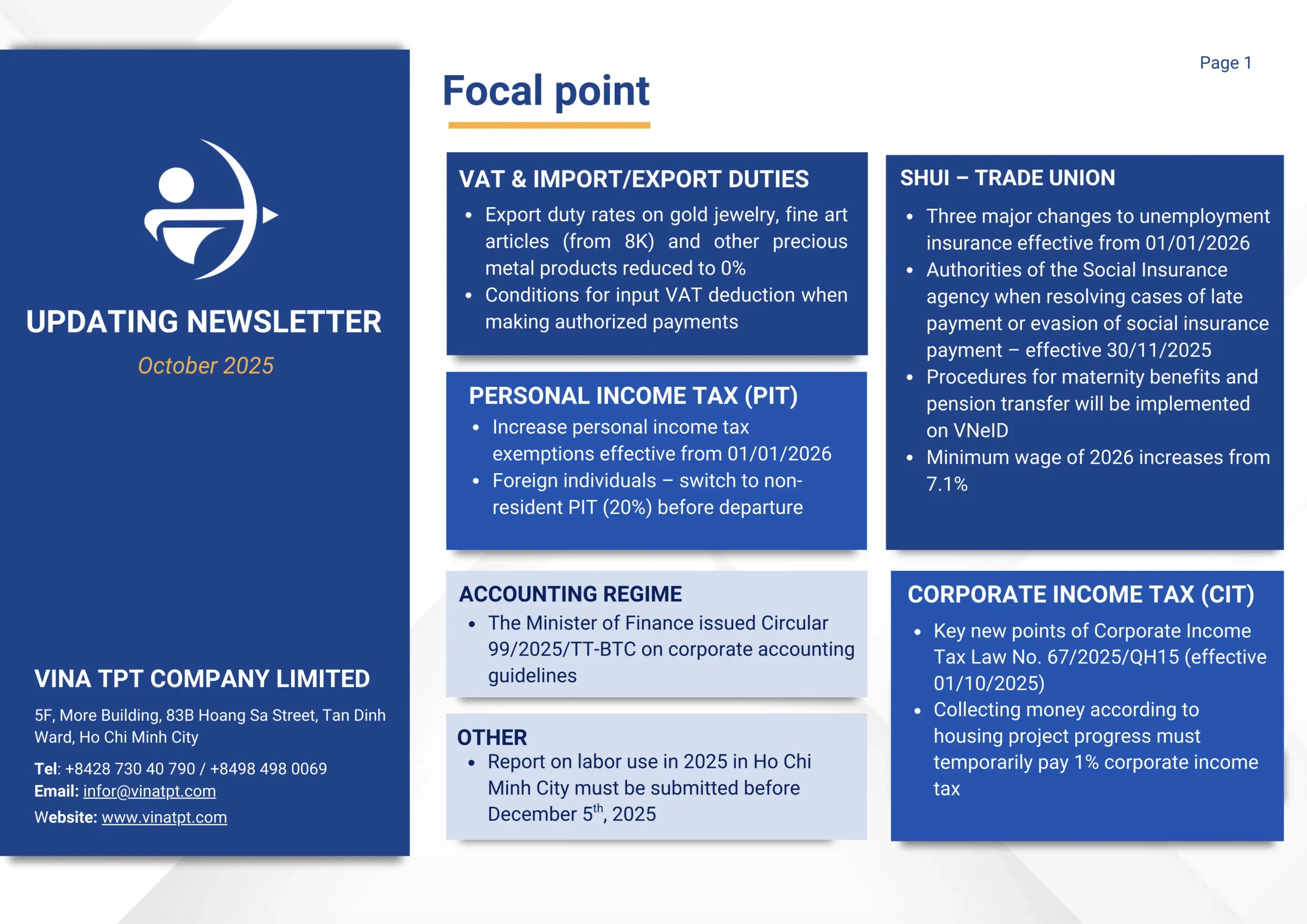
[Newsletter] Vietnam Tax Policy Updates October 2025- CIT, VAT, PIT and Social Insurance

October-2025-Newsletter-CIT-VAT-PIT-and-Social-Insurance-Vina-TPT

Newsletter-October-2025-Vina-TPT

Vietnam is implementing a series of new tax, accounting, insurance, and labour regulations effective from October 2025. Notable updates include reduced export duty rates, clarified rules for input VAT deduction, higher PIT family circumstance deductions, a shift to non-resident taxation for certain foreign individuals, new CIT rates and deductible expense rules, and stricter sanctions on late or unpaid insurance contributions. These updates will reshape compliance requirements and influence core business operations, particularly in finance, payroll, and reporting functions.

This article outlines the essential policy changes businesses need to prepare for to ensure smooth compliance and operational continuity.

1. VAT & IMPORT/EXPORT DUTIES 

1.a. Export duty on gold jewellery, fine art articles (from 8K) and other precious metal products reduced to 0%  

Decree No. 260/2025/NĐ-CP dated 10/10/2025 of the Government amends the export duty rates for certain commodity lines under groups 71.13, 71.14 and 71.15 in the Export Tariff Schedule issued together with Decree No. 26/2023/NĐ-CP dated 31/05/2023. 

The Decree reduces the export duty rate from 1% to 0% for the following items: 

  • Jewellery and parts thereof, of other precious metal, whether or not plated or clad with precious metal (HS codes 7113.19.10 and 7113.19.90); 
  • Articles of goldsmiths’ or silversmiths’ wares and parts thereof, of other precious metal, whether or not plated or clad with precious metal (HS code 7114.19.00); 
  • Other articles of gold or silver (HS code 7115.90.10). 

Products that are currently subject to the 0% export duty rate will continue to enjoy the existing 0% rate. 

1.b. Input VAT deduction when payment is made via third-party authorisation  

Official Letter No. 4850/DON-QLDN1 dated 15/10/2025 of Đồng Nai Provincial Tax Department provides guidance on the deduction of input VAT in cases where non-cash payment is made through authorisation to a third party. 

According to the regulations, for the enterprise to be eligible for input VAT deduction, it must fully satisfy the general conditions prescribed in Clause 2, Article 14 of Law No. 48/2024/QH15: 

  • Possession of a VAT invoice for the purchase of goods and services or VAT payment document. 
  • Availability of non-cash payment evidence. 
  • For exported goods and services, additional documents are required: contract, invoice, non-cash payment evidence, customs declaration, and other related documents. 

In addition, when making payment through authorisation to a third party, the enterprise must comply with the further conditions stipulated in Decree No. 181/2025/NĐ-CP: 

  • The authorisation for payment to the third party must be specifically stipulated in a written contract. 
  • The third party must be an organisation or individual lawfully operating. 

If the company fully satisfies all the above conditions and other relevant legal provisions, it will be entitled to deduct the input VAT. 

2. PERSONAL INCOME TAX (PIT)

2.a. Increase in family circumstance deductions effective from 01/01/2026  

On 17 October 2025, the Standing Committee of the National Assembly issued Resolution No. 110/2025/UBTVQH15 adjusting the family circumstance deductions for personal income tax. This Resolution takes effect from 01 January 2026 and applies to the 2026 tax period. 

  • The deduction for the taxpayer himself/herself is increased from VND 11 million to VND 15.5 million per month (VND 186 million per year) (Article 1, point a). This means the taxpayer may deduct this amount when calculating taxable income, thereby reducing the tax payable. 
  • The deduction for each dependant is increased from VND 4.4 million to VND 6.2 million per month (Article 1, point b). Accordingly, taxpayers with dependants will enjoy an additional deduction corresponding to the number of dependants, further easing the tax burden. 

2.b. Foreign individuals – switch to non-resident PIT (20%) before departure  

On 03 October 2025, the Tax Department issued Official Letter No. 4221/CT-CS providing guidance on PIT for foreign individuals working in Vietnam for less than 183 days and required to finalise their tax obligations before leaving the country. Specifically, where a foreign individual has previously been subject to resident PIT withholding and has self-declared PIT on overseas-paid income arising from work performed in Vietnam, but the actual number of days present in Vietnam is less than 183 days, such individual must re-determine their PIT obligations under the non-resident regime. 

  • PIT is calculated at 20% on total Vietnam-sourced income, irrespective of where the income is paid or received. 
  • Tax finalisation must be completed prior to departure from Vietnam.

3. CORPORATE INCOME TAX (CIT) 

3.a. Key new points of Corporate Income Tax Law No. 67/2025/QH15 (effective 01/10/2025)  

Official Letter No. 2244/QNG-NVDTPC dated 13 October 2025 of Quảng Ngãi Provincial Tax Department introduces the key new points of the Corporate Income Tax Law No. 67/2025/QH15 (effective from 01 October 2025). The main changes are as follows: 

  1. Expanded scope of taxpayers:  

Addition of foreign enterprises that do not have a permanent establishment in Vietnam (including those engaged in e-commerce and digital platforms). 

      2. Taxable income:  

Additional provision stipulating that taxable income arising in Vietnam for foreign enterprises is income derived from Vietnam, regardless of where the business activities are conducted. 

      3.New CIT rates based on revenue: 

  • Standard rate: 20% 
  • Enterprises with total annual revenue not exceeding VND 3 billion: 15% 
  • Enterprises with total annual revenue exceeding VND 3 billion but not exceeding VND 50 billion: 17% 
  • Oil and gas exploration and production activities: 25% – 50% depending on the project. 

      4.Determination of taxable income: 

  • Taxable income from business activities is the total income from all business activities. 
  • Loss carry-forward is allowed between activities, except for real estate transfer activities, investment projects, and participation rights in investment projects when the entity is enjoying tax incentives. 
  • Income from the transfer of mineral exploration, extraction, and processing projects must be accounted for separately and may not be offset against other activities. 

       5.Tax exemption and reduction: 

  • Public-service entities providing public services in socio-economically disadvantaged areas are entitled to a 50% reduction of CIT payable. 
  • Enterprises converted from household businesses are exempt from CIT for two consecutive years from the year taxable income first arises. 

       6.Science and technology development fund:  

Maximum contribution rate increased to 20%. 

       7.New tax calculation method:  

Application of CIT as a percentage of revenue for enterprises with annual revenue ≤ VND 3 billion when revenue can be determined but costs and income cannot be determined. 

      8.Additional deductible expenses: 

  • Expenses related to seconded personnel participating in management, administration, and control at credit institutions under special control or commercial banks subject to mandatory transfer. 
  • Certain expenses incurred for business and production purposes but not yet generating corresponding revenue in the period, as stipulated by the Government. 
  • Expenses for supporting the construction of public infrastructure that simultaneously serves business and production activities. 
  • Expenses related to greenhouse gas emission reduction, carbon neutrality, net-zero initiatives, and environmental pollution reduction linked to business and production activities. 
  • Certain contributions to funds established by decision of the Prime Minister or the Government.


3.b. Temporary CIT payment of 1% on progress payments received for housing projects  

Official Letter No. 5129/CT-CS dated 12 November 2025 of the Tax Department on tax policies: 

  • For housing investment projects intended for transfer/sale: If the investor collects advance payments according to progress, it must make provisional quarterly Corporate Income Tax (CIT) payments equal to 1% of the amounts collected, pursuant to Point b, Clause 6, Article 8 of Decree No. 126/2020/NĐ-CP. 
  • Regarding interest expense for enterprises with related-party transactions: Deductible interest expense is subject to the cap under Clause 3, Article 16 of Decree No. 132/2020/NĐ-CP and applies to all enterprises with related-party transactions, irrespective of whether they are domestic or foreign-invested enterprises. 


4. SOCIAL, HEALTH & UNEMPLOYMENT INSURANCE – TRADE UNION 

4.a. Three major changes to unemployment insurance effective from 01/01/2026 (Law on Employment 2025) 

On 16 June 2025, the National Assembly passed the Law on Employment 2025, which officially takes effect from 01 January 2026. Accordingly, unemployment insurance policies will undergo significant changes, with the following three key updates to unemployment insurance effective from 01/01/2026: 

(1) No entitlement to unemployment benefits upon eligibility for pension 

From 01/01/2026, under point a, clause 1, Article 39 of the Law on Employment 2025, employees who terminate employment or end their labour contract upon reaching eligibility for pension benefits will not be entitled to unemployment benefits. Thus, effective from 01/01/2026, unemployment benefits will not be payable to individuals who meet pension eligibility criteria, regardless of whether pension procedures have been initiated. 

(2) Faster receipt of unemployment benefits with reduced waiting period to 10 days 

From 2025, pursuant to clause 3, Article 39 of the Law on Employment 2025, the commencement date for unemployment benefits effective from 01/01/2026 will be the 11th working day following the submission of a complete application dossier for unemployment benefits. This represents a reduction of 5 days from the current regulation, under which benefits commence from the 16th day after dossier submission. 

(3) Maximum level of unemployment benefits 

Pursuant to clause 1, Article 39 of the Law on Employment 2025, the maximum monthly unemployment benefit for all employees shall not exceed 5 times the regional minimum wage at the time of contract termination. 

4.b. Penalties for late or evaded compulsory social/health/unemployment insurance contributions – effective 30/11/2025  

On 16 October 2025, the Government issued Decree No. 274/2025/NĐ-CP detailing certain provisions of the Social Insurance Law regarding late payment, evasion of compulsory social insurance and unemployment insurance contributions; complaints and denunciations related to social insurance. This Decree takes effect from 30 November 2025. 

  • Late payment interest rate: 0.03% per day calculated on the amount and number of days of late or evaded payment (Article 3, Clause 1, Point d; Article 7, Clause 2). 
  • Conversion period to evasion: An act of late payment shall be converted to an act of evasion after 60 days from the expiry of the latest payment deadline, provided that the Social Insurance Agency has issued a written reminder (Article 6, Clause 1, Point c). 
  • Evasion by understating salary: The act of registering a salary base for social insurance contributions lower than prescribed under the Social Insurance Law shall be deemed evasion (Article 6, Clause 1, Point b). 
  • Exemption from evasion classification (force majeure): Specific enumeration of 4 force majeure cases not to be considered as evasion (such as storms, floods, dangerous epidemics, emergency situations) as announced by competent authorities (Article 4).


5. ACCOUNTING REGIME 

5.a. Circular 99/2025/TT-BTC guiding the accounting regime for enterprises  

On 27 October 2025, the Ministry of Finance issued Circular No. 99/2025/TT-BTC regulating the accounting regime for enterprises, replacing Circular No. 200/2014/TT-BTC dated 22 December 2014. Circular No. 99/2025/TT-BTC takes effect from 01 January 2026 and applies to financial years beginning on or after 01 January 2026. Pursuant to the regulations, Circular No. 99/2025/TT-BTC simultaneously repeals and replaces the following documents: 

  • Circular No. 200/2014/TT-BTC guiding the accounting regime for enterprises; 
  • Circular No. 75/2015/TT-BTC (amending Article 128 of Circular 200); 
  • Circular No. 53/2016/TT-BTC (amending and supplementing certain provisions of Circular 200); 
  • Circular No. 195/2012/TT-BTC dated 15 November 2012 guiding accounting for main investors. 

However, certain provisions related to the accounting for the equitisation of State-owned enterprises under Circular 200 shall continue to apply until the Ministry of Finance issues a new replacement document. 

Below are some key differences between Circular No. 99/2025/TT-BTC and Circular No. 200/2014/TT-BTC regarding the accounting regime for enterprises: 

Method of converting financial statements prepared in foreign currency to Vietnamese Dong: 

  • Assets and liabilities shall be converted to Vietnamese Dong at the average transfer buying/selling exchange rate of the commercial bank where the enterprise regularly conducts transactions as at the end of the accounting period; 
  • Owner’s equity (owner’s contributed capital, capital surplus, other capital, convertible bond options) shall be converted to Vietnamese Dong at the actual transaction exchange rate on the date of capital contribution; 
  • Revaluation differences of assets shall be converted to Vietnamese Dong at the actual transaction exchange rate on the revaluation date; ….. 

Chart of accounts: Reduced to 71 level-1 accounts, abolishing 6 accounts, including 4 accounts related to non-business funding sources, capital construction investments, and 2 accounts (611 and 631). 

Addition of accounts: Renaming of accounts and addition of new accounts (e.g., Account 215 – Biological assets, etc.). Abolition of certain accounts: 621 – Purchase costs, 631 – Production costs, etc. 

Accounting forms and financial statement templates: Enterprises may also design additional or amend and supplement accounting forms and financial statement templates compared to those guided under this Circular to suit the characteristics of production and business activities and management requirements. Renaming of the “Balance Sheet” template to “Statement of Financial Position”. 


6. OTHER 

6.a. 2025 Labour Utilisation Report for Ho Chi Minh City – Must be submitted before 05 December 2025 

Official Letter No. 9002/SNV-VLATLĐ dated 13 November 2025 of the Ho Chi Minh City Department of Home Affairs on the implementation of Article 4 of Decree No. 145/2020/NĐ-CP regarding labour utilisation reporting. 

The Ho Chi Minh City Department of Home Affairs provides the following guidance on the submission of the 2025 labour utilisation report by establishments within the territory of Ho Chi Minh City: 

  1. Entities required to submit the report: 
  • Agencies, organisations, enterprises, cooperatives, households, and individuals that hire, employ, or utilise labour. 
  • Those with headquarters or places of operation within the territory of Ho Chi Minh City. 

      2. Content of the report: 

  • To be completed in accordance with Form No. 01/PLI in Appendix I issued together with Decree No. 145/2020/NĐ-CP. 

      3. Method of submission (select one of the two options): 

  • Submission via the National Public Service Portal: Perform the “Integrated procedure for registering adjustments to compulsory social insurance, health insurance, unemployment insurance contributions and labour utilisation reporting”: https://dichvucong.gov.vn/. 

      4. Submission deadline: To be completed before 05 December 2025. 

      5. Important notes: 

  • After the prescribed deadline, the Department of Home Affairs will not accept any reports. 
  • The Department of Home Affairs will compile the implementation status as a basis for confirming compliance with legal regulations upon request from relevant agencies. 
  • Failure to submit the report on time may result in administrative violations under Clause 2, Article 8 of Decree No. 12/2022/NĐ-CP. 


CONTACT US FOR SUPPORT

Expert-Vietnam-VinaTPT

Ensuring Payroll Compliance for Chinese Restaurant Chains in Vietnam

Ensuring Payroll Compliance for Chinese Restaurant Chains in Vietnam-VTPT

payroll-services

1. Payroll Compliance: The Hidden Challenge in Chinese F&B Expansion

In recent years, a series of well-known Chinese F&B brands  such as Haidilao, Mixue, Heytea, and Luckin Coffee have rapidly expanded their restaurant chains across Vietnam. The country’s young population, strong consumer demand, and appetite for new dining experiences have made Vietnam one of the most attractive markets in Southeast Asia.

However, this fast-paced expansion also brings a less visible but serious challenge: payroll compliance. Many Chinese franchises face difficulties in managing payroll due to the large number of part-time and shift-based employees, frequent staff turnover, and the involvement of foreign managers who are unfamiliar with Vietnamese labor and tax regulations. As a result, even successful brands risk payroll miscalculations, delayed payments, or non-compliance penalties if they lack localized HR and payroll systems.

Many businesses are at risk because they do not fully understand the regulations on salary payment, social insurance, personal income tax (PIT) and labor contracts. Small errors in the payroll calculation process can lead to big consequences: administrative fines, damage to brand reputation, or even suspension of business licenses.

2. Payroll Management in the F&B Industry: What Makes It Complex

Unlike the manufacturing or office sector, the F&B industry operates with shift-based schedules, part-time employees, and a high turnover rate. Manual timekeeping or payroll calculated by hours or daily revenue often leads to data inconsistencies and payment errors.

In addition, social insurance and personal income tax (PIT) management are much more complex in this sector. Restaurants must frequently update employee records, process insurance contributions for both full-time and part-time staff, and ensure accurate PIT declarations.

When foreign employees or managers are involved, payroll compliance becomes even more complex, that requiring accurate handling of work permits, foreign income tax, and insurance policies aligned with Vietnamese regulations.

As the business expands from one store to ten or twenty branches, the volume of payroll and HR data multiplies significantly. In such cases, outsourced payroll processing services become the optimal choice, helping F&B chains automate payroll calculations, minimize manual errors, and ensure that all tax and insurance obligations are completed accurately and on time.

With Vina TPT’s payroll processing services, all these tasks from payroll calculation to social insurance management and PIT filing, are handled in an integrated, compliant, and transparent process, allowing F&B businesses to focus on operations rather than administrative burdens.

BOOK A FREE PAYROLL CONSULTATION

3. Key Compliance Requirements for F&B Businesses in Vietnam

Operating a food & beverage franchise in Vietnam involves navigating a complex framework of local labor laws and tax regulations. To ensure compliance, Chinese F&B chains must pay close attention to several core areas:

  • Employment contracts:

Every staff member, including part-time and probationary workers must have a legally valid labor contract that clearly defines salary structure, working hours, and overtime policies. Failure to issue proper contracts can result in penalties or disputes with labor authorities.

  • Social insurance (SI), health insurance (HI), and unemployment insurance (UI):

Vietnamese law requires employers to contribute to all three funds, based on each employee’s monthly income. Missing or under-reporting contributions can lead to back payments and administrative fines.

  • Personal income tax (PIT):

PIT must be calculated and reported monthly or quarterly, depending on the business size. For F&B franchises with multiple branches, this process becomes even more complex, especially when handling part-time employees with fluctuating income.

  • Overtime and minimum wage compliance:

Restaurants and beverage chains often rely on shift-based operations, so adhering to Vietnam’s overtime limits and regional minimum wage levels is crucial. Incorrect application of wage rates or unpaid overtime can trigger employee complaints and damage brand reputation.

  • Data management and reporting:

Accurate timekeeping, record-keeping, and digital reporting are required for labor audits. Many F&B chains still use manual or paper-based systems, which increases the risk of miscalculation and compliance violations.

4. How Payroll  Solves These Compliance Issues

Outsourcing payroll to a professional service provider offers F&B franchises a reliable and cost-efficient solution to handle these complexities.

Instead of maintaining an internal HR and accounting team, Chinese franchises can delegate payroll management to specialized experts who ensure accurate, on-time, and legally compliant processing. This includes everything from automated payroll calculation by shift to real-time integration with timekeeping systems.

payroll-services

Key advantages of payroll processing services:

  • Automation reduces human error: Manual calculation of working hours, tips, and overtime can easily lead to mistakes. Automated systems minimize these risks while maintaining consistency across multiple outlets.
  • Compliance assurance: Payroll service providers stay updated with Vietnam’s labor laws, tax regulations, and insurance policies ensuring your franchise avoids costly penalties.
  • Tax filing and reporting made easy: Outsourced services handle PIT declarations, Social Insurance/ Health Insurance/ Union contributions, and e-invoices on behalf of your business, freeing up internal resources.
  • Scalability for franchise growth: Whether operating one restaurant or ten, outsourced payroll systems can quickly scale to support expansion without disrupting operations.
  • Cost savings: Compared to hiring full-time accountants and HR staff, outsourcing can reduce administrative expenses by up to 30%, as reported by F&B clients who switched to external payroll management.
  • Transparency and bilingual reporting: With bilingual payslips and compliance reports (English, Vietnamese, Chinese), both local managers and overseas investors can clearly track salary data and performance metrics.

payroll-services

5. Payroll Compliance as Part of Franchise Reputation

In the service industry, paying salaries correctly, adequately and transparently is not only a legal obligation but also an important touchpoint of the brand. A professional payroll system helps businesses retain employees, reduce turnover and improve team morale.

At the same time, stable compliance creates trust for investors and franchise partners, that the Chinese brand is operating transparently, professionally and respecting regulations in Vietnam.

6. Why Chinese F&B Brands Choose Vina TPT Payroll Services

Vina TPT is one of the most reputable payroll services providers in Vietnam for restaurant chains, milk tea shops and F&B brands from China.

With a bilingual consulting team in Chinese – English – Vietnamese and many years of experience in the fields of accounting, human resources and law, Vina TPT helps businesses ensure compliance with Vietnamese labor regulations while maintaining flexible operating processes.

Unlike conventional accounting firms, Vina TPT designs a customized payroll processing services according to each chain’s model – from shift organization, hourly salary calculation, to integration with the brand’s existing ERP or POS system.

Thanks to that, businesses can rest assured about accuracy, transparency and synchronous management across the entire chain of stores.

7. Vina TPT Payroll Services

Vina TPT provides a complete payroll processing services, specifically designed for the F&B industry, including:

  • Automating the process of calculating salary by shift and integrating timekeeping data
  • Declaring and paying personal income tax (PIT) monthly/quarterly
  • Managing labor contracts, social insurance and legal compliance according to Vietnamese regulations
  • Issuing electronic payroll (online payslip) and periodic tax reports
  • Storing and securing employee data on a cloud computing platform, easy to access and check at any time.

All services are deployed on a highly secure system, supporting multiple languages ​​and ensuring absolute transparency in each transaction – helping businesses operate effectively, reduce administrative processes and focus on business development.

Talk to our experts at Vina TPT to build a compliant and efficient payroll system for your F&B business in Vietnam.

BOOK A FREE CONSULTATION

HR Manager Vina TPT Payroll services in Vietnam


Smart Payroll Solutions for Part-Time Staff in Japanese Restaurants in Vietnam

Smart Payroll Solutions for Part-Time Staff in Japanese Restaurants in Vietnam-VTPT

smart-payroll-services-for-small-business-vietnam

1. Managing Payroll for Part-Time Staff: The Hidden Challenge in F&B with Payroll Service for Small Business

Japanese restaurant chains in Vietnam often have dozens to hundreds of employees working in shifts, especially part-time employees in service positions, sous chefs or receptionists. The work schedule changes flexibly every week, making timekeeping, payroll and tax management much more complicated than in conventional business models.

Many Japanese restaurant owners still use Excel spreadsheets or manual records to calculate salaries, making the process both time-consuming and error-prone – especially when adding in items such as evening shift allowances, tips, productivity bonuses, or personal income tax (PIT) deductions based on working hours. This not only increases pressure on the accounting department but also poses risks to compliance with Vietnamese labor laws.

That’s why adopting a payroll service for small business is becoming an essential solution, helping restaurant owners automate payroll processes, reduce errors, and ensure compliance while focusing on improving service quality.

2. The Complexity of Payroll in Restaurant Operations

In the F&B industry, payroll for restaurants is one of the most complex operations due to the highly variable nature of human resources. Each employee can work in many branches, with different working hours and receive hourly, shift or daily wages.

In addition, restaurants also have to handle factors such as:

  • Tips divided by shift or work group;
  • Meal allowances, uniforms, parking;
  • Social insurance, health insurance, unemployment insurance obligations for eligible employees;
  • And especially the declaration and deduction of personal income tax for part-time employees with fluctuating income.

When these factors are processed manually, even a small error in Excel formulas can lead to incorrect payroll, affecting employee trust and violating legal regulations.

GET PROFESSIONAL PAYROLL SUPPORT

3. Why Online Payroll Processing Is the Game Changer

That is why more and more Japanese restaurants are switching to online payroll processing – an automated payroll system that simplifies the entire process. The system allows for shift-based timekeeping, real-time data updates, and automatic calculation of salaries, bonuses, and tax deductions with just a few steps.

For small business owners, using this solution helps:

  • Save up to 70% of payroll processing time
  • Reduce the risk of errors and tax violations
  • Easily track personnel costs by branch or shift
  • And quickly export electronic payroll or bilingual English – Vietnamese reports when needed.

smart-payroll-services-for-small-business-vietnam

Switching to an online payroll system not only helps restaurants modernize their human resource management but also demonstrates a standard operating style in the Japanese spirit – accurate, transparent, and on-time.

4. Vina TPT Payroll Service: Designed for Japanese Restaurants in Vietnam

Understanding the specifics of the F&B industry, Vina TPT Payroll Service has designed a payroll services for small businesses specifically for Japanese restaurant chains in Vietnam. Our solution fully meets the requirements of flexibility, security and bilingualism, making the payroll and human resource management process simpler than ever.

Services include:

  • Automating the payroll process by shift, integrating timekeeping data;
  • Supporting electronic invoices, tax reporting and PIT for part-time employees;
  • Bilingual reports (English – Vietnamese – Japanese) in accordance with corporate standards;
  • Consulting on legal compliance and updating the latest Vietnamese labor regulations.

With an online management system, restaurant owners can track personnel costs in real time, reduce errors and save significant time processing monthly payroll.

5. Simplify Payroll, Focus on Restaurant Quality

Behind Vina TPT’s optimal payroll solutions is a team of experts with in-depth knowledge of Japanese corporate culture and the Vietnamese legal system.

Vina TPT’s accounting, human resources and tax consultants are all well-trained from university level and above, with many years of experience working with Japanese enterprises in the restaurant, hotel and manufacturing sectors. They can communicate fluently in Japanese, understand the management style and internal reporting processes of Japanese investors.

Thanks to that, Japanese restaurant chains can completely focus on their main mission – bringing exquisite culinary experiences and Japanese-standard service to Vietnamese customers.

Contact Vina TPT Payroll Service today for advice on online payroll processing solutions suitable for Japanese restaurant models in Vietnam.

BOOK A FREE CONSULTATION

smart-payroll-services-for-small-business-vietnam

How Korean IoT Startups Streamline Payroll Management in Vietnam

Vina TPT Payroll service streamlining outsource payroll for korean IoT startups

payroll-processing-companies

1. Payroll Challenges Faced by Korean IoT Startups in Vietnam

When Korean startups expand into Vietnam to develop IoT (Internet of Things) products, they often take advantage of the highly skilled and affordable Vietnamese engineering team. However, a major challenge arises right from the beginning: managing payroll and complying with Vietnamese labor regulations – an area where professional payroll processing companies play a crucial role in ensuring accuracy, compliance, and efficiency.

Many startups have to handle complex contracts, including full-time employees, part-time engineers, and freelancers. Calculating salaries, social insurance, personal income tax, and labor declarations are often done manually, leading to errors and legal violations.

That is why more and more Korean businesses choose to outsource payroll to local experts.

2. Why Payroll Outsourcing Is the Smart Choice for Tech Startups

For small tech companies or Korean IoT startups in Vietnam, maintaining an in-house accounting and human resources department is often costly and ineffective. Outsourcing payroll processing services is a smart choice to help them cut operating costs while still ensuring accuracy and legal compliance. When cooperating with payroll processing companies, businesses can automate the entire process of calculating salaries, deducting taxes and issuing electronic payslips, instead of having to manually process them using Excel spreadsheets.

This solution not only saves time but also limits the risk of errors and violations of labor regulations. Instead of spending hours checking data, startups can focus on product research, technology development and market expansion. Meanwhile, all issues related to payroll, taxes and insurance are handled quickly and transparently by a professional team – making outsourcing payroll the optimal choice for startups that want to develop sustainably in Vietnam.

3. Core Components of Payroll Processing Services

A comprehensive employee payroll service typically includes:

  • Collecting and validating timekeeping data.
  • Calculating salaries, bonuses, allowances, and deducting insurance and personal income tax.
  • Preparing periodic reports to tax and insurance authorities.
  • Issuing electronic payslips and storing personnel records.
  • Automatically updating when there are changes in minimum wages or new regulations.

As a result, businesses can save dozens of hours each month on repetitive administrative tasks.

GET PROFESSIONAL PAYROLL SUPPORT

4. Local Compliance for Foreign-Run Startups

When expanding operations to Vietnam, Korean IoT startups need to focus not only on technology development but also on ensuring compliance with all labor and tax regulations for foreign-invested enterprises. In Vietnam, all forms of salary payments, whether for Vietnamese or foreign employees, must be transparently declared and in accordance with regulations on labor contracts, personal income tax (PIT) and social insurance (SI).

What makes it difficult for many Korean startups is the difference in the legal systems between the two countries. For example, a Korean engineer working in Vietnam may have to pay taxes under two double taxation agreements (DTAs), or require a work permit and legal residence declaration. Meanwhile, Vietnamese employees are subject to different regulations regarding fixed-term contracts, overtime hours and compulsory insurance premiums.

Handling these discrepancies without expertise can easily lead to mistakes, such as underpaying insurance, miscalculating taxes, or creating contracts with incorrect formats. Therefore, Korean startups often choose payroll outsourcing services to ensure that the entire payroll and tax reporting process is carried out legally, on time, and always ready for audit. With support from experts who understand Vietnamese law, businesses can avoid legal risks and strengthen their reputation with regulators and investors.

5. How Payroll Outsourcing Integrates with IoT Business Operations

In the IoT industry, human resources often include short-term contract engineers, foreign experts, and R&D partners.

Managing payroll for this diverse group of human resources requires flexibility that conventional Excel spreadsheets cannot provide.

Cloud-based online payroll processing allows startups to:

  • Manage human resources data by project.
  • Track labor costs for each product group.
  • Generate quick reports for investors or headquarters in Korea.

In addition, when there are foreign employees working in Vietnam, the payroll system needs to ensure compliance with tax regulations for foreigners, that something that Vina TPT Payroll Service fully supports.

6. Why Korean Companies Choose Vina TPT Payroll Service

Vina TPT is one of the prestigious payroll processing companies in Vietnam, chosen by many Korean startups thanks to its experience in supporting technology businesses.

Highlights of Vina TPT Payroll Service include:

  • Bilingual interface and reports in English – Vietnamese.
  • Support for many types of contracts (full-time, part-time, freelancer).
  • Integration with the startup’s existing accounting system.
  • Ensuring the security and transparency of salary data.
  • Continuous compliance consulting, helping businesses develop with peace of mind.

With a standardized process, Vina TPT helps Korean startups save time, reduce legal risks and maintain trust with Vietnamese employees.

7. From Payroll Stability to Growth Readiness

A stable payroll system not only helps businesses operate smoothly, but also serves as a foundation for expansion and attracting investment capital.

With the administrative burden removed, Korean IoT startups can focus on their core strengths which are developing technology, expanding products and conquering the Southeast Asian market.

With Vina TPT Payroll Service, payroll is no longer a complicated problem but a stepping stone for sustainable growth in Vietnam.

BOOK A FREE CONSULTATION

payroll-processing-companies

Entering Vietnam’s Clothing Market: A Practical Guide for Chinese Manufacturers

Vina TPT company registration service supporting Chinese clothing investors in Vietnam

business-license-in-vietnam-for-chinese-manufacturer

1. Why Vietnam Is the Next Stop for China’s Clothing Giants

Vietnam is emerging as one of the most dynamic consumer markets in Southeast Asia, especially in the fashion and retail sectors. The middle class is growing rapidly, average incomes are rising, and young people’s shopping trends are gradually shifting towards brands with unique styles and reasonable prices.

For foreign investors and Chinese fashion brands, obtaining a business license in Vietnam is the first important step to legally enter this fast-growing market. With proper licensing and strategic market entry, businesses can take full advantage of Vietnam’s expanding retail opportunities and rising consumer demand.

Vietnamese consumers, especially Gen Z and Millennials, prefer modern fashion that quickly updates global trends while maintaining high practicality. This creates a great advantage for Chinese businesses, which have the ability to produce quickly, flexibly, and at competitive costs.

Not only does Vietnam have great purchasing power, it is also a politically stable market, transparent in investment, and benefits from many free trade agreements (CPTPP, RCEP, EVFTA). In addition, obtaining a business license in Vietnam for fashion or retail activities has become increasingly streamlined, making importing, distributing, or opening Chinese fashion brands in Vietnam easier and more compliant than ever. business license in vietnam

2. Choosing the Right Market Entry Strategy

Chinese businesses can choose one of three popular models when expanding into the Vietnamese market:

  • Establishing a 100% foreign-owned company (WFOE): Suitable for brands that want to control the entire import-distribution-retail process. This model allows for opening physical stores or doing business online after obtaining the required business license in Vietnam.
  • Cooperating with local distributors: helps save costs, quickly access the market, and take advantage of the existing retail network.
  • Joint Venture: Cooperating with Vietnamese businesses to combine local knowledge with goods sources and management capacity from China.

Each form has its own advantages in terms of control level, cost and risk, so it is necessary to consult carefully before choosing.

3. Beyond Paperwork: Setting the Foundation for Operations

To open a business in Vietnam, businesses need to carry out some important legal procedures to have business license in Vietnam:

Investment Registration Certificate (IRC) if there is foreign capital. IRC is the first license allowing the investor to implement the project in Vietnam.

The required documents usually include:

  • Application for investment project implementation and Project proposal: stating the objectives, scale, location, investment capital, progress.
  • Proof of the investor’s financial capacity: bank statement, credit contract or collateral.
  • Legal documents of the investor:
    • Individual: Notarized passport, consular legalization.
    • Organization: Business registration certificate or equivalent document, consular legalization.
  • Project location: lease contract or land/office use rights certificate.

After the IRC is granted (or for 100% domestic-owned enterprises), the investor applies for an ERC – an official license for the enterprise to operate, and also the tax code of the company.

Enterprise Registration Certificate (ERC) at the Department of Planning & Investment. The ERC dossier usually includes:

  • Application for enterprise registration.
  • Company Charter: stipulates the organizational structure, powers of members/shareholders, capital ratio and management method.
  • List of members/shareholders and legal representatives: clearly state information, ownership ratio, voting rights.
  • Appointment decision and authorization letter (if any).
  • Capital contribution plan & financial evidence: bank statement or credit contract (especially important for large capital projects).

Register appropriate business lines, for example:

  • Wholesale and retail of garments and fashion accessories.
  • Import and export of fashion goods.
  • E-commerce business (if selling online).

The good news is that the fashion trade and distribution industry does not require any special sub-licenses, so the establishment procedure is quite simple and the processing time is fast.

After obtaining the business license in Vietnam, the business needs to register a tax code, open a bank account, issue electronic invoices and declare taxes periodically to operate legally.

CONSULT ON BUSINESS LICENSE IN VIETNAM

4. Workforce and Culture Integration

The Vietnamese market is diverse and can be divided into 3 key areas:

  • Ho Chi Minh City: a vibrant commercial center, suitable for young, dynamic fashion.
  • Hanoi: a traditional market, favoring brands with reliability and elegant designs.
  • Da Nang, Can Tho: emerging markets, low cost, easy to test retail models.

In addition to choosing a strategic business location, businesses need to:

  • Cooperate with logistics units to optimize shipping costs from China to Vietnam.
  • Build a localized marketing strategy, combining platforms such as TikTok, Shopee, Lazada and Facebook, which currently account for the majority of online fashion sales channels in Vietnam.
  • Understand Vietnamese fashion tastes: prioritize light, airy, easy-to-match and highly applicable products.

5. Local Compliance and Ethical Manufacturing

When operating in Vietnam, recruiting and managing local human resources is an important factor.

Chinese enterprises need to clearly understand the regulations on labor contracts, social insurance, and personal income tax (PIT) to avoid violations.

In addition, cultural differences should also be noted:

  • Vietnamese people value respect, gentleness, and collaboration in the working environment.
  • A team of dedicated employees, paid on time and transparently will help operations run smoothly, especially in the retail and customer care sectors.

Many foreign enterprises choose to outsource payroll and HR services to ensure compliance, optimize costs, and reduce administrative risks. In addition, working with a professional consulting partner also helps businesses handle legal procedures such as applying for a business license in Vietnam, registering employees, and setting up a compliant payroll system, ensuring smooth and lawful operations from the start.

6. How Vina TPT Helps You Scale Smoothly

Vina TPT Company Registration is a consulting and implementation unit for comprehensive services for foreign investors in Vietnam, especially Chinese enterprises in the fields of fashion, trade and light manufacturing.

We provide:

  • Investment consulting & legal structure according to the desired business model.
  • Business registration services (ERC, IRC), opening bank accounts, tax codes and electronic invoices.
  • Accounting, tax, payroll, periodic compliance management, ensuring transparent and legal operations.
  • Bilingual support in English – Vietnamese, helping businesses easily exchange and process documents.

With a team of experts with more than 2015 years of experience in the fields of foreign investment, finance and law, Vina TPT has accompanied hundreds of Chinese FDI companies to successfully expand in Vietnam – from establishment to stable operation.

7. From Setup to Growth: Building a Sustainable Clothing Brand in Vietnam

Vietnam is not only a “production hub” but also a booming consumer market with long-term potential.

Chinese businesses can take advantage of this market to build their brands, develop distribution channels, and expand into Southeast Asia.

With a deep understanding of Vietnam’s legal framework, tax regulations, and consumer market, Vina TPT helps you take every step with confidence – from setting up a legal entity and applying for business licenses in Vietnam, to managing finances and ensuring smooth operations.

Want to bring a Chinese fashion brand to Vietnam quickly and legally? 

Let Vina TPT accompany you through the entire process of company registration, compliance and tax accounting, helping you focus on developing your brand.

BOOK A FREE CONSULTATION

business-license-in-vietnam-for-chinese-manufacturer