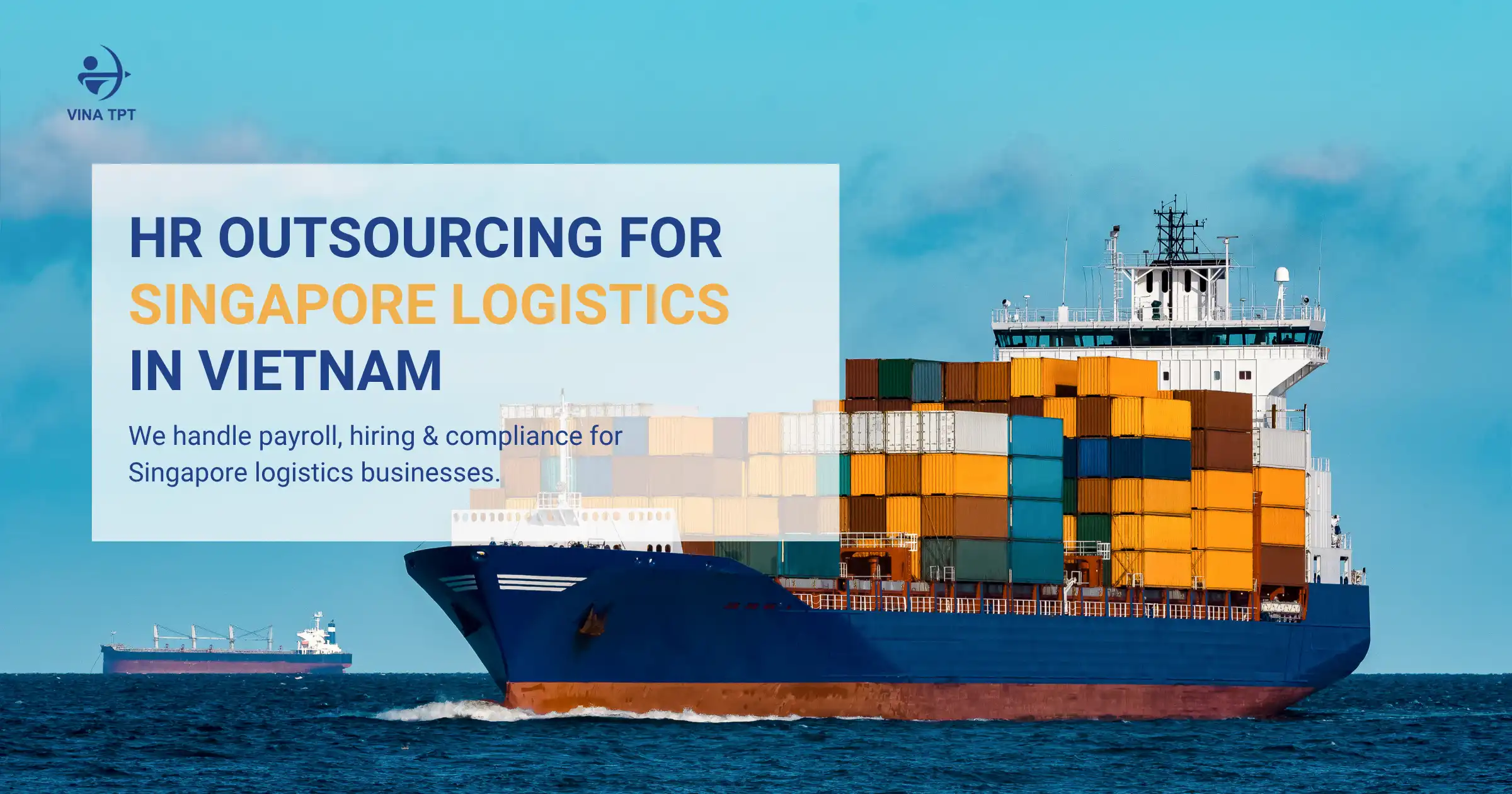
HR outsourcing for Singapore logistics businesses in Vietnam

alt="HR outsourcing services for Singapore logistics companies operating in Vietnam"

alt="HR outsourcing services for Singapore logistics companies operating in Vietnam"

HR outsourcing

1. The Growing Footprint of Singapore Logistics in Vietnam

In the regional investment landscape, Vietnam is becoming a strategic destination for many Singaporean logistics companies. Along with the boom in e-commerce, the demand for cold supply chains, distribution centers and cross-border transportation has led to an unprecedented wave of investment in Singapore’s industrial parks, seaports and logistics centers in Vietnam. 

However, when businesses begin to expand their operations in Vietnam, one of the biggest challenges is not technology or infrastructure, but the human factor. The Vietnamese labor market is significantly different from Singapore’s – from human resource structure, working habits to legal regulations. This makes setting up an internal human resource system for foreign businesses complicated, especially in the early stages of investment or expansion.

2. The HR Puzzle in Vietnam’s Logistics Sector

Vietnam’s logistics industry is a dynamic sector, but also full of challenges in human resource management. The labor force is abundant but there is a shortage of specialized skills, especially in positions such as coordinators, warehouse operators, container drivers or refrigerated transport personnel. In addition, the nature of shift work and the requirement to operate 24/7 requires businesses to maintain a flexible staff while still ensuring compliance with regulations on working hours, leave, contracts and social insurance.

Not only that, the Vietnamese legal system on labor, personal income tax and compulsory insurance has detailed and regularly updated regulations. If foreign businesses do not fully understand, they can easily make administrative mistakes such as false declarations, late insurance payments or lack of valid documents. In addition, the high turnover rate among unskilled workers also causes businesses to spend a lot of money on recruitment and continuous training.

The cultural differences in management between Singapore, which emphasizes efficiency and discipline – and Vietnam, which emphasizes flexibility and humanity – also create a significant gap. That is why many Singaporean logistics enterprises choose HR outsourcing solutions to optimize processes and minimize operational risks.

3. How HR Outsourcing Simplifies Cross-Border Operations

HR outsourcing is becoming an inevitable trend for Singaporean businesses when expanding to Vietnam. Instead of establishing an internal HR department, businesses can entrust the entire recruitment process, contract management, timekeeping, payroll and insurance implementation to a professional unit.

This solution brings many obvious benefits. First of all, businesses significantly save fixed costs related to recruitment, training and maintaining the HR department. All operations are performed by experts with knowledge of Vietnamese law, ensuring absolute compliance with labor and tax regulations. Next, the payroll calculation and personnel records management process is fully automated and digitized, helping to eliminate manual errors and limit audit and reporting risks.

In particular, for logistics businesses operating in many provinces and cities, HR outsourcing helps synchronize the multi-location human resource management process, ensuring that all shifts, payrolls and contracts are centrally controlled. This not only saves management time but also increases overall operational efficiency.

SEE HOW IT WORKS

4. Tailored HR Solutions for Logistics Operations

Understanding the specifics of the logistics industry, Vina TPT HR Service has designed specialized HR outsourcing services packages to meet the actual needs of Singaporean businesses in Vietnam. Services include recruitment, initial training, signing and managing labor contracts, timekeeping, payroll calculation and personal income tax declaration for employees.

We especially focus on key positions such as drivers, coordinators, warehouse operators and shift supervisors, helping businesses maintain a stable team throughout the operation process. In addition, Vina TPT’s electronic payroll management system allows payroll processing at multiple branches at the same time, ensuring accuracy, transparency and timeliness.

In addition, the service also supports onboarding procedures for new employees, setting up welfare and social insurance regimes in accordance with regulations, as well as consulting on human resource strategies suitable for each expansion stage. Thanks to that, businesses can fully focus on core logistics activities – instead of being distracted by heavy administrative procedures.

5. Vina TPT: Local Expertise for Regional Expansion

With a team of Human Resource experts, lawyers and accountants with 10 to 20 years of experience, having worked with more than 200 FDI enterprises in Vietnam, Vina TPT HR Service is not only a service provider but also a strategic companion of Singaporean enterprises.

We understand the differences between the Vietnamese and Singaporean labor systems, thereby helping customers establish flexible human resource processes while still strictly complying with local laws. Our outsourced HR services ensure that businesses always operate stably, costs are optimized and legal risks are minimized.

In the context of Vietnam emerging as a new logistics hub of Southeast Asia, choosing a capable and experienced HR outsourcing partner like Vina TPT will be a solid foundation for Singaporean enterprises to accelerate sustainable development.

Vina TPT HR Service – Specialized human resource solutions, helping Singapore logistics businesses operate effectively and expand steadily in Vietnam.

BOOK A FREE CONSULTATION

Payroll-HR-Manager-Vietnam-VinaTPT

Cost Comparison: In-House HR vs Outsourced Payroll for FDI in Vietnam

Vina TPT HR outsourcing Vietnam solution for foreign businesses

hr-outsourcing-vietnam-consultant-service

1. HR Management Challenges for FDI Companies in Vietnam

As FDI companies expand their operations and investments in Vietnam, HR Outsourcing Vietnam becomes an increasingly relevant solution as one of the biggest challenges is hiring employees and building an internal HR department. The labor system in Vietnam has many specific regulations such as social insurance, health insurance, personal income tax law and regulations on labor contracts. For newly established businesses in Vietnam, understanding this entire legal framework often takes a lot of time, resources and is prone to errors. 

In addition, cultural differences and language barriers also create additional pressure when businesses want to recruit the right people, manage benefits and set up Human Resources Management Challenges for FDI Companies in Vietnam

As FDI companies expand their operations and investments in Vietnam, HR Outsourcing Vietnam becomes an increasingly relevant solution as one of the biggest challenges is hiring employees and building an internal Human Resources department. The labor system in Vietnam has many specific regulations such as social insurance, health insurance, personal income tax law and regulations on labor contracts. For newly established businesses in Vietnam, understanding this entire legal framework often takes a lot of time, resources and is prone to errors. 


In addition, cultural differences and language barriers also create additional pressure when businesses want to recruit the right people, manage benefits and set up Hiring Relation systems. This is the reason why more and more FDI companies choose HR & payroll service as a safer, more economical and effective solution than building an in-house HR team from the beginning.

2. Understanding In-House HR Costs

When maintaining an in-house HR department, FDI enterprises must consider many hidden and fixed costs. First is the recruitment cost, including advertising, headhunter fees, interviews, and training. Next is the salary and benefits for the Human Resources team, which are often higher due to the demand for personnel with legal knowledge and bilingual skills. Moreover, for every in-house employee, enterprises must also pay compulsory social insurance, health insurance, and unemployment insurance, which together amount to approximately 20.5% of the employee’s monthly salary.

In addition, enterprises need to invest in HR & payroll software systems, employee records management, timekeeping, and payroll calculation. Operating costs such as office space, equipment, and the management time required from the board of directors also cannot be overlooked. Particularly for businesses in Vietnam during the early stages, this total cost structure can easily exceed the planned budget, creating financial pressure and reducing operational flexibility. 

Therefore, outsourcing or applying HR & payroll service is becoming a more effective alternative, helping FDI enterprises balance finances and focus on business development.

DISCOVER HR OUTSOURCING VIETNAM BENEFITS

3. Breakdown of Outsourced HR & Payroll Service Expenses

When choosing HR & payroll service, businesses only need to pay service fee based on the number of employees, instead of bearing the entire fixed cost of in-house HR. HR outsourcing service usually includes many items: drafting labor contracts, registering for social insurance, managing employee records, processing monthly payroll, declaring and paying personal income tax. Some advanced packages also support legal advice, updating changes in labor laws, and providing periodic human resources reports. Compared to maintaining an entire HR department, outsourcing allows businesses to predict and control costs more clearly. Especially for companies that have just opened a business in Vietnam, Vina TPT Hiring Employees Service brings advantages thanks to its flexible model, all-inclusive services, and transparent costs, ensuring that businesses only pay for what is necessary without incurring unexpected fees.

4. Key Factors Beyond Cost

Although cost is an important factor, when comparing in-house HR and outsourced service, FDI enterprises need to consider more long-term values. One of them is compliance with Vietnamese labor laws, a factor that helps avoid legal risks and protect brand reputation. Next is flexibility, allowing enterprises to easily expand or reduce the size of their staff without having to recruit or fire them complicatedly. In addition, outsourcing also brings operational efficiency, helping the management focus resources on business development strategies in Vietnam instead of handling administrative procedures. 

With HR & payroll service, enterprises have access to experts who understand the market, laws and local HR processes. This is a factor that Vina TPT Hiring Employees Service is providing outstandingly, bringing peace of mind to FDI when managing human resources in Vietnam.

5. Cost-Benefit Analysis: In-House vs Outsourcing

If analyzed as a whole, we can see a clear difference between maintaining an in-house HR department and using HR outsourcing combined with HR & payroll service:

HR in-house:

  • Enterprises have the ability to directly control their human resources and internal processes.
  • However, the costs of recruitment, training, salaries, benefits and maintaining the management system are very high.
  • The risk of errors in compliance with labor laws and tax regulations often occurs, especially for FDI enterprises that have just started doing business in Vietnam.

Outsourced HR & payroll service:

  • Provides a cost-saving solution, easily scalable according to the size of the workforce.
  • Reduces costs by 30–50% compared to maintaining in-house HR while still ensuring transparency and effective management.
  • Minimizes legal and administrative risks, while ensuring compliance with labor and tax regulations in Vietnam.
  • Creating transparent human resource data, supporting businesses in long-term development planning.

Looking at both costs and benefits, outsourcing HR is not only a short-term option but also an optimal strategy for FDI companies that want to develop sustainably in Vietnam.

6. Vina TPT Hiring Employees Service Advantage

Vina TPT Hiring Employees Service is specially designed for FDI enterprises that want to build and operate their business in Vietnam effectively. With a team of experts knowledgeable in labor, insurance and tax laws, Vina TPT provides a complete HR & payroll service solution including: recruitment, contract drafting, salary and bonus management, social insurance, and personal income tax declaration. The big difference of Vina TPT is the ability to advise on human resource strategies in parallel with legal compliance, ensuring that businesses both save costs and operate transparently. Instead of spending months building in-house HR, businesses can quickly deploy an optimal HR system in just a few days. This is the advantage that helps FDI companies confidently expand their scale, flexibly manage human resources and develop sustainably in the Vietnamese market.

Vina TPT’s HR & payroll service helps businesses save costs, reduce risks and focus on business development in Vietnam. Contact now!

BOOK A FREE CONSULTATION

Payroll-HR-Manager-Vietnam-VinaTPT

Updated 2025 | Corporate Income Tax Rates in Vietnam

Updated 2025 Corporate Income Tax Regulations in Vietnam

Corporate Income Tax Rate in Vietnam in 2025

Since October 1, 2025, under the provisions of Law No. 67/2025/QH15, the Corporate Income Tax (CIT) rates will be officially adjusted and applied nationwide.

Businesses should pay attention to the changes in CIT rates, including the standard rate of 20%, higher tax rates for the natural resource extraction sector, and new CIT incentives for small and medium-sized enterprises (SMEs) as well as businesses operating in priority sectors.

The following article provides a comprehensive update on corporate income tax rates, eligible taxpayers, and major tax incentives applicable in 2025.

1. What is Corporate Income Tax (CIT)?

Corporate Income Tax (CIT) is a direct tax levied on the remaining profit after deducting all allowable expenses incurred during business operations.

It is a significant source of revenue for the state budget and serves as an indicator of a company’s operational efficiency during the accounting period.

2. Who is Subject to Corporate Income Tax (CIT)?

Corporate Income Tax (CIT) is a mandatory financial obligation for organizations engaged in profit-generating business activities.

Entities required to pay Corporate Income Tax include:

  • Enterprises established and operating in Vietnam
  • Foreign enterprises with a permanent establishment in Vietnam
  • Foreign enterprises without a permanent establishment in Vietnam but having income arising in Vietnam
  • Other enterprises established under Vietnamese law with business activities and income generation
  • Public service units with business activities
  • According to the 2025 CIT law effective from October 1, 2025, digital platforms and e-commerce entities without establishments in Vietnam but providing services domestically must also declare and pay CIT.

Who is Subject to Corporate Income Tax in Vietnam


3. Corporate Income Tax Rates 

According to current regulations, Corporate Income Tax (CIT) rates for 2025 are applied as follows:

3.1. Standard CIT Rate 20%

Applicable to most enterprises established under Vietnamese law, engaged in the production and business of goods and services.

This is the standard tax rate applied to most enterprises not eligible for tax incentives.

3.2. CIT Rate 32% – 50%

Tax rates from 32% to 50% apply to exploration and exploitation of oil and gas activities in Vietnam.

The specific tax rate will be determined based on:

  • Location of extraction
  • Extraction conditions
  • Reserve volume

3.3. CIT Rate 25% – 50%

Rates from 25% to 50% apply to oil and gas exploration, prospecting, and extraction (depending on location, extraction conditions, and reserve volume, rates will vary).

3.4. CIT Rate 50%

Applied to exploration and extraction of rare resources:

  • Platinum
  • Gold
  • Silver
  • Tin
  • Vonfram (wolfram)
  • Antimon
  • Gemstones
  • Rare earth
  • Other rare and precious resources as prescribed by law

3.5. CIT Rate 40%

Applied to mines with 70% or more of allocated area located in socio-economically difficult regions.

3.6. Preferential CIT Rates

Preferential rate 15%: applied to enterprises with annual total revenue not exceeding 3 billion VND.

Preferential rate 17%: applied to enterprises with annual total revenue over 3 billion VND up to 50 billion VND.

Revenue for eligibility determination is based on the total revenue of the immediately preceding CIT taxable period. 

A 10% CIT rate for 10–15 years is for:

  • New investment projects in high-tech fields
  • Enterprises in socio-economically disadvantaged areas
  • Enterprises in high-tech zones and high-tech agricultural application zones

4. Partnering with Vina TPT for Reliable Accounting and Corporate Tax Consulting Services

With over 15 years of experience and deep expertise in Vietnamese accounting and tax regulations, Vina TPT is a trusted partner for businesses seeking reliable support in managing their Corporate Income Tax obligations. Our team of seasoned professionals provides end-to-end services covering both Quarterly Corporate Income Tax (CIT) reporting and Annual CIT Finalization, ensuring full compliance with current laws and minimizing the risk of penalties or reporting errors.

As Corporate Income Tax regulations in Vietnam continue to evolve, it is essential for companies to stay updated and implement accurate tax strategies. Vina TPT’s comprehensive approach includes document review, deadline tracking, and strategic consulting tailored to your business size and sector. Whether you are a local enterprise or a foreign-invested company, our services are designed to help your business navigates Vietnam’s tax environment with confidence, optimize tax efficiency, and support your long-term financial goals.

Contact Vina TPT today for trusted full-service accounting and tax solutions in Vietnam.

BOOK A FREE CONSULTATION

accounting service Vietnam for Chinese company vtpt


How Singapore Investors Can Smoothly Establish Business in Vietnam

establish business in Vietnam with vtpt

establish business in Vietnam with vtpt

1. Why Singapore Investors Choose to Establish Business in Vietnam  

Vietnam is becoming an attractive investment destination for Singapore investors in Vietnam thanks to its strategic geographical location in Southeast Asia, competitive labor and operating costs, and free trade agreements (FTAs) that facilitate exports and trade.

For small and medium-sized enterprises from Singapore, establishing a business in Vietnam opens up opportunities to access a large consumer market, taking advantage of lower operating costs compared to other saturated markets. In addition, the preferential policies of the Vietnamese Government for a number of industries such as technology, manufacturing, education and renewable energy also increase the attractiveness, helping Singapore investors to expand their scale sustainably.

2. Key Legal Requirements for Singapore Companies

To ensure a smooth business establishment in Vietnam, Singapore investors need to understand the legal requirements. Choosing the type of business such as Limited Liability Company (LLC), Joint Stock Company (JSC) or Representative Office will determine the ownership structure, charter capital and management rights.

Investors need to determine the investment capital, business lines and licensing conditions. Some specific business lines may require additional licenses or pre-investment approval from state agencies. Basic legal documents include the company charter, list of shareholders/members, legal documents of the investor, legal head office address, and capital contribution plan.

For FDI projects, Singapore investors need to apply for an Investment Registration Certificate (IRC) to get investment approval, then apply for an Enterprise Registration Certificate (ERC) – the official business license and tax code of the enterprise. Compliance with these legal requirements is a prerequisite for legal and effective business operations.

3. Prepare Documents and Apply for Business License (IRC & ERC)

For Singapore investors in Vietnam, establishing a business in Vietnam cannot be separated from the steps of preparing documents and applying for licenses. This is an important stage, especially for FDI projects, because complete and accurate documents determine the progress of granting Investment Registration Certificate (IRC) and Enterprise Registration Certificate (ERC) – two mandatory licenses for businesses to operate legally.

3.1 Investment Registration Certificate (IRC) – For FDI

For projects with foreign investment capital, IRC is the first license, allowing investors to implement projects in Vietnam. The documents usually include:

  • Application for implementing investment projects and Investment Plan, clearly stating the objectives, scale, location, capital and progress of the project.
  • Evidence of the investor’s financial capacity, such as bank statements, credit contracts or mortgaged assets.
  • Legal documents of the investor: individuals submit notarized and consularized passports; legal entities submit notarized and consularized business registration certificates.
  • Project location, including lease contract or land/office use right certificate.

3.2 Enterprise Registration Certificate (ERC) – Operating License

After the IRC is issued (or for 100% domestic-owned enterprises), the investor submits an application for an ERC – which is an official license for the enterprise to operate and also a tax code. The ERC dossier includes:

  • Business registration application.
  • Company Charter, which stipulates the organizational structure, member/shareholder rights, capital contribution ratio and management method.
  • List of shareholders/members and legal representatives, clearly stating information, ownership ratio and voting rights.
  • Appointment decision and authorization letter (if any).
  • Capital contribution plan & proof of financial capacity, especially important for large capital projects.

3.3 General requirements and important notes

  • Notarization, consular legalization & translation into Vietnamese: all documents of foreign investors must be completed before submission. This is a step that often causes delays if the dossier has many shareholders or is complicated.
  • Legal head office address: do not use apartments or collective houses.
  • Unified information: company name, address, capital, and business lines must be consistent on all dossiers.
  • Choosing the right business line: ensure that investment conditions are met to avoid multiple amendments.

3.4 Time to prepare and submit documents

  • Document preparation: 1-2 weeks, depending on the volume and complexity of legalization.
  • IRC appraisal: about 20-45 working days.
  • ERC issuance: 10-20 days after IRC approval.

Due to the complicated process of preparing documents and applying for ERC/IRC, Singapore investors should hire outsourcing with professional services such as Vina TPT start-up business license service. This not only saves time, limits legal errors but also ensures that the licensing process is quick, transparent and safe.


GET EXPERT HELP WITH IRC & ERC REGISTRATION

4. Common Challenges and How to Overcome Them

Singaporean investors often face difficulties due to differences in laws, taxes, and administrative procedures between Vietnam and Singapore. Language barriers and incomplete understanding of regulations also hinder the preparation of documents and communication with authorities.

Common problems include delays in IRC or ERC approval, inconsistent information in documents, and additional licensing requirements for specific industries. Working with a business setup consultant Vietnam helps to minimize these risks through legal advice, accurate document preparation, and direct dealing with government agencies, allowing investors to focus on business planning and strategic operations.

establish business in Vietnam with vtpt

5. Role of a Business Setup Consultant in Vietnam

Using a business setup consultant Vietnam is an important strategy for Singapore investors to optimize the company registration process. Consultants help identify the appropriate type of business, review and prepare all legal documents, and ensure compliance with Vietnamese regulations.

In addition, consultants also provide strategic advice on capital allocation, investment approval, and application for specific industry licenses, helping investors avoid legal errors and shorten the time to complete documents. As a result, Singaporean businesses save costs, time, and feel more secure in long-term development in Vietnam.

6. Vina TPT Company Registration Service for Singapore Investors

Vina TPT company registration offers a complete solution for Singapore investors in Vietnam, with outstanding advantages:

  • Comprehensive support: From initial consultation, document preparation, document submission, to post-registration support.
  • Legal compliance: Ensure documents are valid for both IRC and ERC.
  • Industry expertise: Guidance on applying for additional licenses for regulated fields such as education, fintech, manufacturing.
  • Multilingual service: Bilingual support in Vietnamese and English, ensuring accurate and easy-to-understand information for investors.
  • Save time and costs: Help shorten the registration process, limit errors and reduce operating costs.

Singapore investors can rest assured when choosing Vina TPT company registration to establish business in Vietnam quickly, legally and effectively.

Contact Vina TPT today for advice and quick implementation of business registration in Vietnam!

BOOK A FREE CONSULTATION

Laywer-Establish-business-Vietnam-VinaTPT

Financial Statement Preparation in Vietnam for FDI: Key Differences Between Chinese and Vietnamese Accounting Standards

accounting service Vietnam for Chinese company vtpt

financial-statement-preparation-Vietnam

In recent years, Vietnam has emerged as a strategic destination for Chinese enterprises to invest in FDI, thanks to its advantages in labor costs, geographical proximity and open-door policies to attract foreign capital. However, besides the opportunities, Chinese companies face great challenges in familiarizing themselves with and complying with Vietnamese accounting standards (VAS), which are significantly different from PRC GAAP. This difference directly affects the process of financial statement preparation Vietnam, consolidated reports and tax obligations. To manage effectively and minimize risks, many enterprises choose the Vina TPT accounting system setup solution, which helps build a bilingual accounting system, ensuring transparency and compliance with both Vietnamese regulations and requirements from the parent company in China.

1. Why Chinese Investors Need to Understand Vietnamese Accounting Standards

When investing FDI in Vietnam, Chinese enterprises not only have to comply with the laws on investment and business, but also need to understand Vietnamese accounting standards (VAS). This is the basis for financial statement preparation Vietnam, declaring taxes, and demonstrating transparency to management agencies. Only applying PRC GAAP and ignoring financial statement preparation in Vietnam according to VAS can lead to audit risks, being subject to arrears or difficulties in distributing profits to the parent company. Therefore, understanding and correctly applying Vietnamese accounting standards is not only a matter of compliance, but also a foundation for enterprises to build trust with shareholders, partners and state agencies.

2. Overview of Chinese vs. Vietnamese Accounting Systems

PRC GAAP (Chinese Accounting Standards) and VAS (Vietnamese Accounting Standards) have the same goal of faithfully reflecting the financial situation, but their approaches are different:

  • PRC GAAP: Designed to serve internal management, strict supervision of the Chinese government, emphasizing capital control and compliance with domestic economic policies.
  • VAS: Built to suit the legal and tax environment of Vietnam, closely linked to tax declaration and reporting requirements to management agencies. However, VAS is in the process of integrating with IFRS to approach international standards.

For Chinese companies in Vietnam, this difference creates a gap that needs to be filled, especially when having to prepare reports for management agencies in Vietnam and meet the consolidated reporting requirements of the parent company in China.


TALK TO OUR CHINA–VIETNAM ADVISORS

3. Key Differences in Financial Statement Preparation Vietnam

When preparing financial statements in Vietnam, Chinese enterprises will encounter some major differences between PRC GAAP and VAS, specifically:

  • Revenue: Different ways of recording revenue, especially for long-term transactions or prepaid revenue.
  • Fixed assets: Different methods of asset valuation and depreciation, directly affecting profits and expenses.
  • Provisions and liabilities: VAS has its own provisions on provisioning, while PRC GAAP has a broader scope on estimating liabilities.
  • Presentation: VAS emphasizes compliance with the reporting format issued by the Ministry of Finance, while PRC GAAP is more flexible for enterprises in presentation.
  • International standards: FDI enterprises sometimes have to perform an additional step of converting from VAS to IFRS to serve global reporting.

Understanding these differences helps businesses limit errors and standardize financial data from the start.

4. Compliance Challenges for Chinese FDI Companies

In reality, many Chinese enterprises face difficulties in preparing financial statements in Vietnam. Standardizing bilingual financial statements, handling exchange rate differences, and converting from PRC GAAP to VAS or IFRS can create great pressure on the accounting department. Many enterprises face a lack of personnel who understand both systems, as well as the challenge of meeting the parent company’s expectations of transparency. This is the reason why hiring an accounting service in Vietnam for Chinese companies becomes important.

accounting service Vietnam for Chinese company vtpt

5. Setting Up a Reliable Accounting System in Vietnam

To overcome the above challenges, setting up a reliable accounting system in Vietnam is necessary. Chinese enterprises should choose software that is compatible with VAS and has the ability to export data according to PRC GAAP or IFRS. In addition, the accounting process needs to be standardized, have bilingual personnel, and have close coordination with the parent company.

Therefore, if a business wants to optimize its accounting system and ensure full compliance with Vietnamese regulations as well as requirements from the parent company, choosing a reputable partner like Vina TPT is a strategic step that cannot be ignored.

6. How Vina TPT Supports Chinese Companies Prepare Financial Statements Vietnam

We provides Vina TPT accounting system setup solutions for Chinese enterprises that want to establish business and operate accounting in Vietnam.

  • Comprehensive Accounting Service: Providing a full range of accounting services, from bookkeeping, financial reporting to tax management and bilingual reporting.
  • Dual-Language Expertise: Professional reporting, documentation and communication in both Vietnamese and Chinese, helping the parent company grasp information quickly and accurately.
  • Customized Accounting System Setup: Setting up an accounting system suitable for the scale and model of FDI, including software, processes and operational personnel.
  • Regulatory Compliance: Supporting businesses to fully comply with Vietnamese accounting standards (VAS) while meeting the reporting requirements of the parent company in China.
  • Strategic Financial Advisory: Providing financial strategy advice based on accurate data, helping businesses optimize cash flow, plan budgets and prepare for audits.

Please contact Vina TPT today for consultation on a complete accounting service solution in Vietnam, ensuring compliance and transparency for Chinese businesses in Vietnam.

BOOK A FREE CONSULTATION

financial-statement-preparation-Vietnam

Vietnam Accounting & Tax Services for Japanese Investors

vtpt hire accounting service

vtpt hire accounting service

1. The Need to Hire Accounting Service for Japanese Investors in Vietnam

Vietnam is emerging as one of the top investment destinations in Asia, attracting more and more Japanese businesses looking for new growth opportunities. However, differences in laws, accounting standards and business environments make hiring accounting services a strategic factor to ensure success right from the start.

For Japanese companies, cooperating with a reputable Vietnamese accounting service unit not only helps with daily financial management but also ensures Vietnam accounting compliance for Japanese business, meets the reporting requirements of the parent company and complies with strict regulations in Vietnam. Hiring Vina TPT accounting service helps investors reduce administrative burden, limit errors in tax declarations, and build a transparent accounting system, supporting the long-term business expansion process.

2. Common Financial Challenges for Japanese Businesses

When operating in Vietnam, Japanese businesses often encounter some unique difficulties related to Vietnam accounting compliance for Japanese businesses, including:

  • Different accounting standards: Vietnamese Accounting Standards (VAS) differ significantly from Japanese GAAP and IFRS, requiring accurate and continuous conversion of financial statements.
  • Cash flow and foreign currency management: Exchange rate fluctuations and foreign exchange regulations can affect cash flow, especially for companies that import or transact internationally.
  • Diverse tax requirements: Businesses need to comply with many types of taxes such as Corporate Income Tax (CIT), Value Added Tax (VAT), Foreign Contractor Tax, Personal Income Tax (PIT), as well as social and health insurance.
  • Parallel reporting system: Many companies must simultaneously meet reporting requirements of Vietnam and Japan, resulting in a large amount of accounting and auditing work.

These challenges not only increase the internal workload but also require the support of a highly qualified Vina TPT accounting service partner to help businesses operate financially stably and legally.


BRIDGE JAPAN-VIETNAM ACCOUNTING STANDARDS

3. Essential Services to Hire for Smooth Operations

To overcome barriers and ensure compliance, Japanese investors should hire an accounting service that provides a comprehensive and in-depth service package. Some important services include:

  • Bookkeeping & General Accounting: Standard accounting bookkeeping, invoice management, processing daily transaction documents to ensure accuracy and transparency.
  • Financial Reporting & Conversion: Prepare financial statements according to VAS standards and convert to Japanese GAAP or IFRS for auditing, consolidate reports for parent companies in Japan.
  • Tax Filing & Compliance Service: Support periodic tax declaration, submit CIT, VAT, PIT, social insurance and other tax obligations on time, helping to avoid late payment penalties.
  • Payroll & HR Accounting: Manage payroll, personal income tax and insurance for employees, ensuring compliance with Vietnamese labor laws.
  • Audit Preparation & Internal Control: Establishing an internal control system and preparing documents for independent audits, helping businesses prepare for any financial audit or assessment.

With the above services, Vina TPT accounting service helps Japanese businesses not only comply with Vietnam accounting compliance for Japanese business, but also optimize costs and improve long-term financial management efficiency.

vtpt hire accounting service

4. Ensuring Compliance with Vietnamese Standards and Japanese Reporting Requirements

For Japanese companies operating in Vietnam, dual compliance is not only a legal requirement but also a key factor in maintaining the trust of shareholders and parent companies. Enterprises need to ensure Vietnam accounting compliance for Japanese business, while also meeting international reporting standards such as Japanese GAAP, IFRS or the group’s consolidated standards. This process includes preparing consolidated financial statements, converting reports from VAS (Vietnamese Accounting Standards) to international standards, reconciling internal data, and closely managing multidimensional financial indicators.

Performing these dual requirements yourself requires in-depth knowledge, time and experienced personnel, so hiring a professional accounting service is the optimal solution. A reputable unit like Vina TPT accounting service will provide a complete accounting service Vietnam, support the preparation of bilingual financial reports (Vietnamese – Japanese/English), control input data, and standardize the accounting system to easily serve both the Vietnamese tax authorities and the parent company in Japan.

By combining tax compliance, financial reporting, and business accounting Vietnam in one comprehensive service, Vina TPT helps businesses minimize the risk of errors, optimize the inspection process, and ensure all reports are transparent, accurate, and timely. This is the strategic solution for Japanese businesses in Vietnam to maintain sustainable growth, strengthen their reputation in both markets, and enhance their ability to expand in the future.

5. Vina TPT’s Advantage for Japanese Investors

Vina TPT stands out in the Vietnamese accounting service market thanks to its team of Japanese-Vietnamese bilingual experts and in-depth knowledge of Vietnam accounting compliance for Japanese business. The accompaniment of Lawyer Le Quoc Duy, a legal expert who can communicate directly in Japanese, helps all legal and financial procedures to be implemented quickly, accurately and in accordance with Japanese corporate culture.

Outstanding strengths of Vina TPT accounting service:

  • Bilingual Expertise: Support communication, reporting and financial analysis in both Japanese and Vietnamese.
  • Tailored Accounting Solutions: Provide flexible services from bookkeeping, tax filing to financial advisory, suitable for the needs of each type of investment.
  • Regulatory Insights: Always update Vietnamese tax regulations and accounting standards, helping Japanese enterprises maintain Vietnam accounting compliance for Japanese business in a sustainable way.
  • Strategic Financial Planning: Support financial planning, optimize capital structure and prepare for international audits.

Download Vietnam Tax Handbook - Japanese Edition

6. Steps to Engage the Right Accounting Service in Vietnam

To choose the most suitable and effective hire accounting service, Japanese investors can follow these steps:

  • Determine specific needs: Evaluate business scale, reporting requirements, accounting standard conversion needs and level of support from partners.
  • Evaluate experience and expertise: Choose a partner with professional certification and experience providing accounting services in Vietnam for Japanese businesses.
  • Compare costs and scope of services: Ensure transparent fees, suitable for budget, and include important services such as bookkeeping, tax filing and compliance.
  • Sign the contract and implement the service: Clearly define responsibilities, reporting deadlines and information exchange methods to optimize cooperation efficiency.

With extensive experience and comprehensive services, Vina TPT accounting service is the ideal choice to ensure Vietnam accounting compliance for Japanese business, helping Japanese businesses develop sustainably in Vietnam.

Hire Vina TPT accounting service today to ensure Vietnam accounting compliance for Japanese business and fully meet Japanese reporting requirements.

BOOK A FREE CONSULTATION

Vina TPT Accounting services

Vina TPT Guide to Accurate Financial Statements Vietnam and Professional Business Accounting

Financial statements in Vietnam for accurate business reporting

Financial statements in Vietnam for accurate business reporting

In a competitive and tightly regulated business environment like Vietnam, preparing accurate, transparent and timely financial statements Vietnam (financial reports) plays an extremely important role for every business. Not only is it a legal requirement, preparing standard financial statements is also a decision support tool, helping the board of directors evaluate operational efficiency and strategic direction. Below is a step-by-step process for preparing financial statements, from collecting transactions to internal control, complying with accounting standards and preparing for audits, along with comprehensive support solutions from Vina TPT.

1. Collecting and Organizing Transactions for Financial Statements in Vietnam

The first step in preparing financial statements is to collect and organize all financial transactions of the business. Fully recording invoices, documents, contracts and accounting data not only helps to report accurately but also creates a foundation for accurate financial reporting and compliance with business accounting in Vietnam.

A professional data storage and processing system will support businesses to manage information in real time, helping the management easily track cash flow, control costs and make quick and effective decisions.

2. Preparing Balance Sheet, Income Statement, and Cash Flow Statement

Once the data is standardized, the business needs to prepare three core financial statements:

  • Balance Sheet: Reflects the status of assets, liabilities and equity.
  • Income Statement: Shows revenue, expenses and profits for the period.
  • Cash Flow Statement: Tracks cash inflows/outflows from business, investment and financing activities.

Preparing these reports requires high accuracy and compliance with Vietnam business accounting regulations to ensure accurate financial reporting, while meeting the requirements of regulators and investors.

3. Reviewing and Adjusting Before Submitting Accurate Financial Reporting

Before submitting financial reports, the step of reviewing and adjusting data is extremely important to avoid errors. Enterprises need to compare data, check accounting entries and evaluate the reasonableness of items.

This process not only helps ensure accurate financial reporting but also limits the risk of being fined for incorrect or late reporting according to Vietnamese law.

4. Ensuring Compliance with Vietnamese Business Accounting Standards

Compliance with Vietnamese Accounting Standards (VAS) and current accounting regulations is a mandatory requirement for all businesses operating in Vietnam. 

Compliance with VAS helps financial reports meet standards, are easily compared and accepted in audits. This is also an important factor to enhance corporate reputation, strengthen the trust of shareholders, partners and financial institutions when assessing the financial situation of the company.


STANDARDIZE YOUR FINANCIAL REPORTS WITH VINA TPT

5. Building Internal Control for Audit Readiness

In the process of preparing financial statements, building a tight internal control system is the foundation for businesses to achieve audit readiness.

An effective internal control system allows businesses to monitor cash flow, detect early signs of fraud, control over-budget costs and ensure accounting data is processed accurately.

Applying VAS standards combined with standard processes from recording transactions, classifying documents, approving reports will help businesses not only achieve accurate financial reporting but also confidently pass periodic or ad hoc audits.

This is a key factor to improve transparency, optimize governance and increase profits.

6. How Vina TPT Supports Every Step of Preparing Financial Statements

With 15 years of experience in the field of business accounting in Vietnam, Vina TPT provides a complete solution to help businesses easily manage and prepare financial statements in Vietnam.

Vina TPT’s services include:

  • Collecting and organizing financial data according to national standards.
  • Consulting on preparing balance sheets, income statements and cash flow statements.
  • Reviewing and adjusting data before submission to ensure accurate financial reporting.
  • Supporting businesses in complying with VAS and legal regulations.
  • Building internal controls to achieve audit readiness, minimize risks and increase transparency.

Thanks to professional accounting services, businesses can focus on core business activities, optimize cash flow and strengthen trust with investors, shareholders and audit agencies.

The process of preparing financial statements in Vietnam requires carefulness, high expertise and strict compliance with accounting standards. From collecting transactions, reporting, internal control to preparing for audits, every step plays an important role in ensuring accurate financial reporting and sustainable development. With Vina TPT’s support, businesses can be assured of accuracy, transparency and efficiency in every stage of the financial statements preparation process, ready to conquer long-term financial goals.

Ready to simplify your financial reporting? Contact Vina TPT today

BOOK A FREE CONSULTATION

Vina TPT Accounting services

Full-Service Accounting and Tax Solutions for Businesses in Vietnam

Professional accounting services Vietnam for businesses

1. Why Businesses in Vietnam Need Integrated Accounting and Tax Services

The legal environment in Vietnam requires businesses to comply with many strict regulations on accounting services Vietnam, tax services for businesses, social insurance and financial reporting. Changes in Vietnam Accounting Standards (VAS), regulations on electronic invoices or new tax policies often make it difficult for many businesses, especially SMEs and FDI companies, to update and apply.

Separating accounting and tax services can easily lead to overlaps, errors or inconsistent reporting, thereby increasing the risk of being overcharged, fined or losing credibility with management agencies. Therefore, integrated accounting services Vietnam or full-service accounting solutions that combine accounting and tax management in the same system – such as the professional accounting Vietnam model provided by Vina TPT – help businesses save costs, minimize errors and ensure comprehensive compliance.

2. Understanding the Scope of Full-Service Accounting Solution

To understand the value that full-service accounting solutions bring, businesses need to understand the comprehensive range of services that this model includes. A complete solution does not stop at simply recording and processing accounting books, but also fully integrates important service areas such as accounting services Vietnam, tax services for businesses, financial statement preparation and annual audit coordination (mandatory for all FDI companies), legal compliance consulting, and cash flow management support.. Especially for FDI companies or businesses that are expanding in scale, this service covers monthly bilingual financial statements (including the Income Statement), preparation of consolidated reports for the parent company, and reconciliation between Vietnamese Accounting Standards (VAS) and international standards such as IFRS (if any) or US GAAP.

Another difference of this model compared to traditional services is the integration between accounting and tax. Instead of having to work with many individual suppliers, businesses only need a single point of contact to ensure that all processes – from recording transactions, managing electronic invoices, preparing quarterly tax reports to year-end tax settlement – are implemented synchronously and accurately. This helps save a significant amount of time and personnel costs, while minimizing the risk of errors in auditing or tax inspection.

With a team of experienced experts in the field of professional accounting Vietnam, solutions from Vina TPT also bring strategic benefits when businesses can take advantage of accurate financial data systems to plan budgets, analyze profits and make timely investment decisions.

3. Key Tax Services That Support Business Growth and Compliance

Tax services for businesses play an important role in protecting finances and supporting business growth. In Vietnam, a comprehensive tax service package often includes:

  • Tax Planning & Advisory: Consulting on tax strategies to optimize financial obligations while still complying with the law.
  • Corporate Income Tax & VAT: Preparing and submitting corporate income tax and value-added tax declarations accurately and on time.
  • Personal Income Tax for Expatriates: Managing personal income tax for foreign employees, including declaration and settlement.
  • Tax Audit Support: Representing businesses in working with tax authorities during inspections and audits.

These services help businesses minimize the risk of late payment penalties, avoid additional costs and maintain a reputable image in the eyes of investors.

Professional accounting services Vietnam for businesses

4. How Professional Accounting Enhances Transparency and Efficiency

Using professional accounting Vietnam not only provides accurate financial reports but also increases transparency in the entire business operations. With a data system that is processed, standardized and continuously updated, the management board can monitor business performance in real time, thereby making faster and more accurate decisions on strategic issues such as capital allocation, cost control or investment planning. In particular, when combined with full-service accounting solutions including accounting services Vietnam and tax services for businesses, the business will own an integrated financial platform where all information from accounting to tax is managed synchronously and transparently. 

A professional accounting system also acts as an “early warning system”, helping to promptly detect potential problems such as unstable cash flow, over-budget costs, errors in electronic invoices or even signs of internal fraud. This is the key factor for businesses to proactively prevent risks, avoid administrative fines due to violations of tax and accounting regulations, and optimize financial management processes. 

With the support of reputable units such as Vina TPT, businesses also receive outstanding added value thanks to a team of experienced experts who understand Vietnamese accounting standards (VAS) and international accounting standards (IFRS, US GAAP – applied only when required by the parent company for consolidation). The combination of professional accounting services Vietnam and in-depth tax consulting services helps companies, especially SMEs and FDI, to ensure compliance with the law and improve financial forecasting capabilities, thereby increasing profits and consolidating their position in the Vietnamese and international markets.

START BUILDING TRANSPARENCY TODAY

5. Unlocking Strategic Value from Combined Accounting and Tax Solutions

Combining full-service accounting solutions with tax services for businesses not only helps businesses reduce the burden of procedures but also opens up many strategic values ​​for sustainable development. When accounting services Vietnam and tax services are deployed in the same system, all financial data – from recording transactions, preparing financial statements to tax settlement – are managed synchronously, ensuring accuracy and consistency. This is a key factor for the board of directors to make investment decisions, expand the market or restructure the business based on reliable data.

A prominent advantage of integrating accounting and tax services is the ability to provide real-time information. Standardized and continuously updated data helps businesses promptly identify profit trends, cost fluctuations, or cash flow risks. With this platform, managers can quickly adjust budget plans, optimize tax structures, and improve financial management efficiency without depending on many separate service providers. In particular, FDI enterprises or companies that are expanding their scale will benefit from bilingual reporting services, preparing consolidated reports according to Vietnamese accounting standards (VAS) and international accounting standards (IFRS, US GAAP). This not only helps meet the requirements of domestic management agencies but also supports financial data transparency for parent corporations and international investors.

Special Notes for FDI Companies

  • Monthly bilingual financial statements (including Income Statement) are prepared for parent company review.
  • Annual audit of financial statements is mandatory under Vietnamese regulations.
  • IFRS reporting is optional and only required when the parent company requests consolidated reports; VAS remains the primary standard for local compliance.

6. Partnering with Vina TPT for Reliable Financial Reporting

To achieve accuracy and transparency in both accounting and tax, choosing a reputable partner is a decisive factor. Vina TPT is a provider of full-service accounting solutions and tax services for businesses trusted by many FDI enterprises and SMEs in Vietnam.

With a team of experts with more than 15 years of experience and a deep understanding of Vietnamese accounting and tax laws, Vina TPT provides bilingual Vina TPT financial reporting (Vietnamese – English), ensuring compliance with both domestic management requirements and international standards.

From professional accounting to tax declaration and financial reporting services, Vina TPT not only ensures legal compliance but also acts as a strategic advisor, helping businesses optimize costs and maintain long-term competitive advantages.

Contact Vina TPT today for trusted full-service accounting and tax solutions in Vietnam.

BOOK A FREE CONSULTATION

Vina TPT Accounting services

HR Outsourcing Vietnam: Payroll Compliance & Benefits for Businesses

HR outsourcing Vietnam and payroll services for businesses

HR outsourcing Vietnam and payroll services for businesses

1. Why HR & Payroll Management Is a Challenge in Vietnam

Managing HR outsourcing Vietnam and payroll services in Vietnam requires businesses to understand and comply with a series of complex regulations. From Labor Law, Social Insurance Law, to regulations on personal income tax (PIT) – all are constantly updated, making it difficult for many businesses to keep up. Just a small mistake such as late payment of social insurance or under-declaration of PIT can lead to arrears, administrative fines or being placed on the list of high-risk inspections.

For FDI companies, the pressure is even greater when having to both comply with Vietnamese regulations and standardize the process to report to the parent company according to international standards. SMEs are not easier, because maintaining a competent internal HR and payroll department is both costly and difficult to expand when the scale of human resources increases rapidly.

2. What HR Outsourcing Vietnam Really Offers Beyond Cost Savings

Many businesses turn to  with the initial goal of reducing costs, but the true value of this service goes far beyond financial benefits. When cooperating with a professional partner, businesses have access to a team of professional HR services that are familiar with Vietnamese law and international standards, and at the same time own a standardized and automated management system.

That means businesses not only reduce administrative tasks such as file management, timekeeping, and payroll, but also receive strategic advice on human resource structure, benefits, and tax optimization. In particular, FDI companies using Vina TPT’s services are also supported with bilingual reporting (Vietnamese-English) to meet strict requirements from the parent company – something that internal HR departments often find difficult to do perfectly.

3. Key Benefits of Payroll Outsourcing for SMEs and Larger Enterprises

Payroll services Vietnam brings many practical values, from cost savings, increased accuracy to ensuring compliance. For SMEs, payroll outsourcing helps free up resources, reduce the burden on HR and accounting departments. For large corporations, this service supports data synchronization, ensuring a transparent and secure payroll process.

A professional payroll outsourcing package usually includes:

  • Setting up human resources information & timekeeping: Collecting employee data (labor contracts, allowances, bank information), managing working hours, shifts, leave, overtime.
  • Calculating monthly salaries: Calculating basic salaries, allowances, bonuses, commissions; deducting social insurance, health insurance, unemployment insurance, personal income tax; processing advances and adjusting timekeeping.
  • Preparing and issuing payslips: Creating detailed payroll, sending secure payslips, supporting timely bank transfers.
  • Tax/Social Insurance declaration and payment: Prepare monthly/quarterly personal income tax filings, submit periodic social insurance reports and adjust the increase/decrease of employees.
  • Management reporting and data storage: Provide consolidated payroll reports, store secure records for audits or inspections.

Thanks to this professional process, businesses not only minimize errors but also ensure compliance with complex Vietnamese regulations, while creating transparency and trust for employees.


SEE HOW PAYROLL OUTSOURCING SAVES COSTS

4. Ensuring Compliance with Labor Laws and Tax Regulations in Vietnam

In Vietnam, labor laws and taxes related to human resources are constantly being updated. For example, the adjustment of minimum wages, social insurance contribution rates or labor contract regulations alone has changed many times in recent years. If businesses do not promptly grasp them, they can easily fall into a state of violation, even unintentionally.

HR outsourcing Vietnam and payroll services Vietnam help businesses completely minimize this risk. Professional service providers always monitor, update new regulations and automatically apply them to the process of calculating salaries, declaring taxes and paying insurance. In addition to submitting documents on time, they also support reviewing related transactions to ensure compliance with both tax and labor authorities, helping businesses avoid fines, arrears or being classified in high-risk groups during inspections.

5. How HR Outsourcing Improves Employee Satisfaction and Retention

A professional HR and payroll system not only serves the business, but also directly impacts employee satisfaction. Accurate and timely salary payment, transparent payslips, clear benefits – all create a trustworthy working environment, minimize disputes and increase work motivation.

In particular, professional HR service providers today often integrate technology such as employee self-service portals, allowing employees to look up their own payslips, leave schedules, insurance, etc. This not only saves time for the HR department but also helps employees feel proactive, transparent and respected. For FDI enterprises, maintaining a positive employee experience also contributes to strengthening the recruitment brand, attracting and retaining talent in a fiercely competitive environment.

6. Why Vina TPT Is the Trusted Partner for HR Outsourcing in Vietnam

Vina TPT has become a reputable choice for many FDI and SMEs thanks to its team of HR experts with more than 15 years of experience. Vina TPT provides full-service accounting combined with HR outsourcing solutions, helping businesses comply with labor laws and optimize financial management. Vina TPT’s services stand out with:

  • A team of experts updating the law: Understanding the latest regulations on labor, social insurance, taxes and international standards.
  • Bilingual Vietnamese – English – Japanese reports: Support FDI enterprises to report transparently to both parent companies and management agencies in Vietnam.
  • Integrated solutions: Closely connecting HR, payroll and accounting, helping to synchronize data, minimize errors and save time.

Thanks to Vina TPT HR outsourcing solutions, businesses can focus on core business activities, while the entire HR and payroll process is managed professionally, accurately and transparently. This is the key for businesses to not only ensure compliance, but also build a professional image in the eyes of employees and international investors.

Discover how Vina TPT HR outsourcing solutions and payroll services Vietnam can simplify compliance and boost efficiency for your business today.

BOOK A FREE CONSULTATION

HR Manager Vina TPT Accounting services in vietnam

How Outsourced Full-Service Accounting Empowers FDI Companies in Vietnam

Full-service accounting solutions for FDI companies in Vietnam

Full-service accounting solutions for FDI companies in Vietnam

1. How Full-Service Accounting Supports FDI Companies in Vietnam

With the growth rate of Foreign-capital enterprises in Vietnam (more than 36 billion USD of registered capital in 2024 according to the Ministry of Planning and Investment), more and more multinational enterprises are facing accounting and tax complexities. A Japanese company operating in Vietnam must both prepare reports according to Vietnamese Accounting Standards (VAS) for domestic management agencies and ensure IFRS standards to send to the parent company. Without a professional full-service accounting system, the risk of data errors, late submission of reports or administrative fines is very high.

At the strategic level, full-service accounting is not only an accounting support service, but also acts as a “financial arm” to help Foreign-capital companies optimize capital management, improve internal control processes and minimize legal risks. A typical case is Samsung in Vietnam: huge transaction volume, many supply chains and factories force them to standardize reports on digital platforms. This is an example showing that outsourced accounting can bring long-term sustainability to the operations of Overseas-invested companies

2. Key Advantages of Outsourced Accounting

When choosing outsourced full-service accounting, companies can receive the following practical values:

  • Saving costs & resources: Instead of maintaining a cumbersome internal accounting department, enterprises only need to pay service fees according to demand, avoiding the burden of fixed costs.
  • Ensuring legal compliance: Professional service providers always update the latest regulations on tax and accounting, helping enterprises avoid the risk of administrative fines.
  • Transparency & international standards: Financial reports are standardized according to both Vietnamese law and IFRS, supporting reconciliation and transparency when sent to the parent corporation.
  • Optimizing financial management: Not only stopping at accounting, this service also provides in-depth financial analysis, helping the leadership have a comprehensive view to make strategic decisions.


START YOUR OUTSOURCED ACCOUNTING TODAY

3. Streamlining Financial Operations Through Full-Service Accounting

To maximize the benefits of outsourced full-service accounting, FDI enterprises need to pay attention to some important points:

  • Choose a reputable partner: Priority should be given to companies with experience working with FDI, understanding Vietnamese law and familiar with international standards.
  • Ensure data security: Accounting is directly related to sensitive financial data, so it is necessary to choose a supplier with a standard security system.
  • Define a clear scope of services: Depending on the scale, enterprises can choose a service package including payroll, tax reporting, financial statements or a full-package.
  • Periodic monitoring and evaluation: Enterprises should establish a mechanism to control and evaluate service quality to ensure long-term accuracy and suitability.

4. Enhancing Compliance and Accuracy with Professional Accounting Solutions

In Vietnam, Vina TPT has been a reliable choice for many Foreign Direct Investment companies. With a team of experts who have a deep understanding of Vietnamese accounting laws and rich experience in implementing financial reports according to international standards, Vina TPT full-service accounting solutions not only brings peace of mind in terms of compliance, but also acts as a strategic advisor.

To give Foreign Direct Investment companies a clearer view of how these solutions work in practice, here’s what Vina TPT’s full-service accounting actually delivers in each key stage of financial management.

Vina TPT’s full-service accounting service does not stop at bookkeeping or basic reporting, but covers the entire financial management process of Cross-border investment companies. First, Vina TPT collects and standardizes accounting data, compares data from many sources and ensures compliance with Vietnamese accounting and tax standards, and prepares reconciliation reports according to IFRS or US GAAP when requested by the parent company. Next, Vina TPT’s team of experts will prepare bilingual financial reports (Vietnamese – English or Japanese), including balance sheets, business performance reports, cash flow statements and report notes, satisfying both domestic management agencies and the parent group.

In addition, Vina TPT also conducts compliance reviews and adjustments before the settlement period, checks tax obligations according to investment certificates, mandatory audit requirements and related legal regulations to promptly detect and handle errors. For multinational corporations, Vina TPT supports the preparation of financial consolidation packages, synthesizing data from many subsidiaries or branches in Vietnam to send to the head office in accordance with standards and on time.

Thanks to Vina TPT’s full-service accounting service, Cross-border investment companies can completely focus on core business activities, while all financial and accounting issues are handled professionally, transparently and always in accordance with international standards.

With the support of reputable partners like Vina TPT, Foreign-capital enterprises can completely rest assured to expand their operations, seize opportunities and affirm their position in the Vietnamese market.

From compliance to growth – let Vina TPT full-service accounting solutions guide your FDI success.

BOOK A FREE CONSULTATION

Vina TPT Accounting services