How to Calculate Personal Income Tax 2026 in Vietnam

how-to-calculate-personal-income-tax-2026-vinatpt

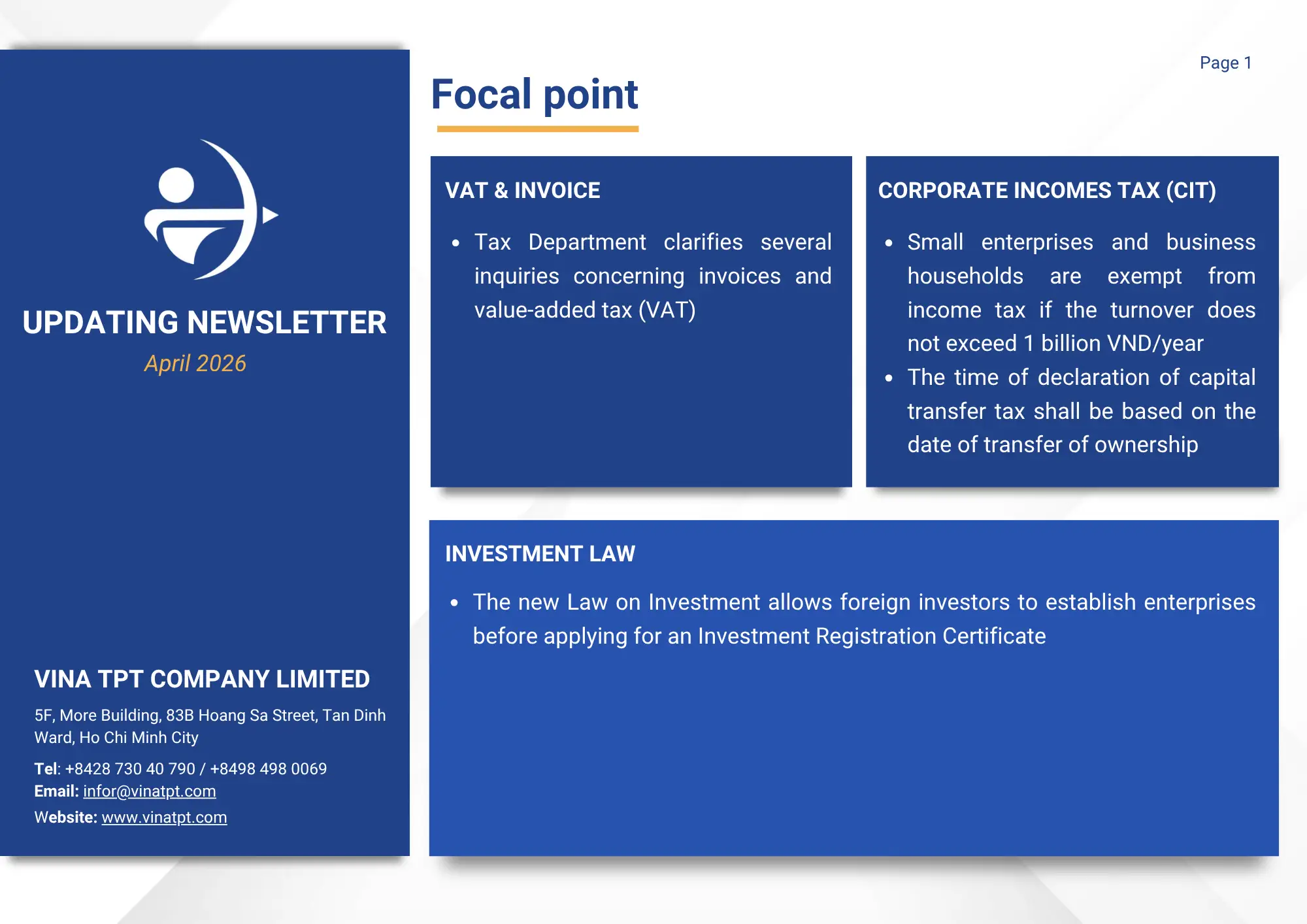
Vietnam’s Personal Income Tax 2026 law was amended Law No. 109/2025/QH15 and officially takes effect from July 1, 2026. Key rules for salary, wages, and business income, however, apply right from January 1, 2026. These updates significantly reduce the tax burden for employees and business owners amid rising living costs. 

This guide explains exactly how to calculate PIT in 2026, highlights the major changes (increased family deductions, simplified progressive rates, expanded exemptions), and provides clear, real-world examples so you can compute your tax accurately and stay fully compliant. 

1. Major Changes to Personal Income Tax from 2026 

2026 introduces the biggest PIT reforms since 2012, driven by the amended PIT Law 2025 and Resolution 110/2025/UBTVQH15. The goal is to ease pressure on middle-income earners, support digital businesses, and attract high-tech investment while keeping pace with economic growth and inflation. 

Change  Main Benefit 
Increased family deductions  Lower tax for individuals and families 
Simplified progressive brackets  Easier calculation, reduced tax for average incomes 
Expanded exemptions  Support for high-tech, agriculture, and green sectors 

These reforms make the tax system more modern, transparent, and easier to comply with. 

1.1 Increased Family Deductions Effective January 1, 2026 

From January 1, 2026, family circumstance deductions are raised to better match higher living costs, helping millions of taxpayers pay less personal income tax The personal deduction increases from VND 11 million to VND 15.5 million per month (VND 186 million per year), and the deduction per dependent rises from VND 4.4 million to VND 6.2 million per month. 

Type of Deduction  2025 Amount  2026 Amount 
Personal deduction  11 million/month  15.5 million/month 
Per dependent  4.4 million/month  6.2 million/month 

Who qualifies as a dependent? 

  • Children: Under 18; over 18 if disabled and unable to work; full-time students (university, college, vocational) under 22 with low or no income. 
  • Spouse: Unable to work or with very low/no income. 
  • Parents, grandparents, siblings: Elderly or disabled individuals with insufficient income, directly supported by the taxpayer. 

Key conditions 

  • Each dependent can be claimed by only one taxpayer. 
  • Proof is required (birth certificate, household registration, disability certificate, school enrollment, support commitment letter). 
  • Register with your employer or tax office (usually via Form 20-ĐK-TNCN) before tax is calculated. 

1.2 New Progressive Personal Income Tax 2026 Rates – Reduced from 7 to 5 Brackets 

Effective January 1, 2026, the progressive tax scale is simplified from 7 brackets to 5, with wider income ranges to reduce the effective tax rate for middle earners. The top rate remains 35%, now applying only to monthly taxable income over VND 100 million (previously VND 80 million). 

Bracket  Monthly Taxable Income (VND million)  Annual Taxable Income (VND million)  Tax Rate (%) 
1  Up to 10  Up to 120  5 
2  Over 10 to 30  Over 120 to 360  10 
3  Over 30 to 50  Over 360 to 600  20 
4  Over 50 to 100  Over 600 to 1,200  30 
5  Over 100  Over 1,200  35 

Old vs. new comparison The old 7-bracket system had narrower bands, pushing many middle-income earners into higher rates. The new structure is simpler and saves 5–15% in tax for most employees, while encouraging extra work without jumping brackets quickly. 

1.3 Expanded Exemptions, Reductions & Special Incentives 

The updated law adds 21 new exempt income categories starting in 2026, focusing on education, healthcare, green projects, and high-tech sectors. Additional benefits include a 50% reduction on certain investment income and a 5-year exemption for high-tech professionals. 

  • New exempt items: Certain overtime pay, scholarships, income from green bonds, organic agriculture, gifts under VND 10 million, disaster relief support. 
  • Special incentives: 5-year PIT exemption for experts in AI, semiconductors, and R&D; 50% reduction on income from investments in tech startups. 
Incentive Type  Condition  Duration 
Scholarship exemption  Full-time formal education  Indefinite 
5-year high-tech exemption  Experts in AI, semiconductors, R&D  5 years from 2026 
50% investment reduction  Green/technology startups  Applies to 2026+ income 

Proof (contracts, certificates) is required, often from the Ministry of Science and Technology. 

personal-incom-tax-2026-vina-tpt

2. How to Calculate Personal Income Tax in 2026 – Step-by-Step Guide 

Core formula Tax payable = Taxable income × Progressive tax rate Taxable income = Total income – Exempt items – Deductions (family + mandatory insurance + charity + eligible medical/education expenses) 

This applies to tax residents. Non-residents pay a flat 20% on Vietnam-sourced income. 

Step 1: Determine Your Tax Residency Status 

Start by confirming whether you are a tax resident or non-resident, as this determines what income is taxable. 

Under Vietnam’s PIT law: 

  • Tax resident: Present in Vietnam ≥183 days in the calendar year, or maintaining a permanent residence (owned home or long-term rental with registered address). 
  • Non-resident: Taxed only on income sourced from Vietnam. 

Tax implications 

  • Residents: Taxed on worldwide income using the 5-bracket progressive scale (5%–35%). 
  • Non-residents: Flat 20% on Vietnam-sourced salary and wages (other rates apply to specific types). 

Step 2: Calculate Taxable Income 

Basic formula: Taxable income = Total income – Exempt items – Deductions 

  1. Total income includes salary, bonuses, taxable allowances, business profits, investment returns, etc. 
  2. Exempt items include scholarships, certain overtime pay, small gifts, etc. 
  3. Deductions include: 
  • Family deduction (VND 15.5 million/month personal + VND 6.2 million/month per dependent) 
  • Mandatory social, health, unemployment insurance (BHXH, BHYT, BHTN) 
  • Charitable donations (with receipts) 
  • Medical & education expenses (new in 2026, up to VND 10 million/year – detailed guidance pending) 

Example In January 2026, Mr. A receives: 

  • Salary: VND 70,000,000 
  • Meal allowance (per company policy): VND 1,000,000 
  • Sales commission: VND 2,000,000 

No charitable contributions. Mr. A has one registered dependent (child under 18). 

Calculation: 

  • Total income: 70,000,000 + 1,000,000 + 2,000,000 = VND 73,000,000
  • Exempt: VND 1,000,000 (meal allowance) 
  • Deductions: 15,500,000 (personal) + 6,200,000 (dependent) + 4,200,000 (mandatory insurance) = VND 24,850,000
  • Taxable income = 73,000,000  – 1,000,000 – 24,850,000 = VND 47,150,000 per month 

Step 3: Apply the 2026 Progressive Rates

new-progressive-personal-income-tax-rates-vina-tpt

Apply the 5-bracket scale to taxable income, calculating tax portion by portion and adding them up. 

Continuing Mr. A’s example (monthly taxable income: VND 47,150,000): 

  • Bracket 1: VND 10,000,000 × 5% = VND 500,000 
  • Bracket 2: (30,000,000 – 10,000,000) × 10% = VND 2,000,000 
  • Bracket 3: (47,150,000 – 30,000,000) × 20% = VND 3,430,000 

Total PIT payable: 500,000 + 2,000,000 + 3,430,000 = VND 5,930,000 

Net take-home pay: 73M – 4.2M (insurance) – 5.93M (PIT) = VND 62,870,000 

3. Special Rules for Foreigners and Expatriates in Vietnam 

Foreign nationals (expats) and overseas workers follow specific PIT rules in 2026. 

  • Non-residents: Flat 20% on Vietnam-sourced income, withheld at source. 
  • Residents: Subject to the same progressive rates as Vietnamese citizens. 

Double Taxation Agreements (DTAs) Vietnam has over 80 DTAs (with the US, EU countries, Japan, Singapore, etc.). To claim relief: 

  • Submit Form NT5/TNCN 
  • Provide proof of tax residency in your home country 
  • Claim credit for taxes already paid abroad 

Example: A non-resident expat earning VND 50 million/month pays VND 10 million (20%) PIT. With a DTA, the rate may drop to 10–15%. 

These rules, plus the 5-year exemption for high-tech experts, make Vietnam attractive for skilled international professionals. 

4. Filing and Finalizing Personal Income Tax in Vietnam 

PIT filing and finalization are fully online via the General Department of Taxation portal (thuedientu.gdt.gov.vn) or eTax Mobile app. 

General deadlines (apply every year): 

  • Employer finalization (for authorized employees): By the last day of the 3rd month after year-end (usually March 31). 
  • Individual self-finalization: By the last day of the 4th month after year-end (usually April 30). → If the deadline falls on a holiday or weekend, it shifts to the next working day. 

Who must self-file? Individuals with income from two or more sources who do not meet authorization conditions, or those seeking refunds or adjustments. 

5. Vina TPT – Your 2026 PIT Solution for Expats & Businesses in Vietnam 

Vina TPT is a leading tax advisory firm in Vietnam specializing in Personal Income Tax services for expatriates and foreign-invested companies. Our experienced team provides full support, from 2026 PIT forecasting and calculation to DTA claims and maximum deduction optimization. 

Why choose Vina TPT? 

  • Free initial consultation with clear guidance 
  • Fast, accurate filing and deadline reminders 
  • Full compliance with 2026 regulations to minimize risks 

Key services 

  • PIT finalization for expats with multi-source income 
  • Assistance with high-tech and investment incentives 
  • HR training on payroll updates and withholding 

Need help with your 2026 Personal Income Tax in Vietnam? Contact Vina TPT today for expert, hassle-free support.

BOOK A FREE CONSULTATION

Vietnam to Implement Mandatory Electronic Employment Contracts from July 1, 2026

Vietnam to Implement Mandatory Electronic Employment Contracts from July 1, 2026

vietnam-electronic-employment-contracts-vinatpt

1- Overview of Decree 337/2025/ND-CP (Electronic Employment Contracts)

Decree 337/2025/ND-CP, issued by the Government of Vietnam on December 24, 2025, marks an important milestone in the digitalization of labor relations. This Decree focuses on providing detailed regulations on electronic employment contracts, aiming to promote digital transformation in human resources and labor management.

Although the Decree takes effect on January 1, 2026, the specific regulations on the conclusion and implementation of electronic employment contracts will be fully applied from July 1, 2026, coinciding with the official operation of the National Electronic Employment Contract Platform.

The Decree consists of 5 chapters and 30 articles, developed based on the 2019 Labor Code and the 2023 Law on Electronic Transactions. Its main contents focus on the following aspects:

Definition and legal validity 

An electronic employment contract is defined as an employment contract concluded in the form of electronic data messages and has the same legal validity as a traditional paper-based employment contract. This ensures that electronic employment contracts are fully legally enforceable, provided that they comply with regulations on digital signatures, trusted timestamps, and data security
(Source: Decree 337/2025/ND-CP, Article 4).

Principles of application 

The parties involved must strictly comply with laws on labor, electronic transactions, cybersecurity, personal data protection, and electronic data storage. The Decree emphasizes voluntariness, equality, and protection of employees’ rights, while encouraging the use of electronic employment contracts to gradually replace traditional paper-based contracts, thereby reducing administrative burdens.

National platform 

Developed and managed by the Ministry of Home Affairs, the national platform will assign a unique identification code (ID) to each electronic employment contract, enabling state authorities to easily search, manage, and supervise employment relationships. This not only enhances transparency but also supports enterprises in periodic labor reporting
(Source: Government News Portal).

Scope of application 

The Decree applies to all enterprises, employers, and employees in Vietnam, including foreign employees working in Vietnam. It also clearly regulates the conversion of paper-based employment contracts into electronic form, requiring digital signatures to confirm the accuracy and authenticity.

2- How does this impact businesses? 

The issuance of Decree 337/2025/ND-CP will bring significant changes to businesses in Vietnam, especially in the context of accelerating digital transformation. Electronic employment contracts are not only a modernization tool but also offer substantial practical benefits, while also posing certain challenges that businesses must address. 

2.1 Key benefits for businesses 

  • Cost and time savings:
    Instead of printing, storing, and physically transferring documents, businesses can conclude electronic employment contracts remotely via digital platforms. For example, a multi-branch company can sign contracts with employees in different provinces without face-to-face meetings, potentially reducing administrative costs by up to 50%, according to HR experts.
  • Greater flexibility and management efficiency:
    With identification codes assigned on the national platform, businesses can easily search, update, and report employment data. This is particularly beneficial for large companies managing thousands of employment contracts. In addition, electronic employment contracts can be integrated with internal HR systems, helping to automate recruitment, payroll, and attendance processes. 
  • Enhanced transparency and legal compliance:
    Electronic contracts protected by digital signatures and trusted timestamps reduce the risk of forgery or document loss. Businesses can easily demonstrate compliance with the Labor Code during inspections by state authorities while protecting the rights and interests of both parties. 
  • Competitive advantage:
    Enterprises that adopt electronic employment contracts early are more attractive to young, tech-savvy talent and are better aligned with modern remote-working trends. 

2.2 Challenges and potential risks 

  • High technical requirements:
    Businesses must invest in digital signatures, security systems, and connectivity with the national platform. Without timely preparation, companies may face difficulties from July 1, 2026, leading to delays in signing new employment contracts. 
  • Data security risks:
    Electronic storage increases the risk of personal data breaches if cybersecurity measures are inadequate. Although the Decree requires compliance with the 2018 Cybersecurity Law, many small businesses may lack sufficient resources. 
  • Transition from existing contracts:
    Existing paper-based employment contracts need to be converted into electronic form in oder to be integrated into the national platform, requiring time and costs for digital signature authentication. 
  • Impact on employees:
    Some older employees or workers in remote areas may not be familiar with digital tools, requiring additional training and support from employers. 

Overall, Decree 337/2025/ND-CP promotes deeper integration of Vietnamese businesses into the digital economy but requires careful preparation to maximize benefits while minimizing risks. 

Decree-3372025ND-CP-Electronic-Employment-Contracts-VinaTPT

3 – What should businesses prepare for electronic employment contracts before 01 July 2026? 

To comply with Decree 337/2025/ND-CP and effectively implement electronic employment contracts, businesses should develop a detailed preparation plan as early as possible. The following practical steps are recommended: 

  • Build technical infrastructure:
    Register digital signatures for legal representatives and HR staff with licensed public certification authorities (CAs) such as Viettel CA or VNPT CA. Ensure that internal systems support secure digital signing and data storage, in compliance with ISO 27001 standards. 
  • Select an eContract service provider:
    Choose reputable providers licensed to authenticate electronic data messages, such as FPT, Viettel, or VNPT. Providers must meet 13 technical requirements stipulated in the Decree, including API connectivity with the national platform and robust data security measures. 
  • Prepare digital identification documents:
    Collect electronic citizen IDs, business registration certificates, and Level-2 electronic identification accounts for both individuals and enterprises. Employees should be encouraged to use biometric authentication (fingerprints or facial recognition) to enhance security. 
  • Training and internal process updates:
    Organize training sessions for HR teams on electronic employment contract workflows, including sending and receiving contracts, dispute handling, and reporting via the national platform. Update internal HR manuals to incorporate the new regulations. 

To support businesses in implementation, companies such as Vina TPT—a professional provider of HR, payroll, and labor compliance services in Vietnam—can serve as an ideal partner. With extensive experience in payroll outsourcing, Vina TPT helps enterprises integrate electronic employment contracts effectively and in compliance with regulations. 

Decree 337/2025/ND-CP is not only a legal requirement but also an opportunity for Vietnamese businesses to modernize HR management. Early preparation will help minimize risks and maximize the benefits of electronic employment contracts.

If you need advice tailored to your company’s specific situation, please contact Vina TPT for prompt and professional support. 

EXPLORE OUR HR SERVICES

Essential Step For Setting Up a Company in Vietnam| Trading Businesses

setting-up-a-company-in-vietnam-trading-Vina-TPT-Legal

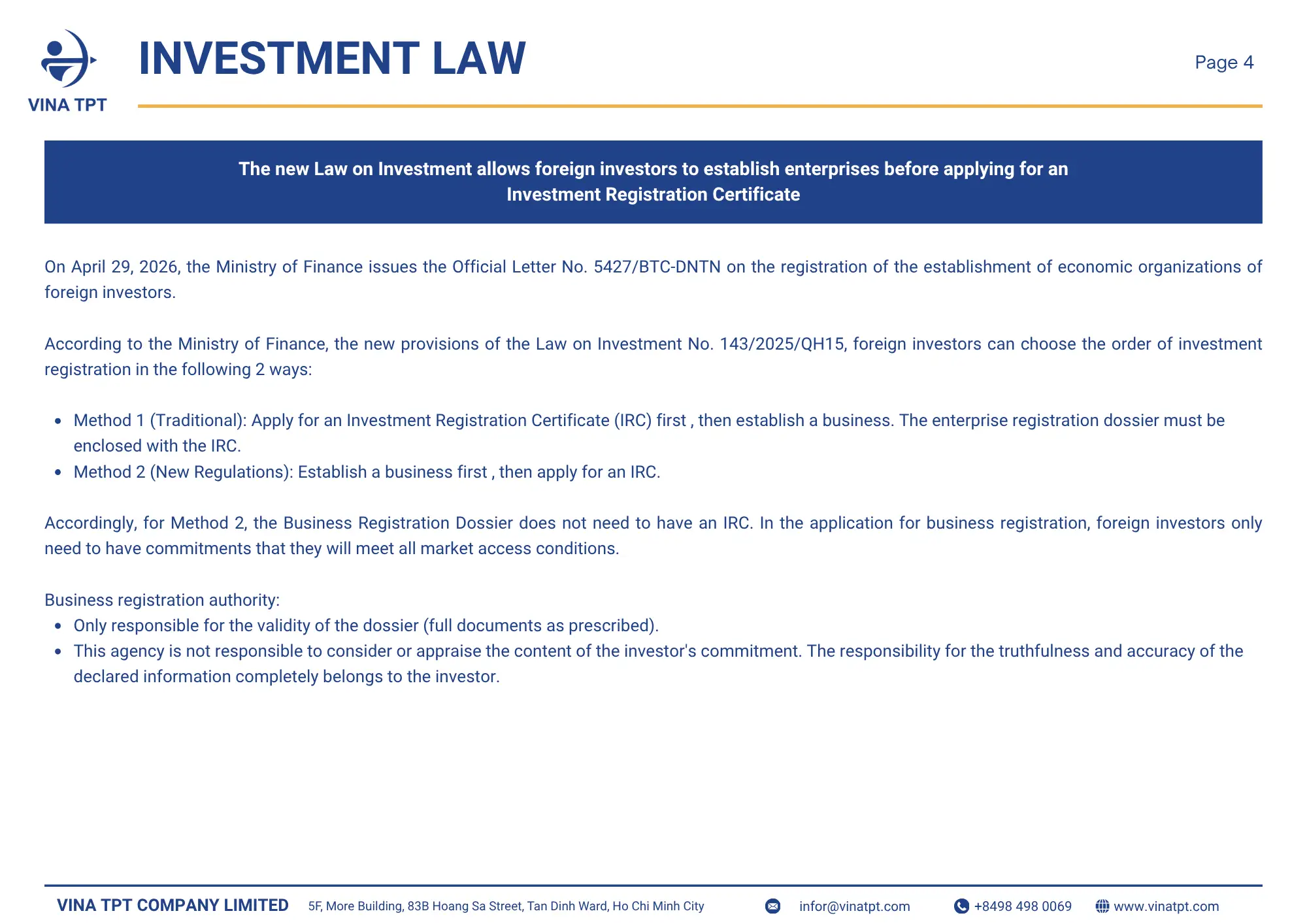
Are you looking for a solution for setting up a company in Vietnam and explore opportunities in one of Asia’s fastest-growing economies? Vietnam, with its strategic geographic location along the South China Sea and borders with China, Laos, and Cambodia, has become a top destination for foreign investors in the trading sector. However, full legal compliance is essential for sustainable success, governed by the Law on Investment 2020 (amended in 2025) and the Law on Enterprises 2020. This comprehensive guide details the essential steps to set up a trading company in Vietnam, from basic concepts to full operations, catering to both informational and transactional search intent. 

  • Key Benefits: Access to FTAs for tariff reductions, excellent logistics positioning, and policies allowing up to 100% foreign ownership in most trading activities. 
  • Challenges to Consider: Administrative procedures can take 1–6 months, and it’s crucial to stay updated on recent changes, such as the 2025 Investment Law amendments permitting company establishment before obtaining the Investment Registration Certificate (IRC). 

By following these steps carefully, you can successfully start a business in Vietnam as a foreigner. 

1/ What is a Trading Company in Vietnam? 

A trading company in Vietnam specializes in buying and selling goods, including import, export, wholesale/retail distribution, and related services, regulated by Decree 09/2018/ND-CP (with a replacement draft under discussion in 2025). Unlike manufacturing companies, which focused on production or service providers offering labor or consulting, trading companies serve as intermediaries in the supply chain, connecting producers with consumers. With Vietnam’s exports surging by 28% in 2025, this sector is booming—especially in electronics, textiles, and agricultural products. According to the Ministry of Industry and Trade, trading contributes 15–20% to GDP, with an average annual growth rate of 9–10% over the past decade, fueled by international integration. 

Key Activities: 

  • Importing goods from abroad for domestic distribution. 
  • Exporting Vietnamese products to global markets. 
  • Wholesale and retail distribution through traditional or online channels. 
  • Logistics, warehousing, and product promotion services. 

Comparison table with other business types: 

Type  Key Characteristics  Example 
Trading  Focuses on buying/selling, no production  Mobile phone importer, apparel distributor 
Manufacturing  Produces goods from raw materials  Textile factory, electronics component maker 
Services  Provides labor or advisory services  Software consulting, management consulting 

2/ Benefits and Challenges of Setting Up Company in Vietnam 

Setting up a trading company in Vietnam offers substantial advantages but also involves challenges. Here is a clear comparison: 

Benefits  Challenges  Illustrative Example 
Young market with 100 million consumers and high demand  Complex and potentially lengthy administrative procedures Textile exports grew by 20% due to young population 
Strategic location near China and major sea routes  A local partner is required hoặc Local partners are required Logistics advantages reduce transport costs by 15% 
FTAs reduce tariffs and open access to EU and US markets  Currency fluctuations and legal risks  EVFTA boosts agricultural exports by 25% 

The benefits clearly outweigh the challenges with proper planning. For example, foreign investors can leverage FTAs to expand markets but must comply with regulatory requirements such as the Economic Needs Test (ENT) for multiple retail outlets. 

3/ Legal Requirements and Foreign Ownership Rules 

Under the Law on Investment 2020 (amended 2025) and the Law on Enterprises 2020, Vietnam permits up to 100% foreign ownership in most trading sectors, except for restricted industries such as pharmaceuticals, oil and gas, and printing. The 2025 amendments (effective from 2026) simplify procedures by allowing company registration before IRC issuance and reducing conditional business lines from 243 to approximately 200. These changes have driven record FDI inflows in 2025. Compliance with Decree 09/2018/ND-CP (a replacement draft pending) remains required for foreign-invested trading operations. 

Key Requirements: 

  • Investment registration with the Department of Finance (DOF) 
  • Compliance with WTO market access commitments. 
  • ENT evaluation for retail operations involving multiple stores. 

Restricted Product Categories and Conditional Business Lines 

Certain products are restricted or required special conditions under the Investment Law and Decree 09/2018/ND-CP, such as explosives, printing materials, and pharmaceuticals. 

Summary table: 

Product Category  VSIC Code  Restrictions 
Explosives  2029  Import prohibited except for national defense purpose
Printing Materials  1811  Requires approval from Ministry of Information 
Pharmaceuticals  2100  Foreign ownership limited to 49% 

Verification checklist: 

  • Check the national portal for conditional business lines. 
  • Assess legal risks with a local lawyer. 
  • Monitor the draft replacement of Decree 09 for 2026 updates. 

setting-up-a-company-in-vietnam-trading-Vina-TPT-Tax-Consultant

4/ Choosing the Right Business Structure 

Selecting the right business structure for your trading company depends on its scale and ownership. Under the Law on Enterprises 2020, the two most common forms are the Limited Liability Company (LLC) and the Joint Stock Company (JSC), with the LLC being ideal for smaller businesses due to its simpler procedures. 

  • LLC Pros & Cons: Flexible, liability limited to contributed capital; drawback: harder to raise large capital. 
  • JSC Pros & Cons: Easier to list on stock exchanges; drawback: more complex structure, requires at least 3 shareholders. 

Comparison table: 

Structure  Number of Members  Legal Liability 
LLC  1–50  Limited to contributed capital 
JSC  Minimum 3  Limited to share capital 

For foreign investors with limited capital, an LLC is the best choice for a fast start. 

LLC vs. JSC: Which is Best for Trading? 

Detailed comparison: 

LLC  JSC  Best for Trading 
Simple procedures, flexible capital  More complex, easier expansion  High for small businesses, local distribution 
No board of directors required  Requires diverse shareholders  Lower if needing large capital for exports 

LLC is generally more suitable for trading due to its flexibility. For example, a foreign agricultural trading company often opts for an LLC to quickly begin import operations. 

Consult a Business Setup Expert

5/ Capital Requirements and Financial Planning 

Vietnam imposes no fixed minimum capital for trading companies, but charter capital must be “reasonable” to demonstrate operational capability. A typical recommendation is USD 10,000–50,000, depending on the business plan. Total investment capital includes charter capital and other expenses, with full contribution required within 90 days of registration. 

Financial preparation checklist: 

  • Estimated setup costs: USD 3,000–10,000 for procedures and office. 
  • Reserve for VND/USD exchange rate risks. 
  • Budget for taxes and employee salaries. 

Estimated capital table: 

Recommended Capital  Purpose 
USD 10,000  Basic operations, small-scale distribution 
USD 50,000  Expansion of import/export activities 

6/ Essential Steps to Setting Up a Company in Vietnam as a Foreign Investor 

Setting up a foreign-invested company in Vietnam requires following a clear, structured process to ensure full legal compliance and smooth operations. This step-by-step guide is tailored for foreign-owned trading or commercial entities. 

Step 1: Prepare Your Investment Documentation 

Gather all necessary paperwork for your investment project. This includes defining your business model (e.g., Limited Liability Company – LLC, joint venture, or representative office), choosing the right structure, and outlining main activities. Verify that your industry allows foreign ownership under Vietnamese law. 

Step 2: Submit Application for the Investment Registration Certificate (IRC) 

The IRC is the foundational approval for foreign-invested enterprises. It authorizes your project and details the charter capital, scale, location, and business scope. Without an IRC, you cannot proceed to company registration. 

Required documents: 

  • Application form and a detailed project proposal (objectives, scale, capital, location, and timeline). 
  • Proof of financial capability (bank statements, audited financials, or credit agreements). 
  • Legal documents: notarized passport (individuals) or business registration certificate (organizations), both legalized. 
  • Proof of location (lease agreement or land use rights). 
  • Power of attorney (if using a third-party service). 

Foreign documents require consular legalization and official Vietnamese translation. Partnering with a professional company setup service such as Vina TPT is recommended to avoid delays. 

Step 3: Obtain the Enterprise Registration Certificate (ERC) 

After the IRC issuance, register the company to receive the ERC, which establishes its legal identity in Vietnam. 

Step 4: Open a Corporate Bank Account and Inject Charter Capital 

Open a dedicated capital account at a licensed Vietnamese bank. Contribute the full charter capital within 90 days of ERC issuance to avoid penalties and ensure the credibility for future permits. 

Step 5: Complete Tax Registration and Post-Licensing Formalities 

Register for a tax ID, VAT, and fulfill obligations such as social insurance and labor compliance if hiring staff. 

Step 6: Secure Industry-Specific Licenses (If Applicable) 

Sectors like trading, retail, F&B, education, or e-commerce may require additional permits. 

By following these steps and staying updated on regulations, foreign investors can successfully set up company in Vietnam.

setting-up-a-company-in-vietnam-trading-Vina-TPT

7/ Taxation, Compliance, and Ongoing Operations 

Foreign-invested trading enterprises (FDIs) in Vietnam must strictly comply with tax, labor, and periodic reporting obligations to avoid penalties and maintain legal standing. 

A – Taxes: 

  • Corporate Income Tax (CIT): 20% (15–17% incentives for SMEs from late 2025 if revenue < VND 50 billion); quarterly provisional payments (at least 80% of annual obligation); due by the 30th of the first month of the following quarter; annual declaration within 90 days after the fiscal year-end. 
  • Value Added Tax (VAT): 8–10% (reduced to 8% until 2026); monthly declaration (revenue > VND 50 billion/year) or quarterly declaration; due by the 20th of the following month or the end of the first month of the next quarter; retain invoices for deductions. 
  • Personal Income Tax (PIT): 5–35% (residents) or 20% (non-residents); withholding and declaration monthly/quarterly, aligned with VAT; annual employee declaration. 
  • Other fees (environmental protection, resource tax, land use): Usually annually or on an event basis, with changes required to be reported within 30 days.

B – Laws and Other Compliance: 

  • Labor Law 2019 (amended): Work permits for foreigners; quarterly labor reports; standard contracts; monthly social insurance contributions (pension, health, unemployment insurance). 
  • Intellectual Property: Registration and monitoring (annual review recommended). 
  • Financial Reporting: Annual audited financial statements for FDI, submitted with final CIT. 
  • Transfer Pricing: Local/master file prepared annually, submitted within 90 days after the fiscal year-end if thresholds are met. 

Compliance Checklist: 

Requirement  Details  Frequency  Deadline  Penalties if Violated 
VAT Declaration & Payment  Input/output, deductions (Form 01/GTGT or 04/GTGT)  Monthly (>50B VND) or quarterly  20th of next month or end of first month of next quarter  0.03%/day interest, disallowed deductions, audits 
PIT Withholding & Declaration  Employee withholding (Form 05/KK-TNCN)  Monthly/quarterly  20th or end of the first month of next quarter; annual within 90 days  Daily fines, criminal liability 
Provisional CIT Payment  Estimated profit-based  Quarterly  30th of the first month of next quarter  Interest if below 80% the annual obligation 
Social Insurance  Contributions and reporting  Monthly  Aligned with PIT monthly/quarterly  Late fees, hiring restrictions 
Labor Usage Report  Employee numbers and changes  Quarterly  End of the quarter  Administrative fines, suspension 
FCT Declaration  Payments to foreign contractors  Monthly or per payment  20th of the next month or 10 days after payment  Employer liability, heavy fines 
Transfer Pricing  Local/master file  Annually  90 days the after fiscal year-end  Audits, tax adjustments 
Audited Financial Statements  VAS-compliant with independent audit  Annually  With final CIT (90 days)  Mandatory audits, penalties for errors 

FDI companies should engage professional accounting services and monitor updates such as Decree 132/2025/ND-CP on CIT, ensuring electronic filing with digital signatures. 

8/ Frequently Asked Questions (FAQs) 

  • Can foreigners own 100% of a trading company in Vietnam? 

Yes, foreign investors can own up to 100% in most sectors, including import-export and distribution. Exceptions apply to restricted sectors such as pharmaceuticals, oil and gas, or printing, where ownership may be limited or may require a local partner. 

  • What is the minimum capital required? 

No fixed minimum capital exists for most trading companies. Charter capital must be reasonable to support operations. Authorities often recommend at least USD 10,000 to show financial capability and avoid delays. The exact amount depends on your business plan and scale. 

  • How long does it take to set up? 

Setting up a business in Vietnam as a foreigner typically takes 1–2 months, depending on the complexity and the province. The IRC usually takes 30–45 working days, the ERC follows in 7–14 days. Additional licenses and post-registration steps may extend the timeline. 

  • Do I need a local partner? 

For general trading (import, export, wholesale, and distribution), no local partner is needed—100% foreign ownership is allowed. In restricted or conditional sectors (e.g., multi-outlet retail, pharmaceuticals, and media), a local partner or joint venture may be required. 

  • How to start a business in Vietnam as a foreigner? 

Follow these key steps: obtain the Investment Registration Certificate (IRC), then the Enterprise Registration Certificate (ERC), secure trading or sector-specific licenses, open a corporate bank account, contribute charter capital, and complete tax registration. Using professional services like Vina TPT’s company setup service ensures accuracy and efficiency. 

Vina TPT – Your Trusted Partner for Foreign Businesses in Vietnam 

Vina TPT is one of Vietnam’s leading company formation consultancies, specializing in helping foreign investors to set up companies in Vietnam for trading, manufacturing, and services. With over 20 years of experience, Vina TPT has assisted hundreds of FDI companies from Europe, the US, Japan, Korea, and Singapore in successfully obtaining IRCs, ERC, and required licenses in minimal time. 

  • Multilingual Expert Team: Lawyers, accountants, and registration specialists fluent in English, Japanese, and more for seamless communication. 
  • Fast and Transparent Process: Commitment to completing the IRC in 30–45 working days and the ERC in 7–14 days, with a near-100% success rate. 
  • Full-Service Package: From company registration to capital advisory, bank account opening, tax filing, work permits, social insurance, and transfer pricing support. 
  • Competitive and Transparent Pricing: Clear quotes with no hidden fees, ideal for SMEs. 
  • Long-Term Post-Setup Support: Daily operational guidance and updates on the latest laws (including the 2025 Investment Law changes) to minimize risks and support sustainable growth. 

We go beyond simply setting up a company in Vietnam – we help you build a strong foundation for success. With our commitment to “Fast – Accurate – Cost-Effective” service, Vina TPT saves time, reduces legal risks, and lets you focus on business growth. Hundreds of satisfied clients trust Vina TPT – contact us today for a free consultation and a personalized quote tailored to your needs. 

BOOK A FREE CONSULTATION

Good-Business-Ideas-to-Start-in-Vietnam_-Company-Setup-Profitable-Opportunities-Vina-TPT


Top 10 | Ideas for small business in Vietnam for Foreign Investors

1. Overview of Business Opportunities for Foreigners

If you’re exploring ideas for small business in emerging markets, Vietnam stands out as one of the fastest-growing economies in Southeast Asia, backed by a young population, a dynamic workforce and rising consumer demand. Foreign investors can tap into numerous developing sectors.

The Vietnamese market is particularly attractive due to the growth of the middle class, new consumer habits and high demand for quality services. Large cities such as Hanoi, Ho Chi Minh City, Da Nang are ideal destinations to test small business models and implement innovative ideas.

2. Profitable Ideas for Small Business

Below are ideas for small business suitable for foreign investors in Vietnam, detailed implementation so that customers can evaluate the potential:

F&B (Food & Beverage):

  • Coffee shops, restaurants, milk tea stalls with creative concepts.
  • Delivery services, processing organic food, healthy food.
  • Business in foreign specialties or combining local culinary culture.

Education services:

  • Foreign language centers, skills training, teaching STEM or coding for children.
  • Online classes, edu-tech models combined with offline.

E-commerce:

  • Online retail, dropshipping, or specialized sales platforms.
  • Providing unique imported products, targeting middle-class customers.

Light Manufacturing:

  • Processing agricultural products, packaged foods, manufacturing handmade products.
  • Producing small consumer products, souvenirs or fashion accessories.

Support and logistics:

  • Transportation, warehousing, fulfillment for e-commerce.
  • Business consulting, marketing, or office rental services.

Tourism & Travel:

  • Boutique travel agencies, guided tours, eco-tourism, and adventure trips.
  • Services combining local culture, culinary experiences, and foreign-language support.

Health & Wellness:

  • Fitness studios, yoga centers, spas, wellness retreats.
  • Health coaching, organic/natural product shops, or dietary consultation services.

Tech & Digital Solutions

  • App or software development for small businesses, fintech solutions.
  • Digital marketing agencies, social media management, or website development.

Creative & Arts Services

  • Photography studios, interior design, handmade crafts, or art workshops.
  • Event planning, wedding services, or cultural experience workshops for foreigners.

Green & Sustainable Businesses

  • Eco-friendly products, recycling services, sustainable packaging, or zero-waste shops.
  • Solar energy solutions or small-scale environmental consulting for local businesses.

These ideas for small business are suitable for small and medium investment capital, flexible in implementation and can be tested in big cities or niche markets.

4. Key Considerations for Compliance and Operations

When planning to implement ideas for small business in Vietnam, foreign investors need to understand some basic factors about operations and legal compliance. Although you do not need to go into the details of the law, understanding these points will help avoid future risks and ensure the company operates smoothly.

4.1 Tax compliance and financial reporting

Every business in Vietnam must declare value-added tax (VAT), corporate income tax (CIT) and personal income tax (if it has employees). Preparing accounting books from the beginning will help businesses easily prepare monthly, quarterly and year-end financial reports, and avoid tax arrears or administrative fines.

4.2 Social insurance and employee benefits

If a business hires local workers, paying social insurance, health insurance and unemployment insurance is mandatory. This is an important factor to ensure employee benefits and compliance with Vietnamese labor laws.

4.3 Compliance with basic industry and legal regulations

Some industries, such as F&B, education or logistics, require specific business licenses or sub-licenses. A basic understanding of these requirements will help investors choose the right business model and avoid legal risks.

GET LEGAL SUPPORT

4.4 Manage operations and administrative records

Preparing basic procedures such as registering for a tax code, opening a corporate bank account and keeping complete records will help businesses operate effectively right from the start.

In short, understanding the above notes helps investors plan in advance, minimize risks and focus on implementing business ideas, without having to go too deep into detailed regulations on laws and taxes.

5. How Vina TPT Supports Foreign Investors

Vina TPT provides comprehensive services for foreign investors, including:

  • Company setup & registration at state agencies and corporate bank account opening.
  • Accounting & tax compliance: bookkeeping, financial reports, tax registration, declarations, and handling tax inquiries.
  • Payroll & social insurance: payroll calculation, insurance registration, and labor report submissions.
  • Work permit & visa support for foreign employees.
  • Ongoing legal compliance to ensure smooth operations.

With more than 20 years of experience supporting startups and FDI enterprises in Vietnam, Vina TPT commits to providing fast, transparent and legally compliant services, helping investors feel secure from the company setup step to initial operation, optimizing time and costs, while ensuring the business operates effectively and safely.

Explore business opportunities in Vietnam and start your investment journey with Vina TPT

BOOK A FREE CONSULTATION

Top-20-Sectors-for-Business-Opportunities-in-Vietnam-VTPT

Open Business Bank Account in Vietnam for Foreign-Invested Enterprises (FDI)


How to Open Business Bank Account in Vietnam for FDI: Step-by-Step Guide

Are you a foreign investor setting up an FDI company in Vietnam? Opening a business bank account is not just the first essential step—it’s a legal requirement to manage investment capital and daily operations. This comprehensive 2025 guide walks you through every stage, from document prep to account activation, based on the Investment Law 2020 and Enterprise Law 2020. Let’s get your open best business bank account for LLC or corporation up and running—fast and compliant. 

1. Why Foreign Investors Need to Open Business Bank Account in Vietnam 

Opening business bank account in Vietnam is critical for FDI compliance and financial transparency. The State Bank of Vietnam (SBV) mandates that all FDI entities maintain dedicated accounts to contribute charter capital and conduct international transactions. This protects assets and enables legal profit repatriation. Here’s why it matters. 

Strategic Importance 

  • Efficient foreign exchange management: Seamlessly transfer funds globally and access offshore loans.
  • Financial transparency: Track expenses, taxes, and annual audits with ease.
  • Build credibility: A dedicated account boosts trust with partners and Vietnamese authorities.
  • Flexible profit repatriation: Move earnings abroad after tax obligations—via the right account.

The Two Essential Accounts 

FDI companies must open two core accounts:  

  • Direct Investment Capital Account (DICA) – for capital contributions.
  • Current Account – for daily operations.

DICA is opened first and is non-negotiable for receiving registered capital. 

2. Step-by-Step Guide to Open Business Bank Account 

The process typically takes 1 week, depending on the bank and document readiness. We break it into four logical phases: Preparation, Bank Selection, Submission, and Activation—all aligned with the Banking Law 2010 and 2025 forex rules. 

Phase 1: Pre-Registration Requirements 

Complete business registration before approaching any bank. 

Legal Entity Establishment 

  • Register with the Department of Planning and Investment (DPI) to obtain:
  • Investment Registration Certificate (IRC) – for the investment project.
  • Enterprise Registration Certificate (ERC) – for company setup.
  • Secure a tax code and enterprise code.
  • Prepare valid passport and visa for the legal representative.

Capital Commitment 

The capital amount stated in the IRC must be fully contributed within 90 days of ERC issuance. The bank opens a DICA to monitor inflows—ensuring SBV compliance. 

Example: If registered capital is $100,000, the full amount must enter the DICA before the deadline. 

Phase 2: Choosing Your Bank Wisely 

Choosing the best business bank account impacts fees, speed, and English support. Prioritize institutions with proven FDI experience.

Key Selection Criteria 

  • FDI expertise: Banks that have processed thousands of DICA openings.
  • Low forex fees: Competitive VND/USD conversion rates and free large transfers.
  • English digital banking: 24/7 mobile apps for international wires.
  • Branch network: Presence in Ho Chi Minh City, Hanoi, and Da Nang.

Top Recommendations (2025) 

  • HSBC & Standard Chartered: Best for global FDI—fast forex, full English support.
  • Vietcombank & BIDV: State-owned, low fees, strong local DICA experience.

Tip: Consider ACB, UOB, or VietinBank for additional best business bank account options. 

Phase 3: Documentation and Submission 

This is the core phase. All documents must be notarized or translated into Vietnamese if required. 

Mandatory Document Checklist

Document  Requirement 
Investment Registration Certificate (IRC)  Notarized copy 
Enterprise Registration Certificate (ERC)  Notarized copy 
Account Opening Resolution (Board-approved)  Original, signed by legal rep 
Passport & visa of legal representative  Notarized copy 
Proof of company address (lease agreement)  Notarized copy 
Chief Accountant / Finance Manager details  Original (if applicable) 
Specimen signature & company seal  Original 

Note: Requirements follow SBV guidelines and may vary slightly by bank. 

Power of Attorney (POA) 

If the legal representative cannot sign in person, a notarized POA (at a Vietnamese notary or consulate) is required. It must explicitly authorize account opening and management. 

Phase 4: Account Activation and Initial Deposit 

Banks review applications in 3–7 days. Once approved: 

  • Transfer capital from abroad into the DICA.  
  • Activate online banking and access rights.  
  • Set up transaction alerts for forex monitoring. 

Capital Contribution Deadline 

Per the Investment Law, full capital must arrive within 90 days of ERC issuance. Late contributions risk VND 10–50 million fines or license revocation. Banks report violations to the SBV.

3. Understanding the Two Mandatory Account Types for FDI 

FDI firms must maintain separate accounts under SBV forex rules. This ensures transparency and prevents misuse of investment capital.

3.1 Direct Investment Capital Account (DICA) 

A dedicated account for direct investment, opened in the currency registered in the IRC (usually USD or VND).

Purpose and Permitted Transactions 

  • Receive capital contributions from foreign investors.  
  • Accept international loans.  
  • Repatriate profits and dividends (post-tax).  
  • Repay foreign debt. 

Strict Compliance Rules 

Every DICA transaction requires supporting documents (invoices, loan agreements). Violations may trigger account freezes under Decree 88/2019/ND-CP. 

3.2 Current Account (Operating Account) 

Opened after DICA and linked to it—for daily business spending. 

Purpose and Permitted Transactions 

  • Pay salaries and VAT.  
  • Purchase local goods and services.  
  • Receive payments from Vietnamese clients.  
  • Make VND domestic transfers. 

Interplay Between Accounts 

Funds flow one-way only: DICA → Current Account. Reverse transfers are prohibited to protect investment capital. 

Bonus: You may open additional accounts (e.g., payroll, project, escrow, or multi-currency) based on operational needs. 

4. Common Challenges and Expert Solutions 

Based on 2025 FDI consulting experience, here are frequent hurdles—and how to solve them. 

Challenge 1: Foreign Currency Management 

Risk: VND/USD rate fluctuations erode profits. 

Solution: Open a parallel foreign currency account with DICA. Use HSBC’s hedging tools to lock rates. Monitor daily SBV conversion limits. 

Challenge 2: KYC/AML Delays 

Risk: Incomplete Ultimate Beneficial Owner (UBO) data extends review by 2–4 weeks. 

Solution: Submit UBO passports and financial history early. 

Challenge 3: Legal Representative Changes 

Risk: Delays in updating DPI and bank records. 

Solution: File updated resolution + new POA. Takes 5–10 days. 

Challenge 4: Profit Repatriation 

Risk: Complex documentation delays transfers. 

Solution: Prepare audited financials, tax clearance from the Tax Department, and route via DICA. Processing: 15–30 days (Circular 19/2014/TT-NHNN). 

5. Value-Added: Comparison of Top Banks for FDI (2025) 

Bank  DICA Opening Fee  English Support  Processing Time  FDI Experience 
HSBC  Free  High  3–5 days  Excellent (Global) 
Standard Chartered  Low  High  4–7 days  Strong 
Vietcombank  Free  Moderate  5–10 days  High (Local) 
BIDV  Low  Moderate  7–14 days  Good 

6. Simplify the Process with Vina TPT Accounting Services 

As a leading provider of accounting, tax, and FDI consulting in Vietnam, Vina TPT Accounting Services has supported over 200 foreign companies in compliant financial setup—including opening business bank accounts, VAT/PIT/CIT reporting, and multinational HR. 

Our all-in-one support includes: 

  • Bank selection advisory: Match HSBC, Standard Chartered, or Vietcombank to your capital and forex needs.
  • Full document preparation & verification: IRC, ERC, POA, signatures—100% notarized and compliant.
  • Proxy submission & KYC follow-up: Reduce approval time to 3–5 business days.
  • Capital contribution guidance: Ensure 90-day compliance and avoid penalties.

Special: Open DICA + Current Account simultaneously with instant English online banking.

Contact Vina TPT now for consultation on opening a business bank account

accounting service Vietnam for FDI company vtpt


[HCM] Hiring | Human Resources Consultant Assistant

Human Resources Consultant Assistant at Vina TPT – a great choice for those looking for jobs in Vietnam. This role offers the opportunity to work with FDI companies, gain hands-on experience in accounting and tax, HR advisory, and build your career in a professional, dynamic environment.

About Vina TPT

Vina TPT is a reputable and professional Accounting, Tax, HR, and Business Advisory Services company in Vietnam. Our mission is to deliver value-added financial consulting services that help clients achieve a strong competitive advantage in a rapidly changing business environment. We specialize in providing tailored solutions for FDI companies in Vietnam, helping them navigate complex tax regulations, streamline accounting processes, and ensure compliance with local laws.

By joining Vina TPT, you will become part of a dynamic and professional team, working alongside industry experts and gaining experience across multiple sectors.

Job description / Main responsibility:

As a Human Resources Consultant Assistant, you will be able to participate in providing HR services for FDI companies in Vietnam. You will have the opportunity to gain critical skills that are essential to advance career paths in the field of HR consulting.

  • Support the salary and benefits system for Clients, including calculating salaries, bonuses, allowances, insurance benefits, Personal Income Tax (PIT) declarations;
  • Support performing procedures related to labor contracts for Clients, including drafting contracts, managing employee records, and monitoring contract expiration dates;
  • Support receiving and processing recruitment-related documents for Clients, including posting job openings, screening candidates, scheduling interviews, and tracking results;
  • Support resolving labor relations issues for Clients, including disciplinary actions, handling complaints, and advising employees on labor law-related matters;
  • Perform other HR administrative tasks for Clients, including managing employee records, tracking leave days, and updating employee information;
  • Other tasks/duties as requested by Clients/HR team leaders, etc.

Working location: Company Office – 83B Hoang Sa, Tan Dinh Ward, Ho Chi Minh City

Requirements:

Educational Background:

– Bachelor’s degree in Human Resource Management, Law, Economics, Accounting or related fields;

Work Experience:

– At least 02 years of experience in Human Resources, specifically Compensation and Benefits (C&B);

– Experience working in the field of HR consulting is preferred.

Skills and Knowledge:

– Proficient in English (both speaking and writing);

– Good communication skills;

– Knowledge of Compensation and benefits and regulations related Vietnam Labor Law;

– Problem-solving, critical thinking, and effective teamwork skills;

– Ability to work independently and under high pressure;

– Proficient in office productivity tools.

Benefits:

Salary and Bonuses:

  • Gross Salary: Basic Salary + Allowances à NEGOTIABLE

+ Basic Salary: 70% of Gross Salary (social insurance contributions based on 70% of Gross Salary)

+ Allowances: 30%

  • Bonuses: 13th-month salary + performance-based bonus (based on individual KPI evaluation and company business performance).

Evaluation:

  • Performance evaluation: one per year;
  • Salary review: one per year (based on evaluation results and company business performance).

Other Benefits:

Insurance:

  • Social insurance, health insurance, unemployment insurance in accordance with the law;
  • Supplementary health insurance (private insurance) for employees and their families (depending on position and seniority).
  • Leave: 12 annual leave days.
  • Health check-up: Annual health check-up.

Training and Development:

  • Opportunities to participate in professional training courses to improve skills;
  • Training cost support (depending on the program and company regulations);
  • Career development and promotion opportunities within the company.

Working Environment:

  • Professional, dynamic, and friendly working environment;
  • Opportunities to work with leading experts in the industry;
  • Participation in team-building activities and company events.

Other Benefits:

  • Travel and business trip allowance (if applicable);
  • Other employee benefits policies.

How to Apply

If you are a motivated and experienced professional seeking a challenging yet rewarding career, send your CV to join Vina TPT as a Human Resource Consultant Assistant in Ho Chi Minh City.

📩 Email: trung.hieu.nhi@vinatpt.com
📌 Email Subject: [HR Assistant] – Full Name

For any questions, please contact our hotline/Zalo: 0984 980 069

Apply Now

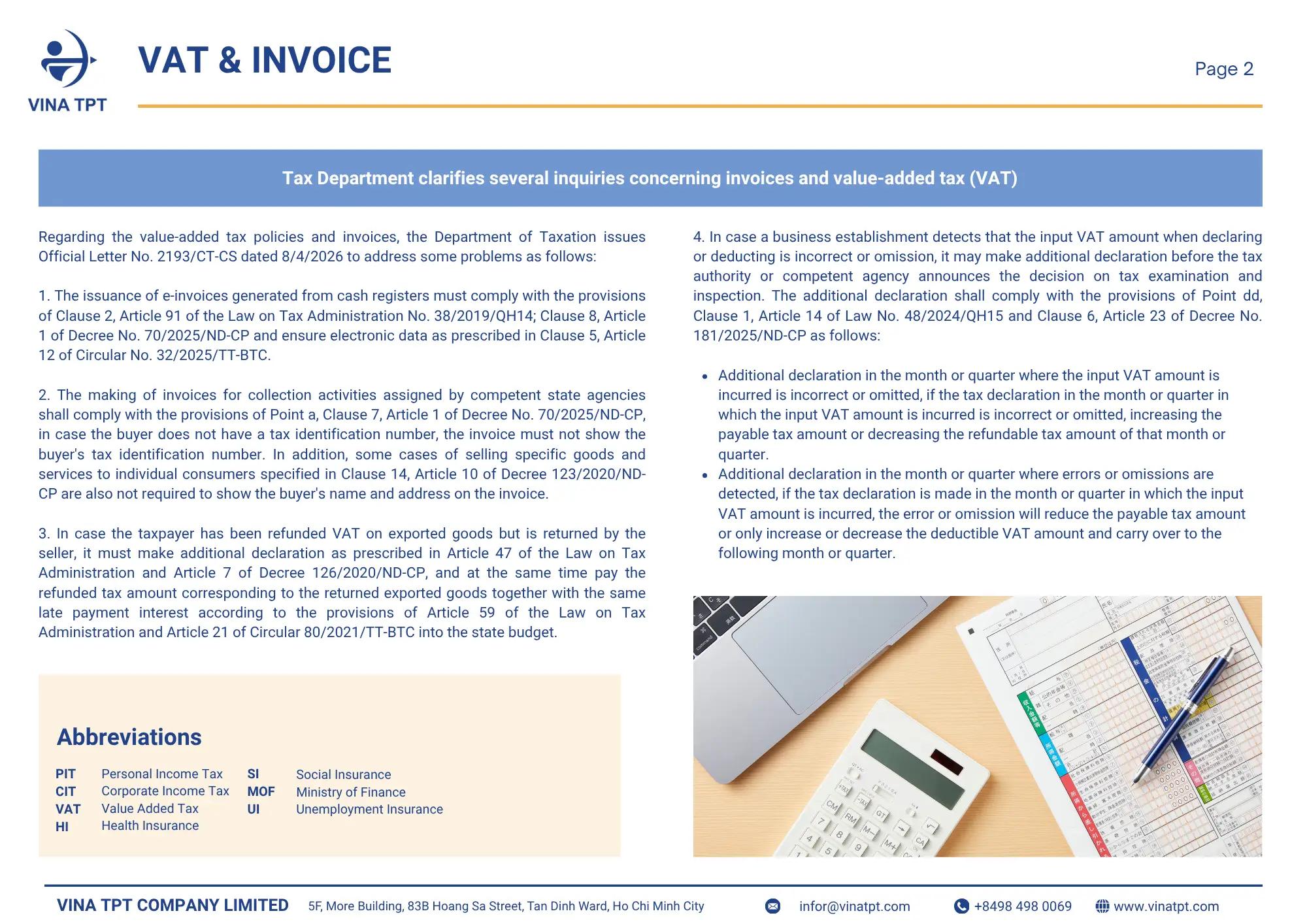
Tax Breaks in Vietnam 2025 | Key CIT, VAT & PIT Updates

1/ Overview of Tax Breaks and Their Importance for FDI Businesses 

Tax breaks, also known as tax incentives, are government measures that reduce or exempt taxes to support businesses and individuals. These aim to boost investment, drive economic growth, and ease financial burdens. In Vietnam, tax breaks typically include exemptions, reduced rates, or deductible expenses. They help companies lower operating costs, boost net profits, and expand operations—especially amid post-pandemic recovery and global competition. 

For foreign direct investment (FDI) businesses, tax breaks serve as both financial tools and strategic advantages to attract capital. Under the 2025 Corporate Income Tax Law (No. 67/2025/QH15), these policies align with international commitments like the 15% global minimum tax. This creates competitive edges, encourages reinvestment, and generates jobs in Vietnam. 

Here’s a summary of key benefits for FDI businesses: 

  • Reduced operating costs: Save 10-15% on tax obligations, improving cash flow. 
  • Increased profits: Support expansion in production and research and development (R&D). 
  • Talent attraction: PIT tax breaks lower taxes for foreign experts. 
  • Sustainability support: Promote investments in green sectors and high-tech industries. 

Explore the common tax breaks available in Vietnam to maximize benefits for your FDI enterprise. 

2/ Common Types of Tax Breaks Currently Available 

Vietnam’s government is refining tax policies to aid businesses during economic recovery, focusing on priority sectors like technology, green manufacturing, and exports. Starting in 2025, incentives apply to key taxes: Corporate Income Tax (CIT), Value-Added Tax (VAT), and Personal Income Tax (PIT). Each targets different groups and goals, helping FDI businesses cut financial loads and enhance competitiveness. Below is a comparison table: 

Tax Type  Main Incentives  Applicable Entities  Duration 
CIT  Exemption for 2-4 years, 50% reduction thereafter  FDI businesses in priority sectors  6-15 years 
VAT  Reduction from 10% to 8%  Goods and services (exclusions apply)  Until December 31, 2026 
PIT  Family deduction of VND 11 million/month (rising to VND 15.5 million/month from 2026)  Individuals and foreign experts as residents  Annual 

2.1 Corporate Income Tax (CIT) Incentives Effective from October 1, 2025 

Corporate Income Tax (CIT) directly impacts FDI business profits. From October 1, 2025, the 2025 CIT Law (No. 67/2025/QH15) expands incentives to attract high-quality investments. FDI enterprises starting new projects in high-tech fields, disadvantaged areas, or economic zones qualify for CIT exemptions for 2-4 initial years and a 50% reduction for the next 4-9 years. Preferential rates can drop to 10% for specially prioritized projects, 15% for small and medium enterprises, or 17% for investments in favored locations. 

Incentives are categorized by: 

  • Sector: High-tech, education, healthcare—exemption for 4 years, 50% reduction for 9 years. 
  • Location: Disadvantaged areas—10% rate for 15 years. 
  • Investment scale: Projects over EUR 750 million apply the 15% global minimum tax. 

Summary table: 

Incentive Type  Conditions  Duration  Reduction Level 
Exemption  High-tech projects  4 years  100% 
Rate reduction  Favored locations  15 years  10-17% 
50% reduction  New investment projects  4-9 years  50% 

Impact on FDI businesses: 

  • Cost savings up to 20-30%, boosting net profits and reinvestment. 
  • Encourages production growth and local job creation. 

Example: An FDI company investing USD 100 million in a high-tech zone could save tens of millions in taxes over the first 10 years. 

FDI enterprises should consult tax experts early to ensure proper reporting, legal workforce use, and eligibility maintenance. Compliance from the start avoids audits, penalties, and maximizes legal tax breaks. 

Maximize Your Tax Incentives Today

2.2 Value-Added Tax (VAT) Incentives Effective from July 1, 2025 

From July 1, 2025, Decree 174/2025/ND-CP reduces Value-Added Tax (VAT) from 10% to 8% until December 31, 2026, to stimulate consumption and support business recovery. This applies to most goods and services, excluding telecommunications, finance, and real estate. For FDI businesses, VAT tax breaks lower input costs, enhance cash flow, and strengthen export competitiveness. 

Specific benefits: 

  • Lower production costs: Imported materials face reduced VAT. 
  • Export support: Exported goods at 0% VAT, plus 8% reduction on related services. 

Example: An FDI firm exporting high-tech software enjoys full VAT exemption, saving 8-10% on costs. 

Key procedures: 

  • Declare VAT using new forms and electronic invoices. 
  • Collect valid documents for deductions or refunds. 
  • Note: Does not apply to specially taxed imports. 

2.3 Personal Income Tax (PIT) Incentives 

Personal Income Tax (PIT) continues to directly impact the income of workers, especially foreign experts in FDI enterprises.
From 2026, the personal allowance has been adjusted upwards to VND 15.5 million/month for the taxpayer themselves and VND 6.2 million/month for each dependent. This increase in allowances helps reduce tax obligations, improve disposable income, and enhance the attractiveness of the Vietnamese labor market.
At the same time, the PIT tax schedule has been simplified, reduced from 7 brackets to 5, with progressive tax rates.

PIT tax breaks for FDI businesses: 

  • Reduced taxes for foreign experts: Residents (present in Vietnam 183+ days/year) get deductions, cutting personnel costs. 
  • Exemptions for certain income: Stock transfers (if qualified) and foreign allowances. 

Notes: 

  • Register dependents electronically with tax authorities. 
  • Update income regularly to prevent back taxes. 

From 2026, updated policies will help FDI firms attract top global talent more easily. 

Download Vietnam Tax Handbook For Investor

3/ Key Benefits: How Tax Breaks Help Save Costs and Expand Business 

Tax breaks directly cut tax liabilities, increasing net profits and providing capital for FDI businesses to reinvest. Experts estimate savings of 10-20% on overall costs, enabling scale-up and global competition. 

Analysis from three angles: 

  • Financial: CIT and VAT reductions improve cash flow and reduce quarterly tax debts. 
  • Strategic: Encourage investments in priority areas like green technology, enhancing brand value. 
  • Human resources: PIT incentives lower salary costs, aiding recruitment of international and local experts. 

In summary, tax breaks not only save costs but also unlock business growth, allowing FDI enterprises to contribute sustainably to Vietnam’s economy. 

4/ Leveraging Tax Breaks with Vina TPT Tax Services 

To fully utilize tax breaks, FDI businesses need professional guidance from firms like Vina TPT—a Vietnam-based expert in tax and accounting. With experience supporting hundreds of FDI clients, Vina TPT identifies suitable incentives, prepares compliant files, and handles timely declarations to avoid audits. 

Standout advantages: 

  • Expertise across industries, from manufacturing to technology. 
  • Team knowledgeable in Vietnamese and international tax laws, with multilingual support. 
  • Transparent reporting and competitive fees for cost optimization. 

Support process: 

  • Assess your business and identify applicable incentives. 
  • Recommend tax plans and prepare registration documents. 
  • Implement declarations and monitor policy updates. 
  • Conduct regular reviews for ongoing compliance. 

Tax breaks are essential for FDI businesses in Vietnam to optimize costs, boost profits, and expand investments—especially with 2025 updates like the 8% VAT reduction and CIT incentives for priority sectors. These changes support economic recovery and position Vietnam as an attractive destination for foreign investment. 

Has your business maximized current tax incentives? Contact Vina TPT Tax Services today for a detailed analysis and tailored tax solutions—ensuring compliance and maximum savings! 

Talk to a Tax Specialist

Vina TPT Accounting services


How to Establish Business in Vietnam: Step-by-Step Company Formation Guide with Vina TPT

establish-your-company-vietnam-vinatpt-guide

Vietnam is becoming one of the most attractive startup and investment destinations in Southeast Asia thanks to its stable economic growth rate, increasingly open business environment and young, dynamic workforce. However, to successfully establish business in Vietnam, businesses and investors need to prepare a clear roadmap — from choosing the type of company and building the charter, to completing legal documents and applying for an operating license. Many founders turn to a professional company registration service or company formation services to streamline paperwork, ensure compliance and speed up market entry. Using a trusted business license service can simplify obtaining the necessary permits, including the startup business license Vietnam, which is critical for early-stage ventures and foreign-invested enterprises. Each stage requires accuracy and strict compliance with regulations. The following article will guide you step-by-step, helping you visualize the entire process from the idea stage to when the business officially starts operating legally in Vietnam.

1.Step 1: Planning Your Venture to Establish Business in Vietnam

Choosing the right type of business is the foundation for startups or investors to establish a business in Vietnam successfully and develop sustainably. In Vietnam, the three most popular models are:

  • Limited Liability Company (LLC): suitable for small and medium enterprises, simple management structure, limited liability according to capital contribution.
  • Joint Stock Company (JSC): suitable for large projects or enterprises with plans to raise capital, list shares.
  • Representative Office: often used for foreign enterprises that want to survey the market but have not yet directly operated.

Each model carries different regulations on ownership structure, management rights, tax obligations and capital mobilization ability. To make the right decision, investors need to clarify the following factors:

  • Business lines: Check whether the field of operation is on the list of conditional business lines or not. Some sectors such as education, finance, e-commerce or healthcare may require specialized licenses or limit the percentage of foreign investment.
  • Charter capital: This is the company’s committed capital and is clearly stated in the business registration dossier. The minimum capital will vary depending on the industry, however, most fields in Vietnam do not require a minimum capital, except for some specific industries such as banking, insurance, securities investment or real estate. This also creates flexible opportunities for investors, especially startups or FDI who want to test the Vietnamese market without having to commit too much capital. The capital stated in the charter also affects the quota for granting work permits to foreigners and future tax obligations.
  • Target investors: Legal procedures will be clearly different between domestic investors and FDI (foreign direct investment). FDI projects must go through the additional step of applying for an Investment Registration Certificate (IRC) before registering a business.
  • Pre-investment approval: Some large-scale projects or projects in sensitive sectors (e.g. real estate, energy) may require pre-approval from the Provincial People’s Committee or the Ministry of Planning and Investment before submitting the dossier to the company registration service.

Carefully analyzing these factors from the beginning will help businesses choose the right model, prepare accurate documents and significantly shorten the time to obtain a license.

2. Step 2: Preparing Documents with a Reliable Company Registration Service

Preparing documents for the Investment Registration Certificate (IRC) and Enterprise Registration Certificate (ERC) is the most important step in the process of establishing a business in Vietnam, especially for projects with foreign investment capital. 

2.1 Investment Registration Certificate (IRC) 

If the project has FDI capital, IRC is the first license allowing the investor to implement the project in Vietnam.

The required documents usually include:

  • Application for investment project implementation and Project proposal: stating the objectives, scale, location, investment capital, progress.
  • Proof of the investor’s financial capacity: bank statement, credit contract or collateral.
  • Legal documents of the investor:
    • Individual: Notarized passport, consular legalization.
    • Organization: Business registration certificate or equivalent document, consular legalization.
  • Project location: lease contract or land/office use rights certificate.

2.2 Enterprise Registration Certificate (ERC) 

After the IRC is granted (or for 100% domestic-owned enterprises), the investor applies for an ERC – an official license for the enterprise to operate, and also the tax code of the company.

The ERC dossier usually includes:

  • Application for enterprise registration.
  • Company Charter: stipulates the organizational structure, powers of members/shareholders, capital ratio and management method.
  • List of members/shareholders and legal representatives: clearly state information, ownership ratio, voting rights.
  • Appointment decision and authorization letter (if any).
  • Capital contribution plan & financial evidence: bank statement or credit contract (especially important for large capital projects).

2.3 General Requirements and Important Notes

  • Consular legalization & translation: All documents of foreign investors must be notarized, consular legalized and translated into Vietnamese before submission. This is a factor that often prolongs the preparation time.
  • Valid head office address: Do not use apartment or collective house address.
  • Unified information: Company name, address, capital, industry… must be consistent on all documents.
  • Business line: Should choose a suitable industry and be qualified for investment to avoid being asked to make many changes.

2.4 Estimated time

Document preparation: 1-2 weeks, depending on the volume of documents and the level of complexity.

  • IRC appraisal: 20-45 working days.
  • ERC issuance: 10-20 working days after IRC (or similar if the enterprise is a domestic enterprise).

In fact, if the enterprise cooperates with a reputable company registration service, it will help the enterprise quickly handle the consular legalization, translation and submission of documents, shortening the time and increasing the possibility of being licensed the first time.

Establish-business-in-Vietnam

3. Step 3: Applying for an Enterprise Registration & Business License Service

For FDI projects, the licensing process usually consists of two main steps:

  1. Investment Registration Certificate (IRC): Required for projects with foreign investment capital. Processing time: about 15–30 working days depending on the industry and locality.
  2. Enterprise/Business Registration Certificate (ERC/BRC): Confirmation of business establishment. Processing time: about 10 working days after the application is approved.

The receiving agency is the local Department of Finance or through the National Business Registration Portal. From 2025, enterprises must register for corporate e-ID to submit documents and perform obligations online.

4. Step 4: Post-Registration Essentials for a Startup Business License in Vietnam

After receiving ERC/BRC, the enterprise needs to complete the following steps:

  • Engrave the legal seal and register the seal sample (if using a physical seal).
  • Open a bank account and complete capital contribution within the prescribed time limit.
  • Register for tax and get an electronic tax code.
  • Register for labor and social insurance.
  • Register to use electronic invoices for commercial transactions.

If not completed on time, the enterprise may be fined or have its license revoked.


AVOID PENALTIES – LET VINA TPT HANDLE YOUR SETUP

5. Maintaining Compliance with Ongoing Business License Service Support

Depending on the field of operation, enterprises may need to apply for additional specialized licenses after being granted an Investment Registration Certificate (IRC) and Enterprise Registration Certificate (ERC).

For example:

  • Food safety: Restaurants, cafes, food processing facilities must have a Food Safety Certificate.
  • Education/Training: Foreign language centers, private schools need an Education Operation License.
  • Fintech/Financial Services: Some activities such as payment intermediaries, peer-to-peer lending need a License from the State Bank.
  • Environment/Production: Manufacturing plants or projects with environmental impacts must prepare and obtain an Environmental Impact Assessment (EIA) Report.

In addition to additional licenses, enterprises must also maintain periodic compliance obligations, including:

  • Annual reporting: Submitting reports on operations and finances to the Department of Finance and tax authorities to ensure transparency.
  • Maintaining statutory capital: Some conditional industries (e.g. banking, insurance, real estate, logistics) require businesses to maintain a minimum statutory charter capital. If the actual contributed capital falls below the prescribed level, the business may be fined or have its license revoked.
  • Updating business information: Any changes related to capital structure, shareholders, legal representatives or head office address must be registered and notified to Department of Finance promptly. Delayed notification may result in administrative fines or invalidation of related transactions.

Applying for additional licenses or updating information usually has a specific time limit (usually 10–30 days depending on the type). Businesses should monitor closely to avoid being fined or having their business license revoked.

6. Why Choose Vina TPT Start-up Business License Service for End-to-End Setup

When establishing a business in Vietnam, especially for foreign investors or startups operating for the first time, handling the procedures to establish a business in Vietnam by yourself can be time-consuming, prone to legal errors and prolong the licensing time. This is when Vina TPT start-up business license service becomes the optimal solution, providing a full package of services from initial consultation to post-registration.

Outstanding advantages when cooperating with Vina TPT:

  • Consulting on international standard business structure: Legal experts analyze investment objectives, business lines and charter capital to propose suitable types (LLC, JSC, Representative Office).
  • Preparing documents & representing ERC/IRC submission professionally: Vina TPT prepares all documents in Vietnamese and English, ensuring compliance with regulations and increasing the rate of being licensed right the first time.
  • Support for consular legalization & multilingual translation: A team fluent in English, Japanese and Vietnamese helps shorten the time for legalizing documents for FDI investors.
  • Fast implementation – Cost savings: Shorten the time to apply for a business license service, limit errors leading to additional costs or administrative fines.
  • Post-registration & long-term compliance: Support for seal engraving, opening bank accounts, tax registration, labor declaration and guidance on applying for specialized licenses (food safety, education, fintech …).

With Vina TPT company registration service, businesses not only save time and costs but are also guaranteed that the entire process from startup business license Vietnam to actual operation is legal, transparent and safe.

Ready to start your business journey in Vietnam? Contact Vina TPT today to receive detailed advice and the most suitable business plan for your startup.

BOOK A FREE CONSULTATION

Establish-business-in-Vietnam

HR Outsourcing & Payroll Service: Smart Strategy for Education Centers to Keep Top Talent

vinatpt-hr-outsourcing-payroll

HR outsourcing & payroll services - Vina TPT

1. The Hiring Challenge in Education Centers and Why Payroll Service Matters

Education centers in Vietnam, especially foreign language centers and training centers, are facing increasing pressure to compete for human resources. Attracting and retaining good teachers, especially foreign teachers, requires centers to ensure teaching quality while strictly complying with labor and tax regulations. Foreign teachers need work permits, Temporary Residence Card (TRCs), Visas and quarterly personal income tax declarations, forcing the human resources department to handle a complex workload and requiring in-depth understanding of Vietnamese law. In this context, accurate and transparent payroll services play an important role, helping centers ensure timely and correct salaries and bonuses, thereby strengthening their reputation and creating satisfaction for the teaching staff. Combining payroll outsourcing for education centers with a professional human resources process also helps minimize legal risks and maintain financial transparency.

2. How HR Outsourcing Vietnam Simplifies Staff Management for Education Centers

For education centers in Vietnam, maintaining a professional internal human resources department is both costly and requires a large amount of resources to ensure that the entire process of business accounting Vietnam. Foreign language centers and training centers often have to recruit both Vietnamese and foreign teachers, which means having to comply with complex regulations on labor contracts, work permits, TRC, Visa and personal income tax declaration. Each step – from social insurance registration, updating Vietnamese accounting standards (VAS), to managing salary and welfare data – has the potential risk of errors if there is no specialized team with legal knowledge.

HR outsourcing Vietnam service allows education centers to transfer the entire human resources management process to a professional service provider. The service provider will take care of everything from recruitment, contract drafting, timekeeping management, preparation and submission of social insurance documents, to tax compliance and reporting related to payroll outsourcing for education centers. When combined with payroll services, centers not only save operating costs and reduce internal staff, but also ensure that all processes are standardized and fully comply with Vietnamese laws, including financial reporting standards.

The integrated solution between HR outsourcing Vietnam and payroll services also helps education centers create a clear competitive advantage. Thanks to a centrally managed financial and human resource data system, centers can easily plan budgets, control salary costs, and detect early cash flow irregularities or signs of fraud. At the same time, the timely and transparent payment of salaries by payroll outsourcing services for education centers helps improve teachers’ experience, strengthen trust and long-term commitment.

With the support of professional HR & payroll services, education center leaders can focus more on core activities such as developing training programs, expanding services, and promoting enrollment marketing, instead of worrying about complicated HR and tax procedures. This is a comprehensive solution that helps education centers ensure compliance, optimize resources, and build a professional image in the eyes of teachers and students.


SIMPLIFY STAFF MANAGEMENT FOR YOUR EDUCATION CENTER

3. Payroll Services for Education Center to Boost Teacher Satisfaction and Loyalty

In the education sector, teacher experience directly affects teaching quality and training effectiveness. A professional working environment is not only reflected in the curriculum or facilities, but also in the way the center manages human resources and pays salaries.

Deploying payroll outsourcing services for education centers helps automate the entire payroll calculation process, ensuring accuracy, transparency and timeliness. Thereby, minimizing manual errors, fully complying with tax regulations and financial reporting according to Vietnamese law.

Especially for foreign teachers, professionally managed payroll also helps ensure compliance with legal requirements such as work permits, visas, TRC and personal income tax procedures. Salaries paid in full and on time will help teachers feel secure, avoiding problems with exchange rate differences or complicated deductions.

The synchronized payroll service application not only helps teachers receive their salaries quickly and transparently, but also improves teacher satisfaction and strengthens teacher loyalty. A professional salary and human resource management system demonstrates the center’s commitment to the interests of teachers, thereby creating a fair and trustworthy working environment. This is the key factor that helps the center retain good staff, build a stable teaching team and enhance brand reputation in the eyes of both teachers and students.

vinatpt-payroll-for-education-center

4. HR & Payroll Service as a Strategic Advantage in Education

Cooperating with an HR & payroll service provider is a necessary next step after education centers have optimized the teacher experience through payroll outsourcing for education centers. The core goal is to establish a sustainable human resource management strategy, ensure teacher engagement and promote long-term growth for education centers. When implementing both HR outsourcing Vietnam and payroll service simultaneously, the center not only reduces administrative burdens but also creates a clear competitive advantage in the teacher recruitment market – a very fierce factor in the education industry. Through professional management and systematization, this service allows centers to build flexible, attractive and transparent salary and bonus policies, suitable for each group of personnel from Vietnamese teachers to foreign teachers. Thanks to that, all processes from salary calculation, tax deduction, to benefits are synchronized, minimizing errors and increasing the ability to adjust promptly to meet the development strategy of the center. More importantly, when combined closely with payroll outsourcing, the compensation policies become easier to track, easier to demonstrate, and increase teachers’ trust in the professionalism of the management unit.

By transferring the entire HR outsourcing Vietnam process and payroll service to experts, the center can focus resources on core activities such as curriculum design, teaching quality improvement, and enrollment marketing. This is not only an optimal operational solution, but also a long-term strategy to help education centers attract and retain high-quality teachers, strengthening their competitive position in the international education industry.

5. Why Education Center Choose Vina TPT  HR & Payroll Service

Vina TPT HR & Payroll service provides comprehensive solutions, specifically designed for education centers in Vietnam, with outstanding advantages:

  • A team of multilingual experts: Proficient in English, Chinese, Japanese... effectively supports centers with foreign teachers, ensuring accurate communication and quick file processing.
  • Experience in international human resource management: Understanding the specifics of the education industry and labor regulations in Vietnam, especially work permits, visas, TRC and personal income tax for foreign teachers.
  • In-depth consultation on HR and payroll processes: Proposing solutions suitable for each center’s operating model, optimizing recruitment, contracts, timekeeping, insurance and taxes.
  • Fast, clear and transparent implementation: Support from system setup, operation to periodic reporting, helping centers save time and costs.
  • Absolute data security and legal compliance: Ensure all information about human resources, salaries and taxes is processed securely and in accordance with international standards.

Thanks to the combination of solid professional capacity and multilingual support, Vina TPT helps education centers feel secure from the recruitment stage, contract signing to the accurate, transparent and timely salary payment process.

6. Getting Started with Professional HR Outsourcing and Payroll Service

To effectively deploy HR outsourcing Vietnam and payroll service, education centers only need to provide information on human resource needs and scale of operations. Vina TPT will advise on optimal solutions, implement the entire package and provide transparent periodic reports, ensuring that the entire process from recruitment, contracts, salary calculation to tax payment is performed accurately, confidentially and in compliance with the law.

Cooperating with Vina TPT HR & Payroll service is a strategic step to help the center save costs, reduce management burden and improve competitiveness in attracting and retaining high-quality teachers.

Contact Vina TPT today to deploy optimal HR outsourcing Vietnam and payroll service, helping your education center save costs and retain good teachers.

BOOK A FREE CONSULTATION

Payroll-HR-Manager-Vietnam-VinaTPT

Step-by-Step Accounting Procedures for FDI Enterprises in Vietnam

Accounting Procedures for FDI company in Vietnam

Accounting Procedures for FDI company in Vietnam

1/ Challenges of Accounting Procedures for FDI Vietnam

Foreign direct investment has become a cornerstone of Vietnam’s economic growth, attracting multinational corporations and small enterprises alike. However, the journey for FDI Vietnam operations is not without obstacles. One of the most pressing issues is compliance with accounting procedures that are both complex and highly regulated.  

Unlike some jurisdictions where accounting systems are more flexible, Vietnamese accounting follows strict rules set by the Ministry of Finance. FDI companies frequently encounter barriers in understanding these procedures because the framework is rooted in local law, written in Vietnamese, and subject to regular amendments. The language barrier is significant, since all accounting documents and reports must be prepared in Vietnamese. This requirement often results in additional administrative costs and reliance on professional translation or advisory services.  

Another common challenge is the fast-changing regulatory environment. Tax regulations, reporting requirements, and compliance obligations are updated frequently, sometimes annually. Without a reliable accounting guide, FDI companies may struggle to stay up to date, leading to errors and compliance risks. Moreover, differences in cultural and business practices can cause misunderstandings in financial communication between local partners and foreign headquarters. 

Get Advisory Support

2/ What Are Accounting Procedures for FDI Operations? 

When discussing accounting procedures in Vietnam, it is essential to understand that they go far beyond basic bookkeeping. For FDI enterprises, accounting procedures encompass the entire framework of recording, classifying, summarizing, and reporting financial transactions in line with Vietnamese accounting standards (VAS).  

This includes maintaining accurate ledgers, preparing quarterly and annual financial statements, and fulfilling tax obligations such as value-added tax (VAT), corporate income tax (CIT), and personal income tax (PIT) for employees. Each of these tasks must follow regulations set by the Ministry of Finance and the General Department of Taxation. For example, financial statements must be prepared in Vietnamese dong (VND), regardless of whether the parent company reports in US dollars, euros, or another foreign currency.  

In addition, all reports must be filed within strict deadlines. Late submission or inaccurate reporting can result in penalties or even suspension of business licenses. This is why FDI Vietnam businesses cannot treat accounting as a secondary matter. Instead, they must approach it as a core compliance function that directly impacts operational success and investor confidence. 

3/ Key Differences Between Vietnamese Accounting (VAS) and International Standards (IFRS) 

One of the most challenging aspects for FDI enterprises is reconciling Vietnamese accounting practices with international standards such as International Financial Reporting Standards (IFRS). The differences between the two systems are not merely technical but often affect how companies strategize their operations in Vietnam.  

For instance, VAS is highly compliance-driven and closely tied to tax regulations, while IFRS prioritizes transparency and comparability for investors. This means that under VAS, companies may need to record expenses and revenues in ways that differ from international expectations. Furthermore, the language requirement poses additional complexity, as all accounting records must be maintained in Vietnamese, regardless of the company’s internal systems.  

Currency is another significant difference. While multinational corporations often operate in USD or EUR, Vietnamese regulations require financial reporting in VND. This necessitates frequent foreign exchange translations, which may create discrepancies between local and global reports.  

These differences are not insurmountable but require careful planning and professional support. Companies often rely on advisory services such as Vina TPT Accounting Service to ensure smooth reconciliation between VAS and IFRS. This allows them to satisfy both local authorities and international stakeholders. 

Get Expert Accounting Support

4/ Risks of Non-Compliance with Vietnamese Accounting Regulations 

The consequences of failing to follow accounting procedures in Vietnam can be severe. Financial penalties are the most immediate risk, as the tax authorities impose fines for late submissions, missing documents, or incorrect financial statements. However, the risks extend beyond monetary loss.  

Non-compliance can damage a company’s reputation, eroding trust with local partners, regulators, and even investors abroad. For multinational corporations, reputational harm in one jurisdiction can quickly spread across global markets. Moreover, persistent violations may lead to stricter audits, sanctions, or even suspension of licenses.  

There is also the risk of operational delays. For example, companies that fail to comply with accounting regulations may face challenges when applying for tax refunds, investment incentives, or expansion licenses. This creates unnecessary bottlenecks in growth strategies. According to the Ministry of Finance of Vietnam, maintaining compliance with financial reporting standards is a prerequisite for building credibility in the local market. 

IFRS

5/ How an Accounting Guide Helps FDI Companies in Vietnam 

An effective accounting guide acts as a roadmap for FDI Vietnam businesses. Rather than reacting to compliance issues after they arise, companies can proactively manage their obligations through structured guidance. A comprehensive guide explains in detail how to maintain ledgers, prepare financial statements, and align reporting with both VAS and international standards.  

The benefits of using an accounting guide are significant. It reduces the likelihood of errors in tax filings, ensures timely submission of reports, and provides clarity on the differences between local and international standards. For new entrants into the Vietnamese market, an accounting guide can shorten the learning curve and prevent costly mistakes.  

Beyond compliance, such guides also help companies design internal processes that optimize efficiency. For instance, knowing how to structure payroll systems according to Vietnamese tax laws can save both time and resources. Access to reliable information from trusted sources such as Google Scholar further reinforces decision-making and ensures that companies rely on accurate, up-to-date knowledge. 

6/ Vina TPT Accounting Service – Professional Solutions for FDI Enterprises 

At Vina TPT Accounting Service, we recognize the difficulties foreign investors encounter when dealing with Vietnamese accounting regulations. Our mission is to provide professional, reliable, and customized solutions that help FDI enterprises thrive in Vietnam.  

We offer comprehensive bookkeeping services tailored to the needs of foreign companies, ensuring all transactions comply with VAS. Our tax compliance support minimizes the risks of penalties and audits, giving businesses peace of mind. We also provide consulting services on IFRS-VAS reconciliation, helping companies deliver consistent and transparent reports to both local authorities and international headquarters.  

What sets Vina TPT Accounting Service apart is our commitment to clarity. We develop customized accounting guides for each client, simplifying complex regulations into practical, easy-to-follow steps. This empowers foreign enterprises to focus on what matters most: growing their business in one of Asia’s most dynamic economies.  

If your enterprise is seeking a reliable partner to navigate accounting procedures in Vietnam, Vina TPT is here to help. Visit our official service page for more details or contact us directly for a consultation.  

Let Vina TPT Accounting Service be your trusted partner in Vietnam. Reach out today to secure compliance and accelerate your business success. 

Book a free consultation

vina tpt accounting & tax firm