Tax incentives for Korean electronics factories in Vietnam

Korean electronics factory in Vietnam receiving tax incentives

tax-incentives-in-vietnam

1. Why Korean Electronics Manufacturers Choose Vietnam

Tax incentives in Vietnam have played a major role in making the country a top investment destination for Korean electronics corporations such as Samsung, LG, Hanwha, and SK over the past decade. Factors that make Vietnam stand out include competitive labor costs, political stability, a strategic location near the Asian supply chain, and especially the extensive Free Trade Agreements (FTA) system.

In particular, tax incentives in Vietnam for Korean investors have created a strong motivation for long-term manufacturing expansion, especially in high-tech and electronic component production. These incentives not only reduce the initial investment burden but also help Korean enterprises enhance profitability and competitiveness in the regional and global markets.

In addition, the Vietnamese government is actively attracting investment in the high-tech and electronic component manufacturing sectors – this is a great advantage for Korean factories that want to establish long-term manufacturing operations. Therefore, the tax incentives policy in Vietnam is also designed to provide maximum support to this group of businesses.

2. Overview of Tax Incentives in Vietnam for Foreign Manufacturers

Currently, Vietnam is applying many tax incentives in Vietnam for foreign investors, especially in the fields of manufacturing, high technology and industrial zones. These preferential policies are designed to encourage long-term investment and improve the competitiveness of enterprises:

  • Exemption from corporate income tax (CIT) for the first 2-4 years, 50% reduction for the next 4-9 years, depending on the scale and field of investment.
  • Exemption from import tax on machinery, equipment, components to create fixed assets or serve R&D.
  • Land lease incentives in industrial parks, high-tech parks, helping to significantly reduce initial investment costs.

In addition, Vietnam also implements a special tax holiday policy for high-tech manufacturing projects. These are important advantages that help Vietnam become an attractive destination for foreign investors looking for an efficient and stable production environment in the region.

GET TAX INCENTIVE CONSULTATION

3. Tax Incentives for Korean Factories in Vietnam: Key Benefits for Electronics Manufacturing Projects

Korean electronics factories investing in Vietnam often enjoy many outstanding incentives:

  • Corporate Income Tax (CIT): Preferential tax rate of only 10% for 15 years (compared to the standard rate of 20%), with a long tax exemption and reduction period.
  • Import Duty Exemption: Exemption from import tax on machinery, production lines, and components that cannot be produced domestically.
  • Land Rental Incentive: Exemption or reduction of land rent in industrial zones, especially in Bac Ninh, Thai Nguyen, and Hai Phong, where many Korean factories are concentrated.
  • Value Added Tax (VAT) Refund: For exporting enterprises, input VAT is quickly refunded, helping to improve cash flow.

These incentives help Korean electronics factories shorten the payback period and maximize profits during the expansion phase.

4. Compliance and Documentation Required to Access Tax Incentives in Vietnam

To enjoy tax incentives in Vietnam, businesses need to prepare complete documents according to regulations:

  • Investment Certificate (IRC) and Enterprise Registration Certificate (ERC) clearly stating the eligible business lines.
  • Documents proving that the project is in an incentive sector or area.
  • Financial statements, CIT declarations and annual investment activity reports.
  • Relevant import documents, invoices and contracts (for import tax exemptions).

Due to the strict review process, missing documents or incorrect declarations can cause businesses to lose their right to enjoy incentives or be subject to tax arrears.

5. Strategic Tax Planning with Vietnam Tax Specialists for Long-Term Profitability

To make the most of tax incentives in Vietnam, businesses need to build a long-term tax strategy that both ensures compliance with regulations and optimizes financial efficiency. Tax planning is not simply about compliance with obligations, but also a management tool that helps businesses maintain a competitive advantage and develop sustainably in the Vietnamese market.

Tax specialists play an important role in this process by helping businesses restructure their investment models to suit the locations and preferential fields, thereby maximizing tax benefits. They also support businesses in optimizing depreciation policies, transfer pricing and eligible expenses, helping to significantly reduce corporate income tax (CIT) obligations while still complying with regulations. At the same time, tax experts also periodically monitor tax compliance, detect potential risks early and limit the risk of being inspected or administratively sanctioned.

A well-thought-out tax plan not only provides short-term financial benefits, but also lays a solid foundation for future expansion and reinvestment, helping businesses maintain flexibility and stability in a rapidly changing economic landscape.

Download Vietnam Tax Handbook For Investor

6. Partnering with Vina TPT Tax Service for Comprehensive Tax Support and Incentive Application

Vina TPT Tax Service is a trusted tax consulting partner of hundreds of FDI enterprises, including many Korean electronics factories in Vietnam. Our team of experts includes tax consultants and legal experts with over 15 years of experience, with in-depth knowledge of tax regulations, accounting and investment incentives in Vietnam.

Vina TPT provides comprehensive support from:

  • Evaluating eligibility for tax incentives.
  • Preparing and submitting tax exemption/reduction applications.
  • Tax strategy consulting, risk management and periodic compliance audits.

With Vina TPT Tax Service, Korean electronics factories not only ensure compliance with regulations but also optimize costs and sustainable profits in Vietnam.

Contact Vina TPT Tax Service now to get advice from our tax experts on optimal tax incentives and costs for your business in Vietnam.

BOOK A FREE CONSULTATION

tax-incentives-in-vietnam

Business Established in Vietnam for Korean Electronics Manufacturers

Korean investor receiving business license in Vietnam

setting-up-electronics-business-in-Vietnam

1. Vietnam – The Next Hub for Korean Electronics Manufacturers

As Korean companies continue to look for new growth opportunities across Asia, Vietnam has become one of the most attractive destinations for manufacturing expansion. With a favorable investment climate and a streamlined business license in Vietnam process for foreign enterprises, Vietnam offers Korean electronics manufacturers an ideal entry point to establish long-term operations. Supported by government incentives and a robust supply chain ecosystem, the country is quickly evolving into a major production hub in the region.

Major corporations such as Samsung, LG, and Hanwha have established large-scale production complexes in Bac Ninh, Thai Nguyen, and Hai Phong, regions that are rapidly becoming Vietnam’s key electronics hubs, supported by modern logistics networks, seaports, and government investment incentives.

Moreover, Vietnam’s active participation in free trade agreements such as CPTPP and EVFTA has unlocked significant tariff advantages, enhancing its competitiveness in the global supply chain. A young, skilled workforce combined with the nation’s push for digital transformation positions Vietnam as the “new manufacturing base” for the global electronics industry, much like South Korea’s industrial rise in the 1990s.

For Korean investors, establishing a business in Vietnam not only optimizes production costs but also opens access to ASEAN, China, and India markets. By obtaining the appropriate business license in Vietnam and leveraging professional strategic consulting, Korean electronics enterprises can streamline the enterprise registration process and transform Vietnam into a sustainable hub for manufacturing and innovation in the region.

2. Strategic Considerations Before Enterprise Registration in Vietnam

Before starting the registration process, investors need to carefully consider strategic factors.

Location is key: Northern regions such as Bac Ninh, Hai Phong, Thai Nguyen currently have many Korean electronics factories, convenient for connecting and sharing the supply chain.

Legal form also directly affects the right to operate and tax obligations. Enterprises can choose to establish a 100% foreign-owned company, joint venture with a Vietnamese partner or open a representative office.

In addition, the domestic supply chain in Vietnam is expanding rapidly, providing components and logistics services suitable for electronics production. Understanding these factors helps Korean enterprises optimize costs and limit risks when entering new markets.

Book a Free Consultation on Your Business License

3. Understanding Business License in Vietnam and Compliance for Electronics Companies

After being granted the Investment Registration Certificate (IRC) and Enterprise Registration Certificate (ERC), the electronics enterprise needs to apply for a business license appropriate to the field of operation.

The electronics manufacturing industry has its own requirements on environmental safety, technology standards and fire prevention.

The estimated time for completion is:

Document preparation: 1-2 weeks, depending on the volume of documents and the level of complexity.

  • IRC appraisal: 20-45 working days.
  • ERC issuance: 10-20 working days after IRC (or similar if the enterprise is a domestic enterprise).

In fact, if the enterprise cooperates with a reputable company registration service, it will help the enterprise quickly handle the consular legalization, translation and submission of documents, shortening the time and increasing the possibility of being licensed the first time.

setting-up-electronics-business-in-Vietnam

4. How to Establish Business in Vietnam and Maintain Legal Compliance

To successfully establish a business in Vietnam, investors need to take the following important steps:

Step 1: Complete the application and apply for Business License in Vietnam IRC, ERC.

If the project has FDI capital, IRC is the first license allowing the investor to implement the project in Vietnam.

The required documents usually include:

  • Application for investment project implementation and Project proposal: stating the objectives, scale, location, investment capital, progress.
  • Proof of the investor’s financial capacity: bank statement, credit contract or collateral.
  • Legal documents of the investor:
    • Individual: Notarized passport, consular legalization.
    • Organization: Business registration certificate or equivalent document, consular legalization.
  • Project location: lease contract or land/office use rights certificate.

After the IRC is granted (or for 100% domestic-owned enterprises), the investor applies for an ERC – an official license for the enterprise to operate, and also the tax code of the company.

The ERC dossier usually includes:

  • Application for enterprise registration.
  • Company Charter: stipulates the organizational structure, powers of members/shareholders, capital ratio and management method.
  • List of members/shareholders and legal representatives: clearly state information, ownership ratio, voting rights.
  • Appointment decision and authorization letter (if any).
  • Capital contribution plan & financial evidence: bank statement or credit contract (especially important for large capital projects).

Step 2: Open a bank account and contribute charter capital within 90 days from the date of issuance of ERC.

Step 3: Register a tax code and set up an accounting system according to Vietnamese standards.

Step 4: Sign a labor contract, pay social insurance and manage payroll according to regulations.

5. Vina TPT Company Registration – Partnering with Korean Electronics Manufacturers for a Sustainable Setup

With more than a decade of experience in investment consulting and business registration services, Vina TPT has successfully assisted hundreds of FDI enterprises, including a large number of Korean electronics manufacturers in establishing and expanding their operations in Vietnam.

Our comprehensive service scope covers every stage of the process — from investment model consulting and legal documentation, to business license application in Vietnam, business license renewal, and regulatory compliance. This integrated approach ensures a smooth and compliant market entry for Korean investors.

Backed by a team of seasoned professionals with in-depth knowledge of Vietnam’s business, tax, and labor laws, Vina TPT provides end-to-end business license advisory and compliance support, helping investors confidently execute their projects while focusing on production growth and long-term success.

Partnering with Vina TPT Business Advisory and Company Registration means more than saving time and costs. It’s about having a trusted local partner who truly understands how to help Korean investors establish, operate, and sustain successful ventures in Vietnam.

Contact Vina TPT for consultation and support on business registration in Vietnam quickly, legally and at optimal cost.

BOOK A FREE CONSULTATION

setting-up-electronics-business-in-Vietnam

VAT Refund in Vietnam 2025: Updated Conditions and Eligible Cases Explained

VAT Refund in Vietnam 2025 Updated Conditions and Eligible Cases Explained-VTPT

VAT Refund in Vietnam 2025_ Updated Conditions and Eligible Cases Explained - VTPT

1.What is a VAT Refund and When is a Business Entitled to it?

Value-Added Tax (VAT) refund refers to the process by which the State reimburses the amount of VAT that a business has either paid into the State budget or has not yet been deducted. When a business meets specific VAT refund conditions, it will be entitled to receive back the paid tax amount. The purpose of this policy is to prevent double taxation and to support businesses in investment or export activities.

Businesses are eligible for VAT refunds when they fall under the cases stipulated by law and meet the specific refund conditions applicable to their business type. Detailed information will be provided by Vina TPT in this article.

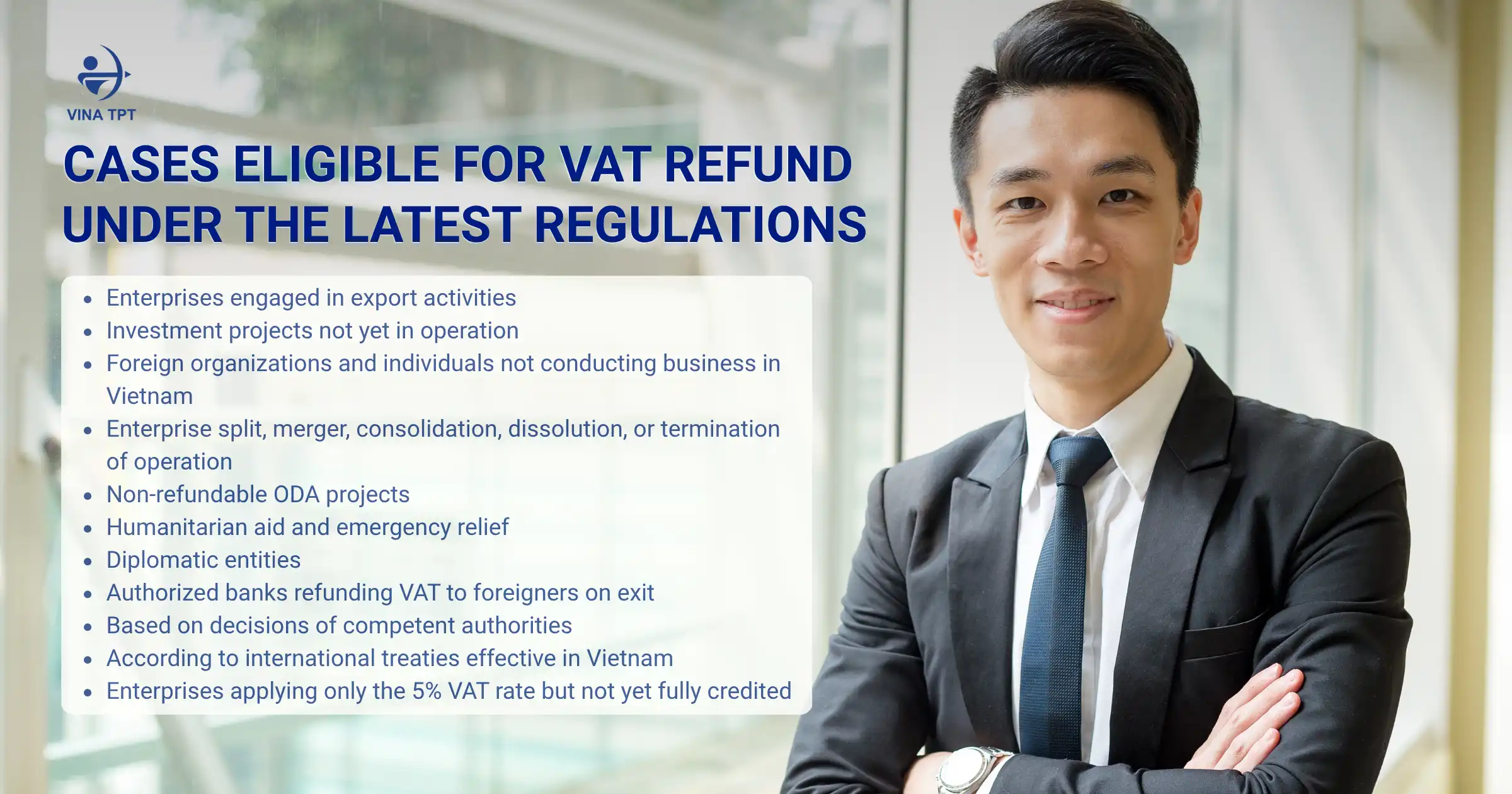
2.Cases Eligible for VAT Refund Under the Latest Regulations

VAT Refund in Vietnam 2025_ Updated Conditions and Eligible Cases Explained - VTPT

No.  Case eligible for VAT refund  Main conditions  Legal basis 
1  Enterprises engaged in export activities  Exported goods and services are subject to a 0% VAT rateInput VAT not yet credited is ≥ VND 300 million

Must have valid customs documents and bank payment records 

Article 13, VAT Law 2024 
2  Investment projects not yet in operation  The investment project has been duly registeredNo revenue has been generated

Input VAT not yet credited is ≥ VND 300 million 

Article 13, VAT Law 2024 
3  Enterprise split, merger, consolidation, dissolution, or termination of operation  The enterprise no longer operates to deduct input VATRemaining input VAT has not yet been credited  Article 13, Amended VAT Law 2008 
4  Foreign organizations and individuals not conducting business in Vietnam  Possess valid tax payment documentsDo not conduct regular business activities in Vietnam  Circular 219/2013/TT-BTC, Article 18 
5  Non-refundable ODA projects  Not using the state budget to pay VATPossess valid confirmation from the donor  VAT Law 2024, Circular 219 
6  Humanitarian aid and emergency relief  Must have a decision approving the receipt of aidMust provide valid documents related to goods and input invoices  Circular 219/2013/TT-BTC 
7  Đối tượng ngoại giao (miễn trừ)  Must have confirmation from the State Protocol DepartmentApplied under international treaties  Decree 134/2016/NĐ-CP 
8  Authorized banks refunding VAT to foreigners on exit  Must have a goods management systemMust prepare a tax refund list according to the prescribed form  Circular 92/2019/TT-BTC 
9  Based on decisions of competent authorities  Must have an official document/decision on tax refundApplied in special cases, subject to post-refund inspection  Decree 49/2022/NĐ-CP 
10  According to international treaties effective in Vietnam  Must fall under subjects clearly stated in the treatyMust provide complete dossiers and supporting documents  Law on International Treaties, Law on VAT 
11  Enterprises applying only the 5% VAT rate but not yet fully credited  Input VAT not yet credited ≥ 300 million VNDAfter 12 months or 4 consecutive quarters – applicable from 01/07/2025  Amended VAT Law 2024

 VAT 2025 Update:The 2024 Value Added Tax (VAT) Law will officially take effect from July 1, 2025.

3. Conditions for VAT refund

Depending on the type of enterprise, the conditions for VAT refund may vary

3.1. For domestic enterprises 

  • Undeducted input VAT of at least VND 300 million
  • Có Valid e-invoices andnon-cash payments for invoices from VND 20 million
  • Not under tax enforcement measures or committing tax violations
  • Proper and timely tax declaration 

3.2. For exporting enterprises 

  • Export contracts, customs declarations, and bank payment documents 
  • Continuous undeducted VAT for 3 periods or at least VND 300 million in one period
  • Exported goods must be cleared through customs
  • No fraudulent invoice transactions 

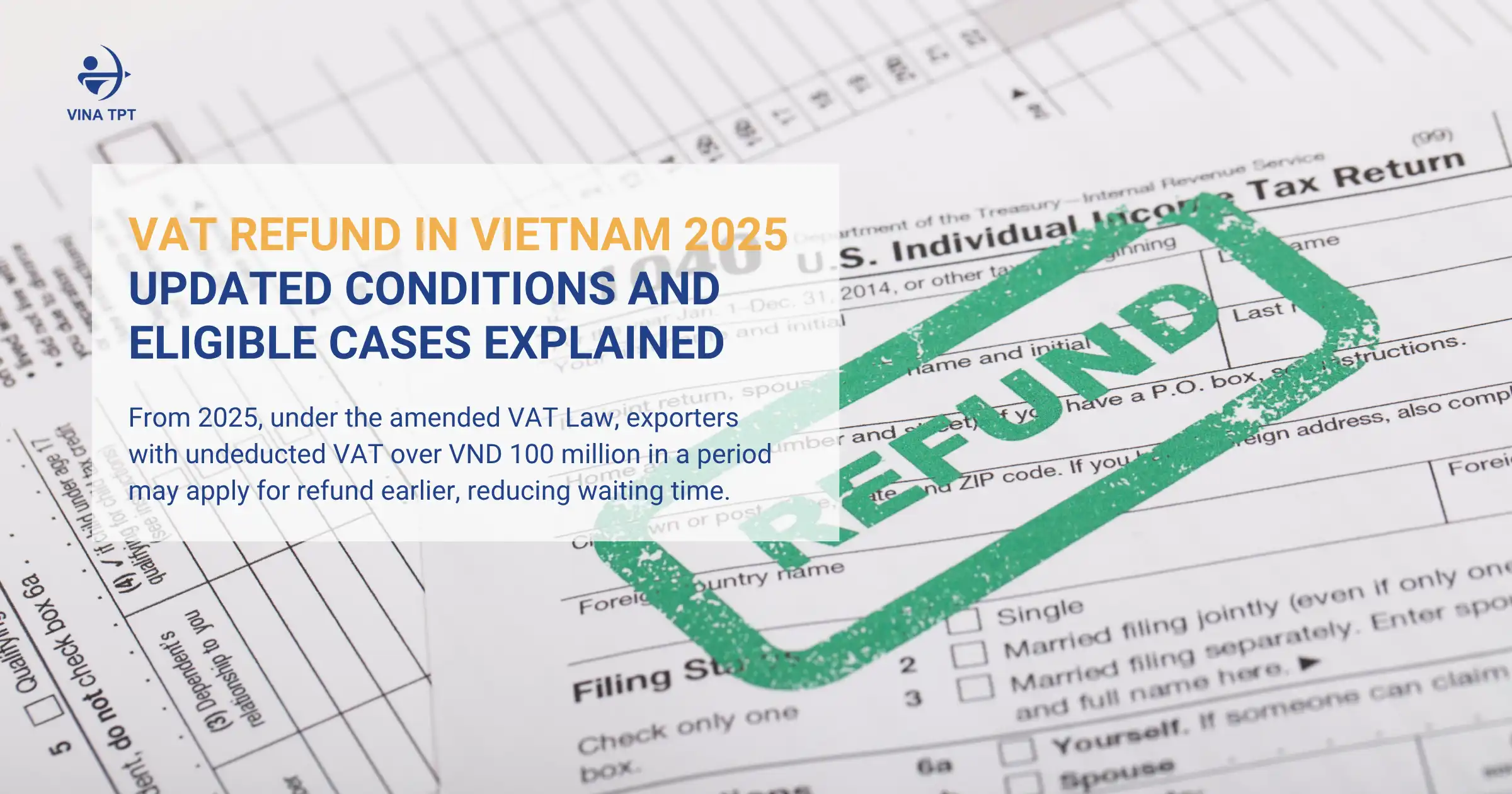
Note: From 2025, under the amended VAT Law, exporters with undeducted VAT over VND 100 million in a period may apply for refund earlier, reducing waiting time.

3.3. For investment projects 

  • Must have an Investment Registration Certificate 
  • No revenue generated, but large undeducted VAT incurred 
  • Separate bank account for the project 
  • Separate accounting for project expenses 

3.4. For foreign organizations/individuals 

  • Valid proof of VAT paid in Vietnam 
  • Non-regular business activities 
  • Full compliance with tax declaration and refund procedures 

Explore Our Tax Services

 4. Cases Not Eligible for VAT Refund

(According to Circular 219/2013/TT-BTC, amended by Circular 130/2016/TT-BTC)

  • Investment projects with insufficient charter capital contribution
    If, by the time of filing the VAT refund application (from July 1, 2016 onwards), the enterprise has not contributed the full registered charter capital it will not be eligible for refund. Instead, the uncredited input VAT will only be carried forward to the next CIT period.
  • Conditional investment sectors not meeting requirements under the Law on Investment
    This includes cases where the enterprise has not obtained the necessary license, certificate of eligibility, or written approval from the competent authority.  
  • Violation of conditions during project implementation
    If, during the implementation, the project has its license or certificate revoked, or is found no longer to meet conditional business requirements, VAT refund will be suspended from that point onward.  
  • Projects involving natural resource/mineral exploitation or production with ≥ 51% cost structure derived from natural resources
    Applicable to projects licensed from July 1, 2016. The determination of the resource ratio is guided under Clause 23, Article 4 of Circular 219.  
  • Imported goods for export but not exported through the prescribed customs area
    VAT refund is not eligible if export procedures are not carried out at the designated customs office.  
  • Exported goods not completing customs procedures at the customs-controlled area
    In this case, VAT refund is also not eligible. 

5. Key Notes on VAT Refund for Businesses

  • Do not consolidate VAT refund applications across multiple periods unless specifically guided by regulations. 
  • Carefully check the payment timeline and payment conditions of each invoice. 
  • For exporting enterprises, clearly keep records of customs declarations, bills of lading, and payment documents.
  • Always review the validity of input invoices – especially those from new suppliers. 

6. Simplify Your VAT Refund with Vina TPT’s Professional Support

Navigating the VAT refund process in Vietnam can be complex, especially with changing tax regulations and documentation requirements. Vina TPT offers professional support to help businesses simplify every step, from eligibility assessment to refund application and follow-up with tax authorities. With deep expertise in Vietnamese tax law, our team ensures accuracy, compliance, and maximum refund value for your company. Partnering with Vina TPT means saving time, avoiding costly errors, and gaining peace of mind knowing your VAT refund is handled by trusted professionals. Let Vina TPT streamline your refund process efficiently and transparently.

Contact Vina TPT today to simplify your VAT refund process!

Discuss Your Case with Our Specialists

accounting skills

Tax Incentive in Vietnam 2025: Comprehensive Guide to Optimize Profits under New CIT Law

Overview of corporate tax incentives in Vietnam 2025 under the new CIT Law

Overview of corporate tax incentives in Vietnam 2025 under the new CIT Law

Tax Incentive: Comprehensive Guide to Corporate Tax Incentives in Vietnam 2025 – Optimize Profits with New CIT Law

With Vietnam’s Corporate Income Tax (CIT) Law 2025 officially in force from October 1, 2025, investors and CFOs are reassessing how to leverage tax incentives to strengthen profitability and compliance.

From 10 – 17% preferential CIT rates to multi-year tax holidays, the new regime gives both domestic and foreign companies more tools to optimize profits but only if you understand the rules.

In this guide, you’ll learn:

  1. What a tax incentive is and why it matters for 2025
  2. The main types of corporate tax incentives available in Vietnam
  3. Key eligibility requirements and risk management
  4. How to prepare and apply effectively with professional support

I. What is a Tax Incentive and Why Do Businesses Need to Know in 2025?

A tax incentive is a government policy designed to reduce or exempt tax liabilities for businesses that invest in targeted sectors or locations, with the aim of encouraging sustainable growth, innovation, and foreign direct investment (FDI).

Under the CIT Law 2025, tax incentives in Vietnam have evolved to:

  • Support the digital economy and green/clean industries.
  • Attract FDI via extended tax breaks and preferential schemes.
  • Motivate companies to reinvest profits inside Vietnam rather than only extracting them.

In today’s competitive ASEAN environment, understanding tax incentives isn’t optional, it’s a survival and growth strategy.

The standard corporate income tax rate remains 20 %. However, preferential rates are flexibly applied:

  • 15 % for enterprises with annual revenue ≤ VND 3 billion
  • 17 % for enterprises with revenue over VND 3 billion up to VND 50 billion
  • In specific cases (e.g., foreign-owned enterprises, cooperatives…) where cost/expense determination is difficult, a direct tax rate on revenue may apply

II. Key 2025 Updates: Major Types of Corporate Tax Incentives in Vietnam

Key Corporate Tax Incentives in Vietnam 2025

1. Expanded deductible expenses under the 2025 CIT Law

Enterprises are now allowed to deduct additional expenses related to scientific research, digital transformation, testing new technologies, emission reduction, and community activities. This aims to create favorable conditions for businesses to pursue sustainable growth and innovation.

2. Incentives by sector, location, and investment project

Investment projects in high-tech sectors such as semiconductor production, AI, data centers, automobile manufacturing, and electronic device production are eligible for a preferential tax rate of 10% for up to 15 years.
Expansion projects applying clean technologies or contributing to environmental improvements may also qualify for tax exemptions or reductions if they meet specific requirements.

3. Clear incentive rules to avoid overlapping

If an enterprise falls under multiple incentive categories, it has the right to choose the most favorable one.
In cases where preferential provisions exist under specialized laws, the 2025 CIT Law will take precedence, except for specially regulated circumstances.

4. Loss carry-forward and Science & Technology Development Fund

Enterprises are allowed to carry forward losses continuously for up to 5 years.
They may allocate up to 20% of annual taxable income to establish a Science & Technology Development Fund, provided it is used for the correct purposes.

To explore how our consulting team can help you secure and optimize CIT incentives effectively, visit our dedicated Tax Consulting Service page for more details.

Explore Tax Consulting Services

III. Common Mistakes and How to Avoid – Plus Profit Optimization

Even with the best intentions, many businesses still miss out on their tax incentive benefits due to simple yet costly mistakes. Below are the most common pitfalls and how to fix them effectively.

  1. Late or incomplete applications: One of the most frequent issues arises from delayed or missing documentation.
    How to avoid: Ensure all required forms and supporting evidence are submitted before your project begins generating income to maintain eligibility.
  2. Ignoring Permanent Establishment (PE) rules: With the 2025 update redefining PE status, overlooking this change can lead to unexpected tax liabilities.
    How to avoid: Reassess your operational and contractual structure under the new PE definition to avoid misclassification.
  3. Overlooking Double Taxation Treaties (DTT): Many foreign investors fail to leverage DTT benefits, leading to duplicate tax payments.
    How to avoid: Coordinate early with professional consultants to utilize DTT relief and minimize cross-border tax exposure.
  4. Unclear bookkeeping and expense tracking: Incomplete financial records can weaken your eligibility for incentives and invite compliance risks.
    How to avoid: Implement digital accounting and reporting systems to ensure transparency and traceability.
  5. No profit optimization strategy: Securing an incentive is only the first step, maximizing its impact requires strategic planning.
    How to avoid: Partner with Vina TPT’s tax consultants to align your incentive structure with long-term financial goals and ROI optimization.

IV. What Should Businesses Prepare to Seize Opportunities from the 2025 CIT Law?

To stay ahead of regulatory changes and fully capitalize on new incentives, businesses must prepare proactively and strategically:

  • Review and assess impact: Conduct a detailed analysis of current financial performance, income, expenses, and business operations. Identify any necessary adjustments to comply with the new Corporate Income Tax (CIT) Law.
  • Understand eligibility criteria for incentives: Study the specific requirements for benefiting from the 2025 CIT incentives. Ensure your business meets all conditions before submitting any application.
  • Update accounting and financial systems: Make sure your accounting software and bookkeeping procedures comply with new regulations on revenue and expense recognition.
  • Train internal teams: Equip your finance and accounting personnel with updated knowledge through training sessions or specialized CIT 2025 courses.
  • Seek expert consultation: Engaging professional tax advisors is a smart move to avoid compliance risks and legally optimize your tax obligations.

Instead of navigating complex tax regulations on your own, you can connect directly with VINA TPT – trusted partner specializing in tax, accounting, and financial consulting ready to support your business in maximizing benefits under the 2025 CIT Law.

Conclusion

Tax incentives in Vietnam are more than just government policy, they’re a strategic growth lever for businesses preparing to thrive in the 2025 landscape.

Key takeaways:

  • Vietnam offers preferential CIT rates of 10 – 17% for up to 30 years.
  • Incentives now extend to green, digital, and financial sectors.
  • Compliance and timing remain critical to securing approval.

V. Why Partnering with Vina TPT Is the Most Effective Way to Leverage Tax Incentives?

The 2025 CIT incentives offer substantial opportunities to reduce tax burdens and enhance profits, but leveraging them effectively isn’t always simple. Businesses must interpret complex eligibility criteria, prepare accurate documentation, and meet strict compliance deadlines. Without expert guidance, it’s easy to miss optimal incentive schemes or face regulatory risks. That’s why partnering with a professional tax consulting firm becomes a strategic advantage.

Vina TPT Tax Service is a trusted advisor to hundreds of FDI and domestic enterprises, including manufacturing, technology, and service companies across Vietnam. Our team consists of senior tax consultants and legal experts with over 15 years of experience in tax planning, accounting compliance, and investment incentives.

We provide end-to-end support, including:

  • Assessing eligibility for tax incentives under the 2025 CIT Law
  • Structuring incentive applications for maximum tax savings
  • Preparing and submitting exemption/reduction dossiers
  • Designing long-term tax strategies aligned with business growth objectives
  • Conducting compliance audits and managing tax risks

With Vina TPT Tax Service, businesses are not only compliant but also positioned to optimize costs and secure sustainable profitability through legally maximized tax benefits.

Contact Vina TPT today and ensure your business fully capitalizes on Vietnam’s 2025 tax incentive opportunities.

Contact Vina TPT for Consultation

Expert-Vietnam-VinaTPT

Tax Breaks in Vietnam 2025 | Key CIT, VAT & PIT Updates

1/ Overview of Tax Breaks and Their Importance for FDI Businesses 

Tax breaks, also known as tax incentives, are government measures that reduce or exempt taxes to support businesses and individuals. These aim to boost investment, drive economic growth, and ease financial burdens. In Vietnam, tax breaks typically include exemptions, reduced rates, or deductible expenses. They help companies lower operating costs, boost net profits, and expand operations—especially amid post-pandemic recovery and global competition. 

For foreign direct investment (FDI) businesses, tax breaks serve as both financial tools and strategic advantages to attract capital. Under the 2025 Corporate Income Tax Law (No. 67/2025/QH15), these policies align with international commitments like the 15% global minimum tax. This creates competitive edges, encourages reinvestment, and generates jobs in Vietnam. 

Here’s a summary of key benefits for FDI businesses: 

  • Reduced operating costs: Save 10-15% on tax obligations, improving cash flow. 
  • Increased profits: Support expansion in production and research and development (R&D). 
  • Talent attraction: PIT tax breaks lower taxes for foreign experts. 
  • Sustainability support: Promote investments in green sectors and high-tech industries. 

Explore the common tax breaks available in Vietnam to maximize benefits for your FDI enterprise. 

2/ Common Types of Tax Breaks Currently Available 

Vietnam’s government is refining tax policies to aid businesses during economic recovery, focusing on priority sectors like technology, green manufacturing, and exports. Starting in 2025, incentives apply to key taxes: Corporate Income Tax (CIT), Value-Added Tax (VAT), and Personal Income Tax (PIT). Each targets different groups and goals, helping FDI businesses cut financial loads and enhance competitiveness. Below is a comparison table: 

Tax Type  Main Incentives  Applicable Entities  Duration 
CIT  Exemption for 2-4 years, 50% reduction thereafter  FDI businesses in priority sectors  6-15 years 
VAT  Reduction from 10% to 8%  Goods and services (exclusions apply)  Until December 31, 2026 
PIT  Family deduction of VND 11 million/month (rising to VND 15.5 million/month from 2026)  Individuals and foreign experts as residents  Annual 

2.1 Corporate Income Tax (CIT) Incentives Effective from October 1, 2025 

Corporate Income Tax (CIT) directly impacts FDI business profits. From October 1, 2025, the 2025 CIT Law (No. 67/2025/QH15) expands incentives to attract high-quality investments. FDI enterprises starting new projects in high-tech fields, disadvantaged areas, or economic zones qualify for CIT exemptions for 2-4 initial years and a 50% reduction for the next 4-9 years. Preferential rates can drop to 10% for specially prioritized projects, 15% for small and medium enterprises, or 17% for investments in favored locations. 

Incentives are categorized by: 

  • Sector: High-tech, education, healthcare—exemption for 4 years, 50% reduction for 9 years. 
  • Location: Disadvantaged areas—10% rate for 15 years. 
  • Investment scale: Projects over EUR 750 million apply the 15% global minimum tax. 

Summary table: 

Incentive Type  Conditions  Duration  Reduction Level 
Exemption  High-tech projects  4 years  100% 
Rate reduction  Favored locations  15 years  10-17% 
50% reduction  New investment projects  4-9 years  50% 

Impact on FDI businesses: 

  • Cost savings up to 20-30%, boosting net profits and reinvestment. 
  • Encourages production growth and local job creation. 

Example: An FDI company investing USD 100 million in a high-tech zone could save tens of millions in taxes over the first 10 years. 

FDI enterprises should consult tax experts early to ensure proper reporting, legal workforce use, and eligibility maintenance. Compliance from the start avoids audits, penalties, and maximizes legal tax breaks. 

Maximize Your Tax Incentives Today

2.2 Value-Added Tax (VAT) Incentives Effective from July 1, 2025 

From July 1, 2025, Decree 174/2025/ND-CP reduces Value-Added Tax (VAT) from 10% to 8% until December 31, 2026, to stimulate consumption and support business recovery. This applies to most goods and services, excluding telecommunications, finance, and real estate. For FDI businesses, VAT tax breaks lower input costs, enhance cash flow, and strengthen export competitiveness. 

Specific benefits: 

  • Lower production costs: Imported materials face reduced VAT. 
  • Export support: Exported goods at 0% VAT, plus 8% reduction on related services. 

Example: An FDI firm exporting high-tech software enjoys full VAT exemption, saving 8-10% on costs. 

Key procedures: 

  • Declare VAT using new forms and electronic invoices. 
  • Collect valid documents for deductions or refunds. 
  • Note: Does not apply to specially taxed imports. 

2.3 Personal Income Tax (PIT) Incentives 

Personal Income Tax (PIT) continues to directly impact the income of workers, especially foreign experts in FDI enterprises.
From 2026, the personal allowance has been adjusted upwards to VND 15.5 million/month for the taxpayer themselves and VND 6.2 million/month for each dependent. This increase in allowances helps reduce tax obligations, improve disposable income, and enhance the attractiveness of the Vietnamese labor market.
At the same time, the PIT tax schedule has been simplified, reduced from 7 brackets to 5, with progressive tax rates.

PIT tax breaks for FDI businesses: 

  • Reduced taxes for foreign experts: Residents (present in Vietnam 183+ days/year) get deductions, cutting personnel costs. 
  • Exemptions for certain income: Stock transfers (if qualified) and foreign allowances. 

Notes: 

  • Register dependents electronically with tax authorities. 
  • Update income regularly to prevent back taxes. 

From 2026, updated policies will help FDI firms attract top global talent more easily. 

Download Vietnam Tax Handbook For Investor

3/ Key Benefits: How Tax Breaks Help Save Costs and Expand Business 

Tax breaks directly cut tax liabilities, increasing net profits and providing capital for FDI businesses to reinvest. Experts estimate savings of 10-20% on overall costs, enabling scale-up and global competition. 

Analysis from three angles: 

  • Financial: CIT and VAT reductions improve cash flow and reduce quarterly tax debts. 
  • Strategic: Encourage investments in priority areas like green technology, enhancing brand value. 
  • Human resources: PIT incentives lower salary costs, aiding recruitment of international and local experts. 

In summary, tax breaks not only save costs but also unlock business growth, allowing FDI enterprises to contribute sustainably to Vietnam’s economy. 

4/ Leveraging Tax Breaks with Vina TPT Tax Services 

To fully utilize tax breaks, FDI businesses need professional guidance from firms like Vina TPT—a Vietnam-based expert in tax and accounting. With experience supporting hundreds of FDI clients, Vina TPT identifies suitable incentives, prepares compliant files, and handles timely declarations to avoid audits. 

Standout advantages: 

  • Expertise across industries, from manufacturing to technology. 
  • Team knowledgeable in Vietnamese and international tax laws, with multilingual support. 
  • Transparent reporting and competitive fees for cost optimization. 

Support process: 

  • Assess your business and identify applicable incentives. 
  • Recommend tax plans and prepare registration documents. 
  • Implement declarations and monitor policy updates. 
  • Conduct regular reviews for ongoing compliance. 

Tax breaks are essential for FDI businesses in Vietnam to optimize costs, boost profits, and expand investments—especially with 2025 updates like the 8% VAT reduction and CIT incentives for priority sectors. These changes support economic recovery and position Vietnam as an attractive destination for foreign investment. 

Has your business maximized current tax incentives? Contact Vina TPT Tax Services today for a detailed analysis and tailored tax solutions—ensuring compliance and maximum savings! 

Talk to a Tax Specialist

Vina TPT Accounting services


Updated 2025 | Corporate Income Tax Rates in Vietnam

Updated 2025 Corporate Income Tax Regulations in Vietnam

Corporate Income Tax Rate in Vietnam in 2025

Since October 1, 2025, under the provisions of Law No. 67/2025/QH15, the Corporate Income Tax (CIT) rates will be officially adjusted and applied nationwide.

Businesses should pay attention to the changes in CIT rates, including the standard rate of 20%, higher tax rates for the natural resource extraction sector, and new CIT incentives for small and medium-sized enterprises (SMEs) as well as businesses operating in priority sectors.

The following article provides a comprehensive update on corporate income tax rates, eligible taxpayers, and major tax incentives applicable in 2025.

1. What is Corporate Income Tax (CIT)?

Corporate Income Tax (CIT) is a direct tax levied on the remaining profit after deducting all allowable expenses incurred during business operations.

It is a significant source of revenue for the state budget and serves as an indicator of a company’s operational efficiency during the accounting period.

2. Who is Subject to Corporate Income Tax (CIT)?

Corporate Income Tax (CIT) is a mandatory financial obligation for organizations engaged in profit-generating business activities.

Entities required to pay Corporate Income Tax include:

  • Enterprises established and operating in Vietnam
  • Foreign enterprises with a permanent establishment in Vietnam
  • Foreign enterprises without a permanent establishment in Vietnam but having income arising in Vietnam
  • Other enterprises established under Vietnamese law with business activities and income generation
  • Public service units with business activities
  • According to the 2025 CIT law effective from October 1, 2025, digital platforms and e-commerce entities without establishments in Vietnam but providing services domestically must also declare and pay CIT.

Who is Subject to Corporate Income Tax in Vietnam


3. Corporate Income Tax Rates 

According to current regulations, Corporate Income Tax (CIT) rates for 2025 are applied as follows:

3.1. Standard CIT Rate 20%

Applicable to most enterprises established under Vietnamese law, engaged in the production and business of goods and services.

This is the standard tax rate applied to most enterprises not eligible for tax incentives.

3.2. CIT Rate 32% – 50%

Tax rates from 32% to 50% apply to exploration and exploitation of oil and gas activities in Vietnam.

The specific tax rate will be determined based on:

  • Location of extraction
  • Extraction conditions
  • Reserve volume

3.3. CIT Rate 25% – 50%

Rates from 25% to 50% apply to oil and gas exploration, prospecting, and extraction (depending on location, extraction conditions, and reserve volume, rates will vary).

3.4. CIT Rate 50%

Applied to exploration and extraction of rare resources:

  • Platinum
  • Gold
  • Silver
  • Tin
  • Vonfram (wolfram)
  • Antimon
  • Gemstones
  • Rare earth
  • Other rare and precious resources as prescribed by law

3.5. CIT Rate 40%

Applied to mines with 70% or more of allocated area located in socio-economically difficult regions.

3.6. Preferential CIT Rates

Preferential rate 15%: applied to enterprises with annual total revenue not exceeding 3 billion VND.

Preferential rate 17%: applied to enterprises with annual total revenue over 3 billion VND up to 50 billion VND.

Revenue for eligibility determination is based on the total revenue of the immediately preceding CIT taxable period. 

A 10% CIT rate for 10–15 years is for:

  • New investment projects in high-tech fields
  • Enterprises in socio-economically disadvantaged areas
  • Enterprises in high-tech zones and high-tech agricultural application zones

4. Partnering with Vina TPT for Reliable Accounting and Corporate Tax Consulting Services

With over 15 years of experience and deep expertise in Vietnamese accounting and tax regulations, Vina TPT is a trusted partner for businesses seeking reliable support in managing their Corporate Income Tax obligations. Our team of seasoned professionals provides end-to-end services covering both Quarterly Corporate Income Tax (CIT) reporting and Annual CIT Finalization, ensuring full compliance with current laws and minimizing the risk of penalties or reporting errors.

As Corporate Income Tax regulations in Vietnam continue to evolve, it is essential for companies to stay updated and implement accurate tax strategies. Vina TPT’s comprehensive approach includes document review, deadline tracking, and strategic consulting tailored to your business size and sector. Whether you are a local enterprise or a foreign-invested company, our services are designed to help your business navigates Vietnam’s tax environment with confidence, optimize tax efficiency, and support your long-term financial goals.

Contact Vina TPT today for trusted full-service accounting and tax solutions in Vietnam.

BOOK A FREE CONSULTATION

accounting service Vietnam for Chinese company vtpt


Financial Statement Preparation in Vietnam for FDI: Key Differences Between Chinese and Vietnamese Accounting Standards

accounting service Vietnam for Chinese company vtpt

financial-statement-preparation-Vietnam

In recent years, Vietnam has emerged as a strategic destination for Chinese enterprises to invest in FDI, thanks to its advantages in labor costs, geographical proximity and open-door policies to attract foreign capital. However, besides the opportunities, Chinese companies face great challenges in familiarizing themselves with and complying with Vietnamese accounting standards (VAS), which are significantly different from PRC GAAP. This difference directly affects the process of financial statement preparation Vietnam, consolidated reports and tax obligations. To manage effectively and minimize risks, many enterprises choose the Vina TPT accounting system setup solution, which helps build a bilingual accounting system, ensuring transparency and compliance with both Vietnamese regulations and requirements from the parent company in China.

1. Why Chinese Investors Need to Understand Vietnamese Accounting Standards

When investing FDI in Vietnam, Chinese enterprises not only have to comply with the laws on investment and business, but also need to understand Vietnamese accounting standards (VAS). This is the basis for financial statement preparation Vietnam, declaring taxes, and demonstrating transparency to management agencies. Only applying PRC GAAP and ignoring financial statement preparation in Vietnam according to VAS can lead to audit risks, being subject to arrears or difficulties in distributing profits to the parent company. Therefore, understanding and correctly applying Vietnamese accounting standards is not only a matter of compliance, but also a foundation for enterprises to build trust with shareholders, partners and state agencies.

2. Overview of Chinese vs. Vietnamese Accounting Systems

PRC GAAP (Chinese Accounting Standards) and VAS (Vietnamese Accounting Standards) have the same goal of faithfully reflecting the financial situation, but their approaches are different:

  • PRC GAAP: Designed to serve internal management, strict supervision of the Chinese government, emphasizing capital control and compliance with domestic economic policies.
  • VAS: Built to suit the legal and tax environment of Vietnam, closely linked to tax declaration and reporting requirements to management agencies. However, VAS is in the process of integrating with IFRS to approach international standards.

For Chinese companies in Vietnam, this difference creates a gap that needs to be filled, especially when having to prepare reports for management agencies in Vietnam and meet the consolidated reporting requirements of the parent company in China.


TALK TO OUR CHINA–VIETNAM ADVISORS

3. Key Differences in Financial Statement Preparation Vietnam

When preparing financial statements in Vietnam, Chinese enterprises will encounter some major differences between PRC GAAP and VAS, specifically:

  • Revenue: Different ways of recording revenue, especially for long-term transactions or prepaid revenue.
  • Fixed assets: Different methods of asset valuation and depreciation, directly affecting profits and expenses.
  • Provisions and liabilities: VAS has its own provisions on provisioning, while PRC GAAP has a broader scope on estimating liabilities.
  • Presentation: VAS emphasizes compliance with the reporting format issued by the Ministry of Finance, while PRC GAAP is more flexible for enterprises in presentation.
  • International standards: FDI enterprises sometimes have to perform an additional step of converting from VAS to IFRS to serve global reporting.

Understanding these differences helps businesses limit errors and standardize financial data from the start.

4. Compliance Challenges for Chinese FDI Companies

In reality, many Chinese enterprises face difficulties in preparing financial statements in Vietnam. Standardizing bilingual financial statements, handling exchange rate differences, and converting from PRC GAAP to VAS or IFRS can create great pressure on the accounting department. Many enterprises face a lack of personnel who understand both systems, as well as the challenge of meeting the parent company’s expectations of transparency. This is the reason why hiring an accounting service in Vietnam for Chinese companies becomes important.

accounting service Vietnam for Chinese company vtpt

5. Setting Up a Reliable Accounting System in Vietnam

To overcome the above challenges, setting up a reliable accounting system in Vietnam is necessary. Chinese enterprises should choose software that is compatible with VAS and has the ability to export data according to PRC GAAP or IFRS. In addition, the accounting process needs to be standardized, have bilingual personnel, and have close coordination with the parent company.

Therefore, if a business wants to optimize its accounting system and ensure full compliance with Vietnamese regulations as well as requirements from the parent company, choosing a reputable partner like Vina TPT is a strategic step that cannot be ignored.

6. How Vina TPT Supports Chinese Companies Prepare Financial Statements Vietnam

We provides Vina TPT accounting system setup solutions for Chinese enterprises that want to establish business and operate accounting in Vietnam.

  • Comprehensive Accounting Service: Providing a full range of accounting services, from bookkeeping, financial reporting to tax management and bilingual reporting.
  • Dual-Language Expertise: Professional reporting, documentation and communication in both Vietnamese and Chinese, helping the parent company grasp information quickly and accurately.
  • Customized Accounting System Setup: Setting up an accounting system suitable for the scale and model of FDI, including software, processes and operational personnel.
  • Regulatory Compliance: Supporting businesses to fully comply with Vietnamese accounting standards (VAS) while meeting the reporting requirements of the parent company in China.
  • Strategic Financial Advisory: Providing financial strategy advice based on accurate data, helping businesses optimize cash flow, plan budgets and prepare for audits.

Please contact Vina TPT today for consultation on a complete accounting service solution in Vietnam, ensuring compliance and transparency for Chinese businesses in Vietnam.

BOOK A FREE CONSULTATION

financial-statement-preparation-Vietnam

Vietnam Accounting & Tax Services for Japanese Investors

vtpt hire accounting service

vtpt hire accounting service

1. The Need to Hire Accounting Service for Japanese Investors in Vietnam

Vietnam is emerging as one of the top investment destinations in Asia, attracting more and more Japanese businesses looking for new growth opportunities. However, differences in laws, accounting standards and business environments make hiring accounting services a strategic factor to ensure success right from the start.

For Japanese companies, cooperating with a reputable Vietnamese accounting service unit not only helps with daily financial management but also ensures Vietnam accounting compliance for Japanese business, meets the reporting requirements of the parent company and complies with strict regulations in Vietnam. Hiring Vina TPT accounting service helps investors reduce administrative burden, limit errors in tax declarations, and build a transparent accounting system, supporting the long-term business expansion process.

2. Common Financial Challenges for Japanese Businesses

When operating in Vietnam, Japanese businesses often encounter some unique difficulties related to Vietnam accounting compliance for Japanese businesses, including:

  • Different accounting standards: Vietnamese Accounting Standards (VAS) differ significantly from Japanese GAAP and IFRS, requiring accurate and continuous conversion of financial statements.
  • Cash flow and foreign currency management: Exchange rate fluctuations and foreign exchange regulations can affect cash flow, especially for companies that import or transact internationally.
  • Diverse tax requirements: Businesses need to comply with many types of taxes such as Corporate Income Tax (CIT), Value Added Tax (VAT), Foreign Contractor Tax, Personal Income Tax (PIT), as well as social and health insurance.
  • Parallel reporting system: Many companies must simultaneously meet reporting requirements of Vietnam and Japan, resulting in a large amount of accounting and auditing work.

These challenges not only increase the internal workload but also require the support of a highly qualified Vina TPT accounting service partner to help businesses operate financially stably and legally.


BRIDGE JAPAN-VIETNAM ACCOUNTING STANDARDS

3. Essential Services to Hire for Smooth Operations

To overcome barriers and ensure compliance, Japanese investors should hire an accounting service that provides a comprehensive and in-depth service package. Some important services include:

  • Bookkeeping & General Accounting: Standard accounting bookkeeping, invoice management, processing daily transaction documents to ensure accuracy and transparency.
  • Financial Reporting & Conversion: Prepare financial statements according to VAS standards and convert to Japanese GAAP or IFRS for auditing, consolidate reports for parent companies in Japan.
  • Tax Filing & Compliance Service: Support periodic tax declaration, submit CIT, VAT, PIT, social insurance and other tax obligations on time, helping to avoid late payment penalties.
  • Payroll & HR Accounting: Manage payroll, personal income tax and insurance for employees, ensuring compliance with Vietnamese labor laws.
  • Audit Preparation & Internal Control: Establishing an internal control system and preparing documents for independent audits, helping businesses prepare for any financial audit or assessment.

With the above services, Vina TPT accounting service helps Japanese businesses not only comply with Vietnam accounting compliance for Japanese business, but also optimize costs and improve long-term financial management efficiency.

vtpt hire accounting service

4. Ensuring Compliance with Vietnamese Standards and Japanese Reporting Requirements

For Japanese companies operating in Vietnam, dual compliance is not only a legal requirement but also a key factor in maintaining the trust of shareholders and parent companies. Enterprises need to ensure Vietnam accounting compliance for Japanese business, while also meeting international reporting standards such as Japanese GAAP, IFRS or the group’s consolidated standards. This process includes preparing consolidated financial statements, converting reports from VAS (Vietnamese Accounting Standards) to international standards, reconciling internal data, and closely managing multidimensional financial indicators.

Performing these dual requirements yourself requires in-depth knowledge, time and experienced personnel, so hiring a professional accounting service is the optimal solution. A reputable unit like Vina TPT accounting service will provide a complete accounting service Vietnam, support the preparation of bilingual financial reports (Vietnamese – Japanese/English), control input data, and standardize the accounting system to easily serve both the Vietnamese tax authorities and the parent company in Japan.

By combining tax compliance, financial reporting, and business accounting Vietnam in one comprehensive service, Vina TPT helps businesses minimize the risk of errors, optimize the inspection process, and ensure all reports are transparent, accurate, and timely. This is the strategic solution for Japanese businesses in Vietnam to maintain sustainable growth, strengthen their reputation in both markets, and enhance their ability to expand in the future.

5. Vina TPT’s Advantage for Japanese Investors

Vina TPT stands out in the Vietnamese accounting service market thanks to its team of Japanese-Vietnamese bilingual experts and in-depth knowledge of Vietnam accounting compliance for Japanese business. The accompaniment of Lawyer Le Quoc Duy, a legal expert who can communicate directly in Japanese, helps all legal and financial procedures to be implemented quickly, accurately and in accordance with Japanese corporate culture.

Outstanding strengths of Vina TPT accounting service:

  • Bilingual Expertise: Support communication, reporting and financial analysis in both Japanese and Vietnamese.
  • Tailored Accounting Solutions: Provide flexible services from bookkeeping, tax filing to financial advisory, suitable for the needs of each type of investment.
  • Regulatory Insights: Always update Vietnamese tax regulations and accounting standards, helping Japanese enterprises maintain Vietnam accounting compliance for Japanese business in a sustainable way.
  • Strategic Financial Planning: Support financial planning, optimize capital structure and prepare for international audits.

Download Vietnam Tax Handbook - Japanese Edition

6. Steps to Engage the Right Accounting Service in Vietnam

To choose the most suitable and effective hire accounting service, Japanese investors can follow these steps:

  • Determine specific needs: Evaluate business scale, reporting requirements, accounting standard conversion needs and level of support from partners.
  • Evaluate experience and expertise: Choose a partner with professional certification and experience providing accounting services in Vietnam for Japanese businesses.
  • Compare costs and scope of services: Ensure transparent fees, suitable for budget, and include important services such as bookkeeping, tax filing and compliance.
  • Sign the contract and implement the service: Clearly define responsibilities, reporting deadlines and information exchange methods to optimize cooperation efficiency.

With extensive experience and comprehensive services, Vina TPT accounting service is the ideal choice to ensure Vietnam accounting compliance for Japanese business, helping Japanese businesses develop sustainably in Vietnam.

Hire Vina TPT accounting service today to ensure Vietnam accounting compliance for Japanese business and fully meet Japanese reporting requirements.

BOOK A FREE CONSULTATION

Vina TPT Accounting services

Comprehensive Tax and Compliance Services for Businesses in Vietnam

Business consultant providing corporate tax service and compliance support

Business consultant providing corporate tax service and compliance support

1. Vietnam Tax & Compliance Overview

The tax environment and legal system in Vietnam are currently in a dynamic phase of updates, covering areas such as value added tax (VAT), corporate income tax (CIT), personal income tax (PIT), financial reporting standards, and electronic filing procedures. These ongoing changes make maintaining tax compliance a significant challenge for all businesses, especially FDI companies and newly established startups. Even minor mistakes in tax declaration or late payments can result in administrative fines, tax arrears, or surprise inspections by regulatory authorities.

For FDI enterprises, the documentation requirements are often more complex, as they must comply simultaneously with Vietnamese accounting standards (VAS) and international standards (IFRS), while also fulfilling regulations related to reporting foreign investment capital. Meanwhile, startups often face limited resources, lack specialized accounting teams, or have incomplete internal control processes. Managing taxes, preparing financial statements, and performing electronic tax filings without professional support can easily lead to common errors such as reporting incorrect indicators, omitting valid expenses, or calculating tax amounts incorrectly.

Using tax services, tax compliance services or full-package services such as accounting & tax services is the optimal solution to help businesses minimize risks and ensure full compliance with Vietnamese tax laws. A professional unit will support from tax code registration, monthly/quarterly tax reporting, implementing tax filing service Vietnam, to checking and periodically comparing books. In addition, tax compliance services also help businesses promptly update changes in tax policies, optimize reasonable CIT costs, prepare annual tax settlement documents and provide transparent data for audits.

2. Key Business Taxes & Compliance Requirements

2.1 Corporate & Operational Taxes

The main taxes that businesses in Vietnam must comply with include:

  • Corporate Income Tax (CIT): Corporate income tax with a common tax rate of 20%, requiring quarterly or annual declaration and payment.
  • Value- Added Tax (VAT): Value added tax applied to most goods and services, requiring electronic invoices and periodic reporting.
  • Foreign Contractor Tax (FCT): Applied to transactions with foreign contractors, requiring complex calculation and declaration processes.

And some other types of taxes depending on the industry and business activities, for example: import and export dutiestax,Natural Resources Tax resource tax, special consumption tax Land and Water Surface Rental, Transfer Pricing Taxation,…

A reputable tax compliance service will assist businesses in reviewing documents, preparing declarations and submitting them on time, avoiding the risk of being fined or collected.

2.2 Employee-Related Taxes

In addition to operating taxes, businesses must also manage:

  • Personal Income Tax (PIT): Personal income tax for employees, requiring monthly or quarterly deductions and declarations.
  • Social Insurance, Health Insurance, Unemployment Insurance: Obligation to pay compulsory social insurance and health insurance according to the provisions of the Labor Law.

Combining tax compliance service with the human resource management system – payroll helps businesses control tax and insurance deductions accurately, limiting risks of periodic inspections.

Download Vietnam Tax Handbook - Japanese Edition

3. Tax Compliance & Tax Filing Service

To operate legally and avoid the risks of late payment penalties or tax arrears, all businesses in Vietnam – from startups, SMEs to FDI companies – must fully comply with tax compliance and tax filing service Vietnam in accordance with the regulations of the tax authorities. This compliance includes many important obligations such as registering for a tax code, preparing and submitting monthly/quarterly tax declarations, annual financial statements, finalizing corporate income tax (CIT) and personal income tax (PIT), as well as paying social insurance, health insurance and union fees.

In reality, the tax declaration and payment process in Vietnam is quite complicated and requires absolute accuracy. Businesses need to clearly understand the deadlines for submitting each type of tax: VAT and PIT declarations are usually submitted monthly or quarterly, CIT reports and financial statements must be completed by the end of the fiscal year, while specific taxes such as Foreign Contractor Tax (FCT) can arise suddenly depending on business activities. Just a small error in tax calculation, reporting targets or late submission of documents can also lead to administrative fines, penalty interest or being subject to tax inspection.

Using a professional tax service or tax compliance service helps businesses significantly reduce this pressure. A reputable service provider will support from the stage of preparing documents, reviewing documents, to implementing tax filing service Vietnam on time on the electronic system of the General Department of Taxation. At the same time, accounting & tax service also acts as an internal control solution, helping businesses promptly update changes in tax laws, optimize deductions, and minimize the risk of being overcharged during settlement periods.

For FDI companies, combining tax compliance services with specialized consulting services like Vina TPT tax service is especially important because it must ensure both Vietnamese accounting standards (VAS) and international standards (IFRS). Vina TPT not only declares and pays taxes on time but also advises on long-term tax strategies, helps businesses optimize CIT, manage PIT for foreign employees, and prepare documents ready for audit or inspection. This is the foundation for businesses to maintain financial transparency and develop sustainably in Vietnam’s increasingly strict legal environment.

OPTIMIZE YOUR TAX STRATEGY

4. Integrated Accounting & Tax Service for Sustainable Growth

To achieve sustainable growth in a competitive and constantly changing business environment, businesses need an integrated accounting & tax service solution – a close combination of accounting service Vietnam and tax compliance service. This service not only ensures the preparation of financial statements according to Vietnamese Accounting Standards (VAS) or International Financial Reporting Standards (IFRS), but also includes in-depth analysis of cash flow management, cost optimization and preparation of documents for independent audit or tax inspection.

The synchronization between accounting and tax helps businesses:

  • Reduce the burden of legal compliance: All financial reports, tax declarations, corporate income tax (CIT) and personal income tax (PIT) finalizations are performed accurately and on time, avoiding the risk of late payment penalties or arrears.
  • Increase financial transparency: Consistent accounting and tax data support the management in making decisions based on actual data, thereby building long-term business plans and effective investment strategies.
  • Optimize operating costs and taxes: Experts can advise on appropriate deductions, cost control, cash flow allocation, and take advantage of tax incentives allowed by Vietnamese law.

Especially for FDI companies or startups, integrated accounting and tax solutions bring outstanding advantages when it comes to cross-border reporting for parent corporations, preparing consolidated financial statements, or handling transactions related to transfer pricing. With extensive experience, Vina TPT accounting & tax service not only performs accurate operations but also provides strategic advisory to help businesses maintain compliance, protect reputation, and develop sustainably in the Vietnamese market.

5. How Vina TPT Delivers Smarter Tax Compliance Service

Vina TPT tax service provides a comprehensive solution, helping businesses handle all procedures from tax code registration, declaration, preparation of periodic reports to representing work with tax authorities. The team of experts regularly updates the latest tax laws, advises on optimal CIT, VAT and PIT roadmaps suitable for each industry.

The strengths of Vina TPT tax compliance service lie in:

  • Experience in implementing for both domestic and FDI enterprises.
  • Multilingual service (English – Vietnamese – Japanese) suitable for international investors.
  • Transparent electronic processes, timely reporting help businesses easily control costs and risks.

Don’t let tax mistakes affect your business. 

Contact Vina TPT today for advice on a complete accounting & tax service solution and start declaring taxes in Vietnam quickly – accurately – legally.

BOOK A FREE CONSULTATION

Vina TPT Accounting services

Vina TPT Guide to Accurate Financial Statements Vietnam and Professional Business Accounting

Financial statements in Vietnam for accurate business reporting

Financial statements in Vietnam for accurate business reporting

In a competitive and tightly regulated business environment like Vietnam, preparing accurate, transparent and timely financial statements Vietnam (financial reports) plays an extremely important role for every business. Not only is it a legal requirement, preparing standard financial statements is also a decision support tool, helping the board of directors evaluate operational efficiency and strategic direction. Below is a step-by-step process for preparing financial statements, from collecting transactions to internal control, complying with accounting standards and preparing for audits, along with comprehensive support solutions from Vina TPT.

1. Collecting and Organizing Transactions for Financial Statements in Vietnam

The first step in preparing financial statements is to collect and organize all financial transactions of the business. Fully recording invoices, documents, contracts and accounting data not only helps to report accurately but also creates a foundation for accurate financial reporting and compliance with business accounting in Vietnam.

A professional data storage and processing system will support businesses to manage information in real time, helping the management easily track cash flow, control costs and make quick and effective decisions.

2. Preparing Balance Sheet, Income Statement, and Cash Flow Statement

Once the data is standardized, the business needs to prepare three core financial statements:

  • Balance Sheet: Reflects the status of assets, liabilities and equity.
  • Income Statement: Shows revenue, expenses and profits for the period.
  • Cash Flow Statement: Tracks cash inflows/outflows from business, investment and financing activities.

Preparing these reports requires high accuracy and compliance with Vietnam business accounting regulations to ensure accurate financial reporting, while meeting the requirements of regulators and investors.

3. Reviewing and Adjusting Before Submitting Accurate Financial Reporting

Before submitting financial reports, the step of reviewing and adjusting data is extremely important to avoid errors. Enterprises need to compare data, check accounting entries and evaluate the reasonableness of items.

This process not only helps ensure accurate financial reporting but also limits the risk of being fined for incorrect or late reporting according to Vietnamese law.

4. Ensuring Compliance with Vietnamese Business Accounting Standards

Compliance with Vietnamese Accounting Standards (VAS) and current accounting regulations is a mandatory requirement for all businesses operating in Vietnam. 

Compliance with VAS helps financial reports meet standards, are easily compared and accepted in audits. This is also an important factor to enhance corporate reputation, strengthen the trust of shareholders, partners and financial institutions when assessing the financial situation of the company.


STANDARDIZE YOUR FINANCIAL REPORTS WITH VINA TPT

5. Building Internal Control for Audit Readiness

In the process of preparing financial statements, building a tight internal control system is the foundation for businesses to achieve audit readiness.

An effective internal control system allows businesses to monitor cash flow, detect early signs of fraud, control over-budget costs and ensure accounting data is processed accurately.

Applying VAS standards combined with standard processes from recording transactions, classifying documents, approving reports will help businesses not only achieve accurate financial reporting but also confidently pass periodic or ad hoc audits.

This is a key factor to improve transparency, optimize governance and increase profits.

6. How Vina TPT Supports Every Step of Preparing Financial Statements

With 15 years of experience in the field of business accounting in Vietnam, Vina TPT provides a complete solution to help businesses easily manage and prepare financial statements in Vietnam.

Vina TPT’s services include:

  • Collecting and organizing financial data according to national standards.
  • Consulting on preparing balance sheets, income statements and cash flow statements.
  • Reviewing and adjusting data before submission to ensure accurate financial reporting.
  • Supporting businesses in complying with VAS and legal regulations.
  • Building internal controls to achieve audit readiness, minimize risks and increase transparency.

Thanks to professional accounting services, businesses can focus on core business activities, optimize cash flow and strengthen trust with investors, shareholders and audit agencies.

The process of preparing financial statements in Vietnam requires carefulness, high expertise and strict compliance with accounting standards. From collecting transactions, reporting, internal control to preparing for audits, every step plays an important role in ensuring accurate financial reporting and sustainable development. With Vina TPT’s support, businesses can be assured of accuracy, transparency and efficiency in every stage of the financial statements preparation process, ready to conquer long-term financial goals.

Ready to simplify your financial reporting? Contact Vina TPT today

BOOK A FREE CONSULTATION

Vina TPT Accounting services